
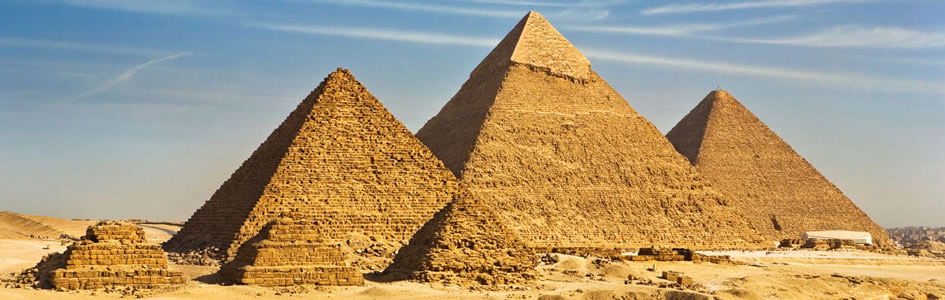
Ancient Egypt
Age of the Great Pyramid
Secular literature commonly dates the Great Pyramid around 2550 BC. If this date is correct, then the Great Pyramid existed before the Flood of Noah’s day, which occurred around 2350 BC and destroyed everything on earth! Obviously, something is askew.
Egyptian Chronology
Discrepancies between traditional Egyptian chronology and the Bible are used to attack the Bible’s historical accuracy. Instead of simply assuming the accuracy of traditional Egyptian chronology and modifying the Bible, people should carefully examine traditional chronology to see if it is as reliable as some claim it to be.
Egypt and the Old Testament
Putting the Egyptian names to persons described in the Bible adds an exciting new dimension to our understanding of the past. Having a correct chronology for Egyptian history provides a basis for identifying archaeological findings which further support the accuracy of the Old Testament.
Rameses II
Rameses II was one of the longest ruling pharaohs, 67 years, and was Egypt’s most prodigious builder of temples and statues. Those which he did not build, he hacked the builders’ names off of and inserted his own.
Articles About Ancient Egypt
-
Book ChapterPharaohs of the OppressionOct. 1, 2009 from Unwrapping the Pharaohs
The texts of Sesostris III reveal him as a strong-minded character who burned the crops of his enemies.
-
Exact Great Pyramid Construction DateSept. 26, 2009 from News to Know
How could construction on Egypt’s Great Pyramid have begun in 2470 BC if the Flood reshaped the earth over a century later?
-
Book ChapterThe Glorious Middle KingdomSept. 24, 2009 from Unwrapping the Pharaohs
The course of history in ancient Egypt has not been fully elucidated. Usually it has to be reconstructed from circumstantial evidence.
-
Book ChapterHow Do We Know What Happened?Sept. 17, 2009 from Unwrapping the Pharaohs
Before dealing with the Middle Kingdom it is necessary to discuss the sources of information on which our knowledge of this era is derived.
-
Book ChapterMore Shoddy PyramidsSept. 10, 2009 from Unwrapping the Pharaohs
To the northeast of the massive Step Pyramid of Saqqara is the mastaba of Mereruka, vizier of King Teti of the 6th Dynasty.
-
Book ChapterThe Shoddy PyramidsSept. 3, 2009 from Unwrapping the Pharaohs
Instead of layers of cut stone, the core consisted of a jumbled heap of stones piled up in the shape of a pyramid and then faced with limestone blocks.
-
Book ChapterThe Pyramid of MenkaureAug. 27, 2009 from Unwrapping the Pharaohs
Menkaure was the last great pyramid-building pharaoh at Giza; however, his tomb is the smallest of the Giza pyramids.
-
Book ChapterThe Pyramid of KhafreAug. 20, 2009 from Unwrapping the Pharaohs
Only the few lower layers of stone remain today, but it is of great interest because the lower half of the tomb chamber is exposed.
-
Book ChapterKhufu Built the Big OneAug. 13, 2009 from Unwrapping the Pharaohs
It is 751 feet (29 m) at the base and originally stood 479 feet (146 m) high.
-
Book ChapterSeneferu, the World’s Greatest Pyramid BuilderAug. 6, 2009 from Unwrapping the Pharaohs
After completing one pyramid he kept on building until he got the perfect pyramid.
-
Book ChapterThe Lost PyramidJuly 30, 2009 from Unwrapping the Pharaohs
Some of the greatest finds have been made when archaeologists have attempted to find missing links in the history of an area.
-
Book ChapterThe Step PyramidJuly 23, 2009 from Unwrapping the Pharaohs
The Step PyrJust why there should have been this new development of using stone instead of mud brick is still debated by scholars.
-
Book ChapterPyramids and MummiesJuly 16, 2009 from Unwrapping the Pharaohs
Until you have stood in front of these massive mountains of stone you cannot grasp the immensity of it all.
-
New Possible Pre-Flood Pyramid Found In EgyptNov. 15, 2008
Down in the Egyptian sand lay the remains of a pyramid that was once nearly five stories tall. Was it around before the Flood?
-
April 1, 2008 from Answers Magazine
What are historic details about the founding of Egypt?
-
April 1, 2008 from Answers Magazine
Were there enough people to build the pyramids?
-
Picking and Choosing EvidenceJune 5, 2007 from Responding to Protestors’ Propaganda
Archaeological evidence provides information about many post-Babel civilizations, but constructing a timeline without a direct eyewitness elicits imagination.
-
Casting Stones at the PyramidsJan. 29, 2007
New evidence regarding the advanced technology evident in the ancient Egyptian pyramids is consistent with the Bible’s account of history. The evolutionary model of the history of early man presents man as an ignorant primitive gradually acquiring intellectual skills and technology. However, the biblical description of mankind’s dispersal from the Tower of Babel is consistent with the findings of advanced technology among ancient people all over the world.
-
Magazine ArticleThe Pyramids of Ancient EgyptSept. 1, 2004, pp. 44–49
Critics of the Bible say the pyramids were built long before Noah's Flood, so the Flood must have only been a local affair, not global.
-
Technical Research PaperFall of the Sothic Theory: Egyptian Chronology RevisitedDec. 1, 2003, pp. 70–73
Current Egyptian chronology consists of 30 dynasties, as compiled by the 3rd century BC Egyptian priest Manetho, chronologically bound by the Sothic theory proposed by Eduard Meyer.

Support the creation/gospel message by donating or getting involved!

Answers in Genesis is an apologetics ministry, dedicated to helping Christians defend their faith and proclaim the good news of Jesus Christ.
- Customer Service 800.778.3390
- Available Monday–Friday | 9 AM–5 PM ET
- © 2026 Answers in Genesis