


“What Is Essential for a Truly Biblical Worldview?”
Part 2 of Theological Triage
Introduction
In the previous article in this three-part series, we explained that not all doctrines in the Bible are equally clear and equally important. The concept of “theological triage” helps us to determine what biblical doctrines are essential for salvation, what doctrines are important enough to affect what church or Christian organization we join but don’t affect our salvation, and what doctrines don’t have any significant influence on our Christian fellowship because we can amicably agree to disagree with other believers on those less clear or less important teachings of Scripture. We concluded that as helpful as this concept and these evaluations are, they don’t really help us know what is essential for a truly (fully) biblical worldview. That is what we will consider in this article.
What Is a Worldview?
A worldview is a way of looking at the world and making sense of it. It is a set of fundamental beliefs, concepts, or assumptions that a person uses (consciously or unconsciously) to understand the world and decide how to live in it. Every person has a worldview, but most people don’t think deeply about their worldview and can’t explain it well to others. Their beliefs or assumptions are philosophical and religious in nature, and they may or may not be true. These beliefs are like a pair of glasses that influence what we see and how we respond to the world around us. The question is, which worldview (or pair of glasses) gives us the most accurate understanding of reality? A worldview answers the important questions of life, such as:
- Are there many gods, or is there only one God? If God exists, is he knowable?
- Is the universe created or eternal? Was it created by natural processes or supernatural acts of God?
- What is the origin, nature, purpose, and destiny of man? In other words, where did I come from, why am I here on earth, am I just an animal, and what will happen to me when I die?
- Is knowledge possible? Is there absolute truth? Or is everything just opinion?
- Are there absolute rights and wrongs? Or is morality relative to a time, place, or culture or a matter of personal preference?
Contemporary non-Christian worldviews include anti-Trinitarian monotheism (such as Judaism and Islam), pantheism, polytheism, naturalism (atheism), postmodernism, Marxism, Hinduism, and Buddhism. Some of these worldviews involve a blending of multiple worldviews.1
The more that Christians and Christian leaders do not have a fully biblical worldview, the weaker the church becomes in following and glorifying Christ and in being effective in evangelizing the lost and discipling the saved.
It is possible to profess to hold to one worldview but in actuality live largely by a different worldview. In fact, most people mix important ideas from more than one worldview. This was true in the Old Testament, when syncretism often plagued the children of Israel. They mixed the worship of Yahweh with the worship of Baal. They followed some of the laws of God but also displayed many pagan, idolatrous ways of thinking and behaving. Syncretism was a problem in the New Testament (as many of the Epistles testify), and it has been a problem all through church history. The more that Christians and Christian leaders do not have a fully biblical worldview, the weaker the church becomes in following and glorifying Christ and in being effective in evangelizing the lost and discipling the saved.
So every Christian needs to have a basic understanding of worldviews and, most importantly, should endeavor to have a fully biblical worldview. A biblical worldview is needed:
- To be a consistent, faithful, and mature follower of Jesus Christ.
- To avoid being subtly and unknowingly deceived by concepts, assumptions, or beliefs from non-Christian worldviews and as a result become compromised or syncretistic Christians.
- To be able to understand and effectively witness to lost souls trapped in false worldviews.
To be clear, a person can be saved and on his way to heaven without having a fully biblical worldview. She can be a faithful member of a church or employee of a Christian organization without a fully biblical worldview. He can have loving relationships with others without a fully biblical worldview. But the spiritual health and effectiveness of the Christian and the church is dependent on having a biblical worldview.
So what is essential for a fully biblical worldview (i.e., a truly orthodox, Christian worldview)? What distinguishes evangelicals (who believe in Jesus for personal salvation) who have a fully biblical worldview from the many evangelicals (who equally believe in Jesus for personal salvation) who do not have a truly biblical worldview (i.e., only a partially biblical worldview)?
Several national surveys have been done in recent years to try to find out how many Christians or pastors have a truly biblical worldview. The survey results in America (and which are likely worse in many other countries) are concerning. George Barna and the Cultural Research Center at Arizona Christian University inform us, based on a recent national survey, that only 12% of professing evangelicals have a biblical worldview.2 In 2022, Barna found that only 37% of American pastors have a biblical worldview.3 So we have a serious problem of syncretism in the church.
The Dominant Worldview Today
The dominant worldview today is based on the assumptions of uniformitarian naturalism and is considered by most people in the world to be “scientifically proven.” The assumptions or presuppositions, which control the thinking and practice of most scientists around the world, are these:
- Nature is all that exists.
- Everything in the natural world is the result of time (millions of years) plus chance plus the laws of nature (the laws of physics, chemistry, genetics, etc.) working on the material world.
- The processes of change in the physical universe have always been at the same rate, frequency, and power as we observe today: essentially slow, gradual change or evolution, with some allowance for occasional local or regional “catastrophic” events.
Given these assumptions, which have controlled science for the last 200 years,4 it is no surprise that atheists or agnostics make up the vast majority of scientists.5 Some scientists may profess a religious belief, such as Christianity, Judaism, Islam, Hinduism, etc. But when they do their science, they generally do it as if naturalism is true.
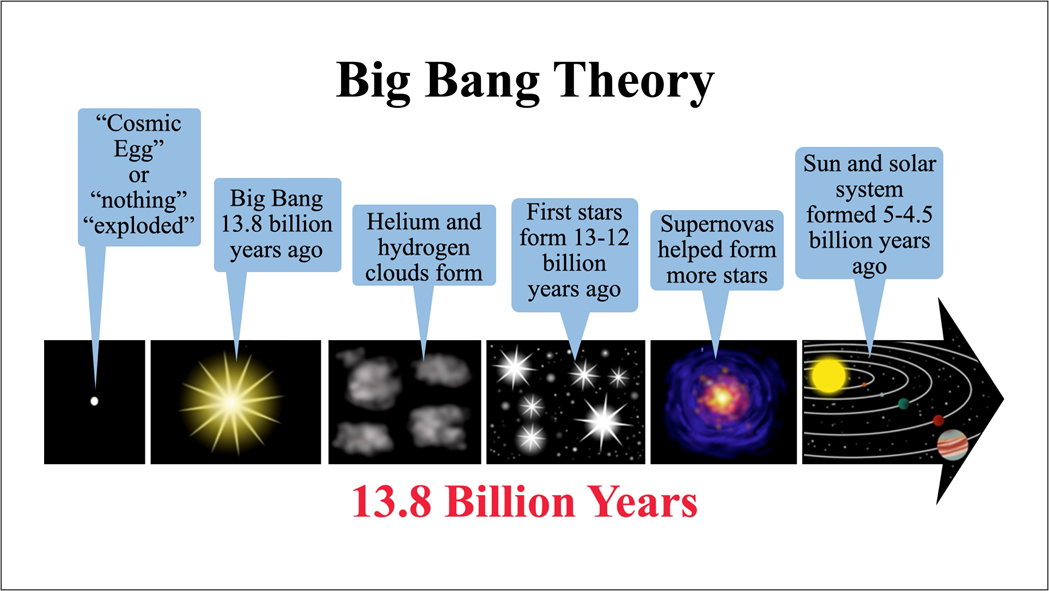
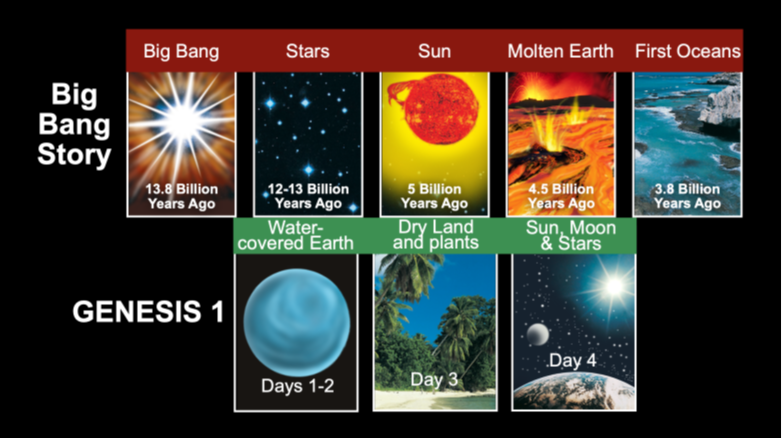
From these naturalistic assumptions, most scientists and most people believe either that the universe is eternal (as a result of a series of expanding and collapsing previous universes) or had a beginning in the “big bang” rapid expansion of a tiny bit of space-matter-energy about 13.8 billion years ago (BYA). According to the naturalistic worldview, eventually helium and hydrogen gas clouds formed, and then about 12–13 BYA, the first stars formed by time and chance and the laws of nature. Eventually galaxies of stars formed. By the same natural processes, the sun (a young star) was formed from a gas cloud 5 BYA. From that gas cloud, the earth and other planets of our solar system formed by accretion over millions of years by about 4.5 BYA. The moon was made from material ejected from the earth as a result of a Mars-size impact. Initially, the earth was a hot molten ball that gradually cooled, developed a hard crust, and evolved an atmosphere and oceans.
There was no life on earth until about 3.8 BYA, when the first single-cell microbial life popped into existence by accident. About 550 million years ago (MYA), the first macroscopic life evolved, and then the evolution of all plants, animals, and people followed up to the present. By natural processes, humans evolved from apelike creatures over the course of the last several million years.
Evolutionists also claim that over the last 500 MY, there have been five major mass extinction events. During each event (or relatively short time period), 60–90% of species living at the time went extinct.6 In the long history of the earth, slow, gradual, geological processes of erosion sedimentation, volcanism, earthquakes, and asteroid impacts have shaped and prepared the earth before man appeared.
We need to be crystal clear in our thinking. Evolution is not just about the origin of biological life. The very famous and influential American geneticist and evolutionary biologist, Theodosius Dobzhansky, explained,
Evolution comprises all the stages of the development of the universe: the cosmic, biological and human or cultural developments. Attempts to restrict the concept of evolution to biology are gratuitous. Life is a product of the evolution of inorganic nature, and man is a product of the evolution of life.7
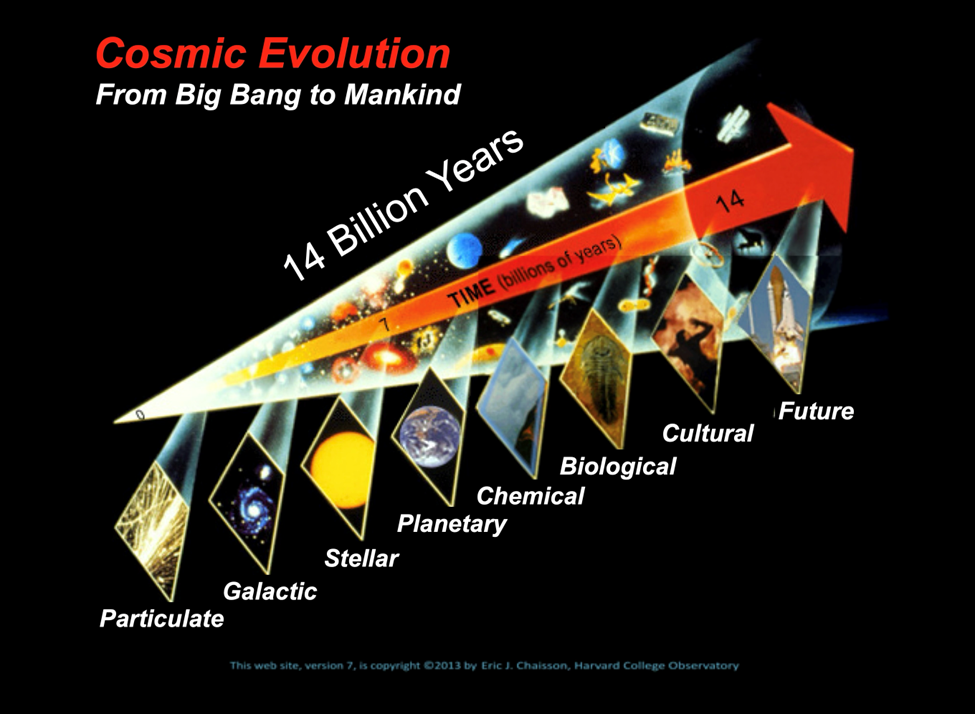
This diagram illustrates the evolutionary, naturalistic view of the origin of the universe.8 Careful Bible readers will see that the order of events in cosmic evolution has stars and galaxies forming billions of years before the earth, contrary to Genesis 1.
This diagram adds a little more detail about the naturalistic view of the formation of the universe up to our early solar system.
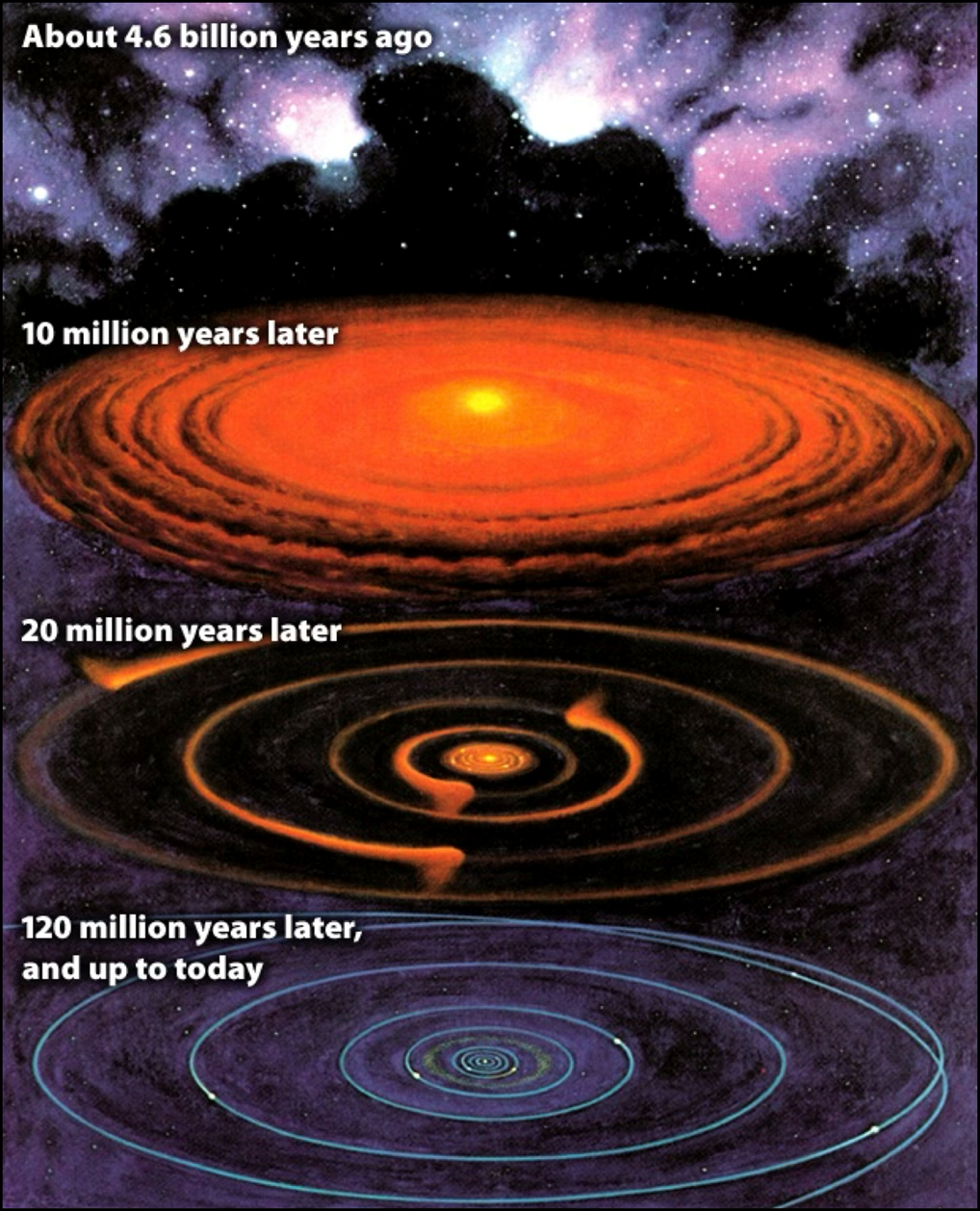
This diagram illustrates the evolutionist view of the origin of the planets of the solar system (including earth).9 So this says the sun formed over 120 million years before the planets (including the earth) formed, which is totally contrary to Genesis 1.
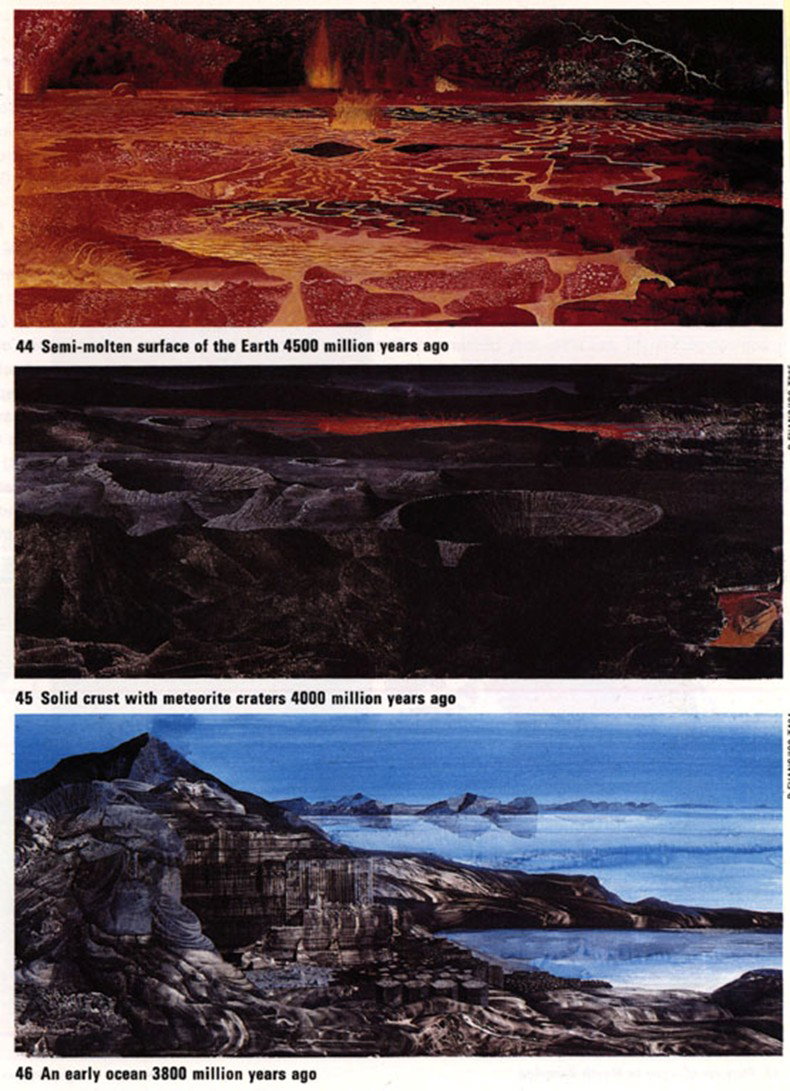
This diagram illustrates the evolutionary, naturalistic view of the early history of the earth.10 This evolutionist view of the first 700 million years of earth history cannot be harmonized with Genesis 1, which says that the earth started out completely covered with water and later dry land appeared. In fact, in the evolutionist view, the earth has never been completely covered with water. But the Bible says it happened twice: the first two days of creation and Noah’s flood.
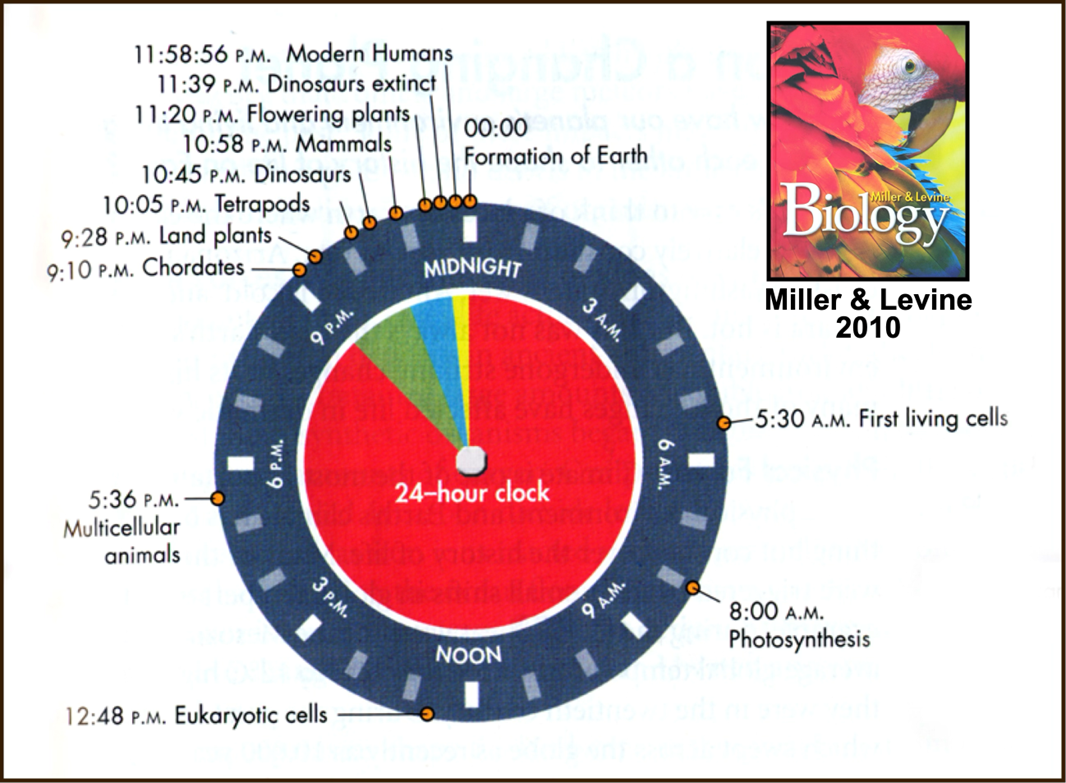
The 24-hour clock below illustrates the naturalistic worldview of the earth and life on it.11 As you can see, during most of the history of the earth, there were no macroscopic forms of biological life. And man came onto the scene at the tail end of time to date. But God says he created the earth to be inhabited by man (Isaiah 45:12, 18). And Jesus clearly indicated that Adam was created essentially at the “beginning of creation” (Mark 10:6), as documented below in endnote 18. Paul implies the same when he says that the evidence of God’s existence and some attributes have been seen (by humans) “since the creation of the world” (Romans 1:20).
Essential Elements of the Truly (Fully) Biblical Worldview
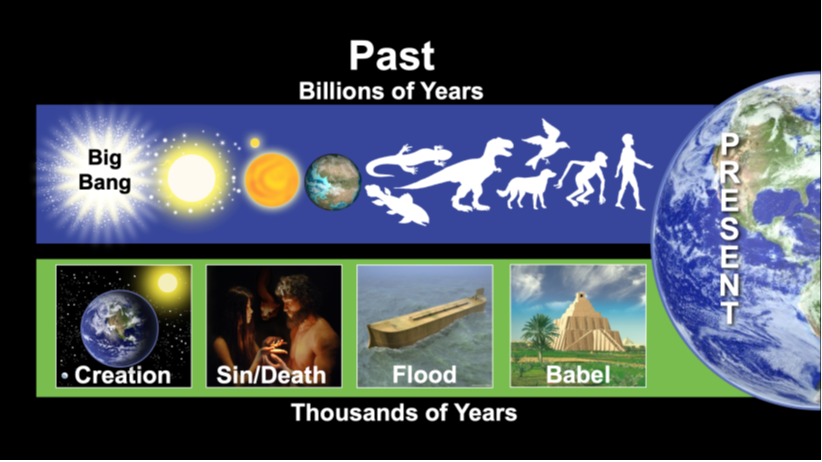
As can be seen from the series of diagrams above and the two pictures below, the dominant, naturalistic, evolutionary worldview is radically different from a straightforward reading of Genesis 1–11, which is foundational to the biblical worldview.
For his national survey, George Barna lists seven cornerstones of the biblical worldview:
- An orthodox, biblical understanding of God.
- All human beings are sinful by nature; every choice we make has moral considerations and consequences.
- The consequences of our sin can only be forgiven and eliminated through Jesus Christ. That forgiveness is available only through our personal, sincere acknowledgment and confession of our sins and complete reliance on His grace to forgive those sins.
- The entire Bible is true, reliable, and relevant, making it the best moral guide for every person in all situations.
- Absolute moral truth exists—and those truths are defined by God, described in the Bible, and are unchanging across time and cultures.
- The ultimate purpose of human life is to know, love, and serve God with all your heart, mind, strength, and soul.
- Success on earth is best understood as consistent obedience to God—in thoughts, words, and actions.12
Although these statements do not say everything that needs to be said about a biblical worldview, they do summarize crucial doctrines. They are certainly necessary. But they are not sufficient for a truly biblical worldview because they do not refer to critical truths in Genesis 1–11 that are foundational to the points above.
On the surface, Genesis 1–11 certainly appears to teach what is often called young-earth creation, and that is the way most of the church understood these chapters during the first 1,800 years of church history.13
- Literal (24-hour) days of creation and an originally “very good” creation with vegetarian man and animals and no death or other natural evils (Genesis 1:29–31).
- Supernatural creation of a literal Adam (from dust) and Eve (from Adam’s side) who were made in the image of God and distinct from all animals (Genesis 1:26–28, 2:7, 2:21–22).
- The cosmic impact of Adam’s fall in sin and God’s curse on creation (Genesis 3:14–19, 5:29).
- The global, yearlong, catastrophic flood of Noah (Genesis 6–9).
- Accurate chrono-genealogies showing about 2,000 years from Adam to Abraham (Genesis 5 and 11).
- Jesus coming to earth to solve problem 3 by his death and resurrection, affirming directly or indirectly points 1, 2, 4, and 5 (Romans 5:12–21; 1 Corinthians 15:20–22; Mark 10:1–9; Matthew 24:37–39).
- Jesus coming again to fully redeem and restore the cursed creation (Romans 8:19–25; Acts 3:21; Colossians 1:20; Revelation 22:3)—without a literal Adam original sin causing creation to be cursed, what exactly is the earth (and universe) supposed to be restored to?
In an article for The Gospel Coalition, Dr. Samuel Emadi suggests that the following seven points are central to the Christian worldview because they are inseparably tied to the gospel and “other Scriptures instruct us to read the creation narrative [which he restricts to Genesis 1–3] in a certain way.”14
- God created the world ex nihilo.
- God is distinct from his creation (Creator/creature distinction).
- God created the world good.
- God created the world for his glory.
- God specially created Adam and Eve who both bear God’s image.
- Adam and Eve are humanity’s first parents.
- Adam and Eve are historical figures who really did disobey God in time and space history in the garden of Eden.15
Following the theological triage model, Emadi says these should be considered “first-order commitments” (or tier 1 in Mohler’s version). Although Emadi identifies as “a fairly committed literal six-day, young earther,” he adds, “The length of the Genesis 1 days, the age of the earth, and animal death and predation before the fall are all secondary or tertiary matters which must be worked out in ways consistent with our first-order commitments.”16 But these points are intimately related to Emadi’s first-order commitments 3 and 4, as we explain below.
The idea of billions of years of cosmological and geological evolution is equally at odds with Scripture and undermines the gospel.
Most old-earth proponents in the church would say that biological evolution and human evolution are contrary to Scripture and therefore not consistent with a biblical worldview. And they would say that the idea of human evolution seriously undermines the gospel. In that we wholeheartedly agree. But the idea of billions of years of cosmological and geological evolution is equally at odds with Scripture and undermines the gospel. Consider these points.
- The story of the big bang and millions of years of earth history is based on the same anti-biblical, naturalistic (i.e., atheistic) worldview as the story of biological and human evolution is based. So old-earth creation views are syncretistic, by mixing biblical truth with naturalistic, atheistic (i.e., anti-biblical) ideas.17
- The story of the big bang and millions of years of earth history is unorthodox in the history of the church—no Christians believed in millions of years and the slow formation of the sun, moon, and stars before the earth until the late eighteenth and early nineteenth centuries.
- The story of the big bang and millions of years of earth history is seriously inconsistent with the character of God. Given what God says in Genesis 1–11 and in other passages commenting on those chapters in Genesis, the perfectly good, infinitely wise, omniscient, omnipotent, totally truthful God revealed in Scripture could not possibly have created the world in the way and over the vast time claimed by the advocates of millions of years. The millions-of-years Creator would be stupid, wasteful, cruel, evil, impotent, and incapable of stating in plain language when, how, and in what order he created the world. Consider these points.
- God says in Genesis 1:14 that he created the sun, moon, and stars so that people could tell time. But what kind of God says this and waits billions of years after he made the heavenly bodies before he made man to measure time by their movement?
- God says in Genesis 1:28 that he assigned Adam and Eve to rule over biological life. But what kind of God says this when (if millions of years happened) most of the sea, land, and flying creatures lived and died (and many became extinct: e.g., all dinosaurs) before man could rule over them?
- God says in Isaiah 45:12 and 18 that he created the earth to be inhabited by man. But what kind of God says this and waits 4.5 billion years after he made the earth to make man?
- And in Psalm 33:6–9, God says with very clear and emphatic language (in complete agreement with the repeated “and God said,” “and it was so,” “and God saw”) that he spoke and things (including the heavenly hosts) immediately came into existence. What kind of God says this through the inspired psalmist, if in fact he spoke and then waited millions or billions of years to see the fruition of his commands?
- What kind of God says he created in six days using the only Hebrew word (yom) that means a literal day (along with the Hebrew words for “evening,” “morning,” and “night”) when he could have used other Hebrew or Aramaic indefinite time-words or phrases to indicate that he created over millions of years?18
- What kind of God tells us that he created things in a certain order using sequentially numbered days, when he could have excluded numbered time-words and told us the correct order (or no order) in which he created over millions of years as sequenced by evolutionists?19
- What kind of God spends millions of years creating and then destroying plants and animals (by disease and other natural evils that he could prevent) before man sinned and then called it all very good (Genesis 1:31)? The “very good” must reflect the perfect character of God. But the god of the millions of years story is most definitely not the wise, omnipotent, good, truthful God revealed in Scripture. The millions-of-years story is an assault on the character of our God.
- The story of the big bang and millions of years of earth history is totally inconsistent with the Bible’s metanarrative, “big picture” teaching. In the naturalistic evolution story, there are no supernatural acts of God. There is no original “very good” state of the creation. There is no fall of man in sin and no resulting divine curse on creation. And there will be no supernatural end to the world. But the Bible presents the original very good (noncarnivorous) creation (Genesis 1:29–31), the cosmic impact of the fall (Genesis 3:14–19, 5:29; Romans 8:19–23), and the future redemption of the whole creation at the return of Christ (Colossians 1:15–20; Revelation 22:3). Jesus is not coming back to fix a terrible job of creating (as all old-earth views, knowingly or unknowingly, imply) but to restore a creation ruined by sin and God’s holy, just judgment—not as one theistic evolutionist pastor put it in a 2004 symposium organized by top evolutionary scientists and education experts: “Natural selection is the main force of evolution, and if this is God’s way of creating, then it is full of suffering and death. God became human in order to undergo the same evolutionary process as the rest of humanity. God became a loser in this process when He was crucified, and this shows God is with us in suffering and death. We can now better understand Paul’s statement of ‘the liberation of the whole creation,’ because God takes on Himself all the evolution of the whole world through Christ. The pattern of death and resurrection are illustrated by Christ’s suffering.”20
- The story of the big bang and millions of years of earth history is impossible to harmonize with the account of the global flood of Noah, which both Jesus (Matthew 24:37–39) and the Apostle Peter (2 Peter 3:3–7) clearly believed was historical and global.21 And Noah’s flood is critical to the correct interpretation of the geological evidence of rock layers and fossils and therefore critical to the question of the age of the earth. Those Christians who accept the millions of years either completely ignore the flood in their thinking about origins or they superficially treat Genesis 6–9 to conclude that it was a large but localized flood in the Mesopotamian Valley in the Middle East.
- The story of the big bang and millions of years of earth history contradicts the teaching of Jesus and the New Testament authors who clearly took Genesis 1–11 as literal history, including that Adam was created at the beginning of creation, not billions of years after the beginning (Mark 10:6; Romans 1:20).22
- By virtue of the previous points, the story of the big bang and millions of years of earth history has undermined the truth, coherency, and believability of the gospel, causing hundreds of millions of people in America and around the world to not even be willing to listen to the gospel, much less to believe it.
- By virtue of the acceptance of the story of the big bang and millions of years of earth history by most of the global church over the last 200 years, the truth and authority of the Word of God have largely been rejected in the once-Christian West. This has led to the collapse of biblical morality in the culture and in much of the church (e.g., acceptance of abortion and euthanasia, LGBTQ+ identities and behavior, racism, etc.) and led to much unorthodox, syncretistic theology in the church.
These last two points are very relevant to comments made by Dr. Albert Mohler in his 2017 debate with old-earth proponent, C. John Collins. Mohler said, “I want to say that heresy ought to be reserved for a teaching that denies a truth essential to the gospel of the Lord Jesus Christ.”23
He went on to say,
So, what are we dealing with here? The question posed in this debate: Does scripture speak definitively to the age of the universe? Well, here, I want to point out that we have the problem that sometimes doctrines move. Sometimes they move in that sense of ranking, especially between second or third order issues, given the urgency of a moment and given the implications of certain doctrines and theological positions. So let me be clear, I believe the question we are dealing with today is by nature a third-order question. So, that is to say, not only do I have many friends who hold to the contrary position, and not only do I recognize them as friends, brothers and sisters in Christ, but also as colleagues. That is to say, I not only accept them as brothers and sisters in Christ, I hire them for the theology faculty for which I am responsible. So, it’s not an issue that defines orthodoxy, even within the institution that I lead, but it’s not an unimportant question.24
But later in the debate, he said,
So, we ask the question. Why not just join and affirm a universe that is billions of years old? Well, the answer is this, I believe I’m bound by Scripture as read by the church for 1800 years, and a view that is symphonically affirmed by Old Testament texts outside of Genesis. I believe that the embrace of an old earth comes with theological and hermeneutical consequences that can have far-reaching effects and potentially damaging doctrinally harmful effects.25
With all due respect to Dr. Mohler and the other evangelical young-earth and old-earth proponents who think that the age of the creation is a third-tier doctrine over which Christians should agree to disagree, we must strongly disagree with their assigning the age of the creation to third-tier importance (and as we noted in the previous article, the triage system is totally inadequate to address worldview issue importance). The acceptance of millions of years has indeed had massively far-reaching, doctrinally damaging effects. The gospel and the clarity and authority of Scripture are severely undermined, if not destroyed, by the church’s widespread acceptance or tolerance of millions of years of cosmological and geological evolution (to say nothing of the growing percentage of professing evangelical scholars, who also accept biological and human evolution). Two hundred years of the church’s compromise with millions of years (through the gap theory, day-age theory, framework hypothesis, etc.) has not caused the Western world to be more open, but rather less open, to the gospel and biblical morality. It has even had a crippling effect on potential seminary and church leaders as stated by Karl Giberson, a former leader of BioLogos:
For a quarter century I taught scientific theories of origins—evolution and the Big Bang Theory—under a cloud of suspicion that waxed and waned but never totally disappeared. With few exceptions, my mostly evangelical students accepted these ideas. I took informal polls indicating that most of the 50 percent of my students who rejected evolution at the beginning of my course accepted it by the end. My colleagues at other evangelical colleges report similar experiences. We were hopeful that these evangelical students would become leaders of their faith communities and gradually persuade their fellow evangelicals that evolution was not a lie from hell—which was what many of them had been taught in Sunday school. But instead, scientifically informed young evangelicals became so alienated from their home churches that they walked away, taking their enlightenment with them. . . . Many of my most talented former students no longer attend any church, and some have completely abandoned their faith traditions.26
A few years before the debate, Dr. Mohler made these helpful remarks on his website about why the creation-evolution debate is so important, which are in contrast to his statements above from the debate:
As I have stated repeatedly, I accept without hesitation the fact that the world indeed looks old. Armed with naturalistic assumptions, I would almost assuredly come to the same conclusions as BioLogos and the evolutionary establishment, or I would at least find evolutionary arguments credible. But the most basic issue is, and has always been, that of worldview and basic presuppositions. The entire intellectual enterprise of evolution is based on naturalistic assumptions, and I do not share those presuppositions. Indeed, the entire enterprise of Christianity is based on supernaturalistic, rather than merely naturalistic, assumptions. There is absolutely no reason that a Christian theologian should accept the uniformitarian assumptions of evolution. In fact, given a plain reading of Scripture, there is every reason that Christians should reject a uniformitarian presupposition.27
What is meant by “looks old”? Astronauts can’t look at the earth from space and tell how old it is. No one can look at a rock or rock layer or fossil and tell if it was formed five months ago or five years ago or 5,000 years ago. And no one could possibly know what a five-million-year-old rock looks like. Only a person who is reasoning with uniformitarian, naturalistic assumptions (or trusting the scientific majority, which uses those assumptions) would conclude the earth looks millions or billions of years old.
We do strongly agree with the rest of Dr. Mohler’s statement. But those uniformitarian naturalistic assumptions took control of geology 50 years before becoming the foundation of Darwin’s theory of biological evolution and 100 years before becoming the foundation of the big bang theory of cosmological evolution. So the age of the creation is not a third-tier teaching over which Christians can agree to disagree with no significant relevance to the health of the church, the proclamation of the gospel, and the impact of the biblical worldview in our world.
The age of the creation is not a third-tier teaching over which Christians can agree to disagree with no significant relevance to the health of the church, the proclamation of the gospel, and the impact of the biblical worldview in our world.
In light of these facts, the doctrine of young-earth creation should be considered essential to orthodox Christianity and a truly biblical worldview. All old-earth views are partially biblical, syncretistic views that should be rejected, just as ancient orthodox Jews rejected the syncretistic worship of Baal and Yahweh by their idolatrous, compromised Jewish brethren. We would say that the age of the creation is not a “gospel issue” (or “salvation issue”). But it is a “biblical worldview issue” and a “gospel-coherency issue.”
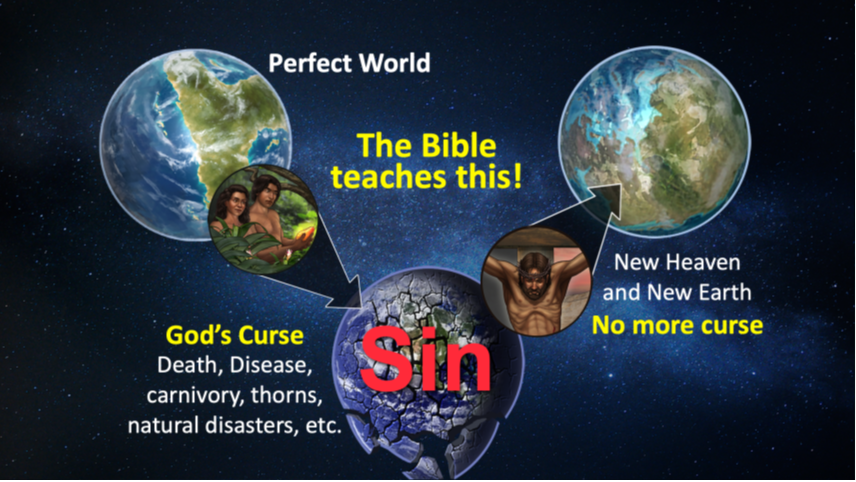
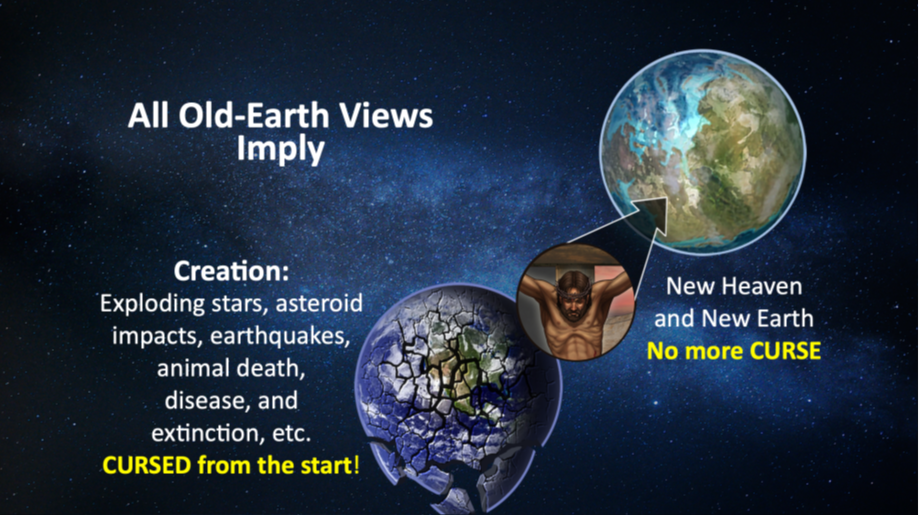
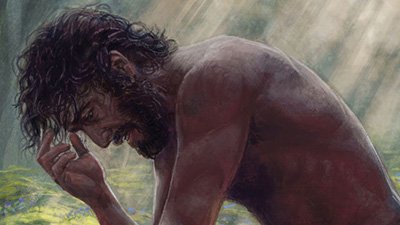
The biblical teaching on the seven points given by Barna and Emadi above is inseparably connected to the historical accuracy of Genesis 1–11. In other words, if the first 11 chapters are not literal history, if they are a kind of myth or mytho-history or symbolic poetry, then the rest of the Bible’s teaching on Barna’s and Emadi’s important points is severely undermined or neutralized, and the moral authority of the Bible as God’s inerrant Word is destroyed in the minds of non-Christians and Christians.28
It is impossible with hermeneutical consistency to argue on the one hand for a literal Adam and literal fall but, on the other hand, deny the literal days of creation and the literal approximately 2,000 years from Adam to Abraham and the literal global, yearlong, catastrophic flood. Genesis clearly teaches all those things, or it teaches none of them. And if it teaches none of that as literal history, then the gospel is based on a myth, and Jesus and the apostles are all liars.
Those young-earth and old-earth Christian leaders who have assigned the Bible’s teaching on the age of the earth (including the length of the creation days and the extent and character of Noah’s flood) to a level of minor importance (or complete unimportance) are giving an unclear trumpet sound to the church. That’s a problem: “For if the trumpet give an uncertain sound, who shall prepare himself to the battle?” (1 Corinthians 14:8 KJV). We are in a battle of naturalism vs. the fully biblical worldview and the gospel. Syncretism cannot be tolerated in this battle of eternal significance.
Conclusion
The biblical worldview is creation-fall-redemption-restoration. The literal history of Genesis 1–11 is foundational to that worldview. A very good creation without any moral or natural evil was made supernaturally in six literal days exactly in the order that God said in Genesis 1. The fall of Adam and Eve into sin resulted in God’s curse on the whole creation. The flood of Noah was a global judgment because of the wickedness of man and stands as a warning of the judgment of God. The Messiah and only Savior, Jesus Christ, was promised in Genesis 3, illustrated by the only ark of salvation in the flood, and will redeem every repentant, believing sinner from among every tribe, tongue, and nation formed as a result of the judgment of the tower of Babel. One day, Jesus will come again to remove God’s curse on creation to remake it in perfect righteousness.
In today’s world, where that worldview has been under massive assault for 200 years, and the world has been brainwashed with the uniformitarian, naturalistic (i.e., atheistic, anti-Christ) worldview, the young-earth view of Genesis 1–11 should be a test of orthodoxy. It should be a test not to determine if someone is saved but to safeguard the truth, clarity, and authority of Scripture and the truth of the gospel. Pre-1800 creeds and confessions in past centuries said very little in defense of Genesis 1–11 because, by and large, the whole church accepted it as literal history. Other battles needed to be fought then. We are living in a different time.
In words that sound like something Martin Luther would have said,
If I profess with the loudest voice and clearest exposition every portion of the truth of God except precisely that little point which the world and the devil are at the moment attacking, I am not confessing Christ, however boldly I may be professing Christ. Where the battle rages, there the loyalty of the soldier is proved and to be steady on all the battle fronts besides, is mere flight and disgrace if he flinches at that point.29
The world and the devil have been attacking Genesis 1–11 for 200 years. We must stand in defense of it as loyal soldiers of Christ since most of the global church does not believe some or all of it.
So how do pastors, seminary professors, Christian college professors, missionaries, parents, and Christian school teachers impart a truly biblical worldview (grounded in the literal history of Genesis) to those they teach? That’s the subject of the next and last article in this series.


Footnotes
- A good introduction to various worldviews and reasons to hold biblical Christianity as the correct worldview is David Closson, An Introduction to Worldview (Center for Biblical Worldview, Family Research Council, 2003), free online at https://downloads.frc.org/EF/EF23G08.pdf. See Bodie Hodge and Roger Patterson, eds., World Religions and Cults (Green Forest, AR: Master Books, 2016), volumes 2 and 3.
- George Barna and the Cultural Research Center, “Study Finds Few Signs of U.S. Spiritual Renewal as Biblical Worldview Levels Remain Stalled,” Arizona Christian University, March 3, 2026, https://azcu.edu/culturalresearchcenter/2026/03/03/study-finds-few-signs-of-u-s-spiritual-renewal-as-biblical-worldview-levels-remain-stalled/.
- Ken Ham, “Study: Only 37% of American Pastors Have a Biblical Worldview,” Answers in Genesis, May 30, 2022, https://answersingenesis.org/culture/study-only-thirty-seven-percent-american-pastors-have-biblical-worldview/.
- See the 1-hour lecture by Terry Mortenson, “Millions of Years: The Idea’s Unscientific Origin and Catastrophic Consequences,” Answers TV, https://www.answers.tv/videos/millions-of-years.
- Edward J. Larson and Larry Witham, “Leading Scientists Still Reject God,” Nature 394, no. 6691 (July 23, 1998): 313. Also, Edward J. Larson and Larry Witham, “Scientists and Religion in America,” Scientific American (September 1999): 88–93.
- The names and approximate evolutionary dates of the supposed five major extinction events are these: Late Ordovician (440 MYA, 100+ families of marine invertebrates perished, www.park.org/Canada/Museum/extinction/ordmass.html, accessed May 2026), Late Devonian (365 MYA, 70% of marine invertebrates perished along with other marine life, www.park.org/Canada/Museum/extinction/devmass.html, accessed May 2026), Permian-Triassic (251 MYA, greatest mass extinction event, 90% of marine species and 70% of land vertebrate species went extinct, https://www.sciencedaily.com/terms/permian-triassic_extinction_event.htm, accessed May 15, 2026), Late Triassic (210 MYA, at least 50% of species went extinct, www.wikipedia.org/wiki/Triassic%E2%80%93Jurassic_extinction_event, accessed May 2026), Cretaceous-Tertiary (65 MYA, second largest mass extinction, 85% of all species, including all dinosaurs), www.park.org/Canada/Museum/extinction/cretmass.html, accessed May 2026). The Canadian website bases its information on Steven M. Stanley (a leading evolutionist), Extinction (New York: Scientific American Library, 1987).
- Theodosius Dobzhansky, “Changing Man,” Science 155, no. 3761 (January 27, 1967): 409.
- A course at Harvard University uses this diagram to visualize Cosmic Evolution. Harvard University Extension Course, Spring 2014: “ASTR E-8 Cosmic Evolution: The Origins of Matter and Life,” https://www.cfa.harvard.edu/~ejchaisson/cosmic_evolution/docs/splash.html, accessed November 21, 2014.
- Roy A. Gallant, National Geographic Picture Atlas of Our Universe (Washington, DC: National Geographic Society, 1986), 38.
- John Thackray, The Age of the Earth (London: Institute of Geological Sciences, 1980), 21.
- Kenneth R. Miller and Joseph S. Levine, Biology (Boston, MA: Pearson Educational, 2010), 543.
- George Barna, “Research Identifies the Best Starting Point for Developing a Biblical Worldview,” March 14, 2023, https://georgebarna.com/2023/03/research-identifies-the-best-starting-point-for-developing-a-biblical-worldview/.
- Old-earth Christian geologist Davis Young has written (though he is off by one century): “It cannot be denied, in spite of frequent interpretations of Genesis 1 that departed from the rigidly literal, that the almost universal view of the Christian world until the 18th century was that the Earth was only a few thousand years old. Not until the development of modern scientific investigation of the Earth itself would this view be called into question within the church.” Davis A. Young, Christianity and the Age of the Earth (Grand Rapids, MI: Zondervan, 1982), 25. I document that it was not until the early nineteenth century that most of the church abandoned the young-earth view: Terry Mortenson, The Great Turning Point: The Church’s Catastrophic Mistake on Geology—Before Darwin (Green Forest, AR: Master Books, 2004), 40–47.
- Samuel Emadi, “Theological Triage and the Doctrine of Creation,” The Gospel Coalition, October 20, 2015, https://www.thegospelcoalition.org/article/theological-triage-and-the-doctrine-of-creation/.
- Emadi, “Theological Triage and the Doctrine of Creation.”
- Emadi, “Theological Triage and the Doctrine of Creation.”
- Terry Mortenson, “Philosophical Naturalism and the Age of the Earth: Are They Related?,” Answers in Genesis, March 2, 2005, https://answersingenesis.org/age-of-the-earth/are-philosophical-naturalism-and-age-of-the-earth-related/.
- The Hebrew word dor is translated in English Bibles as time, period, or generation (e.g., Genesis 7:1; Exodus 3:15 and 31:13; Deuteronomy 32:7). Or God could have used phrases such as “after many days” (Joshua 23:1; 1 Kings 18:1), “after some years” (Daniel 11:6), after “thousands of ten thousands” of years (cf., Genesis 24:60), or after “years of all generations” (Joel 2:2). Or God could have used Aramaic words, as he did in Daniel and Nehemiah: zeman (season or time: Nehemiah 2:6; Daniel 2:16, 4:36) or iddan (period or time: Daniel 4:16, 23, 25, 32).
- Terry Mortenson, “Evolution vs. Creation: The Order of Events Matters,” Answers in Genesis, April 4, 2006, https://answersingenesis.org/why-does-creation-matter/evolution-vs-creation-the-order-of-events-matters/.
- The “Evolution and God Symposium” held at Case Western Reserve University, Ohio, USA, October 2004, in Troy Lacey, “The ‘Sad and Sorry God’ of Theistic Evolution,” Answers in Genesis, October 25, 2004, https://answersingenesis.org/theistic-evolution/the-sad-and-sorry-god-of-theistic-evolution/.
- Terry Mortenson, “Noah’s Flood: A Unique, Historical, Yearlong, Global Catastrophe,” Answers in Depth 13, July 2, 2018, https://answersingenesis.org/the-flood/global/biblical-necessity-global-flood/.
- Terry Mortenson, “Jesus, Evangelical Scholars, and the Age of the Earth,” Answers in Depth 2, August 1, 2007, https://answersingenesis.org/age-of-the-earth/jesus-evangelical-scholars-and-the-age-of-the-earth/.
- Albert Mohler and C. John Collins, “Does Scripture Speak Definitively on the Age of the Universe?,” a debate between Mohler and Collins held at the Henry Center for Theological Understanding at Trinity Evangelical Divinity School, in Deerfield, IL, on February 1, 2017: https://henrycenter.tiu.edu/videos/#video-17226. YouTube version was posted on February 15, 2017, minute mark 20:17–25.
- Mohler and Collins, “Does Scripture Speak Definitively on the Age of the Universe?,” minute mark 23:55–24:55.
- Mohler and Collins, “Does Scripture Speak Definitively on the Age of the Universe?,” minute mark 30:13–43.
- Karl Giberson, “2013 Was a Terrible Year for Evolution,” Daily Beast, January 2, 2014, https://www.thedailybeast.com/2013-was-a-terrible-year-for-evolution.
- R. Albert Mohler, Jr., “No Buzzing Little Fly—Why the Creation-Evolution Debate Is So Important,” January 5, 2011, http://www.albertmohler.com/2011/01/05/no-buzzing-little-fly-why-the-creation-evolution-debate-is-so-important/.
- Terry Mortenson, “Adam, Morality, the Gospel, and the Authority of Scripture” in Terry Mortenson, ed., Searching for Adam (Green Forest, AR: Master Books, 2016), 459–501, https://answersingenesis.org/bible-characters/adam-and-eve/adam-morality-gospel-and-authority-of-scripture/.
- Quoted in Francis Schaeffer, The Great Evangelical Disaster (Eastbourne, UK: Kingsway, 1985), 50–51. Schaeffer cited the source as Weimar Ausgabe Briefwechsel 3, 81f. But the German there does not contain anything that precisely matches the quote above. However, the statement certainly sounds like something Luther could have said. See Bob Caldwell, “‘If I Profess’: A Spurious, If Consistent, Luther Quote?,” Concordia Journal 35, no. 4 (Fall 2009): 356–359, http://issuu.com/concordiasem/docs/cjfall09.
Support the creation/gospel message by donating or getting involved!

Answers in Genesis is an apologetics ministry, dedicated to helping Christians defend their faith and proclaim the good news of Jesus Christ.
- Customer Service 800.778.3390
- Available Monday–Friday | 9 AM–5 PM ET
- © 2026 Answers in Genesis