


Origin of Life
God or Natural Processes
When considering how life began, there are only two options. Either life was created by an intelligent source (God) or it began by natural processes.
No Mechanism to Spark Life
No mechanism by which non-living matter can randomly spark itself into life has ever been demonstrated. Information must come from a source of information.
Time and Chance?
To creationists, the incredible workings of the genetic code are not a mystery to be explained but instead a marvel to be understood as one of God’s most incredible designs. How such a coding system (even in a simpler form) could have arisen through random interaction is yet another leap of faith by evolutionists.
Help From Stardust
By assuming organic compounds ejected by stars could have fortified the primordial solar system, asteroids and meteorites, and of course earth with the building blocks of life, evolutionary scientists see such findings as a source to seed the process of molecules-to-man evolution.
Articles About Origin of Life
-
Magazine Department ArticleArtificial Life in Biology?Oct. 1, 2014 from Answers Magazine
Some are claiming that researchers have taken a step toward showing how life could arise from non-life.
-
July 10, 2014 from Answers in Depth
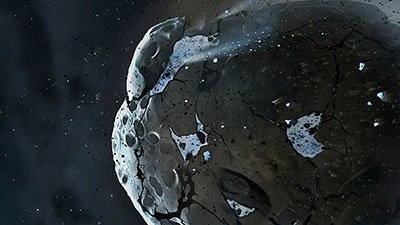
Swedish meteorite said to have triggered mass destruction and opened the way for life’s post-Cambrian explosion.
-
In-Depth ArticleCan Spinning Crystals Show How Life Began?March 4, 2014 from Answers in Depth
Self-assembling virtual crystals are said to show the path to life from lifelessness.
-
The World’s Oldest Water?June 13, 2013 from News to Know
Researchers believe water trapped in tiny fractures within sulphide deposits has had no contact with water exposed for 1.5 to 2.64 billion years.
-
Book Chapter5.6 The Origin of Biological Information and of LifeNov. 15, 2012 from Did God Use Evolution?
From these discussions it should again become clear that all efforts to explain an origin of information depending on matter alone fail empirically.
-
Strelley Pool Stromatolites Strike Another Blow for Early LifeSept. 22, 2012 from News to Know
Strelley Pool stromatolites strike another blow for early life.
-
Secret of Life? . . . Still Not FoundMarch 3, 2012 from News to Know
Stable molecules still don’t hold the secret spark of life.
-
Mother of All Living?Feb. 18, 2012 from News to Know
Ancient sponges take center stage as “our great-great-great-great-great-great-great grandmother.”
-
-
The “Right Hand” of EvolutionJan. 28, 2012 from News to Know
“Potentially prebiotic conditions” permit production of right-handed carbs.
-
Evolutionary Bottleneck: All Multicellular Organisms Begin as One CellDec. 24, 2011 from News to Know
The good of the one outweighs the good of the few and the many—the single-cell bottleneck that unleashes multicellular evolutionary potential(?)
-
Stardust Latest Suspect for Origin of LifeNov. 5, 2011 from News to Know
Spectral signposts suggest interstellar seeds of life.
-
Old Views, New NewsMarch 26, 2011 from News to Know
Believe it or not, the famous Miller–Urey experiment of the 1950s is still making headlines in the creation–evolution controversy.
-
Slime Molds and LifeMarch 19, 2011 from News to Know
The cellular slime mold might seem to be a lowly form of life—maybe just the sort that could conceivably have evolved from inanimate matter.
-
Latest Evolutionist Theory on LifeSept. 11, 2010
Whether it’s mica sheets or meteorites (or both), evolutionists have come up with theory after theory—most untestable, all unproven—about how life on earth got started. Here’s the latest.
-
Life between Sheets of MicaAug. 14, 2010 from News to Know
Evolutionists continue to speculate about where life began. The latest answer? Between sheets of the geological substance mica.
-
Problems for "Accidental" Origin of LifeApril 24, 2010
The “chirality problem” isn’t exactly one of the most prominent topics of debate when it comes to origins. But that doesn’t mean evolutionists have forgotten the problem it poses for an “accidental” origin of life.
-
Evolutionary Researchers Reinforcing Creationist Perspective?April 17, 2010 from News to Know
The evolution of the genetic code remains one of the most speculative, mysterious vignettes in the grand tale of evolution. On that subject, have evolutionary researchers made headway, or do they just reinforce the creationist’s perspective?
-
Book ChapterCan Natural Processes Explain the Origin of Life?Feb. 11, 2010 from The New Answers Book 2
When considering how life began, there are only two options. Either life was created by an intelligent source (God) or it began by natural processes.
-
Prebiotic NonsenseApril 4, 2009 from News to Know
Astrobiologists may be a step closer to identifying prebiotic compounds in space. Now all they have to do is find the compounds!
-
Life Designed Itself?Feb. 28, 2009 from News to Know
Have Canadian scientists uncovered the key that makes an evolutionary origin of life plausible?
-
LUCA Considered Earth’s Original Ancestor Says University of MontrealDec. 20, 2008
LUCA: I am your father?
-
Researchers Examine Possibility of Life Starting From IceNov. 8, 2008
Maybe it was primordial soup. Maybe it was crystals. Maybe it was volcanic pools. Maybe it was lumps of ice. Maybe . . . .
-
Naturally Forming Crystal DNADec. 1, 2007
The search for evidence for abiogenesis has uncovered a new “candidate”: DNA in liquid crystal phases that “self-orients” and stacks into columns.

Support the creation/gospel message by donating or getting involved!

Answers in Genesis is an apologetics ministry, dedicated to helping Christians defend their faith and proclaim the good news of Jesus Christ.
- Customer Service 800.778.3390
- Available Monday–Friday | 9 AM–5 PM ET
- © 2026 Answers in Genesis