
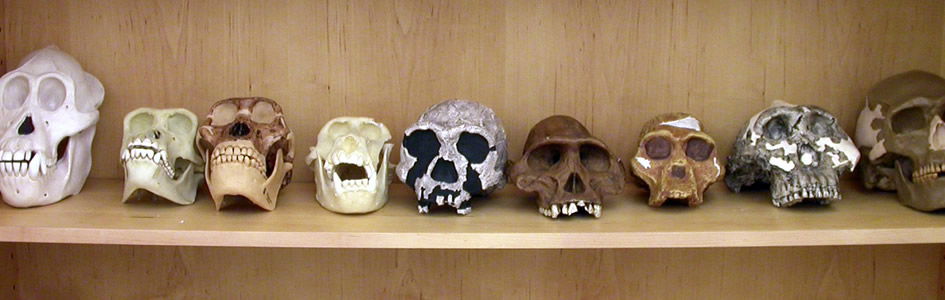
Hominids
Labeling the Hominids
It seems these days that there are precious few ordinary human or ape fossils unearthed, rather they all have to be a missing link between the two. One should be wary of claims that this or that skeletal feature “proves the creature walked upright”, as usually some other evolutionist fossil “expert” will debunk or dispute the claim.
Homo erectus and Other Hominids
Human fossils of people who dispersed from Babel are found in various layers of Pleistocene rocks. Biblically we understand that a variety of people dispersed from Babel, and these human fossils track their scattering around the globe. The oldest and deepest of these human fossils—Homo erectus—were just as human as we are.
Variety Among Hominid Fossils
The existence of human variations in fossils is not evidence that humans evolved through an evolutionary sequence. A better question would involve an exploration of the diversity among humans descended from Noah’s family after the tower of Babel.
Articles About Hominids
-
Lord of the ToolsApril 25, 2009 from News to Know
“How could a hominid with a brain the size of a grapefruit craft tools?” asks ScienceNOW’s Elizabeth Culotta.
-
Toeing the LineMarch 7, 2009 from News to Know
A fossilized footprint found in Kenya—thought to be 1.5 million years old—doesn’t look its age.
-
Early Humans Born With Big BrainsNov. 22, 2008
It’s yet another human ancestor—but, once again, with a larger brain than us.
-
Bones Don’t Add Up For Palauan HobbitsSept. 6, 2008 from News to Know
News broke last week of the misinterpretation of Palauan bone fragments, which had led to the misidentification of a modern human as something else. It isn’t the first time!
-
Hominid Fossil Finder Disputes Age of His FindSept. 6, 2008
After years of thorough dispute from creationist circles, the controversial Toumai skull—said to be the remains of an apeman—is now under another attack from evolutionists.
-
Cro-Magnon Man DNA Similar to that of Modern HumansJuly 19, 2008
Cro-Magnon Man, you may be 28,000 years old, but you haven’t changed a bit!
-
First Walking Human Determined to be Six Million years OldMarch 29, 2008
A new analysis of the bones of a human “ancestor” suggests it was the earliest known hominin to walk upright, reports National Geographic News.
-
Magazine Department ArticleHominid Hopes DashedJan. 28, 2008 from Answers Magazine
For several years, evolutionists have hailed the find nicknamed Toumai as the missing link between humans and an ape-like ancestor.
-
Missed the Memo; Forgot to Leave AfricaNov. 17, 2007
A new fossil found in Kenya’s Rift Valley is shaking up the latest hypotheses about alleged ancient apes and their postulated connection to modern humans, chimpanzees, and gorillas.
-
Review of New Fossils Found in GeorgiaSept. 22, 2007 from News to Know
A team reporting this week in the journal Nature announces the discovery of the remains of four individuals found at the site of a medieval castle at Dmanisi in the former Soviet republic of Georgia.
-
Living With Your AncestorsAug. 11, 2007
Evolutionists are busy rewriting the story of the evolution of humankind becuase of two fossils from Kenya.
-
Magazine Department ArticleThe Mother Lode of Ancestral MomsJuly 30, 2007 from Answers Magazine
Could it be that many evolutionists are scrambling to counter the increasing influence of the creation and intelligent design movements in today’s culture?
-
Magazine Department ArticleKenyan ControversyJuly 1, 2007 from Answers Magazine
Some well-intentioned but misguided Christians in Kenya have raised opposition to a new evolution display in their country’s National Museum.
-
Magazine Department ArticleSkull ScratchingJuly 1, 2007 from Answers Magazine
In the evolutionary worldview, people have been slowly evolving—and improving—over millions of years. According to biblical anthropology, however, humans were created on the sixth day of creation.
-
Skull Exhibits Confusing CharacteristicsJan. 20, 2007
A skull discovered in Romania is causing some head-scratching among evolutionists because it includes “traits normally associated with more ancient species” even though it is “undeniably a Homo sapiens specimen.”
-
Magazine Department ArticleRead the Fine PrintNov. 20, 2006 from Answers Magazine
While headlines often trumpet “Scientists find skull of human ancestor", you need to read on.
-
The Toumaï Skull: Ape or Human Ancestor?Aug. 30, 2006
In 2001, a chimp-sized cranium (lacking the lower jaw) was discovered in the Djurab Desert in the central African nation of Chad.
-
Fact Versus Fiction: The Recent Ethiopian FossilsApril 17, 2006
The Asa Issie fossil discovery is just one more of evolutionists false interpretations of the fossil record in an attempt to “prove” an animal origin for humans.
-
Hominid FeverMarch 11, 2005
It seems these days that there are precious few ordinary human or ape fossils unearthed, rather they all have to be a missing link between the two.
-
Research PaperNew Hominin Skull from KenyaAug. 1, 2001, pp. 8–9
A new fossil discovery that is ‘dated’ as contemporaneous with Australopithecus afarensis in the middle Pliocene has caused paleoanthropologists to re-evaluate their interpretations.
-
New Hominid Skull from KenyaApril 16, 2001
The new fossil skull is quite distinct from A. afarensis, and has been given a new genus and species assignment--Kenyanthropus platyops, “flat-faced human from Kenya.”
-
Research PaperHow Different is the Cranial-Vault Thickness of Homo Erectus from Modern Man?April 1, 2000, pp. 10–13
The physical features which distinguish 'primitive' from modern man can be accounted for by non-evolutionary explanations.
-
Research PaperThe Non-Transitions in ‘Human Evolution’—on Evolutionists’ TermsNov. 1, 1999, pp. 10–12
Commonly, apologists for evolution put up a bold front and try to deny that the tree of evolution is full of holes (or, more accurately, is mostly holes with just twigs at the end). It is therefore instructive whenever an article appears that is written by evolutionists who candidly acknowledged the major discontinuities in (alleged) evolutionary sequences.
-
Technical Research PaperThe Rise and Fall of Skull KNM–ER 1470Nov. 1, 1999, pp. 96–100
Often in the history of evolutionary theory, early preliminary reports of new fossil finds are over-optimistic.
Support the creation/gospel message by donating or getting involved!

Answers in Genesis is an apologetics ministry, dedicated to helping Christians defend their faith and proclaim the good news of Jesus Christ.
- Customer Service 800.778.3390
- Available Monday–Friday | 9 AM–5 PM ET
- © 2026 Answers in Genesis