
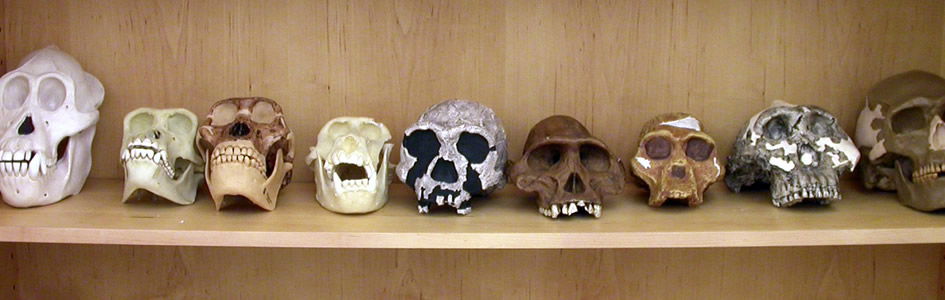
Hominids
Labeling the Hominids
It seems these days that there are precious few ordinary human or ape fossils unearthed, rather they all have to be a missing link between the two. One should be wary of claims that this or that skeletal feature “proves the creature walked upright”, as usually some other evolutionist fossil “expert” will debunk or dispute the claim.
Homo erectus and Other Hominids
Human fossils of people who dispersed from Babel are found in various layers of Pleistocene rocks. Biblically we understand that a variety of people dispersed from Babel, and these human fossils track their scattering around the globe. The oldest and deepest of these human fossils—Homo erectus—were just as human as we are.
Variety Among Hominid Fossils
The existence of human variations in fossils is not evidence that humans evolved through an evolutionary sequence. A better question would involve an exploration of the diversity among humans descended from Noah’s family after the tower of Babel.
Articles About Hominids
-
Magazine ArticlePondering a Great ProfileMarch 1, 1999, pp. 43–44
The early post-Flood descendants of Noah exhibited a great degree of genetic and environmental variation in skull and facial features, as seen in the differences between Cro-Magnons and Neandertals,
-
Magazine ArticleUn-Abel to Fill Evolutionary HopesSept. 1, 1996, pp. 45–46
A fossil found recently in Chad, classed as a new species, and nicknamed ‘Abel’, was the first australopithecine to be found west of the Great Rift Valley.
-
Magazine Article‘Oldest’ Hominid Footprints Show No Evolution!Sept. 1, 1993, pp. 32–33
The Laetoli footprints tell us that man was walking around as he does today when he first appeared in the fossil record. There is no sign of evolution here!
-
Magazine ArticleWho was ‘Java Man’?June 1, 1991, pp. 22–23
The ‘Java man’ was a group of fossils found by Dutch physician Eugene Dubois in the Dutch East indies.
-
Magazine ArticleWho Was ‘Nutcracker Man’?Dec. 1, 1990, pp. 22–23
‘Nutcracker man’ was the popular name given to a skull found by Louis Leakey, father of well-known fossil-anthropologist Richard Leakey, in East Africa in 1959.
Support the creation/gospel message by donating or getting involved!

Answers in Genesis is an apologetics ministry, dedicated to helping Christians defend their faith and proclaim the good news of Jesus Christ.
- Customer Service 800.778.3390
- Available Monday–Friday | 9 AM–5 PM ET
- © 2026 Answers in Genesis