


Old-Earthers’ Postulated Explanations for Soft Tissues in Dinosaur Fossils
Part 6—Dinosaur Blood and the Age of the Earth: A Futile, Deceitful Attempt to Critique Valid, Powerful Young-Earth Evidence
This is the last of a six-part series critiquing Dr. Fazale Rana’s book Dinosaur Blood and the Age of the Earth. In defense of his old-earth, progressive-creation, day-age view of Genesis 1–11 promoted by his organization (founded by Hugh Ross), Reasons to Believe, he is forced to explain how soft tissues and biomolecules found in dinosaur fossils have survived the supposed millions of years.
Here we get to the crux of the issue of just how long soft tissues and biochemicals can survive buried in fossils under the harsh conditions within sedimentary rock layers. Dr. Rana feels at home here because biochemistry is his field of expertise. He begins by confidently expounding on the biochemical structures making up the relevant biomaterials preserved in the soft tissues found in fossils.
So how do biologists explain the survival of soft tissues in fossils? Dr. Rana maintains, “The scientific community has proposed a number of different mechanisms they think could account for the persistence of tissue, cellular, and biomolecular vestiges in fossil remains.”1
Thus, to resolve this conundrum, he claims, “It is unreasonable to think that any one mechanism is sufficient on its own to explain the survival of soft tissue remains. More than likely, a combination of factors worked in conjunction to preserve the original tissues in the fossils.”2
This is proverbially clutching at straws. If every proposed mechanism is incapable on its own of preserving soft tissues and biomolecules intact for millions of years, then how is it that any combination of those mechanisms will succeed? This is all supposition to say the least and wishful thinking at best! The reality is that not one published study demonstrates how a combination of these conjectured mechanisms would preserve soft tissues and biomolecules for tens to hundreds of millions of years. If such a study existed, then Dr. Rana would simply have to quote it and that would settle the issue!
Not one published study demonstrates how a combination of these conjectured mechanisms would preserve soft tissues and biomolecules for tens to hundreds of millions of years.
So what does Dr. Rana do instead? He starts shuffling his deck of biochemistry cards in order to convince his readers that with his superior biochemistry knowledge, his case for a combination of soft tissue preservation mechanisms is unassailable, while in fact he is simply playing card tricks!
A Biochemistry Lesson
He begins his biochemistry lesson with a telltale admission: “Generally speaking, it is true that organic molecules are rather ‘delicate’ materials that readily break down.”3
However, having made that honest admission that undermines his belief that soft tissues have survived in fossils for tens to hundreds of millions of years, next comes his sleight of hand detailed biochemistry lesson designed to convince readers into thinking his belief is backed by hard experimental science when it is not. He continues:
But not all molecules are the same. Some organic compounds form extremely stable structures that result in hard and durable materials. This is the case for most of the biomolecules that survived in the fossil remains of dinosaurs and other creatures. In many instances, the soft tissue materials that survived in fossils are made up of molecules with one of two properties: (1) an extensive cross-linking; or (2) a chemical makeup similar to graphite, which is the most thermodynamically stable structure possible for an organic molecule.4
Dr. Rana then explains that various types of weak cross-links bonding polymers collectively can impart structural stability. However, he admits that “polymers readily break down if the chemical bonds that form their backbone are cleaved. Over time, this process converts long polymer chains into short molecular fragments.”5 In contrast, “chemical materials with graphite-like structures are also incredibly stable. Graphite is also a polymeric material, of sorts. The basic structural unit of graphite consists of a ring made up of six carbon atoms (fig. 1). . . . Graphite forms when the six-membered carbon rings fuse together into a massive two-dimensional sheet.”6
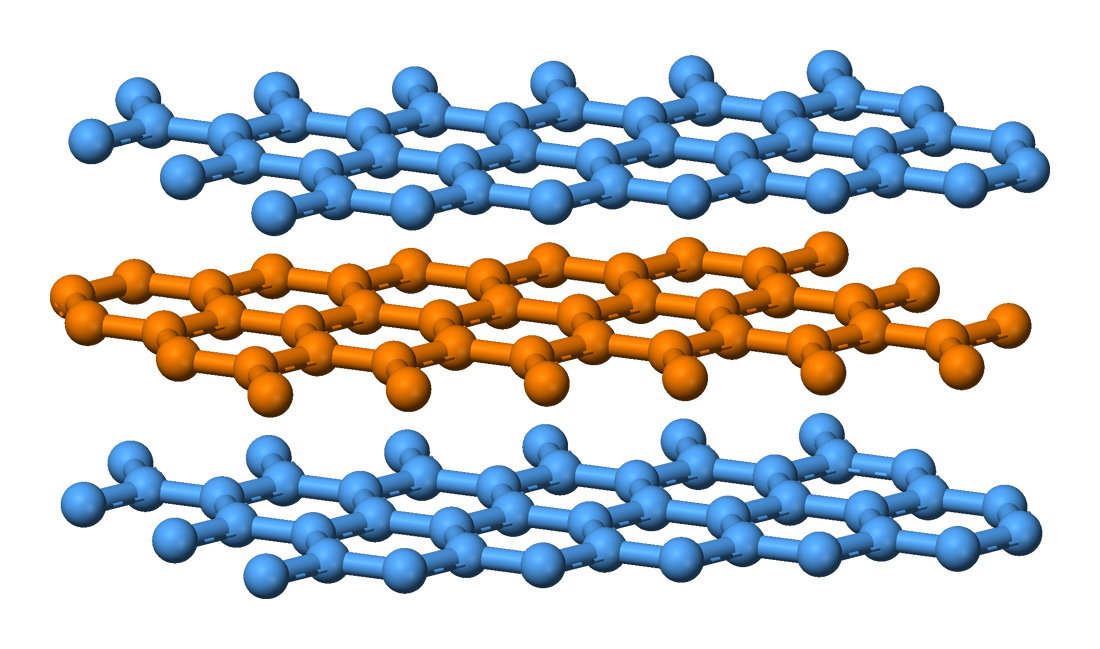
Fig. 1. The basic structure of graphite consisting of stacked sheets of rings joined by bonds (the sticks joining the balls), each ring containing six carbon atoms (the balls)
Benjah-bmm27, Public domain, via Wikimedia Commons
Based on that explanation, Dr. Rana next lists what he claims are seven durable chemical structures that explain why certain soft tissue materials could have (supposedly) survived for millions of years:
1. Collagen is a fibrous protein, “consisting of three long, extended protein chains that intertwine around each other. . . . Numerous of these cross-linked collagen triple helices assemble in a staggered fashion to form a larger structure called a collagen fibril. In turn, large numbers of collagen fibrils assemble . . . into collagen fibers. The intertwining . . . extensive cross-linking between the collagen chains makes collagen an incredibly durable material . . . well-suited to form the connective tissues found in animals.”7 Thus, he claims it is not surprising “that some collagen fragments would survive in fossilized dinosaur bones. Even if the individual protein strands break down, the fiber would still remain largely intact.”8 This claim is made in spite of the experimental evidence that collagen does rapidly break down9 (as already discussed in Part 5 in this series and discussed further below).
2. Keratin is a protein “known as an intermediate filament. Its basic structural unit is extended fibrous protein chains”10 that intertwine to form keratin filaments. Keratin filaments intertwine to form coils with sulfur-bearing cross-links that make keratin insoluble in water. “Keratin makes up hair, feathers, skin, fingernails, reptile scales, animal claws, birds’ beaks, tortoise shells, porcupine quills, and on and on.”11 Dr. Rana claims that “given how hard and tough materials from keratin are, it is not unreasonable to think that this material could persist in fossilized feather-like structures . . . or in fossilized reptile skin.”12,13
3. Chitin has a similar structure to cellulose made up of chains of extensively cross-linked modified glucose molecules (N-acetylglucosamine) in chains. Multiple chains interact to form two-dimensional networks, or “sheets,” of chitin. Dr. Rana claims that “chitin’s heavily cross-linked structure makes it reasonable to conclude that chitin could persist for up to 500 million years under the right conditions,”14 which he does not specify. He does mention that chitin is such a durable substance that engineers are exploring how it can be used to develop new types of materials that can withstand high temperatures and pressures.15,16 However, this is a logically fallacious “hand-waving” argument because those engineers have neither claimed nor are they expecting that their chitin-like materials can survive for 500 million years! Besides, chitin is not relevant to the bones or bodies of dinosaurs or their blood-related molecules.
4. Eumelanin “is a polymer made up of subunit molecules with a chemical bond between them . . . the individual polymer chains of eumelanin [being] extensively cross-linked with each other, making this material even more resistant to chemical decomposition.”17 Dr. Rana claims that “considering its chemical structure, it is not unreasonable to think that eumelanin persisted for well over 160 million years”18 in the ink sacs of a fossilized cephalopod,19 which is based only on the unproven claimed age of the fossil!
5. Heme is a small molecule that binds to hemoglobin, “serving as hemoglobin’s oxygen-binding site. Two components make up heme: a large-ringed structure called porphyrin and an atom of iron.”20 Four such rings are joined by a chemical linkage that makes the porphyrin ring a relatively stable compound, which Dr. Rana claims, explains it being in fossilized dinosaur bones.
6. Quinones are small compounds that consist of either a single ring or two or more fused rings. “One of the rings has two oxygen atoms bound to it through double bonds,” making quinones relatively stable compounds, which supposedly “helps account for their preservation in 340-million-year-old sea lilies.”21,22
7. Blood vessels are relatively durable materials made of special cells that organize into a channel surrounded by an elastin matrix, basement membrane, muscle fibers, and a collagen matrix, respectively. The design helps blood vessels “endure high pressures that result when blood is pumped throughout the body.”23 Thus, Dr. Rana claims, “It is reasonable to think that they would be highly resistant to break down,” accounting for their survival in dinosaur remains.24
Fossilization Processes
After having explained these claimed durable biochemical structures, Dr. Rana admits the bottom line is that “fossilization must occur more rapidly than the processes that degrade the soft tissue materials, if these materials are to be preserved” and that “durability alone is not sufficient to account for the survival of soft tissues in fossil remains [supposedly] for upwards of hundreds of millions of years.”25 Indeed, many other conditions must also be met simultaneously, the most important of which relates to the rate of fossil formation. Specifically, an animal must be buried rapidly under a sufficient thickness of sediments to exclude atmospheric oxygen that would immediately degrade the soft tissues and to protect the soft tissues from scavengers. In the case of a large dinosaur or fish (Fig. 2), this amounts to burial under many tens of feet of sediment within minutes, which equates to a catastrophic sedimentation rate that is orders of magnitude greater than today’s overall minuscule average rate of an inch or two per year or maybe even a few inches per hour under local flooding conditions.
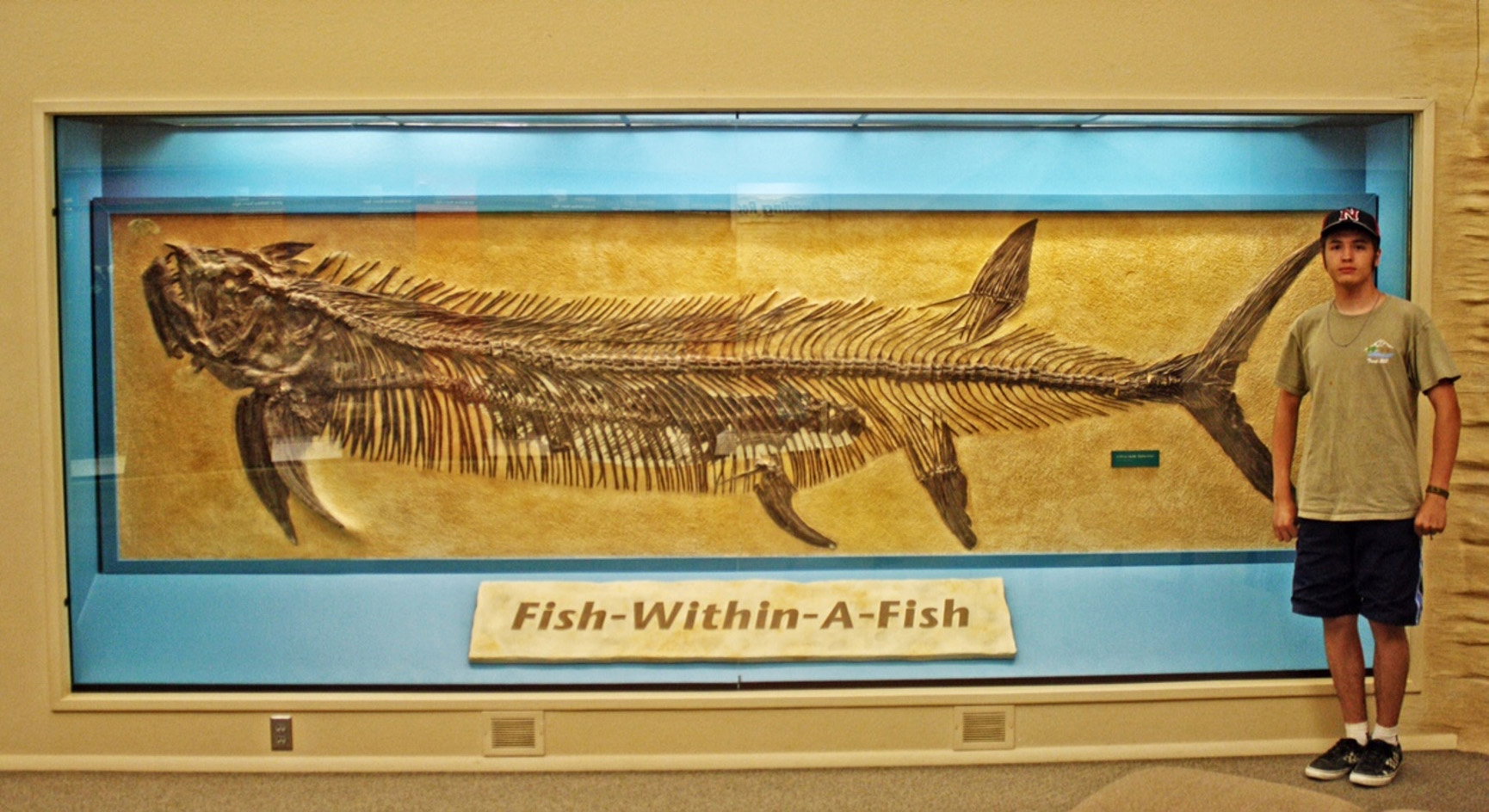
Fig. 2. The fish Xiphactinus audax fossilized with a smaller undigested fish in its stomach, as found in the Niobrara Chalk of Kansas and on display in the Sternberg Museum, Fort Hayes, KS. The young man provides the scale. This large fish must have been buried rapidly under tens of feet of limestone (chalk) within minutes before the swallowed fish was digested or else the remains of these two fish would have been destroyed by rotting or scavengers. Yet uniformitarian (evolutionary) geologists (whose ideas Dr. Rana follows without questioning them) claim that such chalk only accumulates at today’s measured rate of a fraction of in inch per 1,000 years!26
Dr. Rana next claims that there are at least nine stabilizing mechanisms that supposedly prevent soft tissues from degrading before fossilization.27
1. “During fossilization, mineral-rich water infuses the remains of the organism.”28 As a result, “The original minerals in the bones (and other parts of the remains) are replaced with minerals” precipitated from the water. It has been contended that “when these environmental minerals encounter the stabilized soft tissues, they will precipitate onto the surfaces . . ., much in the same way that hydroxyapatite precipitates onto collagen surfaces during bone formation,” resulting in the precipitated minerals entombing the soft tissues.29,30 This entombment supposedly “serves to protect the soft tissue remains from water, oxygen, environmental enzymes, and microbes, the most likely causes of destruction.”31,32
2. “Burial conditions also appear to be important.”33 A survey of “the prevalence of soft tissues in a number of fossil remains recovered from different geological settings (such as [interpreted] fluvial deposits, sandstones, cave deposits, mudstones, and marine deposits) . . . discovered that fossils unearthed from [supposed] fluvial and sandstone environments were much more likely to have soft tissue remnants than specimens retrieved from mudstone and marine settings.”34,35 Water perhaps “more readily drains away from animal remains located in [supposed] fluvial deposits and sandstones, creating drier conditions, removing microbes and environmental enzymes.” It is also believed “that burial conditions also help explain the persistence of quinones in [supposedly] 340-million-year-old sea lilies.”36,37 It is claimed those fossils “experienced a rapid burial that isolated the organic and inorganic materials connected to the sea lily remains from fluids moving through the rocks, preventing their chemical alteration,” and the host rock formation escaped metamorphism.38
3. “Dry, anhydrous conditions are also necessary to preserve soft tissues.”39 If water is not present, it is claimed that water-mediated breakdown of biomolecules cannot take place. On the other hand, “A limited amount of water may actually help preserve biomolecules such as collagen.”40,41 However, others “argue that extreme dehydration of animal remains . . . may help to preserve collagen long enough so that mineral entombment can take place.”42,43 While it was “demonstrated that collagen was structurally intact when isolated from decomposing dolphin, python, and turtle tissues that had undergone dehydration,” and that “when the tissues were rehydrated, the collagen displayed minimal evidence of damage,”44 this was in current time frames, not over the claimed unobserved millions of years.
4. “Sequestering soft tissues from oxygen ranks as another significant preservation factor.”45 Oxygen is highly reactive and chemically destructive, readily destroying organics via oxidation. However, it is also claimed that reactions between oxygen and soft tissues may help preserve their remnants by forming cross-links between the cell membrane components, such as lipids, forming stabilizing bonds, making them resistant to degradation.46 While this type of cross-linking may “explain why remnants of more ‘delicate’ materials, such as red blood cells and osteocytes, persist in dinosaur remains,”47 this process has only been observed in current time frames, not over the claimed unobserved millions of years.
5. “To be preserved, soft tissues also must be kept away from environmental enzymes and microorganisms.”48 The environment has prevalent “digestive enzymes that will break down the proteins that make up soft tissues, such as collagen. Likewise, microbes will use soft tissue materials as a food source, rapidly consuming them. But even though enzymes are highly destructive, their activity can be inhibited in a variety of ways. For example, collagenases (enzymes that degrade collagen) [apparently] have a hard time physically gaining access to collagen when this protein is associated with a mineral matrix such as hydroxyapatite [bone].”49,50
“Heme (the oxygen-binding component of hemoglobin) can also inhibit enzymatic activity”51,52 and possesses the capacity to kill microorganisms.53 “At the time of the dinosaur’s death, heme would be present in bone at relatively high levels, because red blood cells located in the blood vessels permeating bone are loaded with . . . hemoglobin.”54 The antimicrobial activity of that hemoglobin potentially “imparts the blood within the bones of animal remains with the capability of keeping microorganisms at bay while the fossilization and entombment process takes place.”55 But once again, this is conjecture, not a demonstrated observation over past unobserved millions of years!
Schweitzer and her coworkers think they have discovered another way microbial attack can be avoided: the free iron derived from heme appearing to play a role in preserving the soft tissue.56 Living “animals employ protective [sequestering] mechanisms to keep free iron from causing damage while exploiting its life-enabling properties.”57 But when an animal dies the iron-sequestering mechanism fails, freeing the iron that could then potentially “inhibit microbial growth during the fossilization process.”58 However, this is again conjecture, not a demonstrated observation over past unobserved millions of years!
6. “Iron may also help stabilize soft tissues from chemical destruction.”59 “Iron exerts its destructive effect by catalyzing the production of reactive-oxygen species,” producing a mineralized precipitate (rust). Also, “The reactive-oxygen species cause reactions that cross-link proteins and membrane components,” which “would stabilize soft tissue remains . . . thereby preserving vessels, cells, and molecules.”60 However, to the contrary, it has been found that iron oxide derived from hemoglobin of blood that dried in the blood vessels within fossilized dinosaur bones formed framboids rather than preserving the blood vessels.61
Nevertheless, Schweitzer and her coworkers noticed iron particles “in close contact with soft tissue fragments in dinosaur fossils,” which they interpreted as a supposed “telltale sign that iron had played a role in fixing and preserving the soft tissue remains in these fossils.”62 To confirm that role, they “soaked blood vessels isolated from ostrich bone in two different solutions: one containing hemoglobin and one consisting of pure water.63 After two years, the blood vessels in the hemoglobin bath remained intact, but the ones in water fell apart.”64 So they concluded that “iron does indeed play a role in preserving soft tissues in dinosaur bones after they die.”65 However, an experiment lasting only two years cannot be extrapolated back tens of millions of years into the unobserved past.
7. “Temperature also plays a role in soft tissue survival. The rates of chemical reactions roughly double each time the temperature increases by 10°C (18°F).”66 Thus “the higher the temperature, the faster chemical degradation takes place.”67 It is thus claimed that “soft tissue remnants are more likely to survive for longer periods of time”68 if the fossils are buried in a cooler environment. But it is known from down drill-hole measurements that increasing burial depths increase the temperature!69 On the other hand, it is claimed that higher temperatures can sterilize the fossil remains by killing off microbes and inactivate enzymes, thereby contributing to soft tissue survivability. Heat can also evidently “accelerate the formation of cross-links between proteins . . . , which arrests the destruction of soft tissue.”70 But once again, this has not been demonstrated over the supposed past unobserved tens of millions of years! And how can the temperature stay optimal for millions of years? This sounds like a Goldilocks story!
8. “Additionally, pH contributes to soft tissue preservation. Proteins are less likely to break down when the pH of their surroundings is near neutral,” although neutral pH also provides ideal conditions for enzymes and microbes to cause breakdown.71 Highly acidic and highly alkaline conditions promote the water-mediated breakdown of proteins. On the other hand, “pH extremes also deactivate digestive enzymes and keep the growth of microorganisms in check.”72 So, Dr. Rana, how can the pH contribute to soft tissue preservation as you claim if breakdown occurs under both neutral and extreme pH conditions?
9. “Minerals also play a key role in preserving soft tissue materials. . . . Collagen embedded in the mineral matrix of bone is afforded protection from digestive enzymes . . . because the enzymes can’t physically access the collagen.”73 The bone mineral itself also prevents the chemical breakdown of collagen.74 It is thought that interactions between aragonite (calcium carbonate) and chitin helped the survival of the chitin in the supposedly 35-million-year-old cuttlefish.75 It is also claimed that the “interactions between calcium carbonate minerals (calcite and aragonite) and shell-binding proteins most likely accounts for the survival of these proteins in the [supposedly] 15-million-year-old fossilized shells of the gastropod Ecphora.”76,77
What’s Rana’s bottom line? Dr. Rana admits that “no single mechanism can fully account for the persistence of soft tissues, but in combination they can.”78 However, there are no experimental observations in the present of any combination of these supposed mechanisms being capable of preserving soft tissues from breakdown, let alone for the supposed past unobserved tens to hundreds of millions of years. At least Dr. Rana recognizes that when it comes to soft tissue survival, “Sometimes pathways that are destructive under certain sets of conditions can be protective in other circumstances.”79 But yet again, this is only in the present and not in the supposed past unobserved tens to hundreds of millions of years.
The Role of Thermodynamics
No wonder young-earth creationists are not convinced by such claims that cannot be substantiated over the supposed past unobserved tens to hundreds of millions of years. Dr. Thomas quite correctly argues that the laws of thermodynamics alone demand that soft tissue materials are degraded, as observed under present conditions:
If original tissues can avoid being processed by scavengers, microbes, or chemicals, they nevertheless fall apart according to universal entropy, which describes how systems that are left to themselves spontaneously disorganize over time.80
Dr. Rana agrees that Dr. Thomas is correct. “Left on their own, organic materials will eventually break down into carbon dioxide, nitrogen, and water because of the effects of entropy.”81 However, Dr. Rana claims that “Dr. Thomas seems to imply that this process should be well under way, if not completed, after 70 to 80 million years.”82 But based on observations in the present that is an entirely reasonable implication, given the rate at which organic materials are observed to break down, which Dr. Rana admits happens. Yet Dr. Rana has the audacity to then claim that this is where Dr. Thomas is mistaken because he supposedly fails “to distinguish between thermodynamically controlled and kinetically controlled chemical reactions.”83
Dr. Rana then proceeds to explain the difference between chemical thermodynamics and chemical kinetics:
While thermodynamics can tell us if a reaction will or will not occur, it cannot tell scientists anything about when it will happen. That is the purview of chemical kinetics. Some chemical reactions proceed rapidly and others slowly. A quantity known as the energy of activation determines the rate of chemical processes. The energy of activation reflects the energy barrier reactants have to overcome before they can be converted into products: the greater the energy of activation, the slower the reaction; conversely, the smaller the energy of activation, the more rapidly a reaction will proceed.
Due to the relationship between thermodynamics and kinetics, it is possible that a chemical reaction can be highly favorable from a thermodynamics standpoint, but extremely slow because the energy of activation is quite high. In fact, if the energy of activation is extremely high, the reaction may never take place, practically speaking.84
Dr. Rana then gives the transformation of diamond into graphite as an example of a kinetically controlled chemical process, which he claims from a thermodynamics standpoint should spontaneously occur. But it does not happen “because the energy of activation is so large that this spontaneous chemical reaction won’t happen on any appreciable time scale.”85
Therefore, Dr. Rana claims, “This same principle applies to soft tissue remnants interned within fossils” due to the “cross-linking reactions and interactions with replacement minerals” so that the “spontaneous decay of soft tissues into carbon dioxide, nitrogen, and water does not occur.”86 However, Dr. Thomas is correct because the decay of soft tissues into carbon dioxide, nitrogen, and water is an observed reality. Regardless of the claimed chemical kinetics, soft tissue decay is a thermodynamic reality. It is observed happening today fast enough to seriously discredit any claim that soft tissues could survive intact for tens to hundreds of millions of years. Dr. Rana can play his “card tricks” with such chemical kinetics “sleight of hand,” but the observed reality trumps his claims.
The Experimentally Determined Collagen Decomposition Rate
And that observed reality is the experimentally determined collagen decomposition rate, which was so fast it was projected that within 200,000–700,000 years only 1% of the original collagen in bone would remain.87 Because of the obvious implications that no collagen could thus survive in fossil bones for tens of millions of years, Dr. Rana had to attempt to refute that study. Dr. Rana begins by asking: “How is it possible to square this result with the recovery of soft tissue vestiges in fossils that are millions of years old?”88 Notice his insistence the fossils are millions of years old. He is certain, regardless of the implications, that if the fossils were really millions of years old, then the experimental reality is that no soft tissues would have survived. In other words, the reality is that since soft tissues have survived, the fossils cannot be millions of years old! Yet his belief in the millions of years overrides the experimental reality!
Nevertheless, Dr. Rana proceeds to question the experimental work done by these researchers from the University of Manchester in the UK, which was published in a peer-reviewed conventional journal. That means fellow scientists who are as qualified as Dr. Rana reviewed the research paper and deemed it scientifically accurate, thus approving its publication. In their experiment, these researchers “measured collagen loss in cattle and human bones at 90°C (194°F) . . . close to the boiling point of water to accelerate the decay process. It still took them about one month to generate the necessary data,”89 that data was used to “calculate the bone loss at 10°C (50°F), which corresponds to the average temperature of an archeological site in Great Britain. These calculations made use of the Arrhenius equation,”90 which enables the calculation of the “rate for a chemical process (such as the breakdown of collagen) at any temperature, once the rate has been experimentally determined for a single temperature.”91
How then does Dr. Rana get around this experimental reality? He does so by supposing it is quite possible that at 90°C (194°F) “the collagen would undergo structural changes . . . that would make it much more susceptible to chemical degradation than at lower temperatures where collagen would remain in its native state.”92 In other words, on the basis of an unverified supposition, he suggests the conditions employed by these University of Manchester researchers may not be relevant to the soft tissue discoveries! Then rather than justify that claim with his own solid experimental evidence, Dr. Rana questions the relevance of the researchers’ objectives with the further claim. He contends that another reason why their results “do not contradict the recovery of collagen from 70- to 80-million-year-old dinosaur fossils relates to the question they addressed.”93 That question is: “How long can collagen last in animal remains in a form that can be isolated and used as a source of genetic information about the organisms found at archeological and fossil sites?”94 To thus suggest they were not interested in how long chemically and physically altered collagen fragments would persist in fossil remains is absurdly wrong. How else could genetic information be obtained if the collagen had been degraded and decayed? Of course they aimed to measure the collagen decay rate!
Indeed, of crucial relevance, the researchers reported that the region of the collagen molecules of interest to them for genetic studies would be “lost to the burial environment within a relatively short period of geologic time.”95 Thus, Dr. Rana claims the experimental result of only 1% of the original collagen remains after 200,000–700,000 years only applies to the “intact material that corresponds to the most labile (unstable) parts of the molecule.”96 But that’s a proverbial red herring to bamboozle unsuspecting readers into thinking the experimentally determined collagen decay rate does not apply to the survival of soft tissues in fossils. It does apply, and it demolishes the claimed tens to hundreds of millions of years ages for the fossils containing the preserved and intact soft tissues.
Nevertheless, Dr. Rana has to mention that the researchers thought collagen might persist for much longer than 700,000 years but at concentrations less than 1% in a chemically (diagenetically) altered state. In other words, Dr. Rana boldly claims that diagenesis (burial alteration) “will produce chemically altered forms of collagen that will persist in animal remains well beyond a million years.”97 But if less than 1% persists in an altered form to over a million years, then after 70–80 million years at that decay rate no detectable altered collagen would be left! Talk about “clutching at straws”! And to further try and bamboozle readers, Dr. Rana then embarks on a rough calculation of how much collagen might have been in the body mass of a Tyrannosaurus rex, supposedly 2,100 lb., and that even after 200,000–700,000 years of collagen decay 1% or 21 lb. would still be left. But he admits the reality is “a small piece of the T. rex femur would possess a fraction [a very small fraction!] of the total collagen.”98 He stops the calculation there because at the experimentally determined collagen decay rate after 70–80 million years there would still be no detectable collagen left in that small piece of a T. rex femur. Instead, Dr. Rana reverts to hand-waving and special pleading when he states:
In this sense, it is really not surprising that paleontologists have been able to detect trace amounts of collagen fragments in dinosaur fossil remains, given how much was there to begin with. The large initial abundances of ovalbumin in dinosaur eggs and shell-binding proteins in mollusk shells also helps explain why paleontologists have been able to detect these materials (or at least fragmented, altered forms of them) in fossilized remains.99
Really! The reality instead is that the reason the trace amounts of collagen fragments have been detected in dinosaur fossil remains is that they are not 70–80 million years old, but rather only ~4,350 years old from when they were buried in the biblical global Flood cataclysm.
However, to once again dodge that obvious conclusion, Dr. Rana has to make one final point, namely, that pristine blood vessels, red blood cells, osteocytes, collagen, keratin, chitin, and other soft tissues have not been found in fossils! That is true. Instead, what has been uncovered is “materials that have been chemically altered from their original compositions.”100 Intact, unaltered proteins have not been isolated in fossils, but only altered fragments of proteins have been found. “Schweitzer and her fellow researchers did not discover blood vessels, but chemically transformed, chemically cross-linked structures derived from original blood vessels, yet still retaining the original shape. Some being flexible, . . . but others are crystallized and inflexible. She did not find original red blood cells and osteocytes, but structures derived from the original cells.”101 So does that prove the soft tissues and the fossils are 70–80 million years old? Hardly! As Dr. Rana says, it is remarkable that “structures derived from the nuclei of these cells and even the filopodia of osteocytes”102 have been preserved, but that instead is only because the soft tissues and fossils are not 70–80 million years old, just ~4,350 years old!
Conclusion—Soft Tissues Preserved in Fossils Demonstrate the Fossils Are Only a Few Thousand Years Old
Two final considerations add to this refutation of Dr. Rana’s claims and bolster our young-earth creationist conclusion that the reason these soft tissues have been found in so many fossils is that the fossils are not tens to hundreds of millions of years old but are creatures that were buried in the global Flood cataclysm of Noah’s day only ~4,350 years ago.
The reason these soft tissues have been found in so many fossils is that the fossils are not tens to hundreds of millions of years old but are creatures that were buried in the global Flood cataclysm of Noah’s day only ~4,350 years ago.
First, we must consider the 2019 study by young-earth creationist scientists Drs. Thomas and Taylor published in a conventional, peer-reviewed, secular scientific journal. It reviewed many techniques that have been used to attempt to verify the biochemicals that appear to have originated from within fossils throughout the geologic column. They concluded that these “morphological and molecular investigations show that original biochemistry is geologically extensive, geographically global, and taxonomically wide-ranging.”103 In other words, soft tissues and biomolecules are found intrinsic to many fossils throughout the geologic record spanning the supposed hundreds of millions of years. This challenges that timescale because such preservation cannot be demonstrated as feasible, much to the chagrin of many conventional paleontologists and old-earth progressive creationists like Dr. Rana who are confronted with explaining how such often exquisite preservation occurred over that timescale.
Second, making matters worse are the many recent studies by young-earth creationist scientist Mark Armitage and his colleagues that demonstrate observationally many other processes by which soft tissues are rapidly degraded and decay.104 They demonstrated
- (1) abundant preserved nematodes feeding within dinosaur bones when they were buried,
- (2) visible worm ultrastructure, indicating that they were alive when preserved within the bones, and
- (3) “sufficient soft tissue within dinosaur bone canals to sustain large populations of nematodes post-mortem.”105
They also found examples of living fungal hyphae tunneling through compact fossilized bone, even when and after it was buried. The tunneling fungal hyphae emanated “from within the organic material adhering to the inorganic walls of bone vessel canals,” which appeared to be “endogenous clotted blood, and spread into the bone surrounding vessel canals. . . . In many cases the bone tunneling hyphae seem to be aligned to intersect with osteocytes still embedded in the inorganic bone.”106 It thus appears that a complex network of interconnecting and overlapping food chains (indicating feeding relationships within a community) was resident in many fossilized dinosaur bones, which were already consuming the bones during and after burial. This includes bacteria and fungi as “decomposing endogenous organics in dinosaur bones, resulting in a food chain that attracts bacterivore and fungivore nematodes.”107
In other words, it is a wonder any soft tissues have survived in fossilized dinosaur bones even over thousands of years. The observed presence of bacteria, fungi, and nematodes in the fossil bones has demonstrated these predators and destroyers were already at work soon after burial and fossilization of the dinosaur bones.
What Dr. Rana has forgotten is that in his timescale these dinosaur fossils were also subsequently exposed near the earth’s land surface to these predators and destroyers for further supposed millions of years, which today are observed to totally destroy animal carcasses and bones within weeks to years.
So, Dr. Rana, the young-earth creationist argument that the soft tissues in these dinosaur bones and other fossils cannot have survived for tens to hundreds of millions of years is not just based on the one experimental study that determined the collagen decay rate. In your haste to insist on the survival of soft tissues in fossilized dinosaur bones over tens to hundreds of millions of years, you have forgotten these crucial environmental factors, especially that even rapid burial does not guarantee preservation when bacteria and fungi are buried with the bones and then later exposure near the surface brings more of these destroyers into contact with the fossilized bones again.
We young-earth creationists agree with Dr. Rana that the soft tissues found in dinosaur and other fossils are both genuine and amazing, especially when delicate structures and biomaterials have been preserved in exquisite detail.
However, we absolutely reject the claimed reliability of the long-age radioisotope dating methods and have repeatedly demonstrated resoundingly that the unproven assumptions on which they are based are unprovable and unreasonable.108 We have also capably demonstrated that the radiocarbon dating method (when recalibrated because of the earth’s past stronger magnetic field having decreased the assumed atmospheric production rate of radiocarbon) provides dates of a few thousand years of human history totally compatible with the biblical chronology back to the global Flood cataclysm ~4,350 years ago. That is the event that buried all the dinosaur and other fossils in which the soft tissues have been found.109 Furthermore, young-earth creationists and conventional, evolutionary scientists have both resoundingly demonstrated that none of the claimed mechanisms, or any untested combination of them, are capable of preserving the discovered soft tissues in the dinosaur and other fossils for tens to hundreds of millions of years.
Thus, the only scientifically feasible conclusion is that the dinosaur and other fossils are not tens to hundreds of millions of years old but only ~4,350 years old, being buried in the global Flood cataclysm at the time of Noah.
Our confidence ultimately rests in the authority of God’s Word because its author is the Creator of everything, and He and His Word can be trusted because He is eternal, absolutely holy, all-powerful, all-knowing, and never tells lies.
However, our confidence ultimately does not rest in the scientific evidence, even though it is powerful and amazing. Our confidence ultimately rests in the authority of God’s Word because its author is the Creator of everything, and He and His Word can be trusted because He is eternal, absolutely holy, all-powerful, all-knowing, and never tells lies. He is thus the only reliable eyewitness of the earth’s origin and early history, including the global Flood cataclysm. And He has provided not only the earth’s “birth certificate,” but an absolute chronology for earth and human history that places that global Flood cataclysm at only ~4,350 years ago. And that chronology of human history from Adam, whom God created as the first man on creation calendar day six (only five calendar days after He created the earth), is the family history of the direct lineage of our kinsman redeemer, the last Adam, the Lord Jesus Christ. Dr. Rana, His family history thus matters because as the last Adam who was sinless, He could be the only acceptable sacrifice—the Lamb of God to take away the sins of the world. The biblical chronology matters because the gospel matters. We thus champion the soft tissues preserved in dinosaur and other fossils as powerful scientific evidence that confirms the ~6,000–7,000-year family history of our Savior, the Lord Jesus Christ, and thus a young earth, just as recorded in God’s inerrant Word.
Answers in Depth
2026 Volume 21
Answers in Depth explores the biblical worldview in addressing modern scientific research, history, current events, popular media, theology, and much more.
Browse VolumeFootnotes
- Rana, Fazale, Dinosaur Blood and the Age of the Earth (Covina, CA: RTB Press, 2016), 54, emphasis added.
- Rana, Dinosaur Blood and the Age of the Earth, 54.
- Rana, Dinosaur Blood and the Age of the Earth, 54.
- Rana, Dinosaur Blood and the Age of the Earth, 54.
- Rana, Dinosaur Blood and the Age of the Earth, 55.
- Rana, Dinosaur Blood and the Age of the Earth, 55.
- Rana, Dinosaur Blood and the Age of the Earth, 56.
- Rana, Dinosaur Blood and the Age of the Earth, 56.
- Klont, B., and J. M. ten Cate, “Susceptibility of the Collagenous Matrix from Bovine Incisor Roots to Proteolysis After in vitro Lesion Formation,” Caries Research 25, no. 1 (1991): 46–50, https://doi.org/10.1159/000261341 Matthew J. Collins et al., “A Basic Mathematical Simulation of the Chemical Degradation of Ancient Collagen,” Journal of Archeological Science 22 (March 1995): 175–183; M. J. Collins et al., “The Survival of Organic Matter in Bone: A Review,” Archaeometry 44, no. 3 (August 2002): 383–394, https://doi.org/10.1111/1475-4754.t01-1-00071; Mike Buckley and Matthew J. Collins, “Collagen Survival and Its Use for Species Identification in Holocene-Lower Pleistocene Bone Fragments from British Archeological and Paleontological Sites,” Antiqua 1, no. 1 (2011): e1, https://journals.pagepress.net/antiqua/article/view/antiqua.2011.e1.
- Rana, Dinosaur Blood and the Age of the Earth, 57.
- Rana, Dinosaur Blood and the Age of the Earth, 58.
- Rana, Dinosaur Blood and the Age of the Earth, 58.
- See also, Kevin Anderson, “Are Dinosaur Proteins Virtually Immortal?,” Answers in Depth 12 (December 2017), https://answersingenesis.org/dinosaurs/bones/are-dinosaur-proteins-virtually-immortal/.
- Rana, Dinosaur Blood and the Age of the Earth, 59.
- Wysokowski, Marcin, et al., “Poriferan Chitin as a Versatile Template for Extreme Biomimetics,” Polymers 7, no. 2 (February 2015): 235–265, https://doi.org/10.3390/polym7020235.
- Rana, Dinosaur Blood and the Age of the Earth, 59.
- Rana, Dinosaur Blood and the Age of the Earth, 59–60.
- Rana, Dinosaur Blood and the Age of the Earth, 60.
- Glass, Keely, et al., “Direct Chemical Evidence for Eumelanin Pigment from the Jurassic Period,” Proceedings of the National Academy of Sciences, USA 109, no. 26 (June 2012): 10218–10223, https://doi.org/10.1073/pnas.1118448109.
- Rana, Dinosaur Blood and the Age of the Earth, 60.
- O’Malley, Christina E., William I. Ausich, and Yu-Ping Chin, “Isolation and Characterization of the Earliest Taxon-Specific Organic Molecules (Mississippian, Crinoidea),” Geology 41, no. 3 (March 2013): 347–350, https://doi.org/10.1130/G33792.1.
- Rana, Dinosaur Blood and the Age of the Earth, 61.
- Rana, Dinosaur Blood and the Age of the Earth, 61.
- Rana, Dinosaur Blood and the Age of the Earth, 61.
- Rana, Dinosaur Blood and the Age of the Earth, 62.
- Snelling, Andrew A., “Chalk It Up to a Global Flood,” Answers Magazine 11, no. 3 (2016): 32–35, https://answersingenesis.org/geology/natural-features/chalk-it-global-flood/.
- Rana, Dinosaur Blood and the Age of the Earth, 62.
- Rana, Dinosaur Blood and the Age of the Earth, 62, emphasis added.
- Schweitzer, Mary H., Jennifer L. Wittmeyer, and John R. Horner, “Soft Tissue and Cellular Preservation in Vertebrate Skeletal Elements from the Cretaceous to the Present,” Proceedings of the Royal Society B 274, no. 1607 (January 2006): 183–197, https://doi.org/10.1098/rspb.2006.3705.
- Rana, Dinosaur Blood and the Age of the Earth, 62.
- Collins, “The Survival of Organic Matter in Bone,” 383–394.
- Rana, Dinosaur Blood and the Age of the Earth, 62.
- Rana, Dinosaur Blood and the Age of the Earth, 62, emphasis added.
- Schweitzer, Wittmeyer, and Horner, “Soft Tissue and Cellular Preservation,” 183–197.
- Rana, Dinosaur Blood and the Age of the Earth, 62.
- O’Malley, Ausich, and Chin, “Isolation and Characterization of the Earliest Taxon-Specific,” 347–350.
- Rana, Dinosaur Blood and the Age of the Earth, 63.
- Rana, Dinosaur Blood and the Age of the Earth, 63.
- Rana, Dinosaur Blood and the Age of the Earth, 63, emphasis added.
- Collins et al., “Basic Mathematical Simulation,” 175–183.
- Rana, Dinosaur Blood and the Age of the Earth, 63–64.
- Lingham-Soliar, Theagarten, and Joanna Glab, “Dehydration: A Mechanism for the Preservation of Fine Detail in Fossilised Soft Tissue of Ancient Terrestrial Animals,” Palaeogeography, Palaeoclimatology, Palaeoecology 291, nos. 3–4 (May 2010): 481–487, https://doi.org/10.1016/j.palaeo.2010.03.019.
- Rana, Dinosaur Blood and the Age of the Earth, 64.
- Rana, Dinosaur Blood and the Age of the Earth, 64.
- Rana, Dinosaur Blood and the Age of the Earth, 64, emphasis added.
- Schweitzer, Wittmeyer, and Horner, “Soft Tissue and Cellular Preservation,” 183–197.
- Rana, Dinosaur Blood and the Age of the Earth, 64.
- Rana, Dinosaur Blood and the Age of the Earth, 64, emphasis added.
- Collins et al., “Basic Mathematical Simulation,” 175–183.
- Rana, Dinosaur Blood and the Age of the Earth, 64.
- Francis, Susan E., David J. Sullivan, Jr., and Daniel E. Goldberg, “Hemoglobin Metabolism in the Malaria Parasite Plasmodium falciparum,” Annual Review of Microbiology 51 (October 1997): 97–123, https://doi.org/10.1146/annurev.micro.51.1.97.
- Rana, Dinosaur Blood and the Age of the Earth, 64.
- Parish, Craig A., et al., “Broad-Spectrum Antimicrobial Activity of Hemoglobin,” Bioorganic and Medicinal Chemistry 9, no. 2 (February 2001): 377–382, https://doi.org/10.1016/S0968-0896(00)00263-7.
- Rana, Dinosaur Blood and the Age of the Earth, 64.
- Rana, Dinosaur Blood and the Age of the Earth, 65.
- Schweitzer, Mary H., et al., “A Role for Iron and Oxygen Chemistry in Preserving Soft Tissues, Cells and Molecules from Deep Time,” Proceedings of the Royal Society B, vol. 281 (January 2014): 20132741, https://doi.org/10.1098/rspb.2013.2741.
- Rana, Dinosaur Blood and the Age of the Earth, 65.
- Rana, Dinosaur Blood and the Age of the Earth, 65.
- Rana, Dinosaur Blood and the Age of the Earth, 65, emphasis added.
- Rana, Dinosaur Blood and the Age of the Earth, 65.
- Armitage, Mark H., Keith Holcomb, and Kersten A. Peterson, “Light and Electron Microscope Studies of Iron Oxide Framboids in Vessels of Dinosaur Bones”, Texas Journal of Microscopy, vol. 56, no.1 (2025): 18.
- Rana, Dinosaur Blood and the Age of the Earth, 65.
- Schweitzer, Mary H., et al., “Role for Iron and Oxygen Chemistry,” 20132741.
- Rana, Dinosaur Blood and the Age of the Earth, 65.
- Rana, Dinosaur Blood and the Age of the Earth, 65.
- Rana, Dinosaur Blood and the Age of the Earth, 65, emphasis added.
- Rana, Dinosaur Blood and the Age of the Earth, 65–66.
- Rana, Dinosaur Blood and the Age of the Earth, 66.
- Hower, J., “Shale Diagenesis,” in Clays and the Resource Geologist, ed. F. J. Longstaffe (Quebec City, Canada: Mineralogical Association of Canada, Short Course Handbook 7, 1981), 60–80.
- Rana, Dinosaur Blood and the Age of the Earth, 66.
- Rana, Dinosaur Blood and the Age of the Earth, 66, emphasis added.
- Rana, Dinosaur Blood and the Age of the Earth, 66.
- Rana, Dinosaur Blood and the Age of the Earth, 66, emphasis added.
- Collins et al., “Basic Mathematical Simulation,” 175–183.
- Weaver, Patricia G., et al., “Characterization of Organics Consistent with ß–Chitin Preserved in the Late Eocene Cuttlefish mississippiensis,” PLoS ONE 6 (November 2011): e28195, https://doi.org/10.1371/journal.pone.0028195.
- Nance, J. R., et al., “Preserved Macroscopic Polymeric Sheets of Shell-Binding Protein in the Middle Miocene (8 to 18 Ma) Gastropod Ecphora,” Geochemical Perspective Letters 1, no. 1 (January 2015): 1–9, https://doi.org/10.7185/geochemlet.1501.
- Rana, Dinosaur Blood and the Age of the Earth, 66.
- Rana, Dinosaur Blood and the Age of the Earth, 66.
- Rana, Dinosaur Blood and the Age of the Earth, 66.
- Thomas, Brian, “A Review of Original Tissue in Fossils and Their Age Implications,” in Proceedings of the Seventh International Conference on Creationism, ed. John H. Whitmore (Pittsburgh, PA: Creation Science Fellowship, 2013), https://cedarville.tind.io/record/21081?v=pdf; Brian Thomas, “Original Biomaterials in Fossils,” Creation Research Society Quarterly 51 (Spring 2015): 234–247.
- Rana, Dinosaur Blood and the Age of the Earth, 67.
- Rana, Dinosaur Blood and the Age of the Earth, 67.
- Rana, Dinosaur Blood and the Age of the Earth, 67.
- Rana, Dinosaur Blood and the Age of the Earth, 67.
- Rana, Dinosaur Blood and the Age of the Earth, 67.
- Rana, Dinosaur Blood and the Age of the Earth, 67–68.
- Buckley and Collins, “Collagen Survival and Its Use for Species Identification in Holocene-Lower Pleistocene Bone Fragments from British Archeological and Paleontological Sites,” Antiqua 1, no. 1 (2011): e1, https://journals.pagepress.net/antiqua/article/view/antiqua.2011.e1.
- Rana, Dinosaur Blood and the Age of the Earth, 68.
- Rana, Dinosaur Blood and the Age of the Earth, 68.
- Rana, Dinosaur Blood and the Age of the Earth, 68.
- Rana, Dinosaur Blood and the Age of the Earth, 68.
- Rana, Dinosaur Blood and the Age of the Earth, 68.
- Rana, Dinosaur Blood and the Age of the Earth, 68.
- Rana, Dinosaur Blood and the Age of the Earth, 69.
- Buckley, “Collagen Survival.”
- Rana, Dinosaur Blood and the Age of the Earth, 69.
- Rana, Dinosaur Blood and the Age of the Earth, 69, emphasis added.
- Rana, Dinosaur Blood and the Age of the Earth, 69.
- Rana, Dinosaur Blood and the Age of the Earth, 70.
- Rana, Dinosaur Blood and the Age of the Earth, 70.
- Rana, Dinosaur Blood and the Age of the Earth, 70, emphasis added.
- Rana, Dinosaur Blood and the Age of the Earth, 70.
- Thomas, Brian, and Stephen Taylor, “Proteomes of the Past: The Pursuit of Proteins in Paleontology,” Expert Review of Proteomics 16, nos. 11–12 (2019): 881–895, https://doi.org/10.1080/14789450.2019.1700114.
- Armitage, Mark H., “Light and Electron Microscopy Study of Opportunistic Free-Living Nematodes Scavenging and Thriving Within Buried Dinosaur Bones,” Microscopy Today 32, no. 1 (January 2024): 26–34, https://doi.org/10.1093/mictod/qaad110; Mark H. Armitage, “Bone Canal Clots in Surface Collected Shards of Triceratops Horn Are Disrupted by Exposure to Surface Environment Conditions in MT, USA,” Microscopy and Microanalysis 30 (Suppl. 1) (July 2024): 2023–2024, https://doi.org/10.1093/mam/ozae044.999; Kersten A. Peterson and Mark H. Armitage, “Characterization of Nematode Populations Within Hadrosaur Bones at Hell Creek, Montana, USA,” Texas Journal of Microscopy 56, no.1 (2025): 14, https://dstri.org/wp-content/uploads/2025/03/TX_Soc_24_Peterso.pdf; Kersten A. Peterson and Mark H. Armitage, “Inorganic Cretaceous Dinosaur Remains Are Colonized by Specialized Communities of Fungi That Thrive Within Bones and Support Fungivore Nematodes,” Microscopy and Microanalysis 31, no. 7 (2025): 1867–1870, https://doi.org/10.1093/mam/ozaf048.944; Mark H. Armitage, “An Organic Food Web Exists Within the Bioapatite Inorganic Bone Surfaces of Cretaceous Dinosaurs Edmontosaurus, Triceratops and Nanotyrannus,” Microscopy and Microanalysis 31, no. 7 (2025): 1871–1874, https://doi.org/10.1093/mam/ozaf048.945.
- Armitage, “Light and Electron Microscopy Study.”
- Peterson and Armitage, “Inorganic Cretaceous Dinosaur Remains.”
- Armitage, “An Organic Food Web.”
- Snelling, Andrew A., “Radiometric Dating: Back to Basics,” Answers Magazine 4, no. 3 (2009): 72–75, https://answersingenesis.org/geology/radiometric-dating/radiometric-dating-back-to-basics/; Andrew A. Snelling, “Radiometric Dating: Problems with the Assumptions,” Answers Magazine 4, no. 4 (2009): 70–73, https://answersingenesis.org/geology/radiometric-dating/radiometric-dating-problems-with-the-assumptions/; Andrew A. Snelling, “Radiometric Dating: Making Sense of the Patterns,” Answers Magazine 5, no.1 (2010): 72–75, https://answersingenesis.org/geology/radiometric-dating/radiometric-dating-making-sense-of-the-patterns/.
- Snelling, Andrew A., “A Creationist Puzzle,” Answers Magazine 6, no. 2 (2011): 70–73, https://answersingenesis.org/geology/carbon-14/a-creationist-puzzle/; Andrew A. Snelling, “Rapidly Decaying Magnetic Field,” Answers Magazine 7, no. 4 (2012): 52–53, https://answersingenesis.org/evidence-for-creation/5-rapidly-decaying-magnetic-field/.


Support the creation/gospel message by donating or getting involved!

Answers in Genesis is an apologetics ministry, dedicated to helping Christians defend their faith and proclaim the good news of Jesus Christ.
- Customer Service 800.778.3390
- Available Monday–Friday | 9 AM–5 PM ET
- © 2026 Answers in Genesis