

The Flood
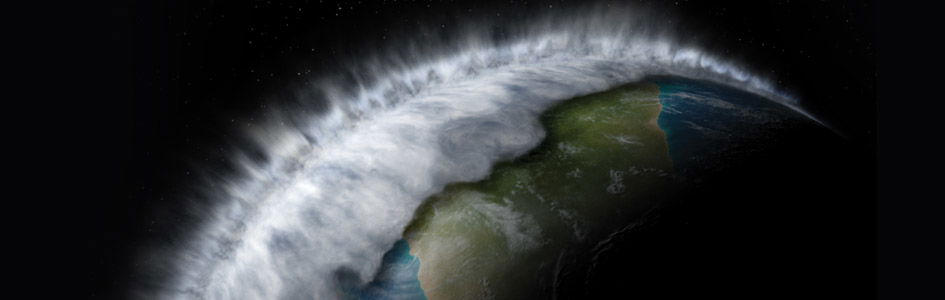
The Flood of Noah’s day (2348 BC) was a year-long global catastrophe that destroyed the pre-Flood world, reshaped the continents, buried billions of creatures, and laid down the rock layers. It was God’s judgment on man’s wickedness and only eight righteous people, and representatives of every kind of land animal, were spared aboard the Ark.
Noah’s Flood: a Historical, Global Catastrophe
Examining the immense biblical data for Noah’s flood as an actual, year-long, worldwide, and catastrophic flood about 4,500 years ago.
Was Noah’s Flood Global?
Did Noah experience a local flood which left only a few sediment layers, as floods do today? God’s record is clear: the water covered the entire globe and killed all the animals on earth. Such unique conditions are the only way to explain worldwide fossil-bearing layers thousands of feet deep.
Local Floods Help Us Understand Noah’s Flood Geology
Geologists repeatedly discover the catastrophic effects of local flooding on the earth’s surface, resulting in the same conclusion each time: that substantial amounts of water can have the same geological effect in a short period of time (even laying down rock layers) that hypothesized millions of years of slow water flow would have.
Noah Did More than Build an Ark
Like people today, almost certainly the people of Noah’s day were busy enjoying the pleasures of life and did not believe or care that judgment was coming. In 2 Peter 2:5, Noah is described as a “preacher of righteousness
.”
Psalm 104 and the Flood
Psalm 104:6–9 sheds important additional light on the geological effects of the Flood. “The mountains rose, the valleys sank down to the place which You established for them” (vs. 8).
Articles About The Flood
-
Psalm 104:6-9—the Flood or Day Three of Creation Week?July 28, 2009
Old-earth creationists such as Hugh Ross claim Psalm 104:6–9 refers to the Creation Week, but a closer look shows otherwise.
-
Death Valley Stream Shows Range of Geological ChangesFeb. 2, 2008
Amid the otherworldly Death Valley of California, geologists are seeing a 1941 stream diversion carve out the land before their very eyes.
-
Dec. 26, 2007 from Answers Magazine
This is a series of articles explaining the evidences from geology for the Genesis Flood.
-
Magazine Department ArticleA Thai to the FloodOct. 1, 2007 from Answers Magazine
A giant oyster shell found on land is yet another reminder of the global Flood.
-
TechnicalThe Flood Accounts
It is important to compare the differences in these two flood accounts in order to examine their relationship.
-
Book ChapterThe Genesis Flood Caused the Ice AgeOct. 1, 2004 from Frozen in Time
The two ingredients required for an Ice Age, cool temperatures and tons of snow, were dramatically fulfilled immediately after the Genesis flood.
-
Book ChapterThe SnowblitzOct. 1, 2004 from Frozen in Time
The Genesis Flood provides the two ingredients necessary for an Ice Age. From this point on, we can use basic meteorology to estimate the storm patterns and where ice sheets would develop.
-
Book ChapterWoolly Mammoths—Flood or Ice Age?Oct. 1, 2004 from Frozen in Time
There is plenty of evidence that the woolly mammoths in Siberia, Alaska, and the Yukon and almost all other surficial sites in the Northern Hemisphere died after the Flood.
-
Research PaperFlood/Post-Flood Boundaries Within the Global Stratigraphical RecordDec. 1, 2003, pp. 52–55
John Reed and I presented the northern Gulf of Mexico Basin as an example where several vertical kilometres of sedimentary strata were deposited.
-
Feedback ArticleHow Did Fish Survive Noah’s Flood?Feb. 26, 2001 from Feedback
This week's positive feedback is from L.N. of the USA, who receives the AiG-U.S. Weekly News.
-
Research PaperMcIntosh, Taylor and Edmondson Reply to Flood ModelsDec. 1, 2000, pp. 80–82
From our perspective, the fossil record into the Cretaceous and further, testifies strongly to God's act of judgment on this world.
-
Research PaperFlood ModelsDec. 1, 2000, pp. 79–80
We did not, and do not, propose that 'most of the fossils found on the earth were buried by post-Flood catastrophes'.
-
Research PaperFlood Models: The Need for an Integrated ApproachApril 1, 2000, pp. 52–59
Any scientific understanding of the Biblical Flood must address the hydrology and sedimentation that occurred during the Flood and in subsequent years as the Earth settled down.
-
Research PaperResponse to Faulkner’s ‘Biblically-Based Cratering Theory’April 1, 2000, pp. 46–49
Argument for an impact bombardment event surrounding the Flood that began with the onset of the Flood and continued for some time, trailing off into the post-Flood period.
-
Technical Research PaperEvidence for a Late Cainozoic Flood/Post-Flood BoundaryApril 1, 1996, pp. 128–167
Geologic evidence of the Middle East and the globe, combined with Scripture, indicates that the Flood/post-Flood boundary is very late in the Cainozoic.
-
Research PaperEvidence for a Late Cainozoic Flood/post-Flood BoundaryApril 1, 1996
The Flood/post-Flood boundary in the geologic column can be determined by investigating geophysical evidence in light of Scripture’s record of the Flood.
-
Technical Research PaperCoal, Volcanism and Noah’s FloodApril 1, 1984, pp. 11–29
Applying the explosive pyroclastic volcanism model to the formation of coal deposits, it is entirely feasible that all the coal seams were formed by the conditions during Noah's Flood.

Support the creation/gospel message by donating or getting involved!

Answers in Genesis is an apologetics ministry, dedicated to helping Christians defend their faith and proclaim the good news of Jesus Christ.
- Customer Service 800.778.3390
- Available Monday–Friday | 9 AM–5 PM ET
- © 2026 Answers in Genesis