


What Dr. Rana Gets Wrong About Radiometric Dating
Part 2—Dinosaur Blood and the Age of the Earth: A Futile, Deceitful Attempt to Critique Valid, Powerful Young-Earth Evidence
Dinosaur Blood and the Age of the Earth was published by Reasons to Believe, which is an old-earth creationist organization. The author, biochemist Dr. Fazale Rana, argued that young-earth creationists’ interpretation of Scripture is wrong. That claim was refuted from Scripture in Part 1 of this response series.
As we noted in Part 1, the real reason Dr. Rana believes in an old earth is that he trusts conventional scientists’ radiometric dating conclusions more than he trusts the plain reading of God’s Word. Dr. Rana’s line of reasoning to support his old-earth progressive creationist interpretation of God’s Word is that “as a scientist and a Christian—I am convinced that the results of radiometric dating are trustworthy.”1 Thus, he reasons, since radiometric dating is reliable and scientists have used it to measure the earth as 4.57 billion years old and to prove the earth’s rock layers and their contained fossils are indeed hundreds of millions of years old, then the earth’s rock layers and fossils are irrefutably hundreds of millions of years old.
The Supposed Objective Authority of Scientists
Dr. Rana introduces his defense of radiometric dating by appealing to the authority of fellow Christian old-earth advocates—an astronomer, two physicists, a geologist, and two groups of geologists—as if the number of such apparently qualified advocates makes radiometric dating reliable. He also appeals to the in-depth books by the non-Christian geochronologist Dr. G. Brent Dalrymple.2
Dr. Rana even goes on to appeal to the myth of neutrality:
To my knowledge, Dalrymple is not a person of faith, but I have no reason to think he harbors any animosity toward Christianity. To put it another way, Dalrymple has no ulterior motive when he makes the scientific case for the antiquity of the earth based on radiometric dating techniques.3
But with respect to a person’s spiritual standing with God, there is no neutrality. Jesus made that crystal clear when He said in Matthew 12:30 and Luke 11:23, “He who is not with Me is against Me and he who does not gather with Me, scatters.”
Furthermore, God says through the Apostle Paul that those who do not thank and worship Him, the Creator (the triune God of the Bible), are actively suppressing the truth in unrighteousness and therefore stand guilty before God and worthy of judgment (Romans 1:18–20). God further says that such unbelievers “walk in the futility of their minds” and are “darkened in their mind” “because of the ignorance that is in them, because of the hardness of their heart” (Ephesians 4:17–18). So Bible-believing, discerning Christians have plenty of reasons to think that Dalrymple harbors animosity toward Christianity (really, toward Christ) and therefore has ulterior motives (whether recognized or not) for making his case for millions of years.
And finally, Dr. Rana appeals to the majority vote when he quotes Dr. Mary Schweitzer as an “evangelical Christian”:
Virtually no one in the scientific community questions the antiquity of Earth or life on Earth. “The fields of geology, nuclear physics, astronomy, paleontology, genetics, and evolutionary biology all speak to an ancient Earth.”4
Science does not speak! It is scientists who speak when they interpret scientific observations.
However, science does not speak! It is scientists who speak when they interpret scientific observations. And Mary Schweitzer’s bias is exposed when she says “evolutionary biology” speaks to an ancient earth. Well, of course it would because evolutionary biology already assumes evolution occurred over billions of years! That’s circular reasoning—proving the billions of years by already assuming life evolved over billions of years.
Jesus made it abundantly clear when He said in Matthew 7:13–14 that truth is never determined by the majority vote (of fallible, finite scientists or any other humans):
Enter through the narrow gate; for the gate is wide and the way is broad that leads to destruction, and there are many who enter through it. For the gate is narrow and the way is constricted that leads to life, and there are few who find it.
Only eight people survived the Flood because they alone entered through the door of the Ark (Genesis 7:6–7, 13; 2 Peter 2:5). The majority were wrong and perished, being “blotted out” by God in the floodwaters (Genesis 7:21–23).
Who Was There When the Clock Started?
At least Dr. Rana starts his defense of radiometric dating with some correct observations on pages:
We can measure the passage of time by using clocks. And we can take advantage of this capability to determine someone’s age—if we were there to witness that person’s birth. But what if we weren’t? In that case, we could make use of that person’s birth certificate—which certifies the date, time, and location of a person’s birth.5
Yes, precisely! And God has provided in His Word the “birth certificate” for the earth and the universe, witnessed by Himself as stated seven times in Genesis 1 (“And God saw . . .” verses 4, 9, 12, 18, 21, 24, and 31) and signed by His finger on the stone tablets of testimony (Exodus 31:14–18). God could not have made it any clearer in His Word what those calendar days of creation were and approximately how long ago the creation week occurred. So who do we trust, Dr. Rana? The all-powerful, infinite, all-knowing Creator God who never lies (Titus 1:2) or the finite, fallible scientists who were not there and often make mistakes?
And again, Dr. Rana says:
Scientists can directly measure the size and weight of a fossil. But to determine a fossil’s age requires indirect methodologies that hopefully employ a reliable “clock” and some way of knowing when the clock got started.6
At least he notes that the methodologies are indirect and that there has to be “some way of knowing when the clock got started.” Of course, the latter is a grave problem since no geologists were present millions of years ago to observe when the clock was started. Yet even after making those correct caveats, he still maintains this:
In other words, there are many independent reasons to think that radiometric dating reliably determines fossils’ ages. . . . As a scientist and a Christian—I am convinced that the results of radiometric dating are trustworthy.7
So Dr. Rana chides young-earth creationists for not accepting the almost absolute majority “vote” in the scientific community for the reliability of radiometric dating:
The primary way the scientific community dates the earth’s geological features and the fossil record is by employing a technique known as radiometric dating. Nearly everyone in the scientific community regards this technique as reliable—but not YECs. These Christians have written countless articles and books detailing reasons why they think radiometric dating is unreliable.8
Yet having said that YEC “Christians have written countless articles and books detailing reasons why they think radiometric dating is unreliable,” Dr. Rana then totally ignores those countless articles and books. So the biochemist Dr. Rana (with no training in radiometric dating and no experience in collecting samples for such dating) unquestioningly trusts the unbelieving (that is, anti-God, truth-suppressing) majority of geologists (like Dr. Dalrymple). But he totally ignores the scientifically reasoned, published work of young-earth creationist PhD-qualified geologists and physicists who are trained and experienced in these dating methods and their assumptions. This is inexcusable, especially ignoring and discounting the two highly technical volumes published as a result of the 1997–2005 RATE (Radioisotopes and the Age of The Earth) project.9 These were available in 2000 and 2005, well before Dr. Rana published his book in 2016. Furthermore, and damning to say the least, he ignored a crucial chapter in the 2000 RATE volume10 in which copious examples of the systematic failures of each of the radiometric dating methods were fully documented from the secular literature, as also similarly documented in the three leading geochronology textbooks used to teach in universities around the globe.11 In other words, not “nearly everyone in the scientific community regards this technique as reliable”!
How Are Radiometric Clocks Supposed to Work?
Now before we address the problems inherent within all radiometric dating methods, it will be helpful to explain how radiometric “clocks” in rocks supposedly work. To help in understanding the principles involved, we can use the analogy of a simple hourglass clock as depicted in Figure 1. Typically, an hourglass uses sand grains. To prepare the clock, we turn it upside down so all the sand grains collect in the bottom glass bowl. Then to start the clock, we turn the hourglass back upright so that over the next hour, all the sand grains in the top glass bowl fall down to the bottom glass bowl. If we left the room where the clock is and came back 30 minutes later, we would observe that half of the sand grains are still in the top glass bowl and half of the sand grains are down in the bottom glass bowl, which equates to the half hour we were out of the room.
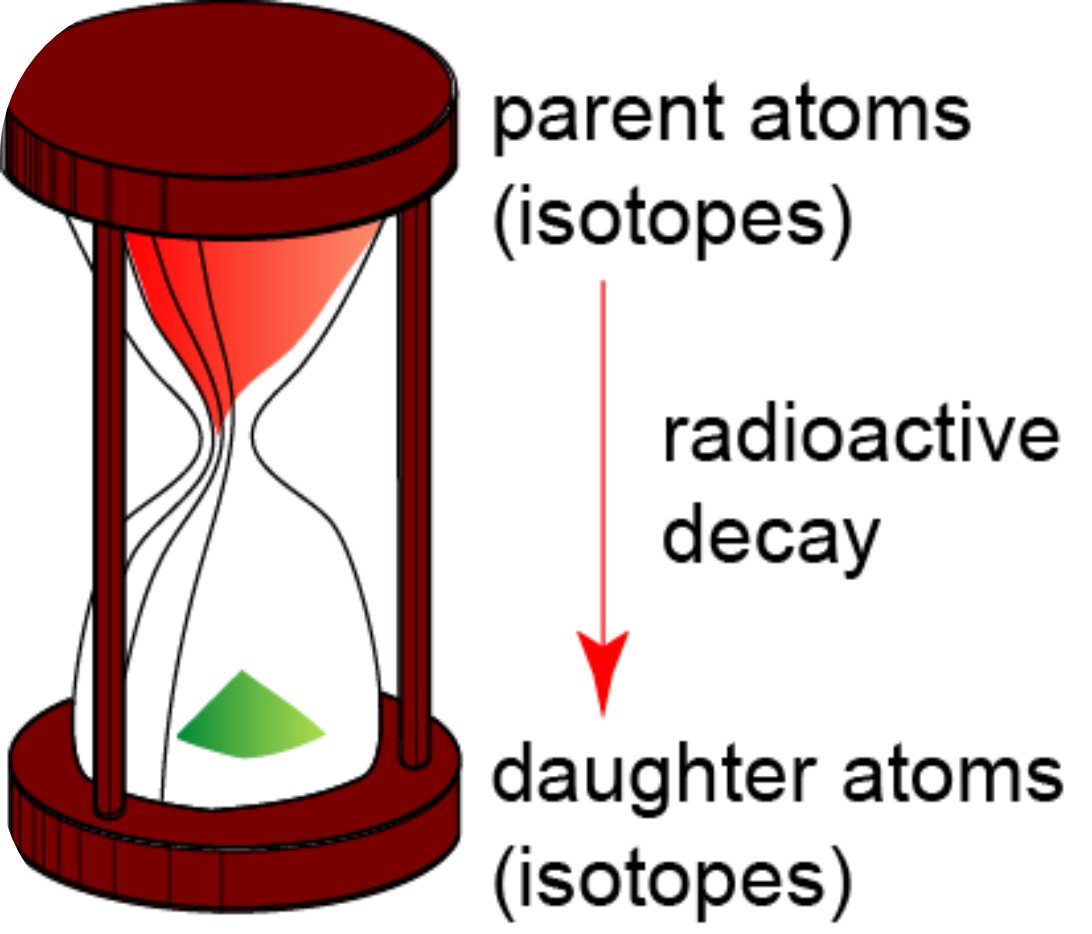
Figure 1. A simple hourglass clock as an illustrative analogy for radiometric dating.
The analogy with the radiometric “clock” in rocks works the same way (Figures 1 and 2). The red sand grains in the top glass bowl represents U atoms that decay to Pb atoms. The U atoms are known as parent atoms (or isotopes such as 238U) and the green sand grains in the bottom glass bowl are known as the daughter atoms (or isotopes such as 206Pb). The falling of the red sand grains is equivalent to the parent atoms decaying into daughter atoms (Figure 2). Thus, geologists collect suitable rock samples, and the samples are analyzed in the dating laboratories for their contents of parent and daughter atoms. With our hourglass clock, we measured half the sand grains in the top glass bowl (red parent atoms) and half the sand grains in the bottom glass bowl (green daughter atoms) and calculated how long the hourglass clock had been ticking (30 minutes or half an hour). Similarly, knowing the present decay rate of the parent atoms (the falling rate), the laboratory calculates how long ago all the daughter atoms were originally all parent atoms when the rock formed (that is, when all the green sand grains were originally red sand grains back when the clock started), which is then determined as the rock’s age.
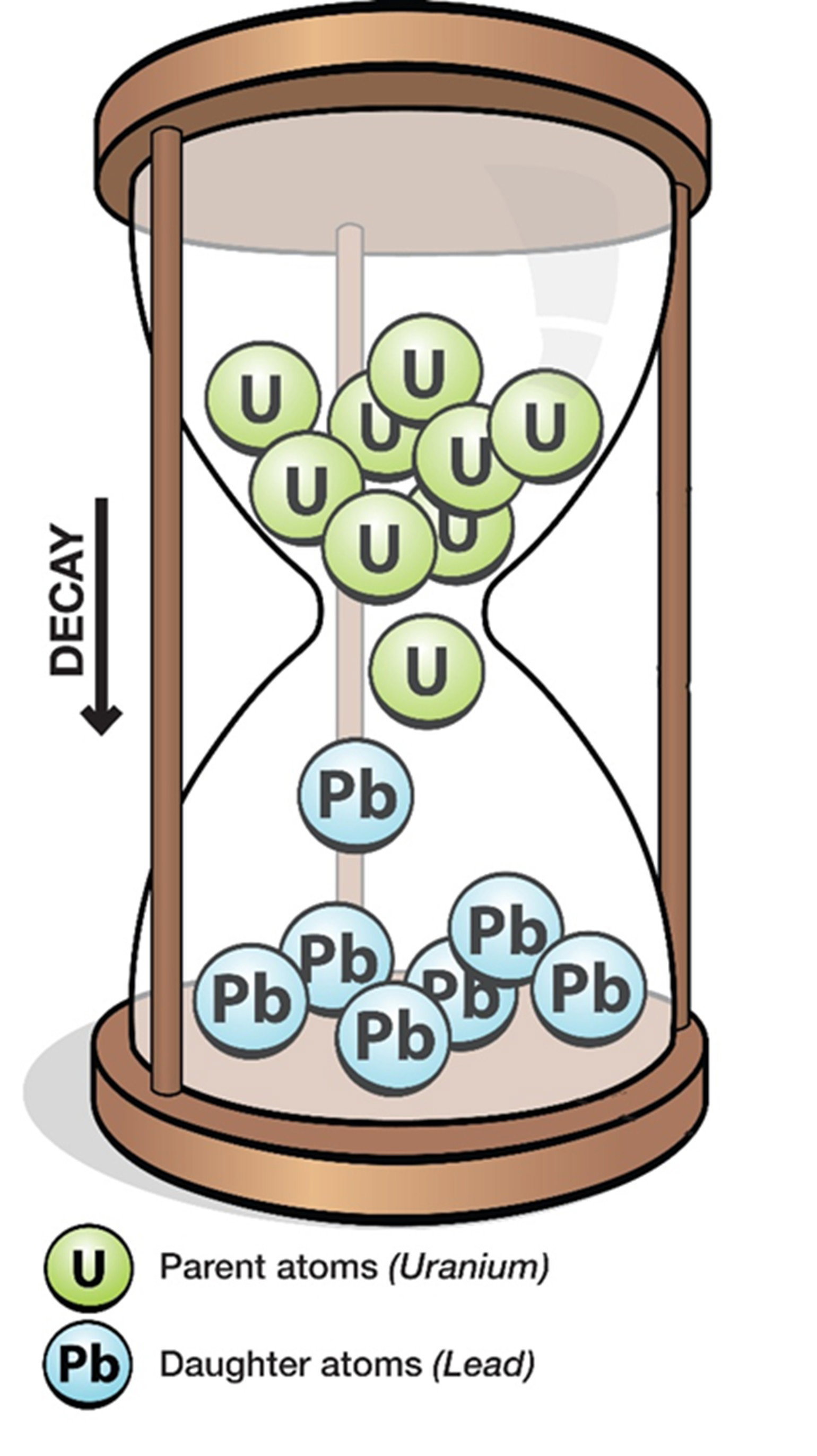
Figure 2. The analogy with the radiometric dating “clock.”
One other concept also needs explanation. The decay rate of the parent atoms (isotopes) is called the half-life, which is the time it has taken for given quantities of parent atoms to decay to daughter atoms, that is, for example, parent 238U atoms to decay into daughter 206Pb atoms. Thus, if we start with a pound of 238U atoms, it would take one half-life for half of them to decay to leave only half a pound of 238U atoms left. At that decay rate, in the next half-life, the half a pound of 238U atoms decay to leave only a quarter of a pound of 238U atoms left. And so on, as the quantities get progressively smaller.
Radiometric Dating Assumptions
So with those concepts explained, what are the problems with these radiometric dating methods which have been rigorously documented from the secular scientific literature12 and which Dr. Rana deliberately ignores? The answer should already be obvious:
- Inheritance of parent and/or daughter isotopes from mantle and crustal source rocks where there are geochemical and isotopic reservoirs due to tectonic stirring of the mantle and crust;
- Contamination of parent and/or daughter isotopes due to mixing with wall rocks and hydrothermal fluids during transport and intrusion or extrusion, and/or subsequent metamorphism; and
- Disagreements between radiometric dating results using different methods on the same rocks and minerals.
Another succinct description of these problems using the hourglass clock analogy in Figures 1 and 2 is the three assumptions that need to be known. But instead:
- The starting conditions of the radiometric clock (when molten material hardened into rock) are not known. Was it 100% parent atoms (red sand grains) and 0% daughter atoms (green sand grains) when the rock formed, or were some daughter atoms (green sand grains) already in the rock when it hardened?
- The radiometric systems have not been closed and have been subject to contamination (no extra red or green sand grains, that is, parent or daughter atoms, have been added to or removed from either glass bowl); and
- The rate of radioactive decay (rate of falling) may not have been constant through earth history.
No geologists were able to measure the starting conditions when the rocks formed supposedly millions of years ago.
Indeed, these three problems involve these three assumptions that are unprovable.13 It should be carefully noted that no geologists were able to measure the starting conditions when the rocks formed supposedly millions of years ago. And no geologists were present throughout the subsequent supposed millions of years to observe and measure whether the dated rock samples were closed to contamination. Furthermore, geologists cannot prove that the radiometric “clocks” ticked at the same rates we measure today throughout all of earth history. Yet the scientific community ignores these problems. It is so enamored with radiometric dating because the millions of years “dates” that it yields dovetail with their uniformitarian evolutionary worldview, which determined that the earth was hundreds of millions of years old long before radiometric dating was invented in the early twentieth century.14
Ignoring these problems, Dr. Rana assures his uninformed lay readers:
The principles that undergird radiometric dating are elegant and straightforward. But, in practice implementing the strategies can be rather involved. Effective use of radiometric dating requires experts who have spent years working with these techniques.15
So Dr. Rana trusts without question the “experts” and appeals to their authority:
The practical challenges that accompany radiometric methods sometimes lead to erroneous results. . . . As Dalrymple points out, “A few verified examples of incorrect radiometric ages are simply insufficient to prove that radiometric dating is invalid. All they indicate is that the methods are not infallible. Those of us who have developed and used dating techniques to solve scientific problems are well aware that the systems are not perfect; we ourselves have provided numerous examples of instances in which the techniques fail. We often test them under controlled conditions to learn when and why they fail so we will not use them incorrectly.”16
However, Dalrymple’s admission of “numerous examples of instances in which the techniques fail” highlights the compounded problem that even when an ancient “date” is obtained that is in the expected ballpark, how do the experts know that the technique has not likewise failed? Testing the techniques under controlled conditions in the present does not guarantee that the techniques worked under uncontrolled conditions through the supposed millions of years in the unobservable past. To suggest otherwise displays the faith of even the experts that these techniques work. Obviously, the yardstick for whether the techniques worked (according to the evolutionists) is whether the techniques gave the desired “dates”! Thus, there is no independent objective test for knowing whether these techniques have worked, the experts notwithstanding!
Nevertheless, undaunted, Dr. Rana proceeds to explain simply the basis of radioactive decay, first focusing on the radioactive decay of the isotope potassium-40 to argon-40 (an inert gas) with a half-life (decay rate) of 1.26 billion years. He highlights one of the major problems of the method:
While it is generally true that when rock becomes molten the argon gas escapes from the rock, occasionally small amounts of gas can be trapped as tiny bubbles in the rock as it hardens. Argon makes up about 1 percent of Earth’s atmosphere. As a result, there will be some argon-40 in the rock that did not result from radioactive decay—a complication that will make it appear as if the sample is older than it actually is. The extraneous argon-40 becomes a much more serious concern for relatively young samples or those with a low level of potassium-40. Fortunately, geochemists know how to correct for the trapped argon-40. As it turns out, there are other isotopes of argon, argon-36 being one. The ratio of argon-40 to argon-36 in the atmosphere is known. So all that researchers have to do is measure the amount of argon-36 in the sample. This value will allow them to calculate how much argon-40 was initially present in the rock when it cooled.17
Dr. Rana quite correctly states that practitioners must experimentally demonstrate that the methods work and thus be validated. He claims that this has been done for these radiometric methods. However, such a claim is again subjective and selective. How can the “date” from a method be validated unless there was an eyewitness of the formation of the rock being dated who thus knows the rock’s true age? And it depends on the example selected! So Dr. Rana selects a suitable example:
For example, in 1997 a team of geochemists from UC Berkeley measured the age of volcanic rock produced when Mount Vesuvius erupted.18 Pliny the Elder recorded the date that this event took place: August 24, 97 AD—1,918 years before the researchers dated the rock. The research team used argon-argon dating (a variant of potassium-argon dating) on 12 samples taken from the eruption site. They determined that the eruption took place 1,925±94 years ago, demonstrating the reliability of potassium-argon and argon-argon dating.19
However, that dating of the AD 97 Mount Vesuvius eruption was not done blind, as the research team already knew what “age” the target was before they analyzed their samples! Furthermore, Dr. Rana failed to explain that the argon-argon dating method depends on measuring for calibration at the same time in the same nuclear reactor samples of supposed known ages that have been determined by other radiometric dating methods. Thus, the argon-argon dating method is only as good as the known ages for the calibration standards determined by the other radiometric dating methods, which in turn have their own problems.
Nevertheless, Dr. Rana then chides young-earth creationists for using the potassium-argon method to “date” the dacite lava erupted by Mount St. Helens in 1986 and thus question the reliability of radiometric dating.20 In that study, samples were submitted blind to a commercial laboratory so that the geochronologist at the laboratory did not know the true, eyewitness age of the samples and thus could not manipulate the interpretation of the analytical results to produce the “target age.” Instead, the samples gave an age of about “350,000 years for the whole rock and ages of 340,000 and 2.8 million years for feldspar-glass and pyroxene mineral concentrates separated from the rock. This work was published 10 years after Mount St. Helens erupted and should have returned an age of less than 10 years.”21 But it did not because the dacite lava had trapped (inherited) extraneous argon-40 present in the gases when the volcano erupted, which is beyond the argon-36 correction for atmospheric argon-40.
So Dr. Rana trusts the radiometric dating of Mt. Vesuvius (where the biased evolutionists knew what the target date “should be”) but doesn’t trust the radiometric dates of the Mt. Helens rocks by unbiased evolutionists who did not know the correct target date.
In chiding the young-earth creation scientist Dr. Steve Austin who undertook that study, Dr. Rana claimed:
Yet, this result is not a sound reason to question the validity of this radiometric dating method. Given that the half-life for the radioactive decay of potassium-40 to argon-40 is 1.26 billion years, this method cannot be used to age-date volcanic rock that is less than a decade old.
But why did these measurements detect any argon-40 at all? Geochemist Roger Wiens explains, “The false radiometric ages of several million years are due to parentless argon . . . first reported in the literature some fifty years ago.”22 This type of argon arises from rocks that are deep within the earth’s crust and has a much higher level of argon-40 than atmospheric argon.23
Dr. Roger Wiens is quite correct that such spurious results of millions of years for recently-erupted lavas due to parentless argon (that is, argon-40 not derived by radioactive decay from parent potassium-40) were reported in the literature many decades ago, as creation scientists have known.24 Indeed, one of those reported studies was of 26 historic subaerial lava flows.25 That study was undertaken by the “neutral” geochronologist Dr. Dalrymple whom Dr. Rana quoted as an authority on the certainty that the radiometric dating methods worked reliably. It is thus hypocritical of Dr. Rana to then chide young-earth creation scientists for likewise using the potassium-argon to “date” historic lava flows, in part to expose the unreliability of these dating methods. And similarly, Dr. Dalrymple found that of the 26 historic lava flows he analyzed, five (almost 20%) contained “excess” argon (parentless argon-40). Among those five historic lava flows were those from the Hualalai Volcano, Hawaii, that erupted in AD 1800–1801 but yielded potassium-argon “dates” of 1.6 and 1.4 million years. Yet two decades later, Dalrymple claimed that excess argon is rare!26
It is also worth mentioning here that Dr. Rana was wrong about the source of the excess (parentless) argon-40 gas in these historic lava flows, which he said was from “deep within the earth’s crust.” While the magma chambers from which those (primarily basalt) lavas erupted are deep within the earth’s crust (which is granitic in composition), the ultimate source of the magmas and thus the excess argon is the earth’s upper mantle (which is basaltic in composition).
The Results of the RATE Project
Now, as already mentioned above, Dr. Rana, whose book was published in 2016, studiously ignores or inexcusably overlooks the experimental results and conclusions of the 1997–2005 RATE project that were published in 2005.27 That is because those results and conclusions are devastating to his claims above about the reliability of radiometric dating. The results demolish the claims. Let me provide three examples.
The first example is the ~300-meter-thick Precambrian Cardenas Basalt that is exposed in the Eastern Grand Canyon, which has a series of lava flows dividing the underlying Mesoproterozoic Unkar Group sedimentary strata from the overlying Neoproterozoic Chuar Group sedimentary strata (Figure 3).28 These lava flows were “dated” using three radiometric methods, all of which are used conventionally to “date” such lava flows, as reported in the relevant literature. Unexpectedly, young-earth creationist geologists Drs. Austin and Snelling obtained three radically different “dates” for these basalts by these three radiometric methods.29 Conventionally “dated” at 1,103 million years by the rubidium-strontium isochron method (which uses multiple samples), the study by Drs. Austin and Snelling obtained a potassium-argon isochron “age” of 516 million years, a rubidium-strontium isochron “age” of 1,111 million years, and a samarium-neodymium isochron “age” of 1,588 million years! So the potassium-argon method touted by Dr. Rana failed miserably to replicate the conventionally accepted rubidium-strontium isochron “date.” In fact, the 516 million-years potassium-argon isochron Cambrian “age” is very much “younger” than radiometric “ages” for the overlaying Precambrian strata! Furthermore, the samarium-neodymium isochron “age” of 1,588 million years is three times “older” than the potassium-argon isochron age. So these radiometric dating methods are hardly trustworthy, as claimed by Dr. Rana. Yet according to his geochronologist authority, Dr. Dalrymple, all three legitimately used radiometric isochron methods should have yielded the same “date” for these basalts.30
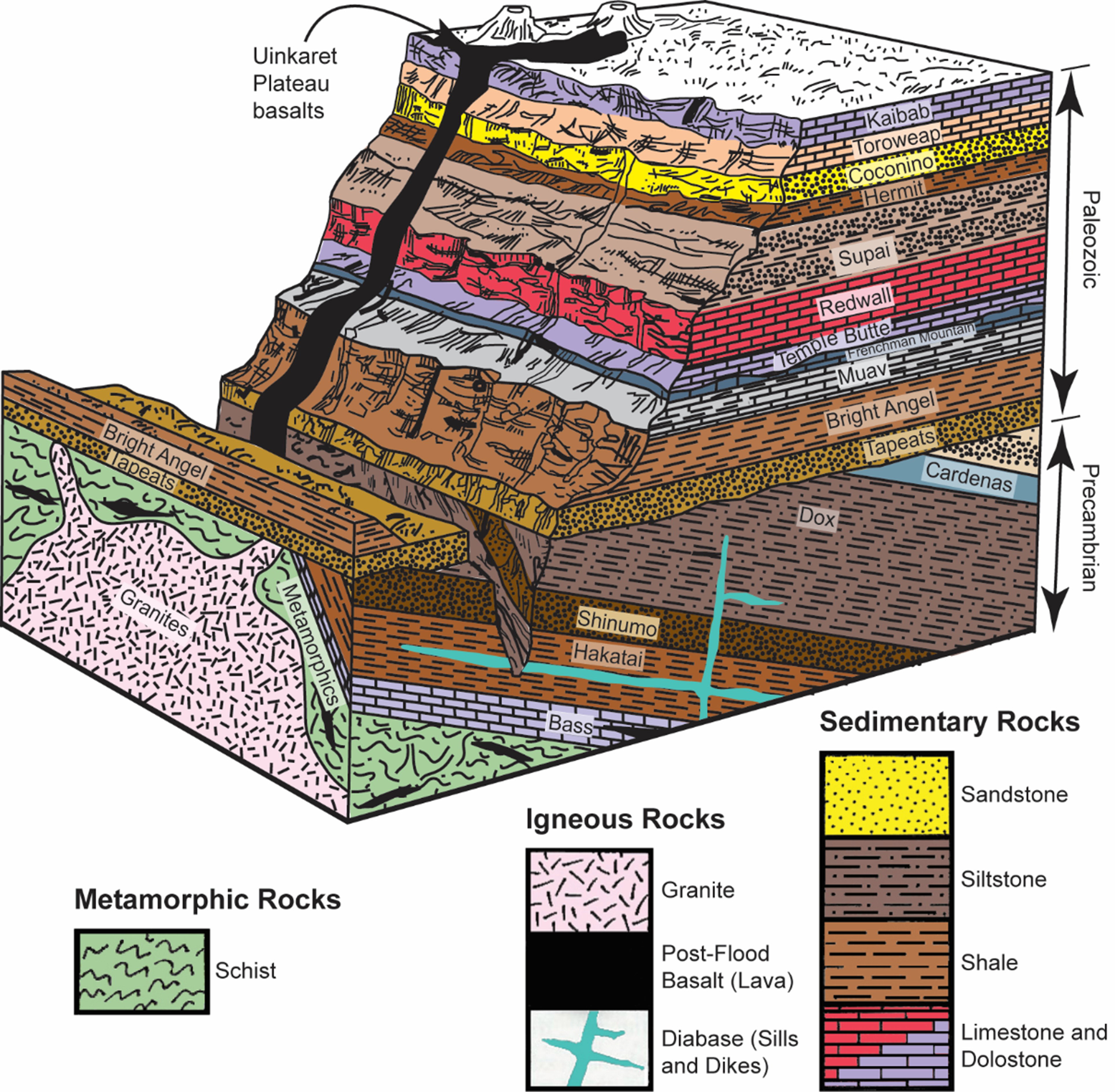
Figure 3. A “block” cutaway diagram depicting the named rock layers exposed in the walls of the Grand Canyon. The Cardenas Basalt lavas exposed in the Eastern Grand Canyon and the Uinkaret Plateau basalts that flowed down the walls of the Western Grand Canyon are labeled.
The second example is the Uinkaret Plateau basalts of the Western Grand Canyon erupted from ~160 volcanic cones as flows generally less than 8 meters thick (Figure 3).31 More than 150 of these lava flows poured southward into the inner gorge of Grand Canyon as lava cascades. Those lava cascades then formed dams that temporarily filled the inner gorge to different heights, blocking the flow of the Colorado River. It is not surprising then that these basalts yielded potassium-argon “ages” of <1.6 million years as they had to be younger than the conventional age of the Grand Canyon’s erosion. Yet these basalts yield a rubidium-strontium isochron “age” of 1,143 million years and a lead-lead isochron “age” of 2.6 billion years!32 So how is it possible that these recent basalt lavas in the western Grand Canyon (which formed after the mile-thick horizontal sedimentary layers were deposited, over supposedly 300 million years, on top of the Cardenas basalts and after the canyon was carved) yield essentially the same old rubidium-strontium isochron “age” as the Mesoproterozoic Cardenas Basalt lavas in the eastern Grand Canyon? The answer is well-established in the conventional literature; namely, all these lavas were derived from the same upper mantle reservoir source with the same rubidium-strontium isotopic signature! Thus, the rubidium-strontium isotopic composition of all these basalts is not their radiometric “age” but an inherited geochemical property of their upper mantle source. This is affirmed by the lead-lead isochron “age” of 2.6 billion years, which is consistent with the so-called “lead isotope paradox” in which recently erupted basalts on ocean islands globally have isotopic compositions inherited from their upper mantle sources, yielding false radiometric “ages” generally of 1–2 billion years.33 Once again, Dr. Rana, these radiometric dating methods are hardly trustworthy.
Once again, Dr. Rana, these radiometric dating methods are hardly trustworthy.
The third example is the Bass Rapids diabase sill in the central Grand Canyon, which represents basaltic magma injected and crystallized in a sheet between beds within the Hakatai Shale, near the base of the Mesoproterozoic Unkar Group (Figure 4).34 This diabase sill is conventionally “dated” with a rubidium-strontium isochron at 1,070 million years. Samples collected progressively from top to bottom down through this diabase sill by Snelling, Austin, and Hoesch yielded a potassium-argon isochron “age” of 841.5 million years, a rubidium-strontium isochron “age” of 1,060 million years, a samarium-neodymium isochron “age” of 1,379 million years, and a lead-lead isochron “age” of 1,250 million years. That is four different radiometric dating methods, all of which are conventionally used to date such rocks and thus the results are legitimate. But they yielded four different results! Once again, Dr. Rana, these radiometric dating methods are hardly trustworthy.
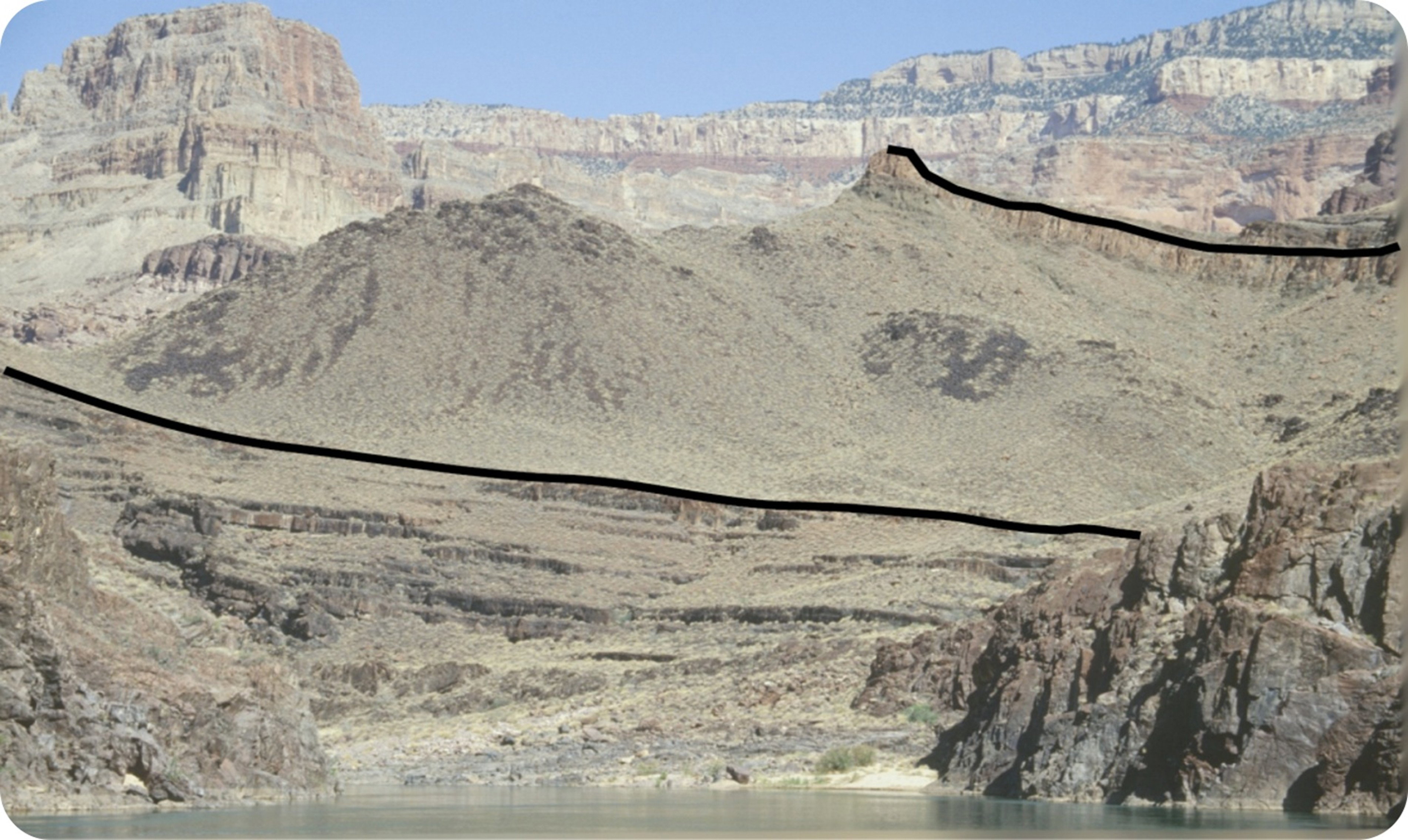
Figure 4. The Bass Rapids sill in the central Grand Canyon is delineated by the black lines. Instead of erupting through a volcano, basalt magma was squeezed sideways underground between sedimentary rock layers where it cooled in a sill consisting of coarser-grained diabase.
According to the theoretical basis for these radiometric “clocks,” all four of these radiometric methods should have yielded the same “age” for this Bass Rapids diabase sill, if all four “clocks” had “ticked” at the same decay rates (as we measure today) from when the sill formed until the present. Drs. Rana and Dalrymple would adamantly agree. So why then did these four methods give four such different “age” results? What if each of these radiometric “clocks” had “ticked” at different faster rates during some catastrophic geologic event in the past after the diabase sill formed? That would definitely explain the same rock unit yielding four radically different radiometric “ages.” This was the conclusion of the RATE team of young-earth creationist geologists and physicists (all with PhDs earned in globally recognized universities) who amassed impressive experimental results that supported five independent lines of evidence consistent with radioactive decay rates having been accelerated by orders of magnitude during a past geologic cataclysm (the global Flood of Noah) when many other processes were likewise accelerated.35 These five lines of evidence included
- (1) these discordant radiometric isochron “dates” for the Bass Rapids diabase sill, Cardenas Basalt, and several other rock units,36
- (2) a very young helium diffusion age for zircons in a granodiorite uranium-lead isochron dated at 1.5 billion years,37
- (3) coexisting uranium and polonium radiohalos in granites of all conventional ages,38
- (4) fission tracks in zircons in Cambrian, Jurassic, and Miocene volcanic ash beds,39 and
- (5) young radiocarbon “ages” for coal, fossilized wood, and other fossils all conventionally “dated” as up to >300 million years old.40
Furthermore, it was argued that there are viable theoretical mechanisms for accelerated nuclear decay to have occurred (that is, the clocks ran faster in the past yielding grossly erroneous old ages).41
However, while Dr. Rana mentions the RATE project on pages 47–48, it is only in passing in order to dismiss the project’s conclusion of past accelerated radioactive decay rates, while ignoring the impressive experimental evidence the RATE project produced to support that conclusion. So Dr. Rana insists:
For radiometric dating to provide reliable ages for geological features and the fossil record, radioactive decay rates must be unvarying. And the assumption that the half-life of a radioactive isotope is a constant is more than reasonable. As Dalrymple points out, “Unless there has been some undiscovered change in the fundamental nature of matter and energy since the universe formed, the presumption of constancy for radioactive decay is, for all practical purposes, eminently reasonable.”42
To bolster this “presumption of constancy,” Dr. Rana tries looking for scientific evidence:
But is there any scientific evidence that supports this proposition? If the radioactive decay rates were accelerated a billion-fold, a number of fundamental constants of physics would have had to change to accommodate this phenomenon. There is no evidence whatsoever that the constants of physics changed that radically at any point in time over the last 10,000 years. If the constants of physics did change in the past, astronomers would be able to detect these changes today by observing light emitted from objects that systematically vary in distance from Earth. Because of light travel time, it takes electromagnetic radiation (EMR) about 8 minutes to reach Earth once emitted from the Sun. When astronomers observe the Sun, they are monitoring events that took place 8 minutes ago. When astronomers observe Sirius, they are documenting events that happened 9 years ago. Observations of the Orion Nebula give information that is 1,500 years old. Light detected today from the Cat’s Eye Nebula, NGC 869/864, and Cassiopeia reflect events that happened 3,000, 7,000, and 10,000 years ago, respectively. None of the light coming from any of these objects shows any evidence for a change in the fundamental constants of physics.43
To suggest, as Dr. Rana does, that if accelerated nuclear decay occurred, we should be looking for evidence “that the constants of physics changed that radically at any point in time over the last 10,000 years” entirely misses the point that accelerated nuclear decay totally changed the radiometric timescale for the universe’s history because it totally wipes out billions of years. And besides, light travel in astronomy is a measure of distance, not time. Plus, it assumes light has always traveled at the speed we measure today, when in fact the speed of light has only been measured in two-way-travel experiments.44 So we cannot be sure of the one-way speed of light through space, especially in the past and especially during the creation week when God created (or provided) light on day one and then created the sun, moon, and stars on day four to be for signs and seasons. Thus, if Adam could not see all the stars on day six, two calendar days after their creation by God, then they were not serving their God-ordained purpose for signs and seasons (Genesis 1:14).
Are the Laws of Physics Always Constant?
Dr. Rana next tries to answer the question, “Does the Bible teach the constancy of the laws of physics?”:
YECs argue that the laws of physics changed during the first two or three days of the creation week, the curse, and the Noahic Flood. As a consequence, radiometric decay rates sped up, giving the appearance that Earth is billions of years old, when in fact it is only a few thousand years in age. But is there any biblical warrant for such an idea?
I would argue, “no.” In Jeremiah 33:25, God compares his immutability with the constancy of the laws that govern the heavens and the earth. From this passage alone, it is reasonable to conclude that the laws of physics—including radiometric decay rates—have been unchanging since the universe’s beginning.45
So Dr. Rana, are you saying that God could not choose to supernaturally intervene at any time and place in His created universe to change the laws of physics to achieve His plans? Did Jesus the Creator not supernaturally, instantly create wine from water (John 2:1–11), create instantly on two occasions more bread and fish to feed thousands (Matthew 14:13–21, 15:32–38; Mark 6:30–44, 8:1–9; Luke 9:10–17; John 6:1–13), supernaturally defy the law of gravity when He walked on water (Matthew 14:22–33; Mark 6:45–51; John 6:16–21), supernaturally raise Lazarus from death and decay (John 11:38–44), and supernaturally rise from the dead Himself (Matthew 28:1–10; Mark 16:1–8; Luke 24:1–12; John 20:1–10)?
Jeremiah 33:25 and Jeremiah 31:35–38 are statements about the future and God’s faithfulness to Israel going forward. They are not statements about the past, going back to the first act of creation during the supernatural creation week. There were no laws of genetics before God made plants, animals, and people. There were no laws of planetary motion before God made the planets on day four. And God disrupted the seasons during the Flood. The present fixed order of the sun, moon, and stars in no way proves that rates of radioactive decay could never change. Jeremiah is talking about the fixed order or pattern of the movement of the heavenly bodies, not the fixed rate of nuclear decay. Dr. Rana is claiming more than Jeremiah’s words say.
So Jeremiah 33:25 does not teach that God cannot supernaturally change the movements of the sun and thus affect the lengths of the day and the night. God is not bound by the laws of physics He created. In fact, Scripture records two instances when (for a special purpose) God temporarily suspended His covenant with day and night and the fixed order of heaven and earth. First, in Joshua 10:12–13, we are specifically told that God caused the sun and the moon to stand still in the sky for a whole day so that Joshua and his army could defeat the fleeing Amorites. And second, as a sign to King Hezekiah that his life would be extended, God moved the sun back in the sky so that its shadow on the sundial moved “back ten steps” (Isaiah 38:7–8).
Thus, if God chose to do so, He could change radioactive decay rates whenever and however He chose in order to accomplish His purposes. Does that mean God has deceived us because evolutionists—while assuming today’s slow radioactive decay rates have been constant throughout history—date rocks as millions of years old when, in fact, they are only a few thousand years old? Absolutely not! God has told us about how and how long ago He created the earth and its rocks and then how and how long ago He destroyed the earth globally by the Flood cataclysm that reshaped the earth and produced new rock layers filled with fossils of the creatures God destroyed when He also destroyed man. And God does not deceive or lie (Titus 1:2). Rather, we deceive ourselves if we do not believe what God has clearly told us in His inerrant Word.
But as skeptics often ask accusingly, as does Dr. Rana’s colleague Dr. Hugh Ross, “Wouldn’t the decay of these radioisotopes at such extremely accelerated rates have instantly vaporized all earth’s life, both terrestrial and marine, the Ark, and all earth’s water?” No, there is impeccable evidence that the claimed heat generated by accelerated radioisotope decay rates was never a problem. Specifically, the generation of polonium radiohalos due to accelerated radioisotope decay rates and the concurrent survival of both radiohalos and fission tracks unequivocally demonstrate that there was no heat problem.46 Both observational and experimental evidence show that radiohalos are destroyed at only 150°C, which is very much below any vaporization temperature, while fission tracks are likewise destroyed at similar temperatures depending on the host mineral. Many skeptics are either unfamiliar with this published research evidence or deliberately choose to ignore it.
More Failed Attempts to Justify the Radiometric Dating Method
Otherwise, Dr. Rana claims that another way to validate the radiometric dating method
is by cross-correlating its results with results from other techniques. The existence of over 40 different radiometric methods makes this a routine practice among geochemists. It is not unusual for scientists to use several different independent radiometric methods to date rock formations.47
Many rock units radiometrically “dated” by multiple independent methods yield different “ages,” indicating these methods are not reliable and trustworthy.
But Dr. Rana, you are ignoring the published results of the radiometric “dating” of many rock units by multiple independent methods that yielded different “ages,” such as the Cardenas Basalt, Uinkaret Plateau basalts, and the Bass Rapids diabase sill, as already detailed above. Furthermore, there are many other significant examples published in the conventional literature. For example, serious readers can consider the Lewisian Metamorphic Complex of northwest Scotland, the Stuart dike swarm in south-central Australia, the Uruguayan dike swarm, a pegmatite in the Union Mine in South Africa, the Guidong Granodiorite of southeast China, the Beartooth andesitic amphibolite of Wyoming, and the Great Dyke of Zimbabwe.48 Further examples are cited in standard geochronology textbooks.49 So Dr. Rana is simply wrong. Many rock units radiometrically “dated” by multiple independent methods yield different “ages,” indicating these methods are not reliable and trustworthy.
Yet Dr. Rana next turns to the radiometric dating of meteorites, lunar rocks, and minerals within one of the earth’s oldest rock formations to persist in justifying his bold assertions that the radiometric methods are reliable:
Dating of meteorites provides a beautiful illustration of how well the results of radiometric methods correlate with each other. Some meteorites are considered to be the oldest objects in our solar system. Meteorites have a complex mineralogy, which affords researchers the opportunity to date them using different radiometric techniques. Meteorites also provide important information about the early history of the solar system. Thus, research groups from around the world study meteorites, which means that most meteorites have been independently dated, time and time again. Virtually every primitive meteorite dates between 4.4 and 4.6 billion years.50
Lunar rocks collected during the Apollo missions date to around 4.3 billion years. The oldest rock formations on planet Earth date to around 3.8 billion years. Zircons—found within some of Earth’s oldest rock formations—date to between 4.2 to 4.4 billion years. Given that scientists believe that Earth was molten for the first few hundred million years of its existence, and that the Moon formed shortly after Earth formed, these measurements provide us with a remarkably consistent set of data and a remarkably consistent picture of the age of the earth and solar system.51
Here is where Dr. Rana’s progressive creation day-age worldview disintegrates because it violates God’s infallible eyewitness record in His inerrant Word, despite Dr. Rana’s claim that he believes God’s Word is inerrant. Dr. Rana unashamedly accepts “that scientists believe that Earth was molten for the first few hundred million years of its existence,” whereas God’s inerrant Word tells us that when God created the earth on creation calendar day one, it was not molten but covered in water. Furthermore, God did not create the sun, moon, and stars until creation calendar day four, meaning that the earth did not form as coalescing molten material out of the solar nebula, as the scientists who are Dr. Rana’s authority believe. Who is right? God, the eternal, all-powerful, all-knowing Creator, who was there to see and tell us what He did or the finite, fallible scientists who were not there?
Dr. Rana’s statement that “virtually every primitive meteorite dates at between 4.4 and 4.6 billion years,”52 with the earth “dating” at 4.57 billion years, relies on assumptions—assumptions that are contrary to God’s inerrant Word. The earth’s 4.57-billion-year “age” was not determined by radiometric dating of earth rocks but by using a group of meteorites to obtain a lead-lead isochron on which a sample of ocean sediment was also plotted.53 But this assumes that the meteorites are from asteroids that are leftover materials formed at the same time when the earth coalesced out of some of the same materials flung out by the solar nebula. This is contrary to God’s order of creation because His inerrant Word tells us the sun was not created by Him until three creation calendar days after He created the earth covered in water. However, perhaps when Genesis 1:16 says God made the sun, moon, and stars on day four, God created more of the same materials from which He created the earth on day one. Admittedly, this is an argument from silence, but given the brevity of the account of the supernatural creation week, it is not unreasonable and nothing in the text proves that it is wrong. This would explain why virtually all primitive meteorites yield the same radiometric “age” as the presumptive radiometric “age” of the earth and the moon, since they were all made in the space of four literal days.54
Furthermore, there is another underlying reason why virtually all the primitive meteorites yield the same radiometric “age” by the use of multiple radiometric methods. When the experiments and techniques used to determine the radioactive decay rates (half-lives) of the various parent radioisotopes were investigated, it was found that there were discrepancies between the resultant “ages” using the experimentally determined half-lives of the different parent radioisotopes. The solution was to systematically adjust the experimentally determined half-lives of potassium, rubidium, samarium, lutetium, and rhenium so that the “ages” calculated from those adjusted half-lives agree with the “ages” determined using the uranium-thorium-lead methods, especially the uranium-lead and lead-lead isochron “ages.”55 However, this procedure does not take into account the problems encountered in experimentally determining the half-lives of the uranium radioisotopes,56 nor the added well-documented problems of common lead, uranium, lead mobility, and mass fractionation associated with the uranium-thorium-lead dating methods.57 Thus, the reason virtually all the primitive meteorites yield the same radiometric “age” is that the arbitrarily applied adjustments have “forced” the radiometric “ages” obtained by the different methods to agree. Yet even then, the resultant “agreed-upon” radiometric “ages” are still unreliable due to the well-documented problems with the uranium-thorium-lead methods.
So Dr. Rana, your faith in the reliability of the radiometric dating methods is ill-founded, particularly as the small circle of geochronology practitioners whom you trust have created the aura of agreement between all the major methods by their unanimous “sleight-of-hand” manipulation of the determined half-lives to force agreement in the derived “ages.” And they have studiously ignored the well-documented problems with the uranium-thorium-lead methods that render “ages” obtained by them to be dubious at best. Dr. Rana, it is imperative that you trust God’s inerrant Word because its trustworthiness is guaranteed by the eternal, all-powerful, all-knowing Creator of the universe who never changes and who always tells the truth because He is the truth (Titus 1:2; John 14:6).
Undaunted, Dr. Rana raises two more issues briefly, hoping to put the proverbial “icing on the cake” of his claimed case for the authoritative reliability of radiometric dating. The first issue is short-lived isotopes:
But there are many other radioactive materials that are short-lived. While these short-lived isotopes may not have much value for dating features of the geological record, they still give scientists another reason to believe that Earth and the fossil record are ancient. None of these isotopes remain on Earth! Except for carbon-14, beryllium-10, and chlorine-36 (short-lived isotopes continuously produced by cosmic radiation), any radioisotope with a half-life less than 500 million years does not naturally occur anywhere on planet Earth. But there are indicators that these isotopes once existed on Earth because we can find evidence of their daughter isotopes.
Why would these isotopes be absent from the earth? Because Earth is nearly 5 billion years old. Remember the rule of thumb. After a time period that is ten times the half-life, the parent isotope can no longer be readily detected because, for practical purposes, it has all decayed away. These short-lived radioisotopes are like a watch with a dead battery. It was keeping time, but then the battery died and the watch stopped.58
Dr. Rana has ignored, or simply does not understand, the implications of the RATE research.
But Dr. Rana has ignored, or simply does not understand, the implications of the RATE research. Such an argument for this claimed evidence for an old earth is totally nullified by the abundant evidence for accelerated decay rates during the Flood year. Since the earliest Flood strata are conventionally at least 500 million years old, then that means at least 500 million years’ worth of radioactive decay (at today’s measured slow rates) occurred during the Flood. And the RATE researchers proposed an earlier burst of billions of years’ worth (at today’s decay rates) of accelerated nuclear decay, perhaps early in the creation week. So any radioisotope with a half-life of less than 500 million years that still existed in the pre-Flood world would have decayed away at that accelerated rate during the Flood and would thus not now occur naturally anywhere on planet earth! True, RATE researchers cannot prove their proposal about creation week is valid. But again, given the supernatural nature of God’s work in creation week, the proposal is not unreasonable, and old-earth critics cannot prove that it is invalid.
Then the second issue Dr. Rana raises is “why aren’t all rocks the same age?”
If YECs are, indeed, correct and the earth is 6,000–10,000 years old, then why don’t the radiometric dates for rock samples from all over the world and in different layers of the geological column yield the same age?59
To answer his own question, Dr. Rana draws on a biologist, of all people, to be an authority on radiometric dating! His argument is:
Biologist Kenneth Miller points out, “If this planet were recently formed . . . potassium-created minerals on a recently created Earth, just like newly formed rocks from active volcanoes, would contain little or no argon.”60 When geochemists determine the ages of volcanic tuffs, the ages of these materials vary widely, instead of yielding one consistent age. Even if the rate of radioactive decay was accelerated at some point, the ages for volcanic tuffs all over the world should be identical. They are not.61
Once again, this glaringly reveals the lack of comprehension by Drs. Rana and Miller of the implications of accelerated radioactive decay during the Flood, or more likely, their total ignoring of the published YEC literature. Had they read the relevant YEC literature, they would not have made this claim. As pointed out by both Humphreys62 and Snelling,63 a volcanic tuff (ash) bed deposited in the first weeks of the Flood year (for example, the volcanic tuff bed in the Cambrian Tapeats Sandstone at the bottom of the Grand Canyon Flood strata sequence) would have suffered from 500+ million years’ worth of accelerated physical radioactive decay, while a volcanic tuff bed deposited at the end of the Flood year (for example, the Miocene Peach Springs Tuff, Kingman, AZ, at the top of the Grand Canyon Flood sequence) would have suffered just a few million years’ worth of accelerated physical radioactive decay.64 Thus as predicted by the published results of the RATE research, the ages for volcanic tuffs all over the world should not be identical, just as the secular scientific literature has reported that they are not identical.
Conclusion
Every “evidence” Dr. Rana presents that radiometric dating is reliable has been refuted, often from the very conventional literature on which he relies but also from published impeccable young-earth creationist scientific research. Furthermore, every objection he raises to critique the young-earth creationist position is demolished from the published impeccable young-earth creationist scientific research he has totally ignored or not carefully read. Radiometric dating is simply unreliable. The radiometric dating methods cannot be trusted to provide the claimed absolute “ages” for rocks and fossils. But there is one radiometric method he next deals with, namely, radiocarbon dating. And we will turn to that in the next article in this series.
Answers in Depth
2026 Volume 21
Answers in Depth explores the biblical worldview in addressing modern scientific research, history, current events, popular media, theology, and much more.
Browse VolumeFootnotes
- Rana, Fazale, Dinosaur Blood and the Age of the Earth (Covina, CA: RTB Press, 2016), 39.
- Dalrymple, G. Brent, The Age of the Earth (Stanford, CA: Stanford University Press, 1991); G. Brent Dalrymple, Ancient Earth, Ancient Skies: The Age of the Earth and Its Cosmic Surroundings (Stanford, CA: Stanford University Press, 2004).
- Rana, Dinosaur Blood and the Age of the Earth, 39.
- Rana, Dinosaur Blood and the Age of the Earth, 38–39.
- Rana, Dinosaur Blood and the Age of the Earth, 37–38, emphasis in the original.
- Rana, Dinosaur Blood and the Age of the Earth, 38, emphasis in the original.
- Rana, Dinosaur Blood and the Age of the Earth, 39.
- Rana, Dinosaur Blood and the Age of the Earth, 38.
- Vardiman, Larry, Andrew A. Snelling, and Eugene F. Chaffin, eds., Radioisotopes and the Age of the Earth: A Young-Earth Creationist Research Initiative (El Cajon, CA: Institute for Creation Research; and St. Joseph, MO: Creation Research Society, 2000); Larry Vardiman, Andrew A. Snelling, and Eugene F. Chaffin, eds., Radioisotopes and the Age of the Earth: Results of a Young-Earth Creationist Research Initiative (El Cajon, CA: Institute for Creation Research; and Chino Valley, AZ: Creation Research Society, 2005).
- Snelling, Andrew A., “Geochemical Processes in the Mantle and Crust,” in Radioisotopes and the Age of the Earth: A Young-Earth Creationist Research Initiative, eds. Larry Vardiman, Andrew A. Snelling, and Eugene F. Chaffin (El Cajon, CA: Institute for Creation Research; and St. Joseph, MO: Creation Research Society, 2000), 123–304.
- Dickin, Alan P., Radiogenic Isotope Geology (Cambridge, UK: Cambridge University Press, 1995); Gunter Faure, Principles of Isotope Geology, 2nd ed. (New York: Wiley, 1986); Hugh Rollinson, Using Geochemical Data: Evaluation, Presentation, Interpretation (Harlow, Essex, UK: Longman, 1993). These popular textbooks have since been republished in updated editions.
- Snelling, “Geochemical Processes in the Mantle and Crust,” 123–304.
- Snelling, Andrew A., “Radiometric Dating: Problems with the Assumptions,” Answers Magazine 3, no. 4 (October–December 2009): 70–73, https://answersingenesis.org/geology/radiometric-dating/radiometric-dating-problems-with-the-assumptions/.
- See Terry Mortenson, “Millions of Years: The Idea’s Unscientific Origin and Catastrophic Consequences,” August 26, 2008, https://answersingenesis.org/media/video/age-of-the-earth/millions-of-years/.
- Rana, Dinosaur Blood and the Age of the Earth, 44.
- Rana, Dinosaur Blood and the Age of the Earth, 44–45; G. Brent Dalrymple, “Radiometric Dating Does Work!,” Reports of the National Center for Science Education 20, no. 3 (May–June 2000): 14–19.
- Rana, Dinosaur Blood and the Age of the Earth, 44.
- Renne, Paul R., et al., “40Ar/39Ar Dating into the Historical Realm: Calibration Against Pliny the Younger,” Science 277 (August 1997): 1279–1280.
- Rana, Dinosaur Blood and the Age of the Earth, 45.
- Austin, Steven A., “Excess Argon Within Mineral Concentrates from the New Dacite Lava Dome at Mount St. Helens Volcano,” Creation Ex Nihilo Technical Journal 10, part 3 (1996): 335–343.
- Rana, Dinosaur Blood and the Age of the Earth, 43.
- Wiens, Roger, C., “Radiometric Dating: A Christian Perspective,” The American Scientific Affiliation, revised version 2002, https://www.evcforum.net/RefLib/RadiometricDatingEvo3.html.
- Rana, Dinosaur Blood and the Age of the Earth, 43.
- Snelling, “Geochemical Processes in the Mantle and Crust,” table 1, 128 and references therein.
- Dalrymple, G. Brent, “40Ar/36Ar Analyses of Historic Lava Flows,” Earth and Planetary Science Letters 28 (1969): 47–55.
- Dalrymple, The Age of the Earth.
- Vardiman, Snelling, and Chaffin, eds., Radioisotopes and the Age of the Earth: Results of a Young-Earth Creationist Research Initiative.
- Snelling, “Isochron Discordances and the Role of Inheritance and Mixing of Radioisotopes in the Mantle and Crust,” in Radioisotopes and the Age of the Earth: Results of a Young-Earth Creationist Research Initiative, eds. Larry Vardiman, Andrew A. Snelling, and Eugene F. Chaffin (El Cajon, CA: Institute for Creation Research; and Chino Valley, AZ: Creation Research Society, 2005), 393–524.
- Austin, Steven A., and Andrew A. Snelling, “Discordant Potassium-Argon Model and Isochron ‘Ages’ for Cardenas Basalt (Middle Proterozoic) and Associated Diabase of Eastern Grand Canyon, Arizona,” in Proceedings of the Fourth International Conference on Creationism, ed. Robert E. Walsh (Pittsburgh, PA: Creation Science Fellowship, 1998), 35–51.
- Dalrymple, The Age of the Earth.
- Snelling, “Isochron Discordances and the Role of Inheritance and Mixing of Radioisotopes in the Mantle and Crust,” 393–524.
- Austin, Steven A., Grand Canyon: Monument to Catastrophe (Santee, CA: Institute for Creation Research, 1994), 123–126; Snelling, “Isochron Discordances and the Role of Inheritance and Mixing of Radioisotopes in the Mantle and Crust,” 393–524.
- Dickin, Radiogenic Isotope Geology; Faure, Principles of Isotope Geology; Rollinson, Using Geochemical Data.
- Snelling, Andrew A., Steven A. Austin, and William A. Hoesch, “Radioisotopes in the Diabase Sill (Upper Precambrian) at Bass Rapids, Grand Canyon, Arizona,” in Proceedings of the Fifth International Conference on Creationism, ed. Robert L. Ivey Jr. (Pittsburgh, PA: Creation Science Fellowship, 2003), 269–284; Steven A. Austin, “Do Radioisotope Clocks Need Repair? Testing the Assumptions of Isochron Dating Using K-Ar, Rb-Sr, Sm-Nd, and Pb-Pb Isotopes,” in Radioisotopes and the Age of the Earth: Results of a Young-Earth Creationist Research Initiative, eds. Larry Vardiman, Andrew A. Snelling, and Eugene F. Chaffin, (El Cajon, CA: Institute for Creation Research; and Chino Valley, AZ: Creation Research Society, 2005), 325–392; Snelling, “Isochron Discordances and the Role of Inheritance and Mixing of Radioisotopes in the Mantle and Crust,” 393–524.
- Vardiman, Snelling, and Chaffin, eds., Radioisotopes and the Age of the Earth: Results of a Young-Earth Creationist Research Initiative.
- Austin, “Do Radioisotope Clocks Need Repair?,” 325–392; Snelling, “Isochron Discordances and the Role of Inheritance and Mixing of Radioisotopes in the Mantle and Crust,” 393–524.
- Humphreys, D. Russell, “Young Helium Diffusion Age of Zircons Supports Accelerated Nuclear Decay,” in Radioisotopes and the Age of the Earth: Results of a Young-Earth Creationist Research Initiative, eds. Larry Vardiman, Andrew A. Snelling, and Eugene F. Chaffin (El Cajon, CA: Institute for Creation Research; and Chino Valley, AZ: Creation Research Society, 2005), 25–100.
- Snelling, Andrew A., “Radiohalos in Granites: Evidence for Accelerated Nuclear Decay,” in Radioisotopes and the Age of the Earth: Results of a Young-Earth Creationist Research Initiative, eds. Larry Vardiman, Andrew A. Snelling, and Eugene F. Chaffin (El Cajon, CA: Institute for Creation Research; and Chino Valley, AZ: Creation Research Society, 2005), 101–207, https://www.icr.org/article/radiohalos-granites-evidence-for-accelerated/.
- Snelling, Andrew A., “Fission Tracks in Zircons: Evidence for Abundant Nuclear Decay,” in Radioisotopes and the Age of the Earth: Results of a Young-Earth Creationist Research Initiative, eds. Larry Vardiman, Andrew A. Snelling, and Eugene F. Chaffin (El Cajon, CA: Institute for Creation Research; and Chino Valley, AZ: Creation Research Society, 2005), 209–324, https://www.icr.org/article/fission-tracks-zircons-evidence-for/.
- Baumgardner, John R., “14C Evidence for a Recent Global Flood and a Young Earth,” in Radioisotopes and the Age of the Earth: Results of a Young-Earth Creationist Research Initiative, eds. Larry Vardiman, Andrew A. Snelling, and Eugene F. Chaffin (El Cajon, CA: Institute for Creation Research; and Chino Valley, AZ: Creation Research Society, 2005), 587–630.
- Chaffin, Eugene F., “Theoretical Mechanisms of Accelerated Radioactive Decay,” in Radioisotopes and the Age of the Earth: A Young-Earth Creationist Research Initiative, eds. Larry Vardiman, Andrew A. Snelling, and Eugene F. Chaffin (El Cajon, CA: Institute for Creation Research; and St. Joseph, MO: Creation Research Society, 2000), 305–331; D. Russell Humphreys, “Accelerated Nuclear Decay: A Viable Hypothesis?,” in Radioisotopes and the Age of the Earth: A Young-Earth Creationist Research Initiative, ed. Larry Vardiman, Andrew A. Snelling, and Eugene F. Chaffin (El Cajon, CA: Institute for Creation Research; and St. Joseph, MO: Creation Research Society, 2000), 333–379; Eugene F. Chaffin, “Accelerated Decay: Theoretical Considerations,” in Radioisotopes and the Age of the Earth: Results of a Young-Earth Creationist Research Initiative, eds. Larry Vardiman, Andrew A. Snelling, and Eugene F. Chaffin (El Cajon, CA: Institute for Creation Research; and Chino Valley, AZ: Creation Research Society, 2005), 525–585.
- Rana, Dinosaur Blood and the Age of the Earth, 47; Dalrymple, Ancient Earth, Ancient Skies, 58.
- Rana, Dinosaur Blood and the Age of the Earth, 48–49.
- Faulkner, Danny R., “The Distant Starlight Problem: What Are the Possible Answers?,” Answers in Depth 21 (January 5, 2026), https://answersingenesis.org/astronomy/starlight/distant-starlight/.
- Rana, Dinosaur Blood and the Age of the Earth, 48.
- Snelling, “Radiohalos in Granites: Evidence for Accelerated Nuclear Decay,” 101–207; Snelling, “Fission Tracks in Zircon: Evidence for Abundant Nuclear Decay,” 209–324.
- Rana, Dinosaur Blood and the Age of the Earth, 45.
- Details and references in Steven A. Austin, “Mineral Isochron Method Applied as a Test of the Assumptions of Radioisotope Dating,” in Radioisotopes and the Age of the Earth: A Young-Earth Creationist Research Initiative, eds. Larry Vardiman, Andrew A. Snelling, and Eugene F. Chaffin (El Cajon, CA: Institute for Creation Research; and St. Joseph, MO: Creation Research Society, 2000), 95–121; Austin, “Do Radioisotope Clocks Need Repair?,” 325–392.
- Dickin, Radiogenic Isotope Geology; Faure, Principles of Isotope Geology.
- Dalrymple, The Age of the Earth, 257–304.
- Rana, Dinosaur Blood and the Age of the Earth, 45–46; Dalrymple, Ancient Earth, Ancient Skies.
- Rana, Dinosaur Blood and the Age of the Earth, 46.
- Patterson, Claire C., “The Age of Meteorites and the Earth,” Geochimica et Cosmochimica Acta 10 (1956): 230–237.
- Snelling, Andrew A., “Radioisotope Dating of Meteorites: 1. The Allende CV3 Carbonaceous Chondrite,” Answers Research Journal 7 (2014): 103–145, https://answersresearchjournal.org/radioisotope-dating-meteorites-1/; Andrew A. Snelling, “The Radioisotope Dating of Meteorites: II. The Ordinary and Enstatite Chondrites,” Answers Research Journal 7 (2014): 239–296, https://answersresearchjournal.org/radioisotope-dating-chondrites-2/; Andrew A. Snelling, “The Radioisotope Dating of Meteorites: III. The Eucrites (Basaltic Achondrites),” Answers Research Journal 7 (2014): 533–583, https://answersresearchjournal.org/radioisotope-dating-meteorites-3/; Andrew A. Snelling, “The Radioisotope Dating of Meteorites: IV. The Primitive and Other Achondrites,” Answers Research Journal 8 (2015): 209–251, https://answersresearchjournal.org/radioisotope-dating-meteorites-4/; Andrew A. Snelling, “The Radioisotope Dating of Meteorites: V. Isochron Ages of Groups of Meteorites,” Answers Research Journal 8 (2015): 449–478, https://answersresearchjournal.org/radioisotope-dating-meteorites-5/.
- Snelling, Andrew A., “Determination of the Radioisotope Decay Constants and Half-Lives: Rubidium-87 (87Rb),” Answers Research Journal 7 (2014): 311–322, https://answersresearchjournal.org/radioisotope-decay-rubidium-87; Andrew A. Snelling, “Determination of the Radioisotope Decay Constants and Half-Lives: Lutetium-176 (176Lu),” Answers Research Journal 7 (2014): 483–497, https://answersresearchjournal.org/radioisotope-decay-lutetium-176/; Andrew A. Snelling, “Determination of the Radioisotope Decay Constants and Half-Lives: Rhenium-187 (187Re),” Answers Research Journal 8 (2015): 93–111, https://answersresearchjournal.org/radioisotope-decay-rhenium-187/; Andrew A. Snelling, “Determination of the Radioisotope Decay Constants and Half-Lives: Samarium-147 (147Sm),” Answers Research Journal 8 (2015): 305–321, https://answersresearchjournal.org/radioisotope-decay-samarium-147/; Andrew A. Snelling, “Determination of the Radioisotope Decay Constants and Half-Lives: Potassium-40 (40K)”, Answers Research Journal 9 (2016): 171–196, https://answersresearchjournal.org/radioisotope-decay-potassium-40/.
- Snelling, Andrew A., “Determination of the Decay Constants and Half-Lives of Uranium-238 (238U) and Uranium-235 (235U), and the Implications for U-Pb and Pb-Pb Radioisotope Dating Methodologies,” Answers Research Journal 10 (2017): 1–38, https://answersresearchjournal.org/radioisotope-decay-uranium/.
- Snelling, Andrew A., “Problems with the U-Pb Radioisotope Dating Methods—1. Common Pb,” Answers Research Journal 10 (2017): 121–167, https://answersresearchjournal.org/problems-radioisotope-dating-u-pb-1/; Andrew A. Snelling, “Problems with the U-Pb Radioisotope Dating Methods—2. U and Pb Mobility,” Answers Research Journal 11 (2018): 85–139, https://answersresearchjournal.org/problems-radioisotope-dating-u-pb-2/; Andrew A. Snelling, “Problems with the U-Pb Radioisotope Dating Methods—3. Mass Fractionation,” Answers Research Journal 12 (2019): 355–392, https://answersresearchjournal.org/problems-radioisotope-dating-u-pb-3/.
- Rana, Dinosaur Blood and the Age of the Earth, 46–47.
- Rana, Dinosaur Blood and the Age of the Earth, 47.
- Miller, Kenneth R., Finding Darwin’s God: A Scientist’s Search for Common Ground Between God and Evolution (New York: Cliff Street Books, 1999), 68.
- Rana, Dinosaur Blood and the Age of the Earth, 47.
- Humphreys, “Accelerated Nuclear Decay: A Viable Hypothesis?,” 333–379.
- Snelling, Andrew A., “Radiometric Dating: Making Sense of the Patterns,” Answers Magazine 5, no. 1 (January–March 2010): 72–75, https://answersingenesis.org/geology/radiometric-dating/radiometric-dating-making-sense-of-the-patterns/.
- Snelling, “Fission Tracks in Zircon: Evidence for Abundant Nuclear Decay,” 209–324.
Support the creation/gospel message by donating or getting involved!

Answers in Genesis is an apologetics ministry, dedicated to helping Christians defend their faith and proclaim the good news of Jesus Christ.
- Customer Service 800.778.3390
- Available Monday–Friday | 9 AM–5 PM ET
- © 2026 Answers in Genesis