
Photo by Alex Moliski via Pexels
Responding to “Peaceful Science” Critics on Grand Canyon Evidence
Part 1 of “A Detailed Response to ‘Examining Young Earth Creation Claims About the Grand Canyon’”
On August 15, 2024, three articles titled “Examining Young Earth Creation Claims About the Grand Canyon” were published on a website called Peaceful Science, the editor of which is Dr. Josh Swamidass.1 Authored by two retired Christian geologists, the articles specifically target three Answers Research Journal papers I produced to publish results of the initial stage of my research on four folds in the Tapeats Sandstone, Bright Angel Shale, and Muav Limestone of the Tonto Group in the Grand Canyon.2
Before engaging with these articles to respond to them in detail, it is important to know who these critics are, their qualifications, and their worldview beliefs. Such background helps understand what motivates their efforts to discredit a creation/global Flood geologist like me, and why they critique the results of our research.
Contents
The Critics
The stated objective of the Peaceful Science website is to support trustworthy scientists as they engage the public. Touted as filling a unique role in the conversation, the website says it seeks dialogue and understanding across disagreements that matter. Yet the founder and editor of the website Dr. Josh Swamidass has been anything but peaceful when it comes to his engagements with young-earth creationists (according to testimonies of some of my colleagues).
Dr. S. Joshua Swamidass is a US computational biologist, physician, academic, and author with two doctoral degrees, one in information and computer sciences and the other in medicine. He is an associate professor of laboratory and genomic medicine and a faculty lead of translational bioinformatics in the Institute for Informatics at Washington University in St. Louis . He says he was raised in a Christian home where he was taught a literal Genesis but then embraced evolution during his science education.
In 2019, Swamidass published his book, The Genealogical Adam and Eve: The Surprising Science of Universal Ancestry, in which he used “the findings of biology and genealogy to affirm belief in both evolution and a historical Genesis creation narrative.”3 In this book, he claimed,
Entirely consistent with the genetic and archeological evidence, it is possible Adam was created out of dust, and Eve out of his rib, less than ten thousand years ago. Then leaving the Garden [of Eden], their offspring would have blended with those outside it, biologically identical neighbors from the surrounding area [who had emerged through evolution by natural selection]. In a few thousand years, they would have become the genealogical ancestors of everyone.4
Swamidass thus asserts that “science . . . tells the story of humankind starting from its evolutionary origins, while the Bible tells the story of the Fall of man, its aftermath, and humankind’s redemption.”5 However, his thesis “lacks a convincing exegetical or theological basis .”6 We must never forget specifically that evolution is a supposed process of death and struggle over millions of years before Swamidass’ Adam, whereas God’s Word is very clear that before the biblical Adam sinned, there was no death or struggle in God’s “very good” creation (Genesis 1:31), but then the biblical Adam’s sin resulted in God pronouncing the curse of death and struggle on all of creation (Genesis 3:17–19; Romans 8:20–22).7 Also, Swamidass’ “assumptions about the biological origins of the people outside the Garden are incompatible with Scripture.”8
Swamidass’ “assumptions about the biological origins of the people outside the Garden are incompatible with Scripture.”
His “Peaceful Science” website is supposed to be tolerant of all views and seeking to reconcile them through respectful discussion. Yet his website has published these three articles that are heavily critical of global Flood geology research, simply because it is incompatible with the conventional uniformitarian and evolutionary exposition of the geology of the Grand Canyon. These three articles are authored by two retired geologists, who in their published biographies, go to lengths to emphasize they are active Christians.
Stephen Mitchell is a retired petroleum geologist. He has a MS degree in geology from UTEP. He worked for 37 years for Mobil Oil and then ExxonMobil around the world. He was recognized in particular for expertise in stratigraphy and regional geologic studies. He is an active member of his local church, Spring Creek Baptist Church, serving as a deacon and teacher there. He has authored one book, “A Texas-Sized Challenge to Young Earth Creation and Flood Geology.” He maintains a website: Jesus in History and Science that deals with apologetic issues such as the age of the Earth.9
Ken Tillman is a retired geologist who worked for ExxonMobil as a petroleum geoscientist for 25 years, where he held technical and leadership positions and received multiple outstanding instructor awards for his work training new-hire geoscientists. He has a PhD from the University of Connecticut where he specialized in structural geology. In his retirement, he continues to pursue his interests in geology and nature through involvement in multiple citizen-science activities. He is active in his local church and very involved [in] local and international missions activities with an emphasis on unreached people groups.10
Their Worldview (Interpretative Framework)
Like Dr. Josh Swamidass, Stephen Mitchell and Kennen Tillman profess to be Christian evolutionists. They also wholeheartedly embrace conventional uniformitarian geology. This is seen obviously in Table 1 of their first web article in which they purport to compare the old age model, that they are championing, with the global Flood geology model they are criticizing, as espoused by Snelling (2009, 2022)11 and Clarey (2020).12 But before engaging their claims about the supposed deficiencies in the global Flood geology model, we need to understand what the basis and assumptions are in conventional uniformitarian geology that these two Christian geologists promote and why those assumptions are incompatible with what Scripture teaches and with what Scripture warns against.
Some Historical Background
Among the “founding fathers” of modern geology were James Hutton and Charles Lyell. James Hutton’s paper “Theory of the Earth” presented to the Royal Society of Edinburgh in 1785 laid the foundation for the doctrine of uniformitarianism. He wrote about the history of the earth and the formation of its rock layers: “The result, therefore, of our present enquiry is that we find no vestige of a beginning, no prospect of an end.”13 According to historian William Berry, Hutton’s talk “encompassed in conclusive form the principle that natural laws may be derived from studying present processes; that understanding of nature’s past operations may be obtained from observations of present natural relationships.”14 And as enunciated by Arthur Holmes,
The rocks are also pages of the book of earth history, and the chief object of historical geology is to learn to decipher those pages, and to place them in their proper historical order. The fundamental principle involved in reading their meanings was first enunciated by Hutton in 1785, when he declared that “the present is the key to the past,” meaning that “the past history of our globe must be explained by what can be seen happening now.”15
Berry continues,
Hutton’s conclusions began to be used by a number of naturalists, but none had so broad an influence on the thought of his time as Charles Lyell. Lyell’s Principles of Geology, published initially in three volumes that appeared in 1830, 1832, and 1833, covered the whole scope of geology, and not only supported but also amplified the principle of the uniformity of natural processes through time by extensive coverage of erosional and depositional processes. . . . All phenomena that are related to the past history of the earth are dependent upon the principle of the uniformity in nature’s processes through time for their interpretation. . . . Hutton’s conclusions and Lyell’s amplification of them are the heart and soul of geology. As may be noted from this short history of the development of Hutton’s conclusions, they have been considered, tested, and used for centuries. Their roots are as old as, if not older than, those of nearly any principle applicable to natural phenomena; they form one of the most broadly based and reliable set of guidelines in scientific investigation.16
It is thus evident that the principle of the uniformity of natural processes through time (uniformitarianism) is “the heart and soul” of modern geology. At its core is the belief that only natural processes “must be” used to explain the earth’s past history. God is not involved, only nature operates according to the processes and their rates that we observe today, only “the present is the key to the past.” Since we have never observed a global Flood cataclysm, then one never happened.
This is the worldview or interpretative framework for understanding earth’s history adhered to by these Christian geologists Stephen Mitchell and Kennen Tillman in their web articles “Examining Young Earth Creation Claims About the Grand Canyon.” It is the worldview that undergirds Stephen Mitchell’s book.17
However, Mitchell and Tillman never lay out clearly their old-earth interpretative framework in their three web articles. They merely indicate that old-earth models involve depositional processes acting over deep time that “can comfortably be interpreted within an Old Earth framework.”18 Thus throughout their three web articles “Examining Young Earth Creation Claims About the Grand Canyon,” they never defend the old-earth model as an interpretative framework but assume it as a given and totally in line with “the heart and soul of (modern) geology”—namely, James Hutton’s assertion that “the past history of our globe must be explained by what can be seen happening now”19 and Berry’s statement that “all phenomena that are related to the past history of the earth are dependent upon the principle of the uniformity in nature’s processes through time for their interpretation.”20
What Does God’s Word Say?
However, in stark contrast to this old-earth interpretative framework assumed by Mitchell and Tillman, what does God’s Word say? After all, Mitchell and Tillman unashamedly identify themselves as active, committed Christians. So surely what God’s Word says should in their thinking override any claims made by finite, fallible geologists who never witnessed the earth’s past history nor the rates of operation of its past geological processes.
The Apostle Peter, in his last letter before his martyrdom, wrote in 2 Peter 3:1–7 a parting warning that he pleads for us to heed:
This is now the second letter that I am writing to you, beloved. In both of them I am stirring up your sincere mind by way of reminder, that you should remember the predictions of the holy prophets and the commandment of the Lord and Savior through your apostles, knowing this first of all, that scoffers will come in the last days with scoffing, following their own sinful desires. They will say, “Where is the promise of his coming? For ever since the fathers fell asleep, all things are continuing as they were from the beginning of creation.” For they deliberately overlook this fact, that the heavens existed long ago, and the earth was formed out of water and through water by the word of God, and that by means of these the world that then existed was deluged with water and perished. But by the same word the heavens and earth that now exist are stored up for fire, being kept until the day of judgment and destruction of the ungodly.
Note that Peter clearly identifies these scoffers as saying, “all things continuing as they were from the beginning of creation.” Furthermore, these scoffers “deliberately overlook this fact” that “the world that then existed was deluged with water and perished,” a reference to the global Genesis Flood cataclysm, which conventional uniformitarian geologists deliberately overlook, reject, or ignore. Indeed, Peter compares the creation, the global Flood, and final judgment by fire. If the creation was global and the final judgment by fire will be global, then the Flood cataclysm must have been global.
Similarly, in Matthew 24:37–39 Jesus warned:
For as were the days of Noah, so will be the coming of the Son of Man. For as in those days before the flood they were eating and drinking, marrying and giving in marriage, until the day when Noah entered the ark, and they were unaware until the flood came and swept them all away, so will be the coming of the Son of Man.
Jesus clearly intended it to be understood that His second coming will be global.
Jesus clearly intended it to be understood that His second coming will be global. He compares the activities of people just before the global Flood came and swept them all away (not some, but all) with people at the time of His second coming. Thus, He was clearly teaching that the Flood of Noah’s day was global in the same sense that His second coming will engulf and impact the whole globe.
Indeed, in Genesis 7:19–23, God, who eyewitnessed what was happening and had Moses record the details under the guidance of the Holy Spirit (2 Peter 1:21), says:
And the waters prevailed so mightily on the earth that all the high mountains under the whole heaven were covered. The waters prevailed above the mountains, covering them fifteen cubits deep. And all flesh died that moved on the earth, birds, livestock, beasts, all swarming creatures that swarm on the earth, and all mankind. Everything on the dry land in whose nostrils was the breath of life died. He blotted out every living thing that was on the face of the ground, man and animals and creeping things and birds of the heavens. They were blotted out from the earth. Only Noah was left, and those who were with him in the ark.
The repeated use of “all,” “whole,” and “every” emphasize the Flood cataclysm was global because the waters didn’t cover just some of the mountains but all the mountains under the whole heaven. And every living thing was blotted out, that is, destroyed. If the Flood of Noah’s day wasn’t global, why did Noah have to take birds onboard the ark with himself. In a local flood, the birds would simply escape to a safe nearby area.21
What Do Mitchell and Tillman Say?
So why do Mitchell and Tillman deliberately overlook what God’s Word says about the Flood cataclysm being global? Is that not confirmed by the testimony of Jesus Christ, who is identified as the Logos, the Word of God and Creator (John 1:1–3; Colossians 1:15–17; Hebrews 1:1–3)? Or was Jesus merely accommodating His description of the Flood of Noah’s day to the understanding of His hearers when in fact the Flood of Noah’s day was only local? If that was so, it means Jesus knowingly mislead His hearers, which is lying! Yet Jesus said He is the truth (John 14:6), and God never lies (Titus 1:2). If Jesus did not speak the truth about the Flood of Noah’s day being a global cataclysm, then He cannot be the way and the life!
Yet Stephen Mitchell writes in his book:
Noah’s flood is undoubtedly a clear example of God’s direct judgment as well as His provision and ability to deliver those who trust in Him. I can’t see how that is changed if the judgment was for over all of Mesopotamia, particularly if all of mankind died except for Noah and his family.22
So in spite of all the Scripture quoted and argued above that he recognizes, he insists the Flood of Noah’s day was only local to Mesopotamia. So much for God’s eyewitness account in Genesis and for Jesus being a trustworthy Savior! What does this reveal about his attitude to the inerrant Word of God?
And then in his book, among the problems Mitchell claims with global Flood geology, he raises the question of the source of the water for the global Flood. But he totally ignores the identification of the fountains of the great deep as the primary source of the waters, as described in Scripture and in the catastrophic plate tectonics model for the global Flood.23 As is so common, these two Christian critics of global Flood geology have not adequately read the global Flood geology literature, or if they have, they have chosen to ignore it. They so much want to identify with and so fit in with the majority consensus that they are willing to reinterpret Scripture to support uniformitarian geology, even though the latter is founded on a deliberate rejection of God’s Word.
In the introduction to their first web article Mitchell and Tillman state, “The modern understanding of the vast majority of geologists is that the rocks were formed over millions of years.”24 They make it clear that they adhere to “the vast majority of geologists” and their “modern understanding” (that is, slow-and-gradual geologic processes over millions of years). But when was the truth determined by majority vote? Jesus stated in Matthew 7:13–14:
Enter by the narrow gate. For the gate is wide and the way is easy that leads to destruction, and those who enter by it are many. For the gate is narrow and the way is hard that leads to life, and those who find it are few.
It is hard to stand against the majority understanding, but that majority understanding deliberately rejects what God’s eyewitness account in His Word tells us about the earth’s past history. God’s Word (Genesis 6–8) clearly describes how geologic processes operated at cataclysmic rates during the global Flood year when God judged the whole earth by totally destroying and reshaping the earth’s entire surface because it was filled with violence and sin.
Their Claimed Critique of Flood Geology
Now that we have established the a priori and anti-biblical commitment of Christian geologists Stephen Mitchell and Kennen Tillman to the modern uniformitarian geological interpretation of earth’s past history, it is easy to understand their claimed critique of young-earth creation geologists’ claims about the Grand Canyon. After all, they state in their introduction:
Snelling’s interpretations sharply contradict modern geologic consensus for these rocks. Despite the length of the reports [that is, my Answers Research Journal papers] and the technical details presented, geologists are not likely to be convinced to reinterpret the geologic record in light of this work.25
Well, of course, uniformitarian geologists are not likely to be convinced because they deliberately overlook and reject the global Flood cataclysm as described in God’s Word as they suppress the truth in unrighteousness (Romans 1:18–20).
They go on to defend the modern geologic consensus and their commitment to it by attempting to explain why geologists will not be convinced by my research results as published:
Why not? It is not because of their bias against the Bible or some sort of atheistic agenda that pervades modern science. Many scientists, including geologists, are Christians and find their geologic interpretations do not call into question their faith or the Bible. Geologists will find his arguments unconvincing because the arguments against his interpretation are far stronger than any support he finds in his studies as presented to date.26 (Emphasis theirs.)
However, as clearly detailed earlier, there is a very strong bias against the Bible that pervades modern science, especially including geology. Deliberately ignoring and suppressing what God’s Word clearly teaches about the earth’s past history, attested to by Jesus, is a bias against the Bible. And that is why the majority of geologists find my arguments and studies unconvincing. After all, if they admitted that God’s Word is correct about the global Flood cataclysm because of the geologic evidence, then God’s Word is right about the wages of sin and the need of the Savior, Jesus Christ. Thus, ultimately, the issue is not simply scientific but spiritual.
Wrongly Insisting That Interpretations Are Proven Evidence
In their Plain Language Summary, Mitchell and Tillman state:
Here we will describe features that indicate that the Tonto Group sediments were deposited by many different events at much slower rate, with many significant pauses in sedimentation. Such pauses are evidenced by herring-bone cross-stratification, mudcracks, trace fossils and stromatolites. . . . The data indicate a diverse geologic history over deep time.27
These claims are indicative of the fundamental misunderstanding (or ignorance) of these modern geologists of the distinction between observations and interpretations. Put bluntly, were these geologists present to observe the deposition of these sediments in question? For example, did they observe mud cracking? Or the slow preservation of traces left by animals? No! Instead, they interpret features such as purported mud cracks and trace fossils as requiring slow depositional processes with pauses in sedimentation because that is what we supposedly observe today. What they claim are “data” is actually a mixture of observations of rocks and fossils and interpretations of that evidence, based on uniformitarian assumptions.
Yet there are alternate explanations for the same features already published in the global Flood geology literature, also based on observations in the present, that they and their uniformitarian colleagues have not read or have chosen to ignore because those alternate interpretations are compatible with rapid geologic processes during the cataclysmic global Flood.28 For example, how would traces left by animals on wet sediment surfaces be preserved unless they were covered up quickly with more sediment? We will deal with these in more detail in my Part 2 article because Mitchell and Tillman also deal with this claimed evidence in more detail in their Part 2 article.
Similarly, Mitchell and Tillman claim in the Plain Language Summary of their Part 1 article:
When we look at the folding in the Tonto Group, we find that the rocks are clearly fractured and many of these fractures were associated with deformation. We find the observations at both outcrop and microscopic scales are consistent with low pressure / low temperature deformation over long periods of time.29
They elaborate on these claims in their Part 3 article, so we will also deal with them in my Part 3 response article.
However, we note here that as Mitchell admitted in a recent Facebook posting in response to comments posted by a colleague of mine:
He is right that I have not been to the outcrops that he sampled. Ken certainly went by them, but at the time was not considering how someone might use them as evidence regarding the age of the Earth. He is right that we have no samples of our own and given the difficulty in getting permission to sample there, we did not consider a trip to do so. We did examine all of his photos carefully.
In other words, Mitchell and Tillman have never personally studied the outcrops and features in question in the field, including the purported mud cracks, trace fossils, and the folds with the fractures they claim are associated with deformation. Did they observe the fractures forming during the deformation that produced the folds? No, and they collected no samples of their own to verify that the deformation occurred at low pressure and temperature. Where are the documented effects of such low pressure-temperature metamorphism of these rocks? All they did is examine carefully my published photos of the outcrops and some of the microscope slides I obtained from my samples! In colloquial language, that is known as armchair geology!
Demonstrably, they clearly never observed the past events of sedimentation and folding. All they have done is remotely examined the features in the outcrops in the published literature rather than examine them in person and then remotely examined published photos of the folds and of only a few of my microscope slides. Then they have interpreted the features observed in the photos of the outcrops, folds, and microscope slides as requiring millions of years of slow-and-gradual depositional and deformational processes, based on their uniformitarian colleagues’ interpretations and on their own a priori (and anti-biblical) commitment to uniformitarian millions-of-years geology, that is, their commitment to uniformitarian geology before they even examined the photos.
To be fair, Mitchell and Tillman in their Part 1 article acknowledge: “Dr. Snelling shows good knowledge of existing publications in his documents. The technical descriptions of the thin sections are well done and have accurate observations.”30
In other words, they are not disputing the technical quality of my work as published in my Answers Research Journal papers but rather my interpretation of the observable data, which of course is based on God’s eyewitness account of earth’s history described in His Word. Clearly, the modern uniformitarian consensus in geology is incompatible with God’s Word.
Comparing Models
This incompatibility is, of course, highlighted starkly in their Part 1 article’s Table 1, which is reproduced here for the sake of this response to it (Fig. 1). In that table, they compare the supposed strengths of the old-earth and Flood-geology models. The first column lists the various processes and features involved in the deposition and deformation of the Tapeats Sandstone, Bright Angel Shale, and Muav Limestone. In the adjoining two columns, representing the old-age and Flood-geology models respectively, green dots reflect that the data are consistent with the models, whereas red dots are given when the data are not consistent with the models. Yellow dots reflect some uncertainty, suggesting that there could be scenarios that might fit.
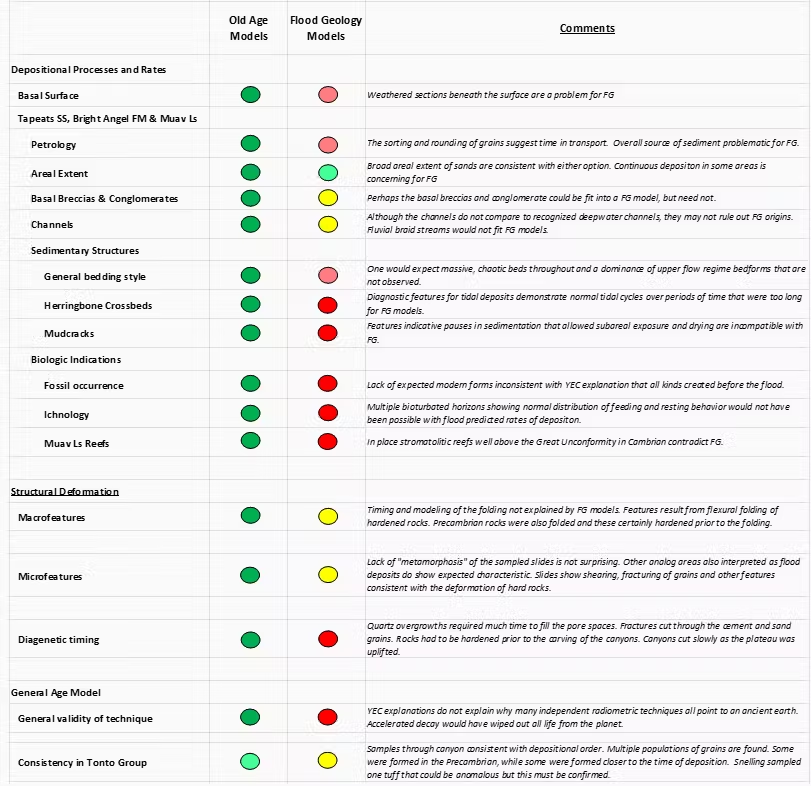
Fig. 1. Table comparing depositional processes and structural deformation features in the old-age and Flood-geology models, reproduced from Table 1 in Mitchell and Tillman, “Examining Young Earth Creation Claims.”
Some dots are light red or light green suggesting that there is overall agreement or disagreement, but they suggest some data have not been completely resolved.
Conveniently, all the dots in the “Old Age Models” column are green. Mitchell and Tillman comment:
Notice that the stoplight column for Old Earth is all green. That means that we interpret that all of the evidence can comfortably be interpreted within an Old Earth framework. This includes the data provided by the Snelling reports and all other published materials that we reviewed. Geologists have had different depositional models and structural understandings, but all involve far longer timeframes than available in the YEC timelines. Although ideas will continue to develop, there is no reason to believe that future models will alter in ways that call into question the general concept of deep time.31
Of course, all the dots in the “Old Age Models” are green because their “evidence” is actually observable data, for example, purported mud cracks that have already been interpreted as requiring long time periods. Thus, this table is hardly objective because the dots have been colored by these two committed uniformitarian Christian geologists according to the established interpretations of old-age uniformitarian geologists!
Not surprisingly, all the dots bar one in the “Flood Geology Models” column are either yellow, red, or light red. As Mitchell and Tillman comment:
Notice that the stoplight column for the Young Earth models includes largely reds and yellows. That means that we find many observations that are difficult or impossible to reconcile with the YEC models or with FG [Flood geology] in general. Dr. Snelling and other YEC authors must provide better explanations for many of the observations that we note in this table. We consider their explanations to be inadequate or invalid in most cases.32
What they call “observations” are their interpretations of the observable data.
Of course, they find my explanations inadequate or invalid, by definition, according to their predetermined old-age interpretations. In the above quotation, what they call “observations” are their interpretations of the observable data. For example, herringbone cross-beds are simply an observable sedimentation structure in the rock layers. The formation of those herringbone cross-beds was never witnessed, so any statement as to how they formed and how long it took is based on the observers’ interpretation. Thus, geologists like Mitchell and Tillman were already committed to the belief in the uniformity of natural processes through time before they studied photos and interpretations of these herringbone cross-beds in the conventional majority consensus uniformitarian (slow-and-gradual) geology literature. That is hardly objective science!
It is important to also point out here that in recent decades there has been a resurgence in neo-catastrophic thinking among conventional geologists. Although those geologists still believe in millions of years, their catastrophist interpretations of particular layers or formations strongly militate against millions of years, for which there is no evidence between the catastrophically (quickly) deposited layers.
Regarding the tactics of his fellow secular uniformitarian geologists, Derek Ager has written about their brainwashing:
Just as politicians rewrite human history, so geologists rewrite earth history. For a century and a half, the geological world has been dominated, one might even say brainwashed, by the gradualistic uniformitarianism of Charles Lyell. Any suggestion of “catastrophic” events has been rejected as old-fashioned, unscientific, and even laughable.33
Ager’s book documents many examples of formations traditionally interpreted as forming over millions of years, but Ager argued they were produced in weeks, days, or hours. For example, the Sutton Stone in Wales:
This has usually been interpreted as the basal conglomerate of a diachronous transgressive sea. It has been suggested, with very little fossil evidence, that this conglomerate spans three to five ammonite zones and therefore up to five million years in time. I think it was deposited in a matter of hours or minutes.34
Harvard’s noted evolutionary paleontologist Stephen Gould wrote,
Charles Lyell was a lawyer by profession, and his book [Principles of Geology, 1830–1833] is one of the most brilliant briefs ever published by an advocate. . . . Lyell relied upon true bits of cunning to establish his uniformitarian views as the only true geology. First, he set up a straw man to demolish. . . . In fact, the catastrophists were much more empirically minded than Lyell. The geologic record does seem to require catastrophes: rocks are fractured and contorted; whole faunas are wiped out. To circumvent this literal appearance, Lyell imposed his imagination upon the evidence.35
Gradualism was never “proved from the rocks” by Lyell and Darwin, but was rather imposed as a bias upon nature. . . . [It] has had a profoundly negative impact by stifling hypotheses and by closing the minds of a profession toward reasonable empirical alternatives to the dogma of gradualism. . . . Lyell won with rhetoric what he could not carry with data.36
The Areal Extent of the Tapeats Favors the Flood Model
We will discuss all of this green dot “evidence” for old-age models in more detail in my Part 2 and 3 articles in response to Mitchell and Tillman’s detailed critique in their Part 2 and 3 articles. However, let me discuss one of the listed features in the first column of their table under Depositional Processes and Rates that illustrates powerfully their bias and lack of full investigation, namely, the areal extent of the Tapeats Sandstone. They do not discuss this topic in any of their three articles, but this topic is the only green dot, albeit only light green, in the “Flood Geology Models” column. Yet when the observable areal extent of the Tapeats Sandstone and its equivalents are examined, it should be a red dot in the “Old Age Models” column and a fully green dot in the “Flood Geology Models” column.
Throughout the Grand Canyon below the Tapeats Sandstone is an erosion surface called the Great Unconformity, which Mitchell and Tillman briefly discuss in their Part 2 article. However, they never mention its areal extent, nor the areal extant of the Tapeats Sandstone and its equivalents. Even in the conventional uniformitarian literature, the Great Unconformity is documented as an almost global erosion surface.37 Then sitting on top of that Great Unconformity erosion surface is the Tapeats Sandstone and its equivalents, which can be traced in outcrops and drill holes right across North America across northern Africa into the Middle East (Fig. 2) and is also seen again in eastern China and South Korea.38
So with which model is the almost global extent of the Great Unconformity most consistent? And the areal extent of the Tapeats Sandstone and its equivalents across at least four continents? Old-age models focus on local and regional flooding events, but the global Flood cataclysm as described in God’s Word (Genesis 6–8) had a global reach when all the mountains under the whole of the heaven were covered by the floodwaters and all flesh (outside the ark) died. Thus, in the columns in Fig. 1, there should be a red dot against the “Old Age Models” and a fully green dot for the “Flood Geology Models.” Yet Mitchell and Tillman ignore all the documentation, even in the conventional uniformitarian literature that they approve and respect. They display their bias, despite the observational evidence, by scoring a green dot for the “Old Age Models” when it really should be a red dot.
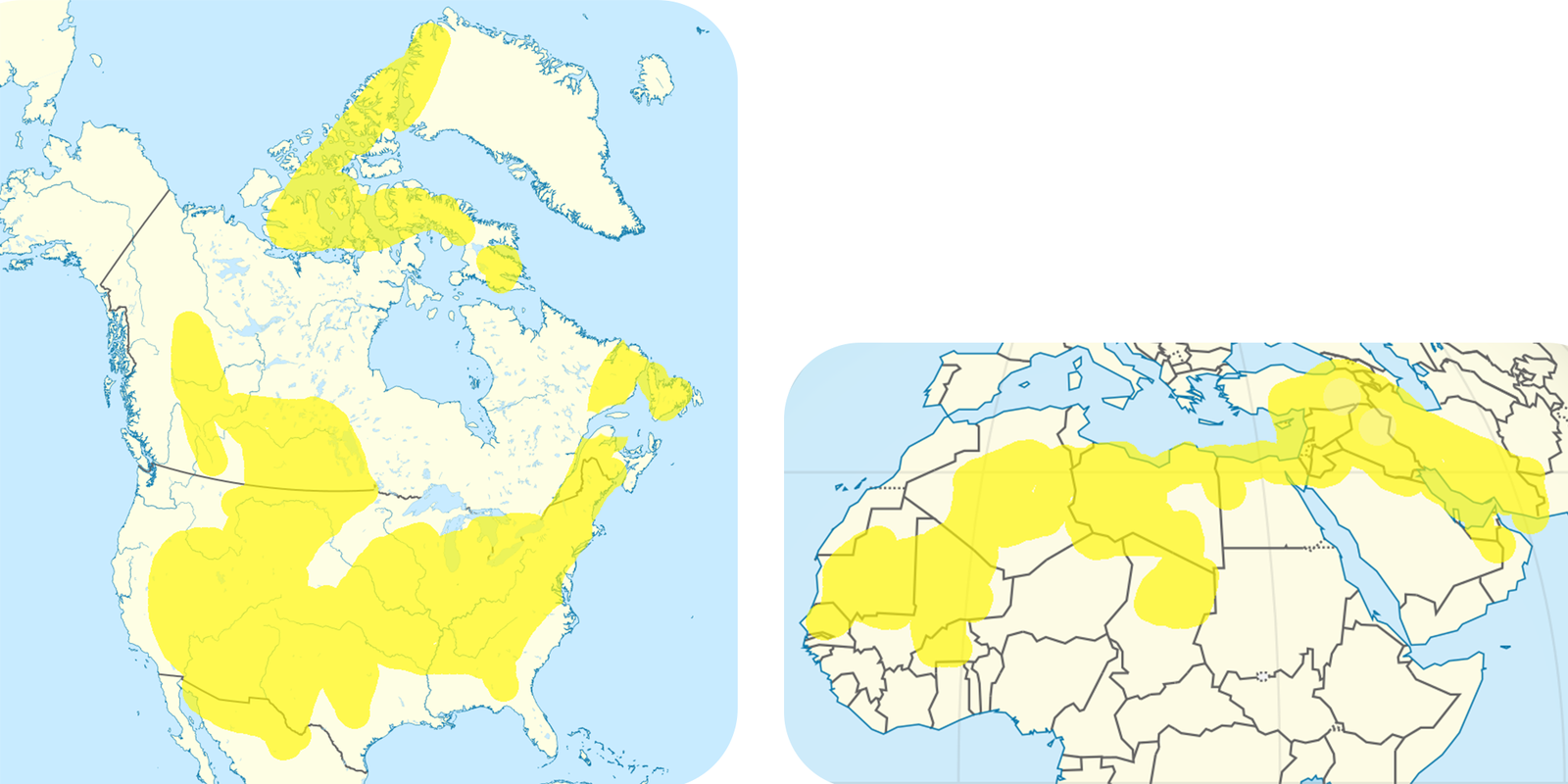
Fig. 2. The extent of the Tapeats Sandstone and its equivalents (rough outline) across North America and Africa to the Middle East as determined from both outcrops and drill holes (after Clarey 2020).
TUBS, CC BY-SA 3.0, via Wikimedia Commons (cropped and yellow outline added)
Can any of their assessments in their table reproduced in Fig. 1 therefore be trusted when a close examination of just one item on their long list demonstrates such obvious bias? We will examine more of these listed items that they discuss in detail in their Part 2 and 3 articles and respond resoundingly in defending the global Flood geology and young-earth model.
Four Crucial Questions
However, before concluding setting the stage in this Part 1 article, which is essentially what Mitchell and Tillman do in their Part 1 article, we should mention the list of their summarized claimed contradictions as questions they intend to answer. They state:
Contradictions with the geologic understanding developed for the formations of the Tonto Group can be summarized by the answers to the following four questions:
- How long did it take for the unit to be deposited? Thousands to millions of years vs. a few days.
- What depositional processes were dominantly involved? Fluvial and tidal processes vs. catastrophic Flood processes.
- How were the rocks deformed? Slow tectonic processes over millions of years vs. rapid soft sediment deformation over days.
- What is the general age model for when the rock was formed? ~500 million years ago vs. less than 10,000 years ago.39
They then go on to declare:
The differences between these two models are major and as a result, both cannot be true. One or the other is false. In this case, if any of these four questions can be demonstrated not to be reconcilable with FG [Flood geology], then YEC [young-earth creationists] should not consider these Cambrian units as “flood deposits” and it makes the entire YEC proposal questionable.40
We would agree, except we would declare that if any of these four questions can be demonstrated not to be reconcilable with old-age models, then old-earth geologists like Mitchell and Tillman should accept these Cambrian units are “Flood deposits,” and it makes the entire old-age proposal not simply questionable but rejectable!
Ironically, Mitchell and Tillman then indicate that they will not deal with question four here in these articles:
In this current report, we will address primarily the first three questions. We believe that the general age model developed using radiometric dating is sound, but we will leave that question for future reports.41
Exposing the Failure to Radiometric Date the Tapeats
However, they have thrown down the proverbial gauntlet that “if any of these four questions can be demonstrated not to be reconcilable” with old-age models, then it makes the “entire” old-age model “questionable.” So we will deal with question four now to definitively demonstrate that their belief in radiometric dating is on very shaky ground. In fact, I have already dealt with the answer to their question four in my three Answers Research Journal papers42 that they claim to have read. But let us unpack the details here for those who have not read those papers.
The recently established conventional age of the Tapeats Sandstone is ca. 507–508 Ma43 based on uranium-lead (U-Pb) dating of detrital zircons.44 Earlier studies also used the U-Pb dating of detrital zircons to establish the provenance (the source of the sand) of the Tapeats Sandstone.45 But the methodology they used raises numerous issues and questions about the reliability of the U-Pb dating method, one of the radiometric dating methods Mitchell and Tillman have faith in. Indeed, the underlying unprovable assumptions of all radiometric dating methods have been repeatedly documented.46
In the supplemental data of the recent study,47 all the U-Pb dating results of the analyzed detrital zircon grains were tabulated, plus all the U-Pb dating results of the detrital zircon grains analyzed by the earlier studies.48 From these data, a wide spectrum of U-Pb ages was obtained. The peaks in the data corresponded to the published ages of source rocks from which they concluded the zircon grains had likely been eroded. The age of the Tapeats Sandstone was then established from the spectrum of the lowest detrital zircon U-Pb ages. The statistically determined peak of the “bell-shaped” curve at 507–508 Ma was called the maximum depositional age.49
However, the supplemental data tables listed many of the detrital zircons as yielding U-Pb ages less than that 507–508 Ma age for the Tapeats Sandstone—at least 59 zircons from their Hermit Creek sample with the lowest U-Pb age of 407.2 Ma, at least 45 zircons from their Frenchman Mountain sample with the lowest U-Pb age of 481.8 Ma, and at least 51 zircons from their East Verde River sample with the lowest U-Pb age of 468.0 Ma. It is not explained how the supposedly 507–508 million years old Tapeats Sandstone could have included within it so many detrital zircons with U-Pb ages less than its supposed maximum depositional age, including one as “young” as only 407.2 million years old. Nor do they explain from where these “younger” detrital zircons within the Tapeats Sandstone originated. Indeed, how could even the 507–508 Ma detrital zircons be incorporated in the Tapeats Sandstone if the underlying rocks that were eroded to provide the sand grains, including the zircon grains, are older than 507–508 Ma? This question alone raises serious doubts as to the applicability and reliability of this technique for supposedly quantifying the apparent maximum depositional ages of these sedimentary rock units.
Exposing the Failures of Radiometric Dating
Details of numerous problems with the U-Pb dating method that are well-documented in the scientific literature have already been provided.
Not only is their methodology questionable, but the U-Pb dating method they used must also be if it produced such illogical ages. Details of numerous problems with the U-Pb dating method that are well-documented in the scientific literature have already been provided. 50 Furthermore, all the determinations of the U-Pb decay rates (half-lives) have been reviewed, and thus, it has been demonstrated that these crucial parameters are not yet precisely known.51 The problems of common Pb, U and Pb mobility, and mass fractionation that plague all efforts to obtain accurate U-Pb age determinations have also been highlighted in detail.52
Nevertheless, in the recent study,53 the authors championed the tandem U-Pb dating procedure they used, that is, LA-ICP-MS (laser-ablation–inductively coupled plasma–mass spectrometry) analyses followed by CA-ID-TIMS (chemical abrasion–isotope dilution–thermal ionization mass spectrometry) analyses. Although this procedure often produced apparently concordant U-Pb dates (essentially matching 206Pb-207Pb, 238U-206Pb, and 235U-207Pb ages), there were still many detrital zircon grains that yielded illogically younger ages than the supposed maximum depositional age of the Tapeats Sandstone. On the other hand, it had already been reported that CA-ID-TIMS analyses of three zircon grains recovered from a thin tuff bed within the Tapeats Sandstone in the western Grand Canyon had yielded concordant ages of 86.2 Ma, 98.2 Ma, and 90.1 Ma.54 Furthermore, single zircon grain fission-track ages of 75 Ma, 158 Ma, and 408 Ma were also obtained in the same study that are very much younger than the tandem U-Pb ages for deposition of the Tapeats Sandstone.55 Yet fission tracks are the physical evidence of the quantity of nuclear decay that has actually occurred. These considerations and highly inconsistent results from what is touted as a superior analytical procedure only highlight the unreliability and fallibility of the U-Pb dating method.
However, it might be argued by Mitchell and Tillman that the accepted radiometric ages of the various Grand Canyon strata, including the basement granites and schists, date those rocks and strata in the correct relative order, and consistently in hundreds of millions to almost two billion years, except for the recent lava flows in the western Grand Canyon.56 On the other hand, it has been demonstrated from six lines of evidence, supported by experimental results, that the reason for this systematic consistency of relative radiometric ages in the Grand Canyon stratigraphic sequence is because during some catastrophic event in the past, there was a systematic acceleration of nuclear decay rates, potentially by six orders of magnitude.57 Three of those six lines of evidence involved experimental results obtained on Grand Canyon samples, namely, discordant radiometric ages obtained from four Precambrian units (the Cardenas Basalt, the Bass Rapids diabase sill, the Elves Chasm Granodiorite, and the Brahma Schist amphibolites),58 coexisting uranium and polonium radiohalos59 and fission tracks in zircons.60 Critics of young-earth creation have pointed to the enormous quantities of heat that apparently would be released by such accelerated nuclear decay.61 Yet this criticism had already been anticipated by creation scientists, and plausible possible explanations were provided.62 Furthermore, the experimental fact that radiohalos only form below 150˚C63 indicates unequivocally that radiohalos would have been annealed if such an enormous heat release had occurred.64
Thus, there is sufficient overwhelming evidence, also documented in the scientific literature, to question the reliability, and even the validity, of the U-Pb dating method. This is highly evident from so many U-Pb dates for detrital zircons within the Tapeats Sandstone that are markedly younger than the claimed maximum depositional age of the sandstone. Thus, the faulty U-Pb dating of detrital zircons from the Tapeats Sandstone,65 coupled with the claimed biostratigraphic age of the Tapeats Sandstone, which is based on the claimed but unproven evolution of organisms through supposed deep time,66 is not an impediment to explaining the deposition of the Tapeats Sandstone in a much more recent catastrophic event less than 4,500 years ago, namely, the global Genesis Flood cataclysm. Indeed, God’s Word even provides the detailed short chronological framework for the earth’s history in which the global Flood cataclysm occurred.
This is contrary to Mitchell and Tillman’s faith in radiometric dating. Furthermore, Mitchell and Tillman essentially stated that if the answer to any of their four questions is not reconcilable with old-age models, then it makes the whole old-age proposal questionable. Thus, the demonstrated failure of radiometric dating, the answer to their question four, makes the whole old-age proposal not only questionable but a rejectable failure.
Summary and Conclusions
In their opening web article setting the stage for their supposed critique of the global Flood geology explanation for the deposition and deformation of the Tonto Group sedimentary layers in the Grand Canyon, Mitchell and Tillman have sadly displayed their worldview bias. They made it abundantly clear they have compromised a total commitment to God’s Word being “true from the beginning” (Psalm 119:160 KJV) to embrace the consensus uniformitarian worldview that is based on deliberately ignoring and rejecting God’s Word. Thus, they do not regard Genesis 6–8 as God’s eyewitness account (who never lies) of the Flood cataclysm being global, which is also affirmed by the testimony of the Creator, Jesus Christ, who is the truth.
Nowhere is their commitment to the conventional uniformitarian consensus of modern geology more evident than in their listing of the features of Tonto Group depositional processes and rates and Tonto deformation. They score old-age models as fully compatible with all those features and score the global-Flood geology model as incompatible with all, except partially with one. Yet that feature (the areal extent of the Tapeats Sandstone), when examined in detail, demonstrates that it is best explained by the global-Flood geology model and is incompatible with old-age models that are based on the assumption of only regional flooding over the course of deep time. Then finally, the answer to question four in their crucial list demolishes the radiometric dating methods they believe are accurate and, by their own admission, therefore, relegates old-age models to being not just questionable but rejectable failures.
Truth is never determined by majority vote of geologists who never witnessed the earth’s past history.
Truth is never determined by majority vote of geologists who never witnessed the earth’s past history. Yet Mitchell and Tillman expound in more detail their commitment to the uniformitarian interpretation of the features observed in the Tonto depositional processes and rates in their Part 2 web article to which we will turn our attention in detail in the next Part 2 response web article.
Answers in Depth
2025 Volume 20
Answers in Depth explores the biblical worldview in addressing modern scientific research, history, current events, popular media, theology, and much more.
Browse VolumeFootnotes
- Mitchell, Stephen, and Kennen Tillman, “Examining Young Earth Creation Claims About the Grand Canyon,” Peaceful Science, August 15, 2024, https://peacefulscience.org/articles/examining-yec-claims-tonto-group-cambrian-1/; Stephen Mitchell and Kennen Tillman, “Tonto Depositional Processes and Rates,” Peaceful Science, August 15, 2024, https://peacefulscience.org/articles/examining-yec-claims-tonto-group-cambrian-2/; Stephen Mitchell and Kennen Tillman, “The Tonto Deformation,” Peaceful Science, August 15, 2024, https://peacefulscience.org/articles/examining-yec-claims-tonto-group-cambrian-3/.
- Snelling, Andrew A., “The Petrology of the Tapeats Sandstone, Tonto Group, Grand Canyon, Arizona,” Answers Research Journal 14 (June 23, 2021): 159–254, https://answersresearchjournal.org/petrology-tapeats-sandstone-tonto-group; Andrew A. Snelling, “The Petrology of the Bright Angel Formation, Tonto Group, Grand Canyon, Arizona,” Answers Research Journal 14 (September 8, 2021): 303–415, https://answersresearchjournal.org/petrology-bright-angel-tonto-group; Andrew A. Snelling, “The Petrology of the Muav Formation, Tonto Group, Grand Canyon, Arizona,” Answers Research Journal 15 (August 10, 2022): 139–262, https://answersresearchjournal.org/geology/petrology-muav-formation-tonto-group.
- Wikipedia, “The Genealogical Adam and Eve,” last edited September 1, 2025, https://en.wikipedia.org/wiki/The_Genealogical_Adam_and_Eve.
- Swamidass, S. Joshua, The Genealogical Adam & Eve (Downers Grove, IL: InterVarsity Press, 2019), 10.
- Wikipedia, “Genealogical Adam and Eve.”
- Madueme, Hans, “Evolution and Historical Adam? A Provocative but Unconvincing Attempt,” The Gospel Coalition, March 2, 2020, https://www.thegospelcoalition.org/reviews/genealogical-adam-eve-swamidass.
- Since the death issue is so important, the following in-depth article defends Scripture on this point:
Terry Mortenson, “The Fall and the Problem of Millions of Years of Natural Evil,” Answers in Depth 7 (July 18, 2012): https://answersingenesis.org/theory-of-evolution/millions-of-years/the-fall-and-the-problem-of-millions-of-years-of-natural-evil/. - Wikipedia, “Genealogical Adam and Eve.” This 16-author, scholarly work thoroughly defends the view that Adam was the literal first man created by God: Terry Mortenson, ed., Searching for Adam: Genesis and the Truth About Man’s Origin (Green Forest, AR: Master Books, 2016).
- Peaceful Science, “Stephen Mitchell,” accessed October 15, 2025, https://peacefulscience.org/authors/stephen-mitchell/.
- Peaceful Science, “Kennen Tillman,” accessed October 15, 2025, https://peacefulscience.org/authors/kennen-tillman/.
- Snelling, Andrew A., Earth’s Catastrophic Past: Geology, Creation and the Flood (Santee, CA: Institute for Creation Research, 2009). Now republished as: Andrew A. Snelling, The Genesis Flood Revisited (Petersburg, KY: Answers in Genesis and Green Forest, AR: Master Books, 2022), https://answersingenesis.org/store/product/genesis-flood-revisited/.
- Clarey, Timothy , Carved in Stone: Geologic Evidence of the Worldwide Flood (Dallas, TX: Institute for Creation Research, 2020), https://store.icr.org/carved-in-stone.html.
- Hutton, James, “Theory of the Earth; or an Investigation of the Laws Observable in the Composition, Dissolution, and Restoration of Land upon the Globe,” Transactions of the Royal Society of Edinburgh 1, no. 2 (1788): 209–304, https://www.cambridge.org/core/journals/earth-and-environmental-science-transactions-of-royal-society-of-edinburgh/article/abs/x-theory-of-the-earth-or-an-investigation-of-the-laws-observable-in-the-composition-dissolution-and-restoration-of-land-upon-the-globe/3799DF5241B9C8488844184FD70AC764.
- Berry, William B. N., Growth of a Prehistoric Timescale Based on Organic Evolution (San Francisco: W. H. Freeman and Company, 1968), 20.
- Holmes, Arthur, Principles of Physical Geology, new and fully revised edition (London: Thomas Nelson, 1965), 142.
- Berry, Growth of a Prehistoric Timescale, 22–23.
- Mitchell, Stephen, A Texas-Sized Challenge to Young Earth Creation and Flood Geology: A Christian Geologist Looks for Answers (Meadville, PA: Christian Faith Publishing, Inc., 2018).
- Mitchell and Tillman, “Examining Young Earth Creation Claims.”
- Holmes, Principles of Physical Geology, 142.
- Berry, Growth of a Prehistoric Timescale; Terry Mortenson, “The Historical Development of the Geological Column,” in John K. Reed and Michael J. Oard, eds., The Geologic Column: Perspectives Within Diluvial Geology (Chino Valley, AZ: Creation Research Society, 2006), 7–30, https://answersingenesis.org/age-of-the-earth/the-history-of-the-development-of-the-geological-column/; Terry Mortenson, “Philosophical Naturalism and the Age of the Earth: Are They Related?,” Answers in Genesis, March 2, 2005, https://answersingenesis.org/age-of-the-earth/are-philosophical-naturalism-and-age-of-the-earth-related/.
- For a detailed biblical defense of the Flood cataclysm being global, see Snelling, The Genesis Flood Revisited, 25–60. For a shorter treatment, see Terry Mortenson, “Noah’s Flood: A Unique, Historical, Yearlong, Global Catastrophe,” Answers in Depth 13 (July 2, 2018): https://answersingenesis.org/the-flood/global/biblical-necessity-global-flood/.
- Mitchell, Texas-Sized Challenge to Young Earth Creation, 262.
- Austin, Steven A., John R. Baumgardner, D. Russell Humphreys, Andrew A. Snelling, Larry Vardiman, and Kurt P. Wise, “Catastrophic Plate Tectonics: A Global Flood Model of Earth History,” Proceedings of the Third International Conference on Creationism, ed. Robert E. Walsh (Pittsburgh: Creation Science Fellowship, 1994), 609–621, https://cedarville.tind.io/record/20925?v=pdf; John R. Baumgardner, “Catastrophic Plate Tectonics: The Physics Behind the Flood,” Proceedings of the Fifth International Conference on Creationism, ed. Robert L. Ivey, Jr. (Pittsburgh: Creation Science Fellowship, 2003), 113–126, https://cedarville.tind.io/record/20990?v=pdf.
- Mitchell and Tillman, “Examining Young Earth Creation Claims.”
- Mitchell and Tillman, “Examining Young Earth Creation Claims.”
- Mitchell and Tillman, “Examining Young Earth Creation Claims.”
- Mitchell and Tillman, “Examining Young Earth Creation Claims.”
- For example, Steven A. Austin, ed., Grand Canyon: Monument to Catastrophe (Santee, CA: Institute for Creation Research, 1994); Michael J. Oard and John K. Reed, eds., Rock Solid Answers: The Biblical Truth Behind 14 Geological Questions (Green Forest, AR: Master Books, 2009).
- Mitchell and Tillman, “Examining Young Earth Creation Claims.”
- Mitchell and Tillman, “Examining Young Earth Creation Claims.”
- Mitchell and Tillman, “Examining Young Earth Creation Claims.”
- Mitchell and Tillman, “Examining Young Earth Creation Claims.”
- Ager, Derek, The New Catastrophism (Cambridge, UK: Cambridge University Press, 1993), xi.
- Ager, The New Catastrophism, 120.
- Gould, Stephen Jay, “Catastrophes and Steady-State Earth,” Natural History 76, no. 2 (February 1975): 15–17.
- Gould, Stephen Jay, “Toward the Vindication of Punctuational Change,” in W. A. Berggren and J. A. Van Couvering, eds., Catastrophes and Earth History: The New Uniformitarianism (Princeton, NJ: Princeton University Press, 1984), 14–16.
- Peters, Shanan E., and Robert R. Gaines, “Formation of the ‘Great Unconformity’ as a Trigger for the Cambrian Explosion,” Nature 484, no. 7394 (April 18, 2012): 363–366, https://www.nature.com/articles/nature10969.
- Lindberg, F. Alan, ed., Correlation of Stratigraphic Units of North America (Tulsa, OK: American Association of Petroleum Geologists, 1988); Andrew A. Snelling, “Transcontinental Rock Layers: Flood Evidence Number Three,” Answers Magazine 3, no. 3 (2008): 80–83, https://answersingenesis.org/geology/rock-layers/transcontinental-rock-layers; D. Avigad, A. Sandler, K. Kolodner, R. J. Stern, M. McWilliams, N. Miller, and M. Beyth, “Mass-Production of Cambro–Ordovician Quartz-Rich Sandstone as a Consequence of Chemical Weathering of Pan-African Terranes: Environmental Implications,” Earth and Planetary Science Letters 240, nos. 3–4 (December 2005): 818–826, https://www.sciencedirect.com/science/article/abs/pii/S0012821X05005947; Andrew A. Snelling, “The Geology of Israel Within the Biblical Creation-Flood Framework of History: 2. The Flood Rocks,” Answers Research Journal 3 (2010): 267–309, http://www.answersingenesis.org/articles/arj/v3/n1/geology-of-israel-2; Clarey, Carved in Stone; J. Woo, H. S. Lee, S. K. Chough, “Deposition of Sandstone (Early Cambrian) Above the Great Unconformity in the Sino-Korean Block, Gondwana: Control of Antecedent Topography,” Gondwana Research 116 (April 2023): 212–228, https://www.sciencedirect.com/science/article/abs/pii/S1342937X22003422.
- Mitchell and Tillman, “Examining Young Earth Creation Claims.”
- Mitchell and Tillman, “Examining Young Earth Creation Claims.”
- Mitchell and Tillman, “Examining Young Earth Creation Claims.”
- Snelling, “Petrology of the Tapeats Sandstone,” 159–254; Snelling, “Petrology of the Bright Angel Formation,” 303–415; Snelling, “Petrology of the Muav Formation,” 139–262.
- “Ma” is an abbreviation for the Latin term megaannum, meaning million years.
- Karlstrom, Karl E., James W. Hagadorn, George E. Gehrels, William Matthews, Mark D. Schmitz, Lauren Madronich, Jacob Mulder, Mark Pecha, Dominique Giesler, and Laura J. Crossey, “Cambrian Sauk Transgression in the Grand Canyon Region Redefined by Detrital Zircons,” Nature Geoscience 11, no. 6 (June 2018): 438–443, https://www.nature.com/articles/s41561-018-0131-7; Karl E. Karlstrom, M. T. Mohr, Mark D. Schmitz, Frederick A. Sundberg, S. M. Rowland, Ronald C. Blakey, John R. Foster, Laura J. Crossey, Carol M. Dehler, and James W. Hagadorn, “Redefining the Tonto Group of Grand Canyon and Recalibrating the Cambrian Time Scale,” Geology 48, no. 5 (May 2020): 425–430, https://pubs.geoscienceworld.org/gsa/geology/article-abstract/48/5/425/581173/Redefining-the-Tonto-Group-of-Grand-Canyon-and?redirectedFrom=fulltext.
- Gehrels, George E., Ronald C. Blakey, Karl E. Karlstrom, J. Michael Timmons, William Dickinson, and Mark Pecha, “Detrital Zircon U-Pb Geochronology of Paleozoic Strata in the Grand Canyon, Arizona,” Lithosphere 3 (2011): 183–200, https://doi.org/10.1130/L121.1; William Matthews, Bernard Guest, and Lauren Madronich, “Latest Neoproterozoic to Cambrian Detrital Zircon Facies of Western Laurentia,” Geosphere 14 (2018): 243–264, https://doi.org/10.1130/GES01544.1.
- Snelling, Andrew A., “Radiometric Dating: Back to Basics,” Answers Magazine 4, no. 3 (2009): 72–75, https://answersingenesis.org/geology/radiometric-dating/radiometric-dating-back-to-basics; Andrew A. Snelling, “Radiometric Dating: Problems with the Assumptions,” Answers Magazine 4, no. 4 (2009): 70–73, https://answersingenesis.org/geology/radiometric-dating/radiometric-dating-problems-with-the-assumptions/; Andrew A. Snelling, “Radiometric Dating: Challenging an Icon of Evolutionary Geology,” in Michael J. Oard and John K. Reed, eds., Rock Solid Answers: The Biblical Truth Behind 14 Geological Questions (Green Forest, AR: Master Books, 2009), 185–206.
- Karlstrom, Hagadorn, Gehrels, Matthews, Schmitz, Madronich, Mulder, Pecha, Giesler, and Crossey, “Cambrian Sauk Transgression in the Grand Canyon Region,” 438–443.
- Gehrels, Blakey, Karlstrom, Timmons, Dickinson, and Pecha, “Detrital Zircon U-Pb Geochronology of Paleozoic Strata in the Grand Canyon,” 183–200; Matthews, Guest, and Madronich, “Latest Neoproterozoic to Cambrian Detrital Zircon Facies of Western Laurentia,” 243–264.
- Karlstrom, Hagadorn, Gehrels, Matthews, Schmitz, Madronich, Mulder, Pecha, Giesler, and Crossey, “Cambrian Sauk Transgression in the Grand Canyon Region,” 438–443; Karlstrom, Mohr, Schmitz, Sundberg, Rowland, Blakey, Foster, Crossey, Dehler, and Hagadorn, “Redefining the Tonto Group of Grand Canyon and Recalibrating the Cambrian Time Scale,” 425–430.
- Snelling, Andrew A., “Geochemical Processes in the Mantle and Crust,” in Larry Vardiman, Andrew A. Snelling, and Eugene F. Chaffin, eds., Radioisotopes and the Age of the Earth: A Young-Earth Creationist Research Initiative (El Cajon, CA: Institute for Creation Research and St. Joseph, MO: Creation Research Society, 2000), 123–304, https://www.icr.org/i/pdf/research/rate-all.pdf; Snelling, Genesis Flood Revisited.
- Snelling, Andrew A., “Determination of the Decay Constants and Half-Lives of Uranium-238 (238U) and Uranium-235 (235U), and the Implications for U-Pb and Pb-Pb Radioisotope Dating Methodologies,” Answers Research Journal 10 (2017): 1–38, https://answersresearchjournal.org/radioisotope-decay-uranium/.
- Snelling, Andrew A., “Problems with the U-Pb Radioisotope Dating Methods—1. Common Pb,” Answers Research Journal 10 (2017): 121–167, https://answersresearchjournal.org/problems-radioisotope-dating-u-pb-1; Andrew A. Snelling, “Problems with the U-Pb Radioisotope Dating Methods—2. U and Pb Mobility,” Answers Research Journal 11 (2018): 85–140, https://answersresearchjournal.org/problems-radioisotope-dating-u-pb-2; Andrew A. Snelling, “Problems with the U-Pb Radioisotope Dating Methods—3. Mass Fractionation,” Answers Research Journal 12 (2019): 355–392, https://answersresearchjournal.org/problems-radioisotope-dating-u-pb-3.
- Karlstrom, Hagadorn, Gehrels, Matthews, Schmitz, Madronich, Mulder, Pecha, Giesler, and Crossey, “Cambrian Sauk Transgression in the Grand Canyon Region Redefined by Detrital Zircons,” 438–443; Karlstrom, Mohr, Schmitz, Sundberg, Rowland, Blakey, Foster, Crossey, Dehler, and Hagadorn, “Redefining the Tonto Group of Grand Canyon and Recalibrating the Cambrian Time Scale,” 425–430.
- Snelling, Andrew A., “Fission Tracks in Zircons: Evidence for Abundant Nuclear Decay,” in Larry Vardiman, Andrew A. Snelling, and Eugene F. Chaffin, eds., Radioisotopes and the Age of the Earth: Results of a Young-Earth Creationist Research Initiative (El Cajon, CA: Institute for Creation Research and Chino Valley, AZ: Creation Research Society, 2005), 209–324, https://www.icr.org/article/fission-tracks-zircons-evidence-for.
- Karlstrom, Hagadorn, Gehrels, Matthews, Schmitz, Madronich, Mulder, Pecha, Giesler, and Crossey, “Cambrian Sauk Transgression in the Grand Canyon Region Redefined by Detrital Zircons,” 438–443; Karlstrom, Mohr, Schmitz, Sundberg, Rowland, Blakey, Foster, Crossey, Dehler, and Hagadorn, “Redefining the Tonto Group of Grand Canyon and Recalibrating the Cambrian Time Scale,” 425–430.
- Wiens, Roger, “So Just How Old Is That Rock?,” chapter 9 in Carol A. Hill, Gregg Davidson, Tim Helble, and Wayne Ranney, eds., The Grand Canyon, Monument to an Ancient Earth: Can Noah’s Flood Explain the Grand Canyon? (Grand Rapids, MI: Kregel Publications, 2016), 88–97, https://www.kregel.com/biblical-studies/the-grand-canyon-monument-to-an-ancient-earth/.
- Vardiman, Larry, Andrew A. Snelling, and Eugene F. Chaffin, eds., Radioisotopes and the Age of the Earth: Results of a Young-Earth Creationist Research Initiative (El Cajon, CA: Institute for Creation Research and Chino Valley, AZ: Creation Research Society, 2005), https://www.icr.org/rate2.
- Austin, Steven A., and Andrew A. Snelling, “Discordant Potassium-Argon Model and Isochron ‘Ages’ for Cardenas Basalt (Middle Proterozoic) and Associated Diabase of Eastern Grand Canyon, Arizona,” in Proceedings of the Fourth International Conference on Creationism, ed. Robert E. Walsh (Pittsburgh: Creation Science Fellowship, 1998), 35–51, https://cedarville.tind.io/record/20983?v=pdf;
Andrew A. Snelling, Steven A. Austin, and William A. Hoesch, “Radioisotopes in the Diabase Sill (Upper Precambrian) at Bass Rapids, Grand Canyon, Arizona: An Application and Test of the Isochron Dating Method,” in Proceedings of the Fifth International Conference on Creationism, ed. Robert L. Ivey, Jr. (Pittsburgh: Creation Science Fellowship, 2003), 269–284, https://cedarville.tind.io/record/21000?v=pdf;
Andrew A. Snelling, “Isochron Discordances and the Role of Mixing and Inheritance of Radioisotopes in the Mantle and Crust,” in Larry Vardiman, Andrew A. Snelling, and Eugene F. Chaffin, eds., Radioisotopes and the Age of the Earth: Results of a Young-Earth Creationist Research Initiative (El Cajon, CA: Institute for Creation Research and Chino Valley, AZ: Creation Research Society, 2005), 393–524, https://www.icr.org/article/isochron-discordances-role-inheritance; Andrew A. Snelling, “Significance of Highly Discordant Radioisotope Dates for Precambrian Amphibolites in Grand Canyon, USA,” in Proceedings of the Sixth International Conference on Creationism, ed. Andrew A. Snelling (Pittsburgh: Creation Science Fellowship and Dallas: Institute for Creation Research, 2008), 407–424, https://cedarville.tind.io/record/21060?v=pdf. - Snelling, Andrew A., “Radiohalos in Granites: Evidence of Accelerated Nuclear Decay,” in Larry Vardiman, Andrew A. Snelling, and Eugene F. Chaffin, eds., Radioisotopes and the Age of the Earth: Results of a Young-Earth Creationist Research Initiative (El Cajon, CA: Institute for Creation Research and Chino Valley, AZ: Creation Research Society, 2005), 101–207, https://www.icr.org/article/radiohalos-granites-evidence-for-accelerated.
- Snelling, “Fission Tracks in Zircons,” 209–324.
- Wiens, “How Old Is That Rock?,” 88–97.
- Vardiman, Snelling, and Chaffin, eds., Radioisotopes and the Age of the Earth.
- Laney, R., and A. W. Laughlin, “Natural Annealing of Pleochroic Haloes in Biotite Samples from Deep Drill Holes, Fenton Hill, New Mexico,” Geophysical Research Letters 8, no. 5 (May 1981): 501–504, https://agupubs.onlinelibrary.wiley.com/doi/10.1029/GL008i005p00501.
- Snelling, “Radiohalos in Granites,” 101–207.
- Karlstrom, Hagadorn, Gehrels, Matthews, Schmitz, Madronich, Mulder, Pecha, Giesler, and Crossey, “Cambrian Sauk Transgression in the Grand Canyon Region Redefined by Detrital Zircons,” 438–443; Karlstrom, Mohr, Schmitz, Sundberg, Rowland, Blakey, Foster, Crossey, Dehler, and Hagadorn, “Redefining the Tonto Group of Grand Canyon and Recalibrating the Cambrian Time Scale,” 425–430.
- Karlstrom, Mohr, Schmitz, Sundberg, Rowland, Blakey, Foster, Crossey, Dehler, and Hagadorn, “Redefining the Tonto Group of Grand Canyon and Recalibrating the Cambrian Time Scale,” 425–430; Frederick A. Sundberg, Karl E. Karlstrom, Gerd Geyer, John R. Foster, James W. Hagadorn, M. T. Mohr, Mark D. Schmitz, Carol M. Dehler, and Laura J. Crossey, “Asynchronous Trilobite Extinctions at the Early to Middle Cambrian Transition,” Geology 48, no. 5 (May 2018): 441–445, https://pubs.geoscienceworld.org/gsa/geology/article-abstract/48/5/441/581172/Asynchronous-trilobite-extinctions-at-the-early-to?redirectedFrom=fulltext.
Support the creation/gospel message by donating or getting involved!

Answers in Genesis is an apologetics ministry, dedicated to helping Christians defend their faith and proclaim the good news of Jesus Christ.
- Customer Service 800.778.3390
- Available Monday–Friday | 9 AM–5 PM ET
- © 2026 Answers in Genesis