

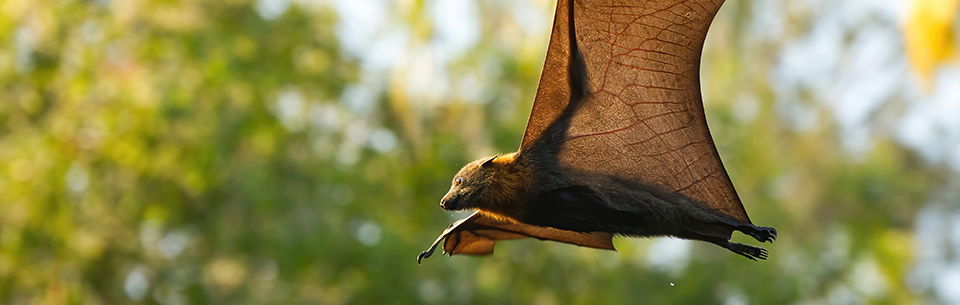
Andrew Mercer, CC BY-SA 4.0, via Wikimedia Commons
Does the Bible Blunder Biology?
Did the Lord Identify Bats As Birds?
In Leviticus 11, the Lord revealed to Moses and Aaron which animals the Israelites were permitted to eat and which animals were forbidden under the Mosaic law. Certain verses in this chapter seem to contain some basic biological blunders, such as the bat being called a bird. Skeptics have seized on these types of alleged errors in their efforts to undercut the doctrine of biblical inerrancy. Let’s take a closer look at this supposed problem to see why this passage is not in error.
And these you shall detest among the birds; they shall not be eaten; they are detestable: the eagle, the bearded vulture, the black vulture, the kite, the falcon of any kind, every raven of any kind, the ostrich, the nighthawk, the sea gull, the hawk of any kind, the little owl, the cormorant, the short-eared owl, the barn owl, the tawny owl, the carrion vulture, the stork, the heron of any kind, the hoopoe, and the bat. (Leviticus 11:13–19)
As soon as you reached the last word in that paragraph, you probably noticed the supposed problem. Did God’s Word really identify bats as birds? The short answer is “No, God did not identify bats as birds” (at least not as we typically think of them). Yes, it does look like it, but we need to dig a little deeper, and when we do, we’ll see that there is not a mistake here. Furthermore, even if it did identify bats as birds, it still wouldn’t necessarily be an error. This article will explore both of those points and another one that arises from a deeper look at this text.
Birds or Fliers?
This passage in Leviticus is about which flying creatures the Israelites were prohibited from eating.
First, the word translated as bird is the Hebrew noun עוֹף (ʿôp̱, pronounced like “oaf”). Hebrew nouns are usually derived from verbs,1 and this case is not an exception since the verb meaning “to fly” is עוף. Because of this, Hebrew nouns often describe functionality rather than providing a physical description, although they occasionally do that, too, as we’ll see. This passage in Leviticus is about which flying creatures the Israelites were prohibited from eating. While birds are usually the first thing that comes to mind when we think of flying creatures, not all birds fly and there are other creatures that do fly. Since the bat is also a flying creature, it is included in the list. In fact, by putting it at the end of the list, the biblical writer may well be signifying that he recognized that they were somewhat different than the other creatures on the list.
Do Ostriches Fly?
This explanation raises another issue. How can this be about flying creatures when verse 16 mentions the ostrich, a flightless bird? It’s important to remember the difficulty in identifying certain plants and animals mentioned in Scripture. The original audience would have been familiar with the terminology, but there are instances where interpreters must make educated guesses as to the identity of a particular plant or animal.2 This is especially true when the term is rare and when its description is lacking.
The term translated as ostrich in verse 16 is bat ha ya‘anah (literally, “daughter of greed/wilderness”).3 Numerous Bible translations identify this creature as some sort of owl, such as the horned owl (NIV, NCV), eagle owl (NASB95, NET, NLT), or just a plain owl (KJV). Translations like these fit the context better than the ESV’s “ostrich,” since the creatures in the immediate context are raptors and other types of owls. Identifying this creature as a type of owl is also consistent with the use of ʿôp̱ for flying creatures. Further support that an ostrich is likely not in view in Leviticus 11:16 is found in Job 39:13–18 where God devotes several verses to describe the ostrich, and here, the Bible uses a different term: רְנָנִ֥ים (renanim).
To summarize so far, the term translated as birds in this passage refers to flying creatures, which could include bats and even flying reptiles, if any of them still existed in Moses’ day, but it would not include flightless birds. And the word translated as “ostrich” is probably better translated as an owl or something similar. Therefore, the Bible does not identify bats as birds, and this settles the issue, right? Well, the issue is still a little more complicated because of Deuteronomy 14:11–18. In this passage, Moses renewed the covenant between God and Israel before they entered the land God promised them. It is nearly identical to the earlier passage in Leviticus, differing in their introductory statements and the ordering of some of the names.
You may eat all clean birds. But these are the ones that you shall not eat: the eagle, the bearded vulture, the black vulture, the kite, the falcon of any kind; every raven of any kind; the ostrich, the nighthawk, the sea gull, the hawk of any kind; the little owl and the short-eared owl, the barn owl and the tawny owl, the carrion vulture and the cormorant, the stork, the heron of any kind; the hoopoe and the bat. (Deuteronomy 14:11–18)
The issue regarding the “ostrich” can be answered just like before since the same term is used in both passages. However, the reason this passage complicates the matter described earlier is that the word for bird is different. Instead of ʿôp̱, Moses used the term צִפּוֹר (tsippor). This term is often used in a generic sense to indicate birds and can often be used interchangeably with ʿôp̱. While ʿôp̱ emphasizes the activity of the creature as a flier, tsippor is sometimes paired with the noun כָּנָף (kanaph), often translated as “winged” so it may refer to the creature’s anatomy or appearance. Note that English translations often render these terms as an adjective followed by a noun (tsippor kanaph, “winged bird” in Genesis 7:14), but in Hebrew, both terms are nouns. Thus, our English translations often give the wrong impression here. Genesis 7:14 is not referring to every “winged bird” but to every “flier” that is also a “winged creature.” Again, this would include fliers that are not birds and would likely exclude flightless birds, such as the penguins and the ancestors of ostriches.4 While ʿôp̱ and tsippor often refer to the same group of creatures, it’s possible that ʿôp̱ emphasizes the creature’s activity (i.e., flying) while tsippor may emphasize that it has wings.
Different Taxonomies
Let’s return to this article’s original question: Did the Bible identify bats as birds? Technically, no, the Bible mentioned bats in the context of other flying and winged creatures. For the sake of argument, let’s assume that “bird” is a good translation of ʿôp̱ or tsippor, which would mean that Leviticus or Deuteronomy lumped bats in with birds. This still would not be an error because the Bible uses a different taxonomy than what is commonly used today, which is different than what was used only a few decades ago. This shouldn’t be a surprise because taxonomies often change. We disagree with the secular scientists, who in recent years have reclassified birds (class Aves) as dinosaurs. Evolutionists used to claim that humans never lived at the same time as dinosaurs, but now, they say that we have always lived with them because birds are dinosaurs. Would these same skeptics who accuse the Bible of being in error about bats and birds also claim that older evolutionary biology textbooks were in error when they did not include birds under dinosaurs? Of course not. They would recognize that those textbooks were using the classification system of their day. Similarly, the Bible should not be expected to utilize modern taxonomies.
To illustrate the Bible’s different taxonomy, we only need to look at the famous account of Jonah and the great fish. Jonah 1:17 mentions this creature and uses Hebrew terms (gādol dāg) that are accurately translated as “great fish.” But in the New Testament, Matthew records Jesus as saying that Jonah was swallowed by a kētos, from which came the Latin term cetus. Both of these terms refer to whales, which belong to the order Cetacea.
The Bible uses a different classification system than we do today, and this is basic common sense.
Hold on, a whale isn’t a fish, so the Bible is wrong here, too, isn’t it? No, the Bible uses a different classification system than we do today, and this is basic common sense. The biblical writers were not attempting to classify animals according to an eighteenth-century system developed by Carl Linnaeus. The way that they grouped the animals was in accordance with the needs and purposes of the original readers of Scripture. The biblical writers apparently were not interested in noting the differences between whales, sharks, fish, and other sea creatures. If it swam in the sea, lake, or river, it was a dāg (fish). If it flew in the air and was not an insect (“creeping thing” in Deuteronomy 14:19 NKJV), then it was a flier or a winged creature, which usually refers to a bird, but it could also be a bat or flying reptile.
The Bible does not set out to fully define and describe birds, fish, or mammals. As we have said at Answers in Genesis many times, the Bible is not a scientific textbook, but in areas where it interacts with science, it is accurate (as it is in every other area). The Bible provides some details about some of these creatures, and it tells us when the Lord made them. The flying creatures and swimming creatures (not simply the birds and fish in our modern taxonomy, respectively) were created on day five. The land animals were made on day six. Thus, if the original ancestors of ostriches never flew, they were probably created on day six because it seems as though the Bible would group them with land animals.
One might object to this notion because Genesis 1:21 states in reference to day five that God made “every winged bird according to its kind.” However, this is very similar to what we saw in Genesis 7:14 where the Hebrew text does not specify “birds.” Instead, it uses two nouns (ʿôp̱ and kanaph) that might best be translated as “flier” and “winged creature.” The text says nothing about feathers here or anything else that might limit this description only to birds or that would encompass all birds. It simply refers to God creating animals that had wings and could fly. Thus, bats, Pteranodons, and most birds would be included here, but flightless birds (assuming they were originally flightless) would likely have been made the following day.5
Conclusion
We need to be careful to avoid reading our own ideas into the text, and we must allow the Bible to speak for itself. This can be difficult when our translations don’t perfectly represent the original Hebrew or Greek in every respect. We also must remember that translators sometimes resort to educated guesses about a creature’s identity. The biblical authors were writing in a way that their original audience could understand—they were not thinking about how people thousands of years later might classify certain animals.
When we keep these things in mind, it is obvious that there is no contradiction in the biblical text. Yes, there are times when it is at odds with modern taxonomies, but this is not a contradiction—it is to be expected given that the Bible’s classification system is different than modern taxonomies. Furthermore, the Bible is internally consistent on these issues, so there is no contradiction here.
Answers in Depth
2025 Volume 20

Answers in Depth explores the biblical worldview in addressing modern scientific research, history, current events, popular media, theology, and much more.
Browse VolumeFootnotes
- Pappas, John, Biblical Hebrew: Basic Grammar of the Hebrew Old Testament, https://biblegreekvpod.com/Hebrew/Bible_Hebrew_vpod.pdf, 20.
- In November 2024, we opened the Plants of the Bible Conservatory at the Creation Museum. We have several signs in the conservatory explaining the difficulty of identifying particular biblical plants. The following list gives three reasons why this task can be so challenging: 1) The names of plants have changed over the years, making it difficult to identify which were the original plant mentioned in the Bible. This is especially true if the Bible does not describe what the plant or tree was like (e.g., gopher wood in Genesis 6:14). 2) Different plant species are sometimes called by the same name, so the plant mentioned in the Bible may refer to a variety of species. 3) Several plants have local names that are used in the Bible but do not match their more common names.
- Swanson, James, Dictionary of Biblical Languages with Semantic Domains: Hebrew (Old Testament), electronic ed. (Oak Harbor: Logos Research Systems, Inc.), §3613.
- All living members and fossils discovered so far of the family Struthionidae, to which the ostrich belongs, are or were clearly incapable of flight.
- While it is highly unlikely that members of the penguin kind ever flew, it is possible that they were still made on day five if they were among the marine creatures God made. After all, they spend most of their time in the water. However, if they are technically land animals, then they would likely have been made on day six.
Support the creation/gospel message by donating or getting involved!

Answers in Genesis is an apologetics ministry, dedicated to helping Christians defend their faith and proclaim the good news of Jesus Christ.
- Customer Service 800.778.3390
- Available Monday–Friday | 9 AM–5 PM ET
- © 2026 Answers in Genesis