

Why Were Ice Age Animals like Mammoths So Big?
You’re standing in a creek valley—broad and marshy. The morning air is chilly yet stagnant. What is that stench? That frothy pool nearby must be a mineral sulfur spring.
Branches snap in the tree line. A lumbering wall of gray hide emerges from the woods to your right.
It’s a Columbian mammoth, and it’s walking directly toward you. Your heart hammers in your chest. Don’t run. Don’t even move.
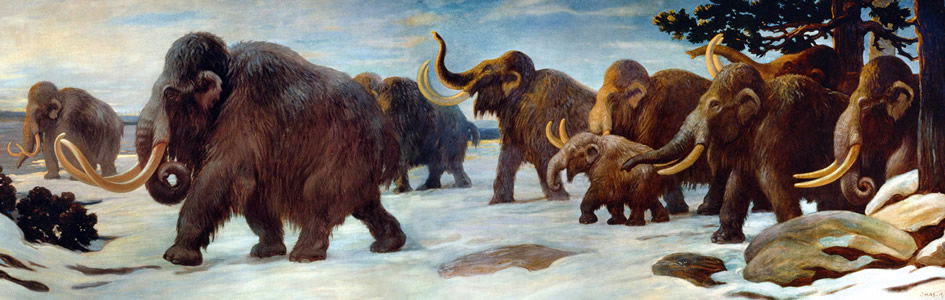
Stretching its trunk to the banks of the smelly pond, the beast scoops up a clump of briny mud and swallows it whole. A low, rolling bellow rattles your ribs. But what keeps your breath short and your mouth dry is its sheer scale. Your eyes drift skyward. This is no ordinary elephant—its shoulders tower more than twice your height.
Welcome to Northern Kentucky near the end of the Ice Age. The edge of the continental ice sheet lies 30 miles to your north. Yet as you scan this mosaic of open woodland and grassland, you notice something striking: Mammoths aren’t the only titans to roam these hills. Stag-moose, giant ground sloths, and American mastodons all share this landscape.
Why were they so gigantic?
I Thought You’d Be Taller
If you look closer, a curious pattern emerges: Many of the creatures sharing this valley aren’t gigantic at all. The elk, black bears, and caribou browsing nearby resemble their modern counterparts. Meanwhile, on an island off the California coast, dwarf mammoths stand barely shoulder-high to a human—descendants of the very same Columbian mammoth species looming over the mud pit.
You may have heard the term Ice Age megafauna. While the phrase is often used informally for the largest animals of Pleistocene sediments, megafauna has a broader technical meaning. It generally refers to animals weighing more than 99 pounds (45 kg). By that definition, a white-tailed deer qualifies. But that isn’t what comes to mind when we imagine the Ice Age.
So the core question isn’t, “Why did every Ice Age animal become enormous?” but, “Why did extreme body size flourish in specific lineages, while others remained unchanged or even shrank?”
Whatever was driving these biological changes, it clearly wasn’t a simple formula of "Animal"+"Cold"="Giant".
A World of Opportunity
To understand the possibilities, we should look a little further back.
After the warm waters of the Flood receded from the land, pioneer seedlings dotted the landscape and eventually matured into lush forests. Tectonic and volcanic activity continued to thermally charge the seas while atmospheric aerosols blocked solar radiation over the landmasses. High evaporation rates combined with cooling continents produced massive snowfall across high latitudes and elevations. With mild summers failing to melt the winter accumulation, snow compacted into continental ice sheets. As vast volumes of water became locked in ice, global sea levels dropped.
Yet the Ice Age world was far from a uniform, frozen wasteland. Near glacier margins, some regions supported tundras and parklands. Elsewhere around the globe, environments looked very different:
- South America: Giant ground sloths, giant armadillos, and other enormous herbivores (such as toxodonts) roamed expansive, semiarid pampas rather than snowdrifts.
- North Africa: Regions that are tropical savannas today were hyperarid scrublands and dune fields inhabited by desert-adapted gazelles and hyenas.
- Sundaland: Lowered sea levels exposed land bridges connecting parts of Southeast Asia. There, Asian elephants, tigers, and orangutans thrived in warm, humid rainforests, open habitats, and wetlands.
In other words, “Ice Age” describes a climatic period, not a single type of landscape. What many of these environments shared were abundant resources, open habitats, and changing ecological conditions.
When Bigger Is Better
So what are the potential advantages of being large? Depending on the animal and its environment, large body size can provide distinct biological payoffs:
- Energetic Efficiency: While a large animal requires more total food than a small one, it generally uses less energy per unit of body mass. For some large herbivores, greater digestive capacity also makes abundant, fibrous vegetation a workable food source.
- Thermoregulation: As an animal grows, its internal volume increases faster than its outer surface area. A lower surface-area-to-volume ratio slows heat loss—an advantage in cold climates.
- Predator Defense: Reaching colossal adult proportions is one of the most effective defenses against predation.
- Locomotive Range: Large size and longer limbs help animals travel efficiently across long distances between seasonal feeding grounds and water sources.
- Life History and Mating Competition: Larger body size often accompanies later maturity and longer lifespans, conferring competitive advantages in securing mates.
These are real potential advantages, but they don’t mean that animals must become larger. They simply help explain why, under the right ecological conditions, larger body size is favorable.
However, large size also carries costs. In warmer conditions, a body that loses heat slowly risks overheating. An animal that can process coarse vegetation still needs vast quantities of it. And a giant that is difficult to kill takes years to reach that protective size threshold.
So why were large animals so prominent in many Ice Age ecosystems?
Two Rules—and Their Limits
Biologists have historically pointed to two classical patterns: Cope’s Rule and Bergmann’s Rule. Neither provides a complete answer.
- Cope’s Rule notes that animal lineages often trend larger over time. However, it is an observation, not a driving mechanism, and it does not apply to every lineage. An apparent trend toward larger size can also arise because small ancestors have more room to diversify upward than downward—a phenomenon known as a “left-wall constraint.”
- Bergmann’s Rule describes a tendency for larger body size to occur in colder environments, either among populations of a single species or among closely related species. Heat retention offers one explanation, but the rule cannot account for all Ice Age giants. Large ground sloths, armadillos, and toxodonts flourished in warm, subtropical regions.
Notice that these two rules address different patterns: Cope’s rule concerns change through time, while Bergmann’s rule concerns body size relative to climate. Neither, by itself, establishes when a lineage became large or explains why so many large-bodied animals occupied particular Ice Age ecosystems.
Kind of a Big Deal
There is another question to consider: What if mammoths, giant ground sloths, and giant armadillos didn’t become large? What if they were created large at the beginning?
Also, doesn’t suggesting that new species developed mean acceptance of evolution? Not at all.
Modern creation biologists do not believe that the organisms God created at the beginning, around 6,000 years ago, were all the same species that exist today—a concept known as “species fixity.” Instead, they propose that created kinds (baramins) possess substantial genetic and developmental potential for diversification (intrabaraminic diversification) on a much faster timescale (obviously not millions of years).
This differs fundamentally from the mainstream evolutionary view that all living organisms share a last universal common ancestor across deep time.
Both frameworks recognize biological relationships: mammoths belong to the elephant lineage, ground sloths are related to other sloths, and glyptodonts group with the fairy armadillos. The disagreement concerns how those relationships arose and how far back their ancestry extends.
A Perfect Storm
Instead of searching for a single universal mechanism, Ice Age gigantism is probably best understood as the result of numerous factors acting together.
Several ecological studies have observed that rapid biological diversification (adaptive radiation) occurs when multiple factors align, including:
Ice Age gigantism is probably best understood as the result of numerous factors acting together.
- Newly available resources
- Expansion into novel, unpopulated landmasses
- An absence or low density of established competitors
In the post-Flood era, these ecological opportunities initially existed on a global scale. As land bridges opened and plant communities reestablished, animals expanded into empty continents. In lineages where large body size offered competitive, thermal, or locomotive advantages, selective pressures rapidly favored giant variants. Elsewhere, isolated habitats with limited resources favored smaller forms.
God did not need to create these creatures in their giant forms. Instead, He engineered created kinds with a limited ability to adapt, flourish, and scale to meet the demands of a changing world.
The Harder They Fall
Unfortunately, gigantism comes with heavy ecological costs: higher total food requirements, lower population densities, and slower reproduction rates.
As the mechanisms that drove the Ice Age subsided, glaciers melted, sea levels rose, and land connections vanished. Weather patterns shifted and plant communities transformed. In some regions, large mammal losses coincided with expanding human populations. Animals adapted to specific post-Flood conditions may have been unable to keep pace with new environmental shifts. As the “perfect storm” that fueled their rise disappeared, so did many of the giants.
Back in the Valley
Standing once more in that quiet Kentucky creek valley, the towering silhouette of the mammoth drifts back into the tree line.
Its size presents no simple cold-weather formula. It points instead to a magnificent display of divine engineering, ecological opportunities, and biological trade-offs in a recovering world.



Support the creation/gospel message by donating or getting involved!

Answers in Genesis is an apologetics ministry, dedicated to helping Christians defend their faith and proclaim the good news of Jesus Christ.
- Customer Service 800.778.3390
- Available Monday–Friday | 9 AM–5 PM ET
- © 2026 Answers in Genesis