


What’s the Truth About Radiocarbon Dating and the Ages of Fossils?
Part 3—Dinosaur Blood and the Age of the Earth: A Futile, Deceitful Attempt to Critique Valid, Powerful Young-Earth Evidence
In Part 2 of our response to Reasons to Believe’s old-earth creationist book Dinosaur Blood and the Age of the Earth, we refuted Dr. Fazale Rana’s claim that radiometric dating is reliable. But Dr. Rana goes on to discuss the reliability and limitations of radiocarbon (carbon-14) dating specifically because it too has become contentious, given the measured significant amounts of carbon-14 in fossils supposed to be millions of years old, including fossils in which soft tissues have been found. He first discusses how radiocarbon dating works because it is different from the long-age radiometric methods:
Cosmic radiation impinging upon Earth’s atmosphere continually produces the radioactive form of carbon by converting nitrogen-14 into carbon-14. As a result, carbon dioxide in Earth’s atmosphere consists of a small amount of carbon-14, with the ratio of radioactive carbon to the stable isotopes of carbon (carbon-12 and carbon-13) being roughly constant. The carbon-14 in carbon dioxide makes its way into living organisms, primarily through photosynthesis. During this process, plants convert water and carbon dioxide into carbohydrates. In this way, radioactive carbon becomes incorporated into plants. When animals consume plants, they, too, wind up with carbon-14 becoming incorporated into their tissues. Plants and animals possess a characteristic amount of carbon-14. When an organism dies, it stops taking up carbon-14. Because of radioactive decay, carbon-14 begins to disappear from the organism’s remains. The time of the organism’s death is the start of the carbon-14 radiometric clock. Researchers know the approximate initial amount of carbon-14 in organisms because of calibration curves prepared from tree rings and sedimentary varves. The half-life of carbon-14 is about 5,700 years [5,730 years], meaning that after about 50,000 years most of the measurable carbon-14 disappears from the organism’s remains. Carbon-14 dating is used to determine the age of animal and plant remains (bone and wood), but it also can be used to age-date materials made from once-living organisms such as cloth and paper.1
Embedded in this otherwise accurate description of how the radiocarbon dating method works is the claim by Dr. Rana that “researchers know the approximate initial amount of carbon-14 in organisms because of calibration curves prepared from tree rings and sedimentary varves.” But how were these calibration curves derived?
Carbon-14, Tree Rings, and Varves
As well documented in the conventional literature, uniformitarian practitioners assume that generally only one tree ring grows per year, consisting of winter and summer growth, and one varve couplet is deposited per year, consisting of winter and summer deposition. That assumption automatically rules out the formation of multiple tree rings and varves in a year due to storms or unseasonable wet periods, even though such periods are well known in recorded and recent history to produce multiple tree rings and varves. If the tree ring and varve dates are unreliable, then so are the carbon-14 dates that are calibrated on those erroneous (exaggerated) dates.
Yet Dr. Rana claims:
Scientists have also validated carbon-14 dating. For example, researchers have measured the carbon-14 dates for samples taken from the center of tree rings of bristlecone pines found near the California-Nevada border. These trees can live up to 6,000 years in age. By looking for overlapping tree rings in living and dead trees, scientists can generate a continuous record of tree rings all the way back to 11,800 years ago. Therefore the amount of carbon-14 in a sample of unknown age is compared to carbon-14 in the bristlecone pine tree rings to determine a calendar age in years ago when the animal lived, or charcoal was used from trees.2
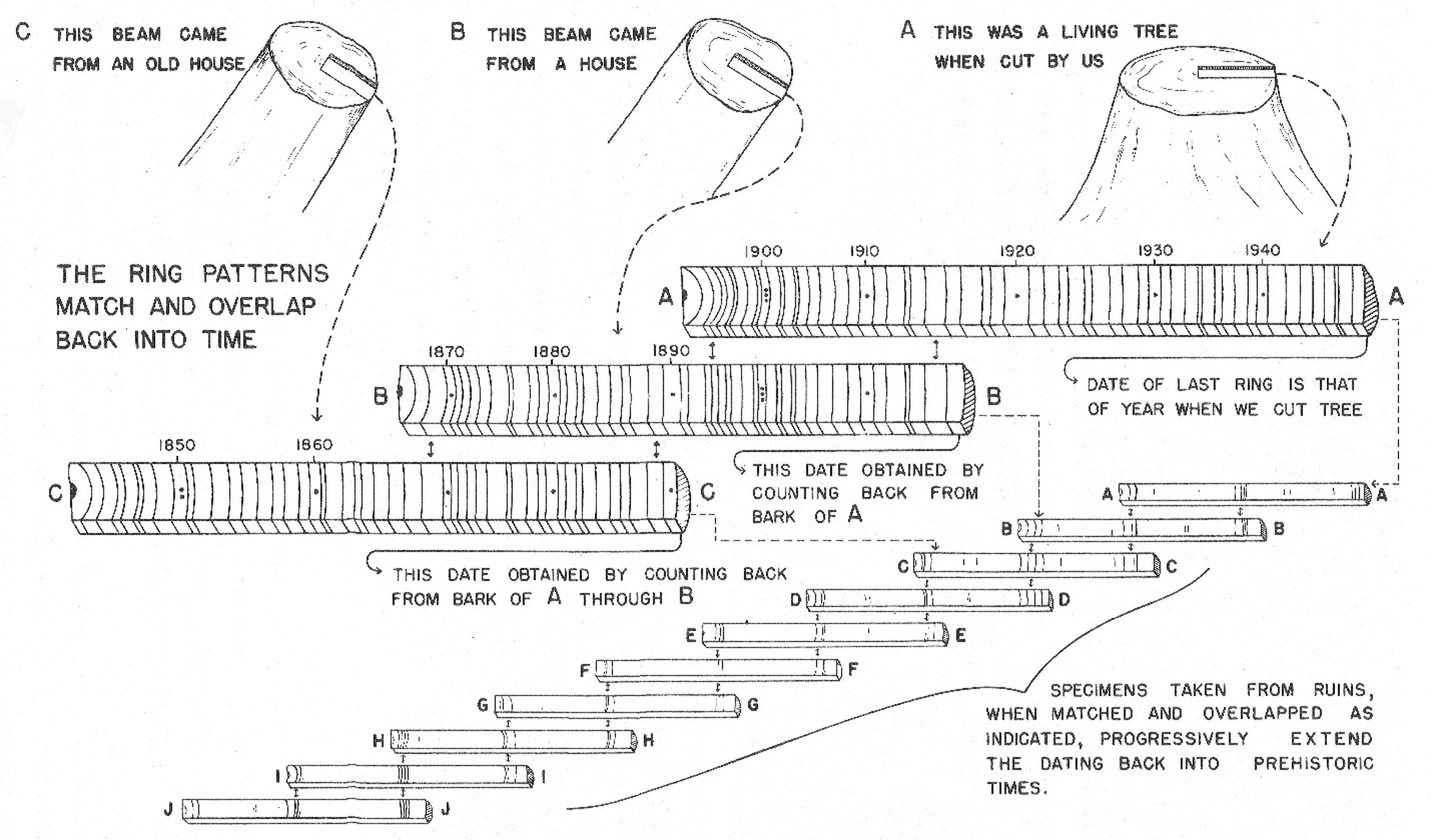
Figure 1. The construction of a tree-ring chronology from living trees and historically documented wooden beams. Note that the matching of patterns of tree rings is done visually, which while often obvious is still subjective.
So to construct a tree-ring chronology, the evolutionists utilized the tree rings in living trees and historically documented wooden beams (Figure 1). But to go further back in time, they used the tree rings in dead sub-fossiliferous trees (for example, in swamps). And the reality is that, contrary to Dr. Rana’s claim, while the living bristlecone pines are up to 6,000 years old, most of the tree-ring chronology has been constructed using dead trees (Figure 2).3 However, in the crossmatching procedure that Dr. Rana fails to explain and acknowledge, to check whether a ring pattern in the dead tree fits with the apparent matching section in the tree-ring chronology, the chosen rings in the dead tree are radiocarbon-dated.4 When the rings of the dead tree are thus added to extend the tree-ring chronology, that tree-ring chronology is then used, as stated by Dr. Rana, as a calibration curve for radiocarbon dating! That is classical circular reasoning, namely, radiocarbon dating the rings to add them to their “correct” place in tree-ring chronology, then use that tree-ring chronology to calibrate radiocarbon dating! Similar circular reasoning has occurred in the construction of the varve chronology, whereby varves are radiocarbon dated to position them in the varve chronology, which is then used to calibrate radiocarbon dating! All these issues have been thoroughly discussed and well-documented.5 They render the tree-ring and varve chronologies biased, overinflated, and thus useless for obtaining true calendar ages and for knowing the initial approximate amount of carbon-14 in organisms, contrary to the claim by Dr. Rana.
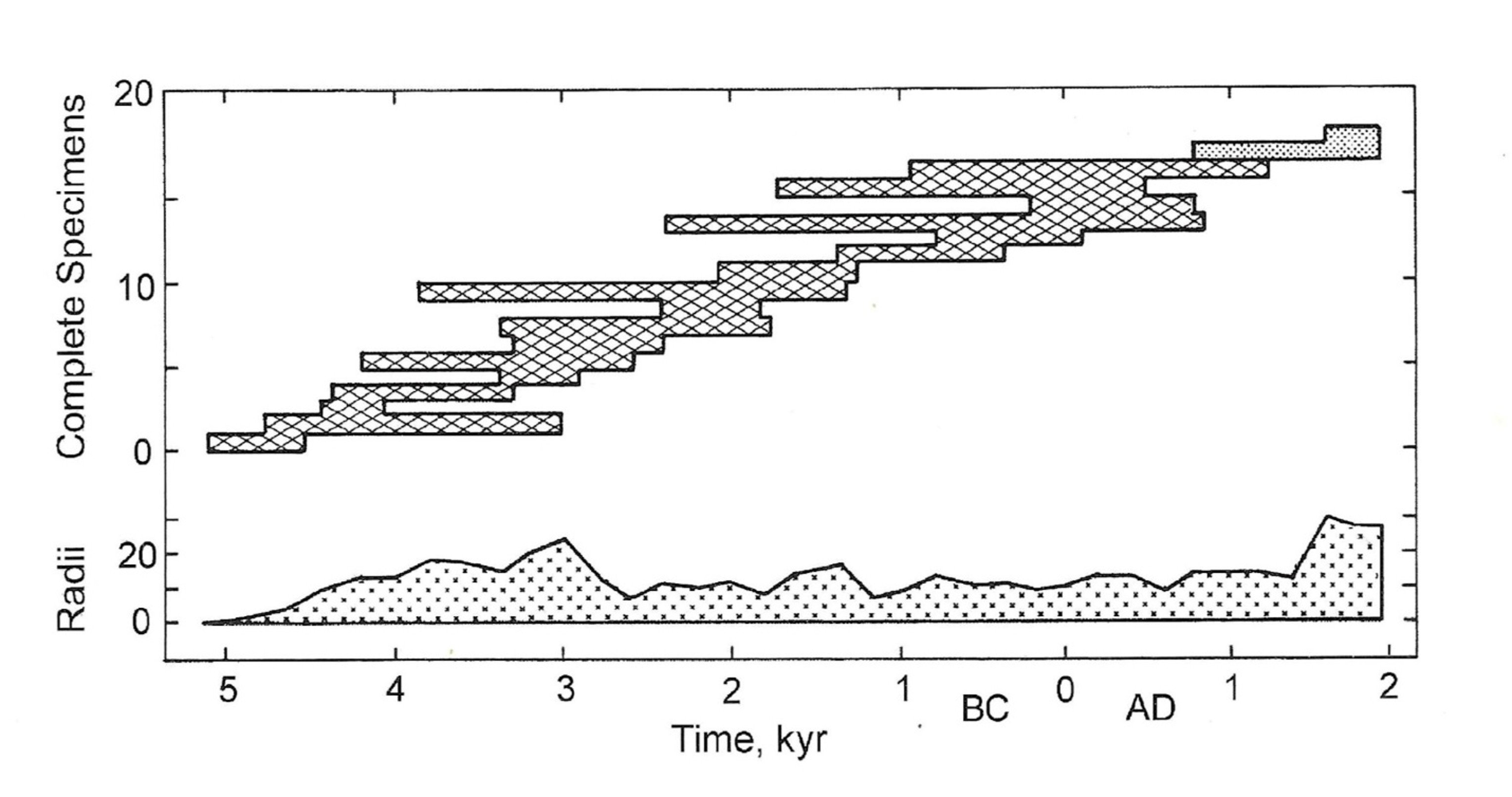
Figure 2. The construction of the Bristlecone pine tree-ring chronology from living trees (the two dotted bars in the top right of the diagram) and dead trees (the many crosshatched bars in the rest of the diagram). It can be seen that most of this tree-ring chronology is based on dead trees.
Carbon-14 in Coal, Limestone, and Fossils
The next problem with radiocarbon dating for Dr. Rana is the analysis of some 70 samples of coal, oil, natural gas, limestone, marble, and various fossils well-documented in the conventional secular literature between 1984 and 1998. In conventional thinking, these samples were regarded as up to more than 500 million years old and therefore should be 14C dead (that is, should have no carbon-14 in them). But when analyzed using the superior AMS (accelerator mass spectrometer) instrument, all the samples contained significant levels of radiocarbon.6 To counter this problem, Dr. Rana, of necessity, raises the potential problem of contamination:
Contamination is always a concern. Microorganisms growing on or in the sample will introduce carbon-14 that will skew the ages to be younger than it actually is. Contamination is a real concern for older samples with low levels of endogenous radiocarbon.7
However, Dr. Rana is apparently ignorant of the standard, extremely harsh pretreatment of samples that laboratories routinely use during their preparation for AMS 14C measurements. This harsh treatment includes alternating thorough washing in hot and cold strong acids and strong bases, all of which is designed to successfully remove any field or laboratory handling of samples that could have been inadvertently introduced contamination with “modern” carbon. Furthermore, in the published RATE study, the 10 coal samples were carefully chosen from the US Department of Energy’s Sample Bank maintained at Pennsylvania State University, where the original mine samples had been purged with argon and then stored in multi-laminate foil bags sealed under argon and kept refrigerated at 3°C. Then the samples went through the standard extreme pretreatment just described. The 10 coal beds from which the samples came spanned the Eocene to the Pennsylvanian (40–320 million years old), and yet these samples after such careful handling and storage and extreme pretreatment still yielded similar radiocarbon “ages” with a mean of 48,500 years.8 This implies that the plant materials in these coal beds all lived and died at the same time, which of course, is consistent with the biblical global Flood cataclysm but refutes the old-earth myth.
Then finally, Dr. Rana raises yet another known complication with radiocarbon dating:
Another complication has to do with the varying amount of carbon-14 in the atmosphere at different times in recent Earth history and in different locations around the world. Fortunately, geochemists have ways to correct for these differences by comparing the carbon-14 dates of samples of known and varying ages.9
However, this problem is even worse that Dr. Rana indicates. It is well-documented that there has been a varying amount of carbon-14 in the atmosphere at different times in recorded history in different locations around the globe. This includes the so-called Suess effect (due to dramatically increased carbon emissions from burning of fossil fuels) and the Maunder Minimum (when 14C concentration increased in the atmosphere due to a decrease in sunspot activity).10 Such variations in the atmospheric 14C concentrations results in systematic deviations of radiocarbon dates from dendrochronology (tree-ring) dates so that by 2000 BC, the correction factor is 500 years!11
Furthermore, there are geophysical causes for the observed variations. They are due to natural variations in the production rate of 14C in the atmosphere because of changes in the intensity of the solar wind and the strength of the earth’s magnetic field.12 Indeed, the earth’s magnetic field shields the earth from the cosmic radiation that generates the 14C. So a stronger magnetic field decreases the production of 14C in the atmosphere. Since measuring began in 1845, the total energy stored in the earth’s magnetic field has been decaying at a rate of 5% per century, while archaeological measurements show that the field was 40% stronger in AD 1000.13 Recent records of the International Geomagnetic Reference Field, the most accurate measurements ever taken, show a net energy loss of 1.4% in just three decades (1970–2000). This means that the field’s energy has halved every 1,465 years or so. Thus, the production of 14C in the earth’s atmosphere was much less even just 1,000 years ago, consistent with the archaeological measurements of the field strength in AD 1000. And this means that the farther back in history we go, the more inaccurate 14C dating becomes, resulting in much older dates than the true age of the dated object.
The farther back in history we go, the more inaccurate 14C dating becomes, resulting in much older dates than the true age of the dated object.
However, all radiocarbon dating laboratories calculate the carbon-14 “ages” for all the samples that they analyze using the erroneous uniformitarian assumption that the past atmospheric 14C production has been the same as today’s production rate. Yet it has been demonstrated conclusively by measurements, as already discussed, that the atmospheric 14C production rate was progressively much less the further back in recorded history one goes. Thus, the radiocarbon “ages” calculated by the laboratories are inflated; that is, they are progressively much older than they really should be the further one goes back in recorded history. Hence, scientists need to add corrections to radiocarbon “ages” when they don’t match well-established archaeological dates.
Furthermore, during the global Flood cataclysm of Noah’s day, the burial of so much normal carbon in fossilized plants and animals diluted the radiocarbon content of coal beds, oil, and fossils.14 The net result is that the mean radiocarbon “age” of 48,500 years for those 10 coal bed samples analyzed during the RATE project is overinflated and thus the real radiocarbon “age” should be much younger, much closer to the biblical date for the Flood of about 4,500 years ago.15 Similarly, all the samples of coal, oil, natural gas, marble, and fossils reported in the conventional literature that contained significant levels of radiocarbon would yield overinflated radiocarbon “ages.”16 Since all of them are less than 500 million years old, when a similar correction for the earth’s past stronger magnetic field is applied to them, they likewise would all date back to the global Flood cataclysm!
Carbon-14 in Dinosaur Bones
Nevertheless, Dr. Rana still must take issue with the presence of significant carbon-14 found in fossilized dinosaur bones because the implications are that the reason the soft tissues found in those dinosaur bones have survived is that they are really only about 4,350 years old and not more than 66 million years old as evolutionists so confidently claim. He says,
If the fossils that yielded soft tissue remnants are really millions of years old, then why were Brian Thomas and Vance Nelson [young-earth creation scientists] able to detect carbon-14 in dinosaur samples?17 Given that the half-life of carbon-14 is about 5,700 years, all of the carbon-14 should have been extinguished in less than 100,000 years.18
Then to discredit this finding of significant carbon-14 in fossilized dinosaur bones, Dr. Rana appeals again to contamination because he simply cannot admit or allow these fossilized dinosaur bones to be only 4,350 years old. So he goes on to say,
Finding carbon-14 in dinosaur fossils does not mean these specimens are only a few thousand years old. There are several ways to explain the results. The age Thomas and Nelson reported for the samples (between 20,000 and 41,000 years in age) corresponds to relatively low levels of carbon-14. It is possible that some of the carbon-14 signal stems from contamination of the sample by, say, microorganisms picked up from the environment. They treated their samples to remove any potentially contaminating carbon-14, but the possibility still exists that the protocol may not have removed all the contamination, particularly if the microbes infused into the interior of the specimens.19
Thus, Dr. Rana is accusing the certified, qualified, professional radiocarbon laboratory that analyzed the fossilized bone samples for Thomas and Nelson of not being thorough with the harsh pretreatments (as detailed above) they would have used as the standard protocol, which is used in all such laboratories to remove all possible contamination. And the accusation is made without a shred of evidence to support it. To the contrary, given the porosity of the original bones and the severity of the harshly corrosive hot strong acids and bases in which the fossilized bones were soaked during the extreme pretreatment, it is inconceivable that any microbes in the interior of the specimens would not have been eliminated prior to the preparation of the samples for the carbon-14 analyses. Indeed, after such harsh, extreme pretreatment, the specimens were converted to graphite. Such heating would likewise have destroyed any microbes, even if infused in the interior of the specimens. Put simply, Dr. Rana is grasping at proverbial straws!
Similarly, he hopes to convince his readers with technical details and possibilities that they cannot substantiate. He continues with a further claim not supported by any evidence:
It is also conceivable that some of the carbon-14 detected by the team is due to a ubiquitous carbon-14 background. Cosmic rays continuously produce radiocarbon. Because of this nonstop production, carbon-14 is everywhere and will show up at extremely low levels in every measurement that is made.20
Actually, it is simply not true that carbon-14 “will show up at extremely low levels in every measurement that is made.” Yes, radiocarbon laboratories have what they call their background carbon-14, which they routinely deduct from their sample analyses. However, that background level has been determined by analyzing a sample such as anthracite, which is supposed to be carbon-14 “dead” because it is supposedly millions of years old. Yet the levels of 14C measured in the RATE project’s coal samples and the Thomas and Nelson fossil samples are well above such laboratory background levels of carbon-14, meaning that they are not due to either contamination or cosmic rays producing background carbon-14. Indeed, it is worth noting that when no sample is placed in the AMS spectrometer no 14C is detected, which should normally be considered the laboratory background! So carbon-14 does not show up at extremely low levels in every measurement that is made.
Then finally, Dr. Rana presents the same old objection routinely raised by skeptics:
It is also possible that some of the carbon-14 in the fossil samples arises from the conversion of nitrogen-14 to carbon-14 in the fossil interior driven by the decay of radioactive elements, such as uranium and thorium, in the environment. If any soft tissue vestiges are present in the fossils, there will be plenty of nitrogen-14 hanging around. Uranium and thorium from the environment would readily infuse into the fossil interior and as these elements decay, the high energy they release will convert nitrogen-14 to carbon-14.21
This is an oft-repeated claim that has been preempted and repeatedly answered. As usual, like others who repeat this claim, Dr. Rana provides absolutely no details as to exactly how much uranium and thorium was in the environment from which the fossilized bones were extracted and provides no calculations as to how much carbon-14 would actually be produced by such irradiation of however much nitrogen-14 there supposedly is in the fossilized bones. In other words, this criticism is merely nebulous hand-waving because no substance is ever provided.
Is Dr. Rana Reading Creationist Technical Literature?
The measured 14C in the fossilized dinosaur bones is significant and indicates that the bones are only thousands of years old, not millions of years.
The reality is, Dr. Rana apparently didn’t read the volume published in 2005 reporting the results of the RATE project. His objection was resoundingly answered there. In Dr. John Baumgardner’s discussion of the significant 14C levels measured in the RATE coal samples, he used the reported levels of uranium and thorium in coals to calculate just how much 14C would be produced by the uranium and thorium α-particle bombardment of the levels of nitrogen reported in coals.22 The calculated 14C produced was extremely insignificant, well below the carbon-14 levels measured in those 10 coal samples. Similarly, the levels of uranium, thorium, and nitrogen in fossilized dinosaur bones are negligible when compared to those in coal. So Dr. Rana’s hand-waving objection is null and void. The measured 14C in the fossilized dinosaur bones is significant and indicates that the bones are only thousands of years old, not millions of years.
Yet Dr. Rana persists by claiming,
In reality, any of these possible sources of carbon-14 may be in play at the same time. While any one mechanism may be insufficient to account for the carbon-14 in the dinosaur samples, the combination of sources could readily explain why the YEC investigators detected carbon-14 in the fossil specimens.23
No! It has been demonstrated above that none of these possible sources explains the carbon-14 levels measured in the fossilized dinosaur bones. Furthermore, even in combination, these sources do not explain the carbon-14 levels measured in the fossilized dinosaur bones. Indeed, the radiocarbon laboratory’s background 14C level measured on samples such as anthracite includes the combination of all three of these possible sources suggested by Dr. Rana (contamination, cosmic ray bombardment, and bombardment by uranium and thorium α-particles). Yet that laboratory background level is insignificant compared to the 14C measured in these fossilized dinosaur bones. Dr. Rana’s repeated claims are intended to convince readers who have little knowledge of radiocarbon laboratory dating procedures into thinking he has successfully discredited the radiocarbon analyses done by qualified professionals in certified radiocarbon laboratories and the careful research done by these young-earth creation scientists. To the contrary, when the details are investigated, Dr. Rana’s lack of knowledge is exposed and his objections fail miserably. These fossilized dinosaur bones have been genuinely radiocarbon dated at only thousands of years old.
In making one final point aimed at demolishing the Thomas and Nelson radiocarbon dating results, Dr. Rana raises a total red herring:
One final point: the results Thomas and Nelson obtained for the radiometric dating of the Triceratops horn make it impossible that the carbon-14 they detected was endogenous to (produced within) the soft tissue.24 Recall that Armitage and his associate Kevin Anderson (both YECs) uncovered soft, flexible brown sheets about 8 inches by 4 inches in size from the Triceratops fossilized horn after soaking pieces of it in a mild acid bath for a month. (This procedure provides a source of carbon-14 because of the small amounts for carbon dioxide dissolved in the liquid.) That is a considerable amount of soft tissue. If the Triceratops horn were somewhere between 3,000 and 6,000 years old, then there should have been somewhere between 50 and 75 percent of the original carbon-14 in the sample. This amount of material should have easily produced a strong carbon-14 signal. The fact that they measured the age of the bulk Triceratops horn at about 33,500 years in age and the bioapatite fraction around 41,000 years old means that less than 2 percent of the original carbon-14 was present in these samples, if the results of this measurement are taken at face value. This outcome makes no sense if these samples are less than 6,000–10,000 years old.
It is also strange that the bioapatite fraction (which should have an enriched organic content) should be dated 10,000 years older than the bulk horn. These spurious results make sense if the carbon-14 signal was due to contamination, ubiquitous background radiocarbon, and/or irradiation of the flexible sheets by uranium or thorium. It is impossible to reconcile the data Thomas and Nelson reported with any scenario that would treat the flexible sheets of soft tissue as only 3,000 to 6,000 years old.25
The red herring is the recovery of the soft tissue (the flexible brown sheets) from the fossilized Triceratops horn by soaking pieces in a mild acid bath for a month. Dr. Rana is implying, in as many words, that Thomas and Nelson used a piece of the fossilized Triceratops horn for radiocarbon dating after it had been soaked in a mild acid bath for a month because he then says that procedure would have provided “a source of carbon-14 because of the small amounts for carbon dioxide dissolved in the liquid.” However, to imply that is not only misleading; it is dishonest. If Dr. Rana had actually read the Thomas and Nelson paper,26 he would have readily seen both described in the text and in their Table 1 that what they had radiocarbon dated was the bulk bone, that is, fossilized bone that had not been previously “soaked in a mild acid bath for a month.” Such dishonest tactics are simply not acceptable. To make matters worse, Dr. Rana is again using such a misleading statement of implication, expecting that his readers don’t have access to the Thomas and Nelson paper or won’t be bothered to look up that paper to check but instead will simply accept his word for it!
Then Dr. Rana states, “If the Triceratops horn were somewhere between 3,000 and 6,000 years old, then there should have been somewhere between 50 and 75 percent of the original carbon-14 in the sample.” Such a claim indicates that Dr. Rana has either not read or comprehended the problem, which is even reported in the conventional literature, that radiocarbon “dates” diverge from, and are much older than, the well-established historical and archeological dates.27 And this has been confirmed and established by the mean radiocarbon “age” of 48,500 years of coal beds (supposedly 40–320 million years old) composed of plants that all lived and died at the same time only about 4,350 years ago.28 Furthermore, the inflated radiocarbon “ages” are due to conventional radiocarbon dating practitioners assuming that today’s measured atmospheric 14C production rate has essentially been the same in the past. But this ignores the well-established effect on the atmospheric 14C production rate of the earth’s magnetic field being increasingly stronger going back into the past.29 There is simply no excuse for Dr. Rana to have ignored the young-earth creationist literature, published well before his 2016 book, and then mislead his readers accordingly. Such tactics are dishonest!
But what about the difference in radiocarbon “ages” between the bulk fossilized Triceratops horn (33,570 years) and the bioapatite fraction (41,010 years)? Does this make these radiocarbon results “spurious,” as claimed by Dr. Rana? Absolutely not! Thomas and Nelson made it clear in the text of their paper that they requested the radiocarbon laboratory to separate the bioapatite fraction from a piece of the bulk fossilized horn. Unfortunately, they did not report how the laboratory separated the bioapatite fraction. Although Dr. Rana claims that the bioapatite fraction should have had an enriched organic content, he provides no basis for that claim. Instead, it is clear that whatever method the laboratory used to separate the bioapatite fraction, which no doubt involved dissolution liquids, that method would have affected the carbon-14 content of the bioapatite fraction, likely removing some of it in the dissolution solvent. And this is clearly reflected in the different δ13C values Thomas and Nelson reported in their Table 1: a δ13C value of -17.1 0/00 for the bulk horn and a δ13C value of -4.3 0/00 for the bioapatite fraction. This difference implies fractionation of the carbon isotopes during the separation procedure. Such fractionation of carbon isotopes between different organic materials is well-documented.30
So the differences in radiocarbon “ages” of the bulk fossilized Triceratops horn and the bioapatite fraction extracted from it are definitely not indictive that those radiocarbon “ages” are “spurious.” To the contrary, those differences are expected due to measured fractionation of carbon isotopes during the extraction process, as reported in the different δ13C values. Instead, these details are a positive confirmation that the radiocarbon “ages” are genuine and definitely not “due to contamination, ubiquitous background radiocarbon, and/or irradiation of the flexible sheets by uranium or thorium,” as wrongly claimed by Dr. Rana. Once again, he has simply not done his homework in reading the relevant literature that explains why it is expected there would be such differences in these organic fractions that were radiocarbon dated.
Finally, Dr. Rana resorts to the objection used frequently by skeptical opponents who likewise have not read the relevant young-earth creationist technical literature yet have the temerity to criticize the young-earth creationist position that has been established by solid experimental evidence. He says,
But YECs would likely point out that the discrepancy in the carbon-14 dates reflects the acceleration in radioactive decay rates that took place at the fall of Adam or during Noah’s flood. But this rejoinder doesn’t solve their problem. In fact, it highlights another inconsistency in their model. For the sake of argument, let’s assume that the Triceratops horn is 3,000 years old but measures to be 30,000 years old because of accelerated radioactive decay. This differential means that the rate of radioactive decay must have sped up by a factor of ten. But, the RATE scientists contend that radioactive decay rates during select times in Earth’s history were billions of times faster than today, not merely an order of magnitude faster. If the radioactive decay rate increased by a magnitude factor of billions, then there should be no carbon-14 in any of the fossil samples. The presence of carbon-14 gives scientists another reason to think that the carbon-14 signal is due to contamination, background carbon-14, and/or conversion from nitrogen-14 by exposure to radioactive materials such as uranium and thorium.31
First, nowhere has any young-earth creationist scientist ever claimed that radiocarbon “ages” for coal, oil, fossils, etc.—for example, the 33,570 years radiocarbon “age” for the bulk fossilized Triceratops horn—is “because of accelerated radioactive decay,” as dishonestly claimed by Dr. Rana. To the contrary, young-earth creation scientists have only ever maintained that these inflated radiocarbon “ages” are due to the atmospheric 14C production rate of the earth’s magnetic field being increasingly stronger going back into the past.32 Second, in any case, if Dr. Rana had read the results of the RATE research project published in 2005,33 he would have known, and thus not made his untrue claim, that the RATE research found that the magnitude of the accelerated radioactive decay was related to today’s measured half-lives (decay rates), the mode of radioactive decay and the atomic weights of the parent radioisotopes, particularly the latter.34 Indeed, it was concluded that the heavier the atomic weight of the parent radioisotope, the greater the acceleration rate was, and that conversely the lighter the atomic weight of the parent radioisotope, the less was the acceleration rate. Thus carbon-14, with an atomic weight of only 14, compared to uranium-238, with an atomic weight of 238, would have had its radioactive decay accelerated negligibly so that the resultant radiocarbon “ages” would be negligibly affected.
Conclusion
This is strong evidence that they are only thousands of years old, dating back to the biblical global Flood cataclysm.
Dr. Rana’s reasoning in this objection is fallacious. The decay rate of radiocarbon was not accelerated by a factor of billions, as he erroneously claimed. And as demonstrated above, radiocarbon “ages” of dinosaur bones as reported creation scientists are not due to contamination, background carbon-14, and/or conversion from nitrogen-14 by exposure to radioactive materials such as uranium and thorium. Instead, the reported radiocarbon “ages” are due to significant measurable carbon-14 in the coal, oil, fossils, etc. This is strong evidence that they are only thousands of years old, dating back to the biblical global Flood cataclysm, which God’s inerrant Word describes in detail, confirmed by the testimonies of the Lord Jesus Christ and the Apostle Peter.
Answers in Depth
2026 Volume 21
Answers in Depth explores the biblical worldview in addressing modern scientific research, history, current events, popular media, theology, and much more.
Browse VolumeFootnotes
- Rana, Fazale, Dinosaur Blood and the Age of the Earth (Covina, CA: RTB Press, 2016), 42–44.
- Rana, Dinosaur Blood and the Age of the Earth, 45.
- Dickin, Alan P., Radiogenic Isotope Geology 2nd ed. (Cambridge, UK: Cambridge University Press, 2005), 383–398; C. W. Ferguson, “Dendrochronology of Bristlecone Pine, Pinus artista. Establishment of a 7484-Year Chronology in the White Mountains of Eastern-Central California, USA,” in Radiocarbon Variations and Absolute Chronology, Proceedings of the 12th Nobel Symposium, ed. I. U. Olsson (New York: Wiley, 1970), 571–593.
- Baillie, M. G. L., Tree-Ring Dating and Archaeology (London: University of Chicago Press, 1982); Dickin, Radiogenic Isotope Geology, 383–398.
- Hebert, Jake, Andrew A. Snelling, and Timothy L. Clarey, “Do Varves, Tree-Rings, and Radiocarbon Measurements Prove an Old Earth? Refuting a Popular Argument by Old-Earth Geologists Gregg Davidson and Ken Wolgemuth,” Answers Research Journal 9 (2016): 339–361, https://answersresearchjournal.org/varves-trees-radiocarbon-old-earth/.
- Giem, Paul, “Carbon-14 Content of Fossil Carbon,” Origins 51 (2001): 6–30; John R. Baumgardner, “14C Evidence for a Recent Global Flood and a Young Earth,” in Radioisotopes and the Age of the Earth: Results of a Young-Earth Creationist Research Initiative, eds. Larry Vardiman, Andrew A. Snelling, and Eugene F. Chaffin (El Cajon, CA: Institute for Creation Research; and Chino Valley, AZ: Creation Research Society, 2005), 587–630.
- Rana, Dinosaur Blood and the Age of the Earth, 44.
- Baumgardner, “14C Evidence for a Recent Global Flood and a Young Earth,” 587–630.
- Rana, Dinosaur Blood and the Age of the Earth, 44.
- Faure, Gunter, and Teresa M. Mensing, Isotopes: Principles and Applications, 3rd ed. (Hoboken, NJ: Wiley & Sons, 2009), 614–625.
- Faure and Mensing, Isotopes: Principles and Applications, 614–625.
- Faure and Mensing, Isotopes: Principles and Applications, 614–625.
- Snelling, Andrew A., “Carbon-14 Dating: A Creationist Puzzle,” Answers Magazine 6, no. 2 (April–May 2011): 70–73, https://answersingenesis.org/geology/carbon-14/a-creationist-puzzle/; Andrew A. Snelling, “Rapidly Decaying Magnetic Field” Answers Magazine 7, no. 4 (October–December 2012): 52–53, https://answersingenesis.org/evidence-for-creation/5-rapidly-decaying-magnetic-field/.
- Baumgardner, “14C Evidence for a Recent Global Flood and a Young Earth,” 587–630.
- Snelling, “Carbon-14 Dating: A Creationist Puzzle,” 70–73.
- Giem, “Carbon-14 Content of Fossil Carbon,” 6–30; Baumgardner, “14C Evidence for a Recent Global Flood and a Young Earth,” 587–630.
- Thomas, Brian, and Vance Nelson, “Radiocarbon in Dinosaur and Other Fossils,” Creation Research Society Quarterly 51 (Spring 2015): 299–311.
- Rana, Dinosaur Blood and the Age of the Earth, 49.
- Rana, Dinosaur Blood and the Age of the Earth, 49.
- Rana, Dinosaur Blood and the Age of the Earth, 49.
- Rana, Dinosaur Blood and the Age of the Earth, 49.
- Baumgardner, “14C Evidence for a Recent Global Flood and a Young Earth,” 587–630.
- Rana, Dinosaur Blood and the Age of the Earth, 49–50.
- Thomas and Nelson, “Radiocarbon in Dinosaur and Other Fossils,” 299–311.
- Rana, Dinosaur Blood and the Age of the Earth, 50.
- Thomas and Nelson, “Radiocarbon in Dinosaur and Other Fossils,” 299–311.
- For example, see Faure and Mensing, Isotopes: Principles and Applications, 614–625.
- Baumgardner, “14C Evidence for a Recent Global Flood and a Young Earth,” 587–630.
- Snelling, “Carbon-14 Dating: A Creationist Puzzle,” 70–73; Snelling, “Rapidly Decaying Magnetic Field,” 52–53.
- Hoefs, Jochen, Stable Isotope Geochemistry, 5th ed. (Berlin, Germany: Springer-Verlag, 2004).
- Rana, Dinosaur Blood and the Age of the Earth, 50–51.
- For example, Snelling, “Carbon-14 Dating: A Creationist Puzzle,” 70–73; Snelling, “Rapidly Decaying Magnetic Field,” 52–53.
- Vardiman, Larry, Andrew A. Snelling, and Eugene F. Chaffin, eds., Radioisotopes and the Age of the Earth: Results of a Young-Earth Creationist Research Initiative (El Cajon, CA: Institute for Creation Research; and Chino Valley, AZ: Creation Research Society, 2005).
- Austin, Steven A., “Do Radioisotope Clocks Need Repair? Testing the Assumptions of Isochron Dating Using K-Ar, Rb-Sr, Sm-Nd, and Pb-Pb Isotopes,” in Radioisotopes and the Age of the Earth: Results of a Young-Earth Creationist Research Initiative, eds. Larry Vardiman, Andrew A. Snelling, and Eugene F. Chaffin (El Cajon, CA: Institute for Creation Research; and Chino Valley, AZ: Creation Research Society, 2005), 325–392; Andrew A. Snelling, “Isochron Discordances and the Role of Inheritance and Mixing of Radioisotopes in the Mantle and Crust,” in Radioisotopes and the Age of the Earth: Results of a Young-Earth Creationist Research Initiative, eds. Larry Vardiman, Andrew A. Snelling, and Eugene F. Chaffin (El Cajon, CA: Institute for Creation Research; and Chino Valley, AZ: Creation Research Society, 2005), 393–524.
Support the creation/gospel message by donating or getting involved!

Answers in Genesis is an apologetics ministry, dedicated to helping Christians defend their faith and proclaim the good news of Jesus Christ.
- Customer Service 800.778.3390
- Available Monday–Friday | 9 AM–5 PM ET
- © 2026 Answers in Genesis