

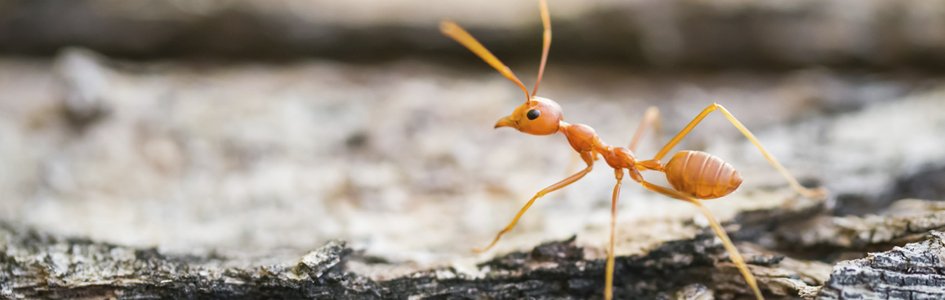
Did Adam Step on an Ant Before the Fall?
Often Christians, pastors, and theologians who try to fit millions of years into Genesis 1 object to a literal, recent six-day creation by arguing, “So Adam never stepped on an ant in the garden of Eden? That can’t be true. There had to be death before sin.” But is such an objection valid?
Aside from the possibility that ants, and other insects, are not even alive in the biblical sense,1 the question to ask first is why the idea of death before sin is so important that the accidental death of an ant would be an objection.
The issue of death before sin is significant because it’s a question of biblical authority and because the idea undermines the very foundation of the gospel. If we take God at his Word, it is abundantly clear that death, and this would include animal death, is the consequence and by-product of sin and was not part of the original creation. Here are just a sampling of verses that clearly make this point.
A Perfect Creation
And God saw everything that he had made, and behold, it was very good. And there was evening and there was morning, the sixth day. (Genesis 1:31).
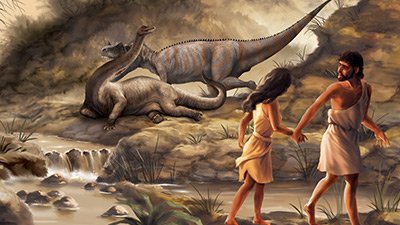
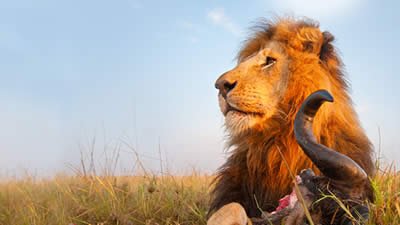
Would God call a creation full of death and suffering “very good”?
Would God call a creation full of death and suffering “very good”? Certainly not! Death is “the last enemy” (1 Corinthians 15:26) that Jesus Christ came and died to defeat! And this would include animal death. The God who cares for the sparrows (Matthew 6:26) and who promises that someday animals will once again live in harmony (Isaiah 11:6) would not call animal death and suffering “very good.” Saying that God called death and suffering “very good” accuses God of being a monster responsible for all the evil we see in the world. But Scripture is clear—it’s our fault in Adam.
And God said, “Behold, I have given you every plant yielding seed that is on the face of all the earth, and every tree with seed in its fruit. You shall have them for food. And to every beast of the earth and to every bird of the heavens and to everything that creeps on the earth, everything that has the breath of life, I have given every green plant for food.” And it was so. (Genesis 1:29–30)
Both the animals and people ate plants before the fall, so both animal and human death was not God’s plan for his creation; it was unnecessary and did not occur.
Death—Sin’s Consequence
But of the tree of the knowledge of good and evil you shall not eat, for in the day that you eat of it you shall surely die. (Genesis 2:17)
Death was the clear consequence for Adam and Eve’s sin. But if death already existed, why was death given to them as the consequence for sin? They would have died anyway. Clearly, death was not present in the world before sin. If Genesis doesn’t make it clear enough, Romans emphasizes the point; death is the direct result of the sin of Adam: “Therefore, just as sin came into the world through one man, and death through sin, and so death spread to all men, because all sinned” (Romans 5:12).
Of course, this is referring in context to human death, but Romans 8:22 tells us that it is this sin that makes the whole creation groan. If death existed before sin, then creation was already groaning, waiting for liberation from the Messiah, before sin had even entered the world. But it was sin that resulted in Christ’s coming to earth to die as the last Adam so that Adam’s descendants could live (1 Corinthians 15:21–22) and so that creation could be restored (Romans 8:19–22).
The Lord God said to the serpent,
“Because you have done this,
cursed are you above all livestock
and above all beasts of the field;
on your belly you shall go,
and dust you shall eat
all the days of your life.
I will put enmity between you and the woman,
and between your offspring and her offspring;
he shall bruise your head,
and you shall bruise his heel.” (Genesis 3:14–15)
One of the consequences for sin was a curse on the animals. It wasn’t just the serpent who was cursed. Genesis 3:14 says that the serpent was cursed “above all livestock and above all beasts of the field.” So the animals were cursed as the result of Adam and Eve’s sin. Based on Scripture’s teachings on death, we can infer that death was part of this curse on the animals. So animal death didn’t exist before the fall. It, too, was a consequence of sin.
And to Adam he said, “Because you have listened to the voice of your wife and have eaten of the tree of which I commanded you, ‘You shall not eat of it,’
cursed is the ground because of you;
in pain you shall eat of it all the days of your life;
thorns and thistles it shall bring forth for you;
and you shall eat the plants of the field.
By the sweat of your face
you shall eat bread,
till you return to the ground,
for out of it you were taken;
for you are dust,
and to dust you shall return.” (Genesis 3:17–19)
Genesis 3 clearly makes a connection between Adam and Eve’s rebellious choice and the cursing of the earth. Their sin didn’t just affect them. Changes took place at the time of the fall for all of creation because of sin, and this surely would have included animal death, as the revelation of Scripture as a whole supports.
Whom heaven must receive until the time for restoring all the things about which God spoke by the mouth of his holy prophets long ago. (Acts 3:21)
Eventually there will be a restoration of all things in which death will be done away with (Revelation 21:4). This restoration will include a time when strife between animals will cease (Isaiah 11:6), which implies that animal death will also cease when everything is restored to what it was before sin.
What exactly did Jesus die for if it wasn’t to pay our well-deserved penalty?
Scripture is abundantly clear—human and, by extension, animal death is the consequence of sin and did not exist before Adam and Eve’s decisive act of rebellion in the garden. If this is not true, then the entire gospel stands on shaky ground. After all, why did Jesus have to die a physical death if death wasn’t actually the consequence for sin? What exactly did Jesus die for if it wasn’t to pay our well-deserved penalty?
It should come as no surprise that the gospel is dependent on what God’s Word teaches—death was the consequence for sin, and in his grace and mercy, Jesus came and died in our place, taking our penalty, so that we no longer need to fear death but will experience eternal life (John 3:16). Eventually, death will be thrown in the lake of fire, and there will be no more death.
Sadly, many Christians have ignored God’s Word and wrongly accept the idea of millions of years. But millions of years puts death and suffering, clearly seen in fossils, before sin. Such an idea undermines both the authority of Scripture and the gospel of Jesus Christ. As Christians, we cannot accept any idea that runs contrary to Scripture. Instead, we need to take God at his Word and believe what he has clearly told us.
We Live in a Cursed World
Living in a cursed world that groans from the weight of sin, it’s hard for us to imagine a world without death and suffering. But we can’t use our fallen experiences in a cursed world to say what life could or couldn’t have been like in the perfect garden of Eden. It’s hard to imagine a world in which an ant never got squashed, but that doesn’t mean that before sin such a world never existed. We simply don’t have any experience (yet) with a perfect world and cannot comprehend what such a world would be like (1 Corinthians 2:9).
Thankfully, those who have trusted in Christ will someday get to experience just that in the new heavens and new earth. But until then, we cannot allow our fallen experiences to dictate our theology and cause us to reject God’s Word. After all, the Word of the infallible God who was there, who knows what happened, and who never lies, is surely more worthy of our trust than the opinions and experiences of fallible humans living in a sin-cursed and death-drenched world.
God Upholds the Universe
Also, consider the experience of the Israelites. After leaving Egypt, they eventually disobeyed God and were consigned to wandering in the wilderness for 40 years. During those long years of a nomadic lifestyle, God upheld them so that clothes and shoes never wore out and their feet never swelled (Deuteronomy 8:4, 29:5). This is clearly very different from the way that we observe God upholding the universe today (Hebrews 1:3) and is hard to imagine. Or consider God’s supernatural protection of Shadrach, Meshach, and Abednego so that they were untouched by the flames and smoke in Nebuchadnezzar’s fiery furnace (Daniel 3:8–30).
Again, this is not our normal experience. Surely, the God who could uphold the shoes, clothes, and feet of every wandering Israelite and who protected his servants from the fire could sustain the perfect pre-fall world in such a way that no ant accidentally got squished. This would not be hard for the all-powerful God who created the universe simply by speaking. Just as it will be in heaven, so it once was on earth, before the fall; accidents never happen in a perfect world.
This objection of accidental death before the fall is really a smoke screen to try to hide the fact that those who compromise with evolutionary ideas are rejecting God’s Word and are instead trusting fallible man’s opinions. We need to put our faith and trust in the perfect Word of the Creator who was there and who told us what, how, and when he created.
Footnotes
- It is not clear from Scripture whether insects receive the designation nephesh that people and most animals receive in Genesis. The Hebrew word nephesh basically means “breathing creature,” but Leviticus 17:11 states that “the life [nephesh] . . . is in the blood,” so it is possible that nephesh life must have blood. Scripture never uses “blood” in reference to invertebrates, and in an everyday sense, invertebrates don’t actually have blood. It might be implied from this that insects may have died before the fall. However, this is unlikely as God only gave “every green plant for food” to all animals, including “everything that creeps on the earth, everything that has the breath of life” (Genesis 1:29–30). So it would appear that nothing ate insects in the pre-fall world.


Support the creation/gospel message by donating or getting involved!

Answers in Genesis is an apologetics ministry, dedicated to helping Christians defend their faith and proclaim the good news of Jesus Christ.
- Customer Service 800.778.3390
- Available Monday–Friday | 9 AM–5 PM ET
- © 2026 Answers in Genesis