


Faithful to the Foundation
The History of Creationism
Understanding the history of creationism better equips us to defend the authority of God’s Word.
Since Adam and Eve first doubted God in the garden, humankind has struggled against him and his Word.
Perhaps nothing shows this struggle more than the history of creationism—a history beginning millennia before Darwin ever penned On the Origin of Species.
Understanding our place in that history helps us discern the present ideological strife and enables us to speak winsomely to a sin-bound culture that despises the very truth that could set it free. After all, the basis of creationism is the basis of the gospel.
A look at creationism’s history better equips us to stand on the truth of God’s Word, learn from our spiritual forefathers, and encourage future generations.
In the Beginning. . . And a Little Later

Creationism is the belief in the authority of God’s Word in its beginning chapters, accepting that Genesis 1–2 records God’s creation of the world in six literal, 24-hour days.1 Because the Hebrew word for day (yom) appears with the words evening and morning, the context indicates literal 24-hour days. God declared his creation “very good” (Genesis 1:31); therefore, death and suffering could not have existed until after Adam sinned and received sin’s consequences.
After Adam and Eve sinned, God removed them from the garden. Over the next 1,600 years, their descendants became so evil that God judged the world with a global flood catastrophe, saving only Noah and his family and pairs of each animal kind.2 The flood catastrophe created the conditions for fossils and sedimentary layers to be rapidly laid down around the globe.
Not long after the flood, people gathered in Babel, disobeying God’s command to fill the earth (Genesis 9:1). God intervened by confusing their language, forcing them to disperse in groups according to their new languages. This dispersal resulted in the formation of small gene pools and caused people to develop different ethnic characteristics.
Each people group carried narratives of creation and the global flood, narratives that became lore and legend. All reflect various degrees of similarity to each other, and many echo the actual creation account in Genesis 1 and 2. They contain elements of darkness to light, chaos to order, water and land, an original man and woman, a talking snake, and a tree.
Over the next 2,500 years, the creation account was twisted or thwarted.
Over the next 2,500 years, the creation account was twisted or thwarted. By the sixth century BC, the Greek philosopher Anaximander suggested that the earth was once a type of uniform mass with no distinction of materials, neither wet nor dry, hot nor cold. As this mass moved in a rotational manner, eventually things separated, leading to masses of land and waters appearing.3
Diodorus Siculus, a Greek historian from the first century BC, described the early earth as soft and clay-like, with pockets of warm, moist pools. He proposed that these pools produced embryonic materials that led to all kinds of animals.4 This description isn’t far from the primordial soup idea that evolutionists proposed in the early part of the twentieth century.
The Early Church, AD 300s
After Christ’s resurrection, the inspired New Testament Scriptures were penned. Both testaments were then copied, translated, and spread. Many early church fathers took pains to rightly understand the Scriptures and teachings of the apostles. They also refuted teachers who relied on the prevailing philosophies and cultural understandings of their day to interpret the texts.
Augustine (AD 354–430), an early church father from North Africa, wrote extensively on the creation account. He did not, as some claim, hold to an old earth position.5 Rather, he believed all things were instantaneously created in a single moment. He primarily held to an allegorical interpretation of the six days of creation,6 but in the last of his commentaries on Genesis 1, he took a literal interpretation.7
But Augustine was at a disadvantage. The Bible he used was a Latin translation known as the Vetus Latina, the “Old Latin” version. This translation came from the Septuagint, a Greek Bible translated for Greek-speaking Jews who couldn’t read the Hebrew Old Testament.
Augustine was using a translation of a translation of the Bible. This translation was subject to numerous errors and numerous versions.8, 9 It’s no surprise that he allegorized Genesis 1 at different times in his life.
Basil of Caesarea (c. AD 329–379) was a bishop who fought against Arianism, a heretical denial of Christ’s divinity. Basil specified his belief that Genesis 1 describes a literal, 24-hour day during the week of creation.10
Ambrose of Milan (c. AD 330–397) also refuted Arianism and was a spiritual mentor of Augustine. He understood the days in Genesis 1 to be literal, 24-hour days. He even went so far as to state that “Scripture established a law” that a day was specifically a 24-hour period.11
The Renaissance and the Reformation (1300–1700s)

Over the next thousand-plus years of the Medieval Era, many people were unable to read Scripture. The Bible was written in Latin, a language they couldn’t read—and most couldn’t read any language at all. The general population relied on the Roman Catholic church to interpret Scripture for them. Like Augustine, many leaders in the Roman Catholic church varied in their interpretation of Genesis 1, though even the allegorists believed the creation of the world was only a few thousand years before their day.
But during the Renaissance, the Western world revived classical Greek and Roman ideas. Humanism, Platonism, and natural philosophy began to fertilize the soil from which the ideas of evolution would grow.
Literature, art, and architecture boomed. Technology and scholarly research soared. And amid it all, Martin Luther sparked the Reformation, which challenged the Roman Catholic church.
With literacy on the rise and printing presses mass-producing books, Christians began translating the Bible into German, French, and English—putting God’s Word into the common people’s homes for the first time.
Expositional preaching became the mainstay of churches that desired to know God and his Word. With a commitment to Sola Scriptura (Scripture alone) and proper biblical exegesis and hermeneutic, the Reformers taught a literal Genesis.
In his commentary on Genesis, Martin Luther explains that from Moses we know that the earth is no older than 6,000 years.12 The French Reformer John Calvin also held to a 6,000-year-old world13 and a literal six days of creation.14
“The Reformation showed that Christianity is a reasonable faith.”
James Ussher, archbishop of Armagh of the Church of Ireland, agreed with many of the Reformers as far as the age of the earth. In his famous The Annals of the World, first published in 1650, Ussher calculated the age of the earth at 6,000 years. He also stated that the earth was created in six literal days.15
The Reformation showed that Christianity is a reasonable faith based on an authoritative text of Scripture. But basing reason on Scripture rather than human intellect would clash with the coming Enlightenment.
The Englightenment, 1685–1815

The Enlightenment Era is also called the Age of Reason as cultures began to highly value intellect and logic. Some people reasoned from a biblical worldview, but the era shows a heightened emphasis on reasoning from human logic. Some men reasoned with a biblical worldview, but the era shows a heightened emphasis on human reasoning.
In his Sacred Theory of the Earth, English theologian Thomas Burnet discusses a global flood and young earth,16 but he treated the six days of creation as six years instead of six literal days.17
Similarly, William Whiston, an English physicist who succeeded Isaac Newton at Cambridge University, theorized that each day of creation was a year.18
The results of embracing human reasoning during the Renaissance and the Enlightenment led many to make conclusions about the earth’s origins without consulting Scripture—the only logical foundation for truth.
Enlightenment philosophers in Europe led the charge to remove the Bible from society, and Bible critics arose throughout Europe and America.
This era saw the rise of deism, which proposes that mankind can determine, through reason, that God exists. Deists viewed God as a clockmaker who made the clock, wound it, and walked away. They rejected the idea of miracles and spiritual interference on earth, and regarded the Bible as merely a text for moral living.
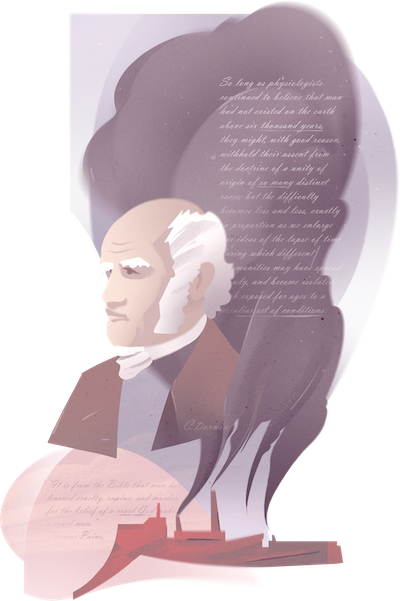
The United States was influenced by deistic-leaning political figures and writers such as Benjamin Franklin and Thomas Jefferson, as well as Thomas Paine. In fact, Paine’s book The Age of Reason repeatedly states that the Bible is full of lies and deceptions.19
In fact, Paine’s book The Age of Reason repeatedly states that the Bible is full of lies and deceptions.
Philosophers of the enlightenment in France, such as Voltaire, Denis Diderot, D’Alembert, and the Genevan Jean-Jacques Rousseau, all promoted this human-centered reasoning. After centuries of poor biblical hermeneutics from the Roman Catholic church, many people lacked biblical literacy. Though they had rightly learned that the Bible is the authority, they didn’t understand that the Bible sometimes includes poetry and figurative language. As a result, they started questioning the trustworthiness of Scripture regarding science.
Challenges to Scriptures followed. Could the scientific method explain miracles? Did the “stories” in the Bible actually happen? How could a man come back to life? How could a virgin become pregnant? Was the Bible just a collection of myths and legends?
With human reasoning separated from God’s Word, the question of origins arose. Where did everything come from if not from God?
During the late 1700s, James Hutton, a farmer who had previously studied medicine and chemistry, promoted a geological cycle that supposedly formed the earth as we know it today. Hutton believed a slow and steady process of molten rock was forced to the earth’s surface and eroded, and then sediments were washed away.
Did the “stories” in the Bible actually happen? How could a man come back to life? How could a virgin become pregnant? Was the Bible just a collection of myths and legends?
His theory would come to be known as uniformitarianism, the idea that earth was shaped by slow geological changes. These processes generally happen at the same speed and in the same manner as we witness today. There was no catastrophic flood of Noah’s time, and everything we see geologically today is due to this uniform pace. It appears that his belief in deism was a major factor in Hutton’s conclusions.20
In contrast to Hutton’s uniformitarianism were old-earth catastrophists, such as Georges Cuvier, a paleontologist and comparative anatomist in France. He imagined that a series of major catastrophic floods separated by long periods of time could explain the fossil-bearing sedimentary rock layers.
In the 1820s, William Buckland, an Anglican clergyman and professor at Oxford University, initially taught that geology confirmed the global flood (though he believed most of the rock record formed untold ages before human existence). But in the early 1830s, he abandoned belief in the biblical flood due to the influence of Charles Lyell.21
Building on Hutton’s uniformitarian thinking, Lyell further dismissed the global flood through his three-volume Principles of Geology (1830–1833) and expanded earth history beyond what the catastrophists had imagined. Geologists began referring to geologic history in terms of millions of years.
During the first half of the nineteenth century, most Christians accepted millions of years as geological fact. To accommodate this, the church began accepting the gap theory (putting millions of years between the first two verses of Genesis 1), the day-age view of Genesis 1 (spreading the millions of years over the supposed non-literal days), and the local flood view of Genesis 6–8.22
The efforts of the scriptural geologists failed to stop the compromise.
But a small number of scriptural geologists (some of whom were competent geologists by the standards of their day) published books raising biblical, philosophical, and geological arguments against the old-earth geological theories and various compromised views.23
However, the efforts of the scriptural geologists failed to stop the compromise. By about 1850, nearly the whole church had abandoned the biblical chronology and global flood. Charles Spurgeon was one in a long line of godly, orthodox men who continued the compromise because they did not realize that the idea of millions of years did not come from rocks and fossils but from anti-biblical assumptions controlling the interpretation of geological evidence.

With the idea of millions of years locked into the minds of the scientific world, it was ready for Charles Darwin’s On the Origin of Species in 1859. This book is considered the origin of the idea of evolution, but as we have seen with the Greeks and others, the seeds of evolutionary thought had been planted and watered over centuries. Even with Darwin’s book, the concept of evolution was not yet in full bloom. In fact, Darwin didn’t use the word evolution until one of his later works.24
Darwin didn’t break ground with his ideas. Rather, he synchronized ideas from many men before him, especially Charles Lyell. In a letter, Darwin said, “I always feel as if my books came half out of Lyell’s brains.”25 He also called himself “a zealous disciple of Mr. Lyell’s views.”26
Post-Darwin and Early Modern Era
Having compromised with millions of years, the church began to cave to Darwinian evolution. Historian Ronald Numbers reports,
As early as 1880 the editor of one American religious weekly estimated that “perhaps a quarter, perhaps a half of the educated ministers in our leading Evangelical denominations” believed “that the story of the creation and fall of man, told in Genesis, is no more the record of actual occurrences than is the parable of the Prodigal Son.”27
Though many in the church embraced theistic evolution, many fundamentalist Christians, including those who produced the 12-volume series The Fundamentals, opposed Darwinism but continued to promote the day-age theory, the gap theory, and a local flood. Few stood solely on God’s Word as the authority for truth.28
Fundamentalist Congregational minister C. I. Scofield published his Scofield Reference Bible in 1909, a Bible still popular among evangelicals around the world today. Sadly, the marginal notes in Genesis 1 popularized the gap theory even more. Although the editors of the 1967 third edition modified his old-earth statements, they still leave the door open for the acceptance of millions of years.
At this time, most Christians in Western civilization were compromising with evolution.
At this time, most Christians in Western civilization were compromising with evolution, but some were standing for biblical authority regarding biological evolution, especially human evolution. The opposition against biological evolution came to a legal head in the 1920s when a handful of US states sought to make the teaching of evolution in public schools illegal. On March 13, 1925, Tennessee became the first state to pass a law, the Butler Act.29
John Scopes, a high school teacher in Dayton, Tennessee, was soon accused of violating the Butler Act, though it’s not clear whether he really taught evolution. The famous Scopes “Monkey” Trial provided a stage to prompt a legal challenge and incite public debate.
Scopes was found guilty, but the ACLU filed an appeal, which was thrown out on a technicality. The trial received national attention in the press, and while the ACLU lost an appeal to the case, the anti-Christian ACLU lawyer Clarence Darrow won by making the anti-evolution Christians look like inconsistent buffoons.
The prosecuting attorney and fundamentalist Christian leader William Jennings Bryan knowledgeably opposed Darwinian evolution, but he waffled on the days of Genesis 1 and compromised with the idea of millions of years. Darrow effectively exploited this inconsistency. As a result, resistance to the teaching of evolution in schools rapidly dissipated, trust in the authority of Scripture in Genesis further eroded in churches, and fundamentalists become more culturally isolated.
Throughout history, some people taught the truth of Genesis 1–11, while others introduced ideas to fit their own understanding into Scripture.
Brush up on some definitions below.
Young-Earth Creationism
God created the universe in six 24-hour days about 6,000 years ago. Creation was “very good” until Adam’s sin brought pain and death into the world. God destroyed the world with a global, catastrophic flood at the time of Noah and dispersed people by new language groups at Babel, according to the literal history in Genesis 1–11.
Intelligent Design (ID)
Biological evolution and billions of years of cosmic and earth history were guided and directed by an intelligence to achieve a certain outcome. It includes no identification of the Intelligent Designer nor consideration of Genesis.
Naturalistic Evolution
The universe and all it contains (including all life forms and humans) evolved by purely natural, unguided processes without any involvement of a Creator.
Theistic Evolution
God used natural, evolutionary processes over billions of years to create the universe, earth, and all forms of life, including humans (which descended from non-humans).
Old-Earth Creationism
The earth and universe are billions of years old. God created life over millions of years, involving the death, disease, and mass extinction of animals and other natural evils (earthquakes, volcanos, hurricanes, etc.)
Several ideas fall into this category:
Day Age Theory
The days in Genesis were not literal 24-hour days but rather representations of long periods of time. How God created is not clearly indicated.
Progressive Creationism
The big bang and billions of years of geological history happened, as evolutionary scientists say, but periodically God supernaturally created new kinds of life, including humans.
Gap Theory
A gap of millions of years of cosmic and geological history exists between Genesis 1:1 and Genesis 1:2.
The Modern-Postmodern Era, 1940–1999
After World War II, technology was growing exponentially. Fields of science were advancing at a feverish pace. The infant mortality rate was decreasing, diseases were disappearing, food production was soaring, and men even traveled to the moon. Science was king—the very reason people were living such wonderful lives. Who were they to question science and its experts?
Evolutionary thought was fully entrenched in higher education, and public schools soon followed. Churches felt helpless against the ever-encroaching attack on truth.
Then a new word entered the English vocabulary: postmodernism. Truth became subjective. The ideals of Christianity were contested. Right and wrong were relative. Science was the only truth to stand on.
But there were skeptics of old-earth geology, including the Seventh Day Adventist George McCready Price, the Lutheran Byron Nelson, and the Presbyterian Harry Rimmer. God used these skeptics to pave the way for an engineering professor at Rice University in Houston—Henry Morris Jr.
Convinced of the Bible’s authority on all matters, including science, Morris read numerous books on science and the Bible but found many of them lacking commitment to God’s Word. A few purported that God created everything and later judged the earth with a global flood, but many meshed ideas of evolution with Scripture.
As he studied, Morris said that he “became more and more convinced that the Bible taught a recent, literal creation, and it seemed completely impossible that the Bible could be the infallible Word of God if it was wrong on such a foundational issue.”30
Morris “became more and more convinced that the Bible taught a recent, literal creation, and it seemed completely impossible that the Bible could be the infallible Word of God if it was wrong on such a foundational issue.”
At the American Scientific Affiliation Convention in 1953, Morris presented the paper Biblical Evidence for a Recent Creation and Universal Deluge. Many members in the affiliation and other Christians rejected his ideas outright.
Two matters of importance arose from this convention. First, Morris became more convinced that people needed a “book on the effects of the universal Flood and its relevance to the Bible.”31 Second, he received a letter from John C. Whitcomb Jr., associate professor of the Old Testament at Grace Theological Seminary in Indiana. Whitcomb shared Morris’ beliefs regarding a young earth and universal flood.
In 1961, the two men published The Genesis Flood: The Biblical Record and Its Scientific Implications. Many consider this book to be the beginning of the modern creation movement and the most important analysis on biblical and scientific evidence for the global flood. Its publication sparked debate across evangelical circles and earned Henry Morris Jr. recognition as the father of the modern creationist movement. Though the technical creationist understanding of the geological record has become much more detailed and sophisticated, The Genesis Flood is still worth reading today.

Lasting Legacy & Continued Work: The Genesis Flood
The clarity and force of The Genesis Flood defense rallied Christians to take a stand on a literal Genesis.
The book also caught the attention of geologist Dr. Andrew Snelling. “As a young Christian and aspiring geologist, I carefully digested The Genesis Flood,” he recalls. “Its robust defense of the global flood and a young earth convinced me of the authority of God’s Word as our essential guide for understanding God’s world and interpreting the evidence from earth’s past. The book gave me a passion to train as a geologist and defend Scripture against the monolithic enterprise of evolutionary uniformitarian geology, launching my life’s work in creation research.”
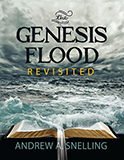
Dr. Snelling’s work has built on Morris and Whitcomb’s foundational geological premise, but his research has also adjusted these premises based on scientific discoveries since the book’s publication in 1961. For example, radiometric dating was in its infancy at the time of its publication. Dr. Snelling updated Morris and Whitcomb’s defense in 2022 with his book The Genesis Flood Revisited.
Such advancements further support the legacy of The Genesis Flood, which teaches readers to trust the truth of Scripture to interpret the world around us. Our scientific understandings may shift with ongoing study, but God’s Word is faithful from the start (Psalm 119:89).
By 1963, discouraged by the increasing influence of theistic evolution within the American Scientific Affiliation, Morris and nine other scientists formed the Creation Research Society.
By 1963, discouraged by the increasing influence of theistic evolution within the American Scientific Affiliation, Morris and nine other scientists formed the Creation Research Society. The next year, the society began publishing the Creation Research Society Quarterly. This professional society for creationists has more than 1,000 members and remains one of the oldest creation organizations in the world.
In 1972, Morris founded the Institute for Creation Research (ICR), with an emphasis on research and publications of creation-based books and articles without compromise on biblical authority. By the mid-1980s, ICR opened a research laboratory, and their scientists on staff became in-demand speakers. The organization later founded The School of Biblical Apologetics and the ICR Discovery Center for Science and Earth History.
As Morris was founding ICR, Ken Ham, a young public-school teacher in Australia, started teaching churches the truth of Genesis and the authority of God’s Word, getting creationist resources into the hands of Christians.
Ken asked the Lord, “Why can’t we have a creation museum that teaches the truth?”
At an Australian museum in the late 1970s, Ken was standing near an “ape-man” exhibit when he “overheard a father telling his young son, ‘This was your ancestor.’” Ken’s heart ached, and he asked the Lord, “Why can’t we have a creation museum that teaches the truth?”32 It would be many years before God answered that prayer—but not in Australia.
In 1987, Ham moved to the United States to be a speaker with ICR. By the early 1990s, he and his wife, Mally, saw the need for a creation ministry for lay people, something that the non-scientist could appreciate. With Morris’ blessing, Ham resigned from ICR, and he, Mark Looy, and Mike Zovath founded Answers in Genesis (AiG) in 1994.
AiG headquarters opened just south of Cincinnati, Ohio, with plans to build the Creation Museum. Staff were writing books, holding seminars, and producing radio and video programs. Their web presence was growing, and AiG speakers were traveling to churches and other arenas.
Other creationist organizations were also forming, and the creation science message was flooding across America and the world. The work of ICR, CRS, AiG, and other creationists around the world wasn’t lost on evolutionists.
As AiG was planning to build the Creation Museum, a local atheists group filed a complaint with the local zoning board, and AiG lost the rights to build on their original site.33 God soon blessed them with a better location.
Numerous articles and letters spilled across the internet, and news agencies decried the evils of AiG, even charging them with “intellectual molestation” and “terrorism.”34
But by God’s grace, the Creation Museum opened in 2007. Nine years later, the Ark Encounter opened. Naysayers again circled and decried the efforts, but to no avail. Each year, over a million guests come from around the world to visit these top-rated Christian attractions.
AiG continues to publish books, hold seminars, provide a streaming platform (Answers TV), and offer ongoing web content. They also publish Answers Research Journal and, of course, Answers magazine.
Creationism Today
History has shown us that God is faithful to his people. He has raised men and women in the church and in science to teach the truth of his Word. As God worked through these people in the past, he is still working today, not only through Answers in Genesis and other organizations but through pastors, college professors, schoolteachers, parents, and so many other believers around the world. May we continue the work of believers through history who understood the importance of this great work of creation apologetics.
is a Bible and History teacher at Heritage Christian Academy in Maple Grove, Minnesota. He is a graduate of Northwestern College–St. Paul, and of Bethel Seminary (MATS).
Answers Magazine
July–September 2025

This anniversary issue celebrates a legacy of unwavering commitment to a biblical worldview and the ongoing impact of creation-based apologetics.
Browse IssueFootnotes
- Ken Ham, “Could God Really Have Created Everything in Six Days?,” Chapter 8 in The New Answers Book 1 (Master Books, 2006), https://answersingenesis.org/days-of-creation/could-god-really-have-created-everything-in-six-days/.
- Terry Mortenson, “Noah’s Flood: A Historical, Global Catastrophe,” Answers in Genesis, October 10, 2020, https://answersingenesis.org/noahs-flood/.
- W. K. C. Guthrie, In the Beginning: Some Greek Views on the Origins of Life and the Early State of Man (Cornell University Press, 1957), 31, https://archive.org/details/inbeginningsomeg00guth/page/n5/mode/2up.
- Guthrie, In the Beginning, 36.
- Philip Schaff, ed., Nicene and Post-Nicene Fathers, series 1, vol. 2, 529 and 532, https://www.ccel.org/ccel/schaff/npnf102.html.
- Tim Chaffey, “An Examination of Augustine’s Commentaries on Genesis One and Their Implications on a Modern Theological Controversy,” Answers Research Journal 4 (2011): 89–101, https://answersresearchjournal.org/augustine-genesis-one/.
- Chaffey, “An Examination of Augustine’s Commentaries,” 89–101.
- Chaffey, “An Examination of Augustine’s Commentaries,” 89–101.
- Augustine’s Bible, Friends of Augustine Bulletin, accessed March 14, 2025, http://augnet.org/en/life-of-augustine/augustine-in-general/1302-augustines-bible/.
- Basil of Caesarea, “Hexaemeron (Homily 2),” accessed March 15, 2025, https://www.newadvent.org/fathers/32012.htm.
- Roy Deferrari, ed., The Fathers of the Church: A New Translation, volume 42, trans. John J. Savage (Fathers of the Church, 1961), https://dn790005.ca.archive.org/0/items/fathersofthechur027571mbp/fathersofthechur027571mbp.pdf.
- Martin Luther, Luther’s Works: Lectures on Genesis Chapters 1–5 volume 1, ed. Jaroslav Pelikan, trans. George V. Schick (Concordia Publishing House, 1958), https://ia800305.us.archive.org/16/items/OutOfThisWorldThomasLJr1950.rOpts/Stories/LuthersWorks%20vol1%20Genesis1-5%20PelikanJ%201958.r-opts.pdf.
- John Calvin, The Institutes of the Christian Religion, 1.14.1, trans. Henry Beveridge, 145–146, https://ccel.org/ccel/calvin/institutes/institutes.
- Calvin, 1.14.2, 146.
- James Ussher, The Annals of the World, accessed March 16, 2025, https://sdamaranathachurch.org/wp-content/uploads/2019/05/James-Usher-Annals-of-the-World.pdf.
- Thomas Burnet, Sacred Theory of the Earth, Book 1, 26–28, accessed March 16, 2025, https://sacred-texts.com/earth/ste/ste05.htm.
- Terry Mortenson, The Great Turning Point (Master Books, 2012), 26.
- William Whiston, A New Theory of the Earth, 230–244, accessed March 16, 2025, https://quod.lib.umich.edu/e/eebo/A65672.0001.001/1:6.4.1?rgn=div3;view=fulltext;q1=Bible+and+science.
-
Some examples of Paine’s words concerning the Bible:
“What is it the Bible teaches us?—rapine, cruelty, and murder. What is it the Testament teaches us?—to believe that the Almighty committed debauchery with a woman engaged to be married, and the belief of this debauchery is called faith” (Page 243 Willey reprint).
“Revelation when applied to religion, means something communicated immediately from God to man. It is revelation to the first person only, and hearsay to every other, and, consequently, they are not obliged to believe it. It is a contradiction in terms and ideas to call anything a revelation that comes to us at second hand, either verbally or in writing. Revelation is necessarily limited to the first communication” (Pages 8–9 Willey reprint).
Thomas Paine, The Age of Reason Being an Investigation of True and of Fabulous Theology (Willey Book Company, 1795, [digital version 2019]), https://ia600904.us.archive.org/5/items/ageofreasonbeing0000pain/ageofreasonbeing0000pain.pdf. - Dennis R. Dean, James Hutton and the History of Geology (Cornell University Press, 1992), 265, https://archive.org/details/jameshuttonhisto00dean/page/264/mode/2up?q=deism.
- Mortenson, The Great Turning Point, 30.
- The gap theory was advocated by the prominent Scottish Presbyterian pastor Thomas Chalmers as early as 1804. See The Works Thomas Chalmers, volume 12 (William Collins and Co., 1836), 369–370, http://classicchristianlibrary.com/library/chalmers_thomas/Chalmers-Works-pt12.pdf. The day-age view was advocated by the respected Anglican theologian George Stanley Faber in his 1823 book The Treatise on the Genius and Object of the Patriarchal, the Levitical, and the Christian Dispensations. The view that Noah’s flood was a local flood in the Mesopotamian Valley was popularized by the Congregational theologian John Pye Smith in his 1839 book On the Relation Between the Holy Scriptures and Some Parts of Geological Science.
- Terry Mortenson’s The Great Turning Point gives a thorough analysis of this period and the arguments of the scriptural geologists.
- Phillip Sloan, “Evolutionary Thought Before Darwin,” in The Stanford Encyclopedia of Philosophy Archive, Spring 2024 Edition, eds. Edward N. Zalta and Uri Nodelman, https://plato.stanford.edu/archives/spr2024/entries/evolution-before-darwin/.
- A letter written to Mr. Leonard Horner dated August 29, 1844, in which Darwin says that Lyell’s works have influenced him greatly: “I always feel as if my books came half out of Lyell’s brains & that I never acknowledge this sufficiently, nor do I know how I can, without saying so in so many words—for I have always thought that the great merit of the Principles, was that it altered the whole tone of one’s mind & therefore that when seeing a thing never seen by Lyell, one yet saw it partially through his eyes— it would have been in some respects better if I had done this less—but again excuse my long & perhaps you will think presumptuous discussion.” https://www.darwinproject.ac.uk/letter?docId=letters/DCP-LETT-771.xml, accessed January 26, 2025.
- A letter written to W. D. Fox dated August 9–12, 1835, in which Darwin refers to Lyell’s writings:
“I am become a zealous disciple of Mr Lyells views, as known in his admirable book” https://www.darwinproject.ac.uk/letter?docId=letters/DCP-LETT-282.xml, accessed January 26, 2025. - Ronald L. Numbers, The Creationists: The Evolution of Scientific Creationism (Alfred A. Knopf, 1992), 3. The quotation is from William Hayes Ward, “Whether It Is Right to Study the Bible,” Independent 32 (February 26, 1880): 4.
- See Terry Mortenson, “Exposing a Fundamental Compromise,” Answers Magazine 5, no. 3 (July–Spetember 2010), https://answersingenesis.org/theistic-evolution/exposing-a-fundamental-compromise/.
- Tennessee Evolution Statutes, House Bill No. 185, 64th General Assembly, (1925), https://famous-trials.com/scopesmonkey/2128-evolutionstatues, accessed February 1, 2025; Tennessee Governor Peay’s Signing Statement (1925), ttps://librarycollections.law.umn.edu/darrow/trials_details.php?id=7, accessed February 1, 2025.
- Rebecca Morris Barber, Henry M. Morris: Father of Modern Creationism (Institute of Creation Research, 2017), 94–95.
- Barber, Henry M. Morris, 134.
- Answers in Genesis, “The History of Answers in Genesis Through December 2024,” accessed February 9, 2025, https://answersingenesis.org/about/history/.
- Ken Ham, “Overcoming the Opposition,” March 23, 2019, https://answersingenesis.org/culture/overcoming-the-opposition/.
- Lew Moores, “Fantastic World: Creation Museum Tells a Whopper of a Tale, with a Literal Interpretation of Genesis Only the Beginning,” CityBeat, June 13, 2007, https://www.citybeat.com/news/cover-story-fantastic-world-12217463.



Support the creation/gospel message by donating or getting involved!

Answers in Genesis is an apologetics ministry, dedicated to helping Christians defend their faith and proclaim the good news of Jesus Christ.
- Customer Service 800.778.3390
- Available Monday–Friday | 9 AM–5 PM ET
- © 2026 Answers in Genesis