

Did Methuselah’s Death Herald the Global Flood?
If you use the genealogy in Genesis 5 to create a timeline from Adam to Noah, with the flood happening in Noah’s 600th year (Genesis 7:11), you’ll also notice that Methuselah dies in Noah’s 600th year, so his death was close to the flood.
Methuselah was 969 years old when he died, which is the longest recorded lifespan in the Bible (other than Enoch and Elijah, who did not die but were taken alive into heaven—see Genesis 5:24 and 2 Kings 2:11).
Methuselah’s name probably means “man of the spear.” However, in The Genesis Flood, Morris favors the meaning “when he dies, it shall be sent.” He writes,
If this suggestion is correct (and there is at least a possible basis for it), then a justifiable inference is that Enoch, the prophet of coming judgment, had received—at the time of the birth of his son—a special revelation concerning the coming judgment of the great Flood. God, however, promised him that it would not come as long as Methuselah lived; and Enoch gave him a name to commemorate that prophetic warning and promise.1
However, when Methuselah’s son Lamech begot Noah, the explanation for his name is right there in Scripture—just a few verses after the entry of Enoch begetting Methuselah. If Methuselah’s name had an important prophetic meaning, we would expect that to be explained in Scripture.
Which Text?
Some people might have the idea that Methuselah survived the flood for over a decade. That’s because a strict chronology following the Septuagint, the Koine Greek translation of the Old Testament, implies that Methuselah lived past the flood. The fact that the Masoretic text has Methuselah dying the year of the flood is one reason the Masoretic chronology is preferred, although some people who prefer the Septuagint have looked at this issue too.2
This chart represents the lifespans of the patriarchs according to the Masoretic Text of Genesis 5 and 11.
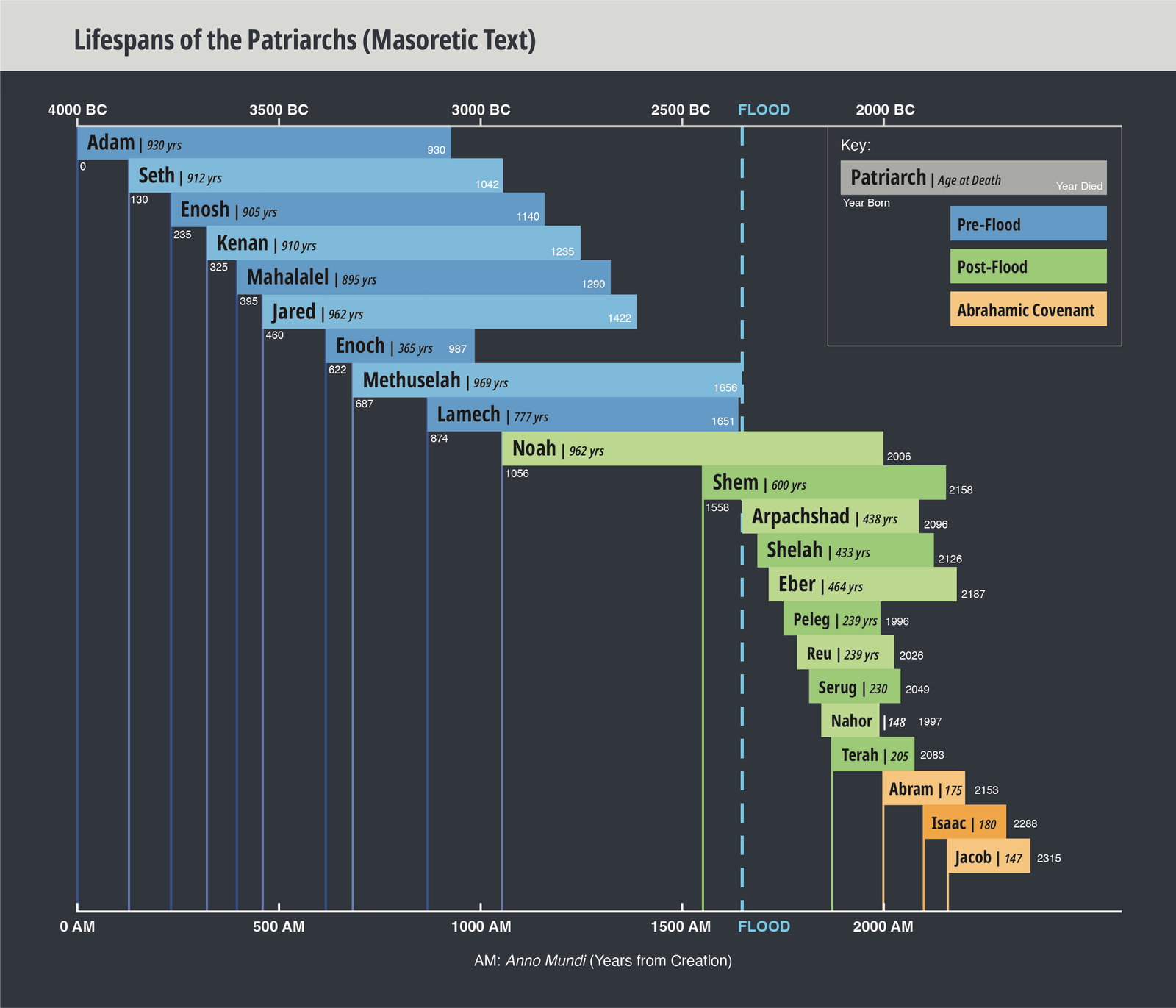
You can see that Lamech dies in 1651, five years before the global flood, and Methuselah dies in the year 1656, the same year as the flood. We know that only eight people—Noah, his sons, and their wives—got on board the ark.
Did Methuselah Die Immediately Prior to the Flood?
One theory is that Methuselah died immediately prior to boarding the ark, and the seven days between boarding and the flood beginning were to mourn Methuselah. However, this is pure conjecture because Scripture says nothing about it.
John Morris speculated that Methuselah may have been an antediluvian martyr killed in the violence of the pre-flood world:
Certainly the violence [of the pre-flood world] took the lives of many. Animals became violent and bloodthirsty. Wars must have been rampant as man’s sinful nature had full sway. Would we not be correct in assuming that the violence was directed toward believers most of all? Perhaps Noah had many more converts over the years, and the only ones left were the eight mentioned.
And this may have been what happened to Methuselah. Perhaps he was the last martyr, and when he was killed, God’s patience was over.3
Scripture does not tell us what the relationship between Methuselah’s death and the coming of the global flood was, only that they occurred in the same year.
Scripture does not tell us what the relationship between Methuselah’s death and the coming of the global flood was, only that they occurred in the same year. However, we can probably surmise that he was a godly man. He was the son of Enoch, who was taken alive into heaven, and his son was Lamech, who prophetically named Noah in the hope that through him God would remedy the curse on the ground.

Footnotes
- Henry Morris, The Genesis Record (Grand Rapids, MI: Baker Books, 1976), 160.
- Henry B. Smith, Jr., “Methuselah’s Begetting Age in Genesis 5:25 and the Primeval Chronology of the Septuagint: A Closer Look at the Textual and Historical Evidence,” Answers Research Journal 10 (August 2, 2017): 169–179, https://answersresearchjournal.org/methuselah-primeval-chronology-septuagint/.
- John D. Morris, “How Did Methuselah Die?,” Institute for Creation Research, December 1, 2006, https://www.icr.org/content/how-did-methuselah-die.
Support the creation/gospel message by donating or getting involved!

Answers in Genesis is an apologetics ministry, dedicated to helping Christians defend their faith and proclaim the good news of Jesus Christ.
- Customer Service 800.778.3390
- Available Monday–Friday | 9 AM–5 PM ET
- © 2026 Answers in Genesis