
Gecko Diversity and Evolution
Gecko feet: Does their fabulous diversity make them the flagship for convergent evolution?
News Source
- Discover blog: “Geckos Evolved Sticky Feet Many Times”
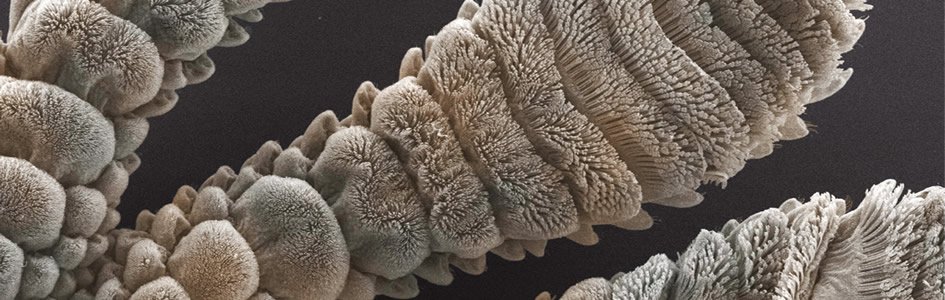
Geckos, lizards known for their ability to scamper up walls, are able to execute their amazing acrobatic prowess because they have toes covered with remarkably designed hairs (setae) with spatula-shaped split-ends. About 40 percent of the 1,450 species of geckos, however, have non-adhesive feet. (In fact, some have no legs at all, a reminder of the extreme variability that can occur within a kind of creature.) The sticky-ended hairs are specialized forms of spinules, little hair-like growths covering gecko bodies. (Spinules probably help geckos shed their skin.) Thus, all geckos have the necessary “equipment” to build sticky feet, and optimization of tendon function and flattened toes complete their acrobatic adaptations. These flat toe pads and the all-important spatula-like split ends on hundreds of tiny setae make wall-clinging possible.
Researchers have now determined the genetic information determining feet adhesion is encoded on six genes. After analyzing these genes in 107 of the 118 genera of geckos, they believe the adhesive ability evolved convergently in eleven separate events and was lost at least nine times. (Evolutionists date the rise of of the tackiness of the gecko toe to millions of years ago thanks to a gecko trapped in Cretaceous amber.) Presumably, the clingy toes would be a hindrance to locomotion for geckos living in less vertical terrain—perhaps burrowing in sand—so those geckos without the sticky adaptation would have been naturally selected to survive and reproduce, producing a population preferring to keep its feet on the ground.
The researchers believe their work, by elucidating the optimal gecko grip components, will be helpful for biomimicry projects seeking to mimic gecko feet in man-made materials. However, this research does not demonstrate anything in support of upward evolution but only the fact that reshuffling genetic material within a kind of creature is instrumental in producing species diversity.
The genetic information to produce clingy-footed adaptations does not represent an advance toward a non-gecko but is only a variation within geckos. Such variations, acted on by natural selection and other factors, does result in a diversity of gecko species suited to many environments. But that’s not the same sort of process required for evolution of new kinds of creatures.
Biology confirms what the Bible says: God created each kind of creature to reproduce after its kind. It’s not evolution; it’s just geckos.
Further Reading



Support the creation/gospel message by donating or getting involved!

Answers in Genesis is an apologetics ministry, dedicated to helping Christians defend their faith and proclaim the good news of Jesus Christ.
- Customer Service 800.778.3390
- Available Monday–Friday | 9 AM–5 PM ET
- © 2026 Answers in Genesis