
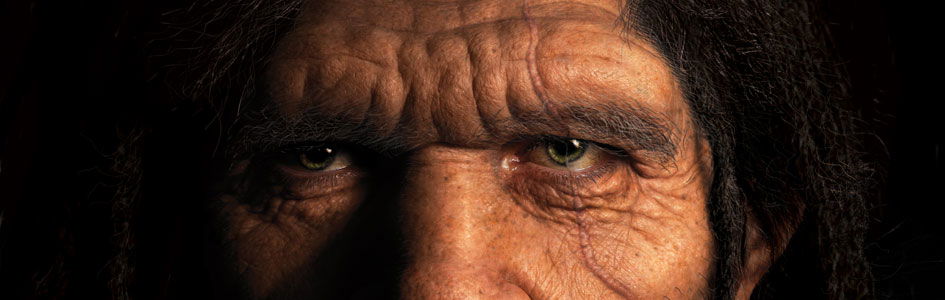
It’s a “Nose-Brainer”: Neanderthal Noses Weren’t Much Different Than Ours
A new digital study of the remarkably preserved nose bones of a neanderthal (discovered in a cave in 1993 in Altamura, South Italy) challenges long-held evolutionary claims about neanderthal evolution.1
The skeleton of “Altamura Man” is covered in “cave popcorn,” a form of calcite precipitated from the surrounding limestone, entombing and preserving the bones. Researchers, not wanting to damage the remains, left the skull and bones in place but discovered the skull’s nasal cavity was intact, making it one of the best-preserved neanderthal fossils ever found. The neanderthal individual is thought to have fallen, become trapped inside the cave, and died in place.

Neanderthal remains preserved in calcite, from a cave in Altamura, South Italy.
(Photo CC by 4.0. Thilo Parg via Wikimedia Commons.)
Using endoscopic cameras and 3D modeling, scientists were able, for the first time, to document the internal nasal bones of a neanderthal without relying on theoretical reconstructions or assumptions. What they found runs counter to the popular evolutionary idea that neanderthals had “specially evolved,” enlarged nasal structures to survive cold ice age climates, according to the popular online science magazine Live Science.2
The study shows that the “inner nasal structures were neither unique nor substantially different from those of modern humans.”3 Although neanderthals tended to have robust skeletons and compact builds—well suited for the harsh, post-flood ice age environment4—their inner nasal anatomy does not display the supposed unique evolutionary adaptations previously claimed.
Hypothetical nasal features once thought to be exclusive to neanderthals were absent in the Altamura skull, leading researchers to admit that these “should not be considered Neanderthal specific features.”5 This suggests that neanderthals, like all humans, displayed normal variation within humankind, not evidence of a separate evolutionary branch.
Experts also note that wide noses are common across many human groups, both past and present; only a small percentage of modern humans (mostly those from far northern climates) have narrow nasal openings. This indicates that neanderthal nose shape was simply part of ordinary human diversity, not a special “evolutionary feature” somewhat unique to an entirely different species, as many evolutionists see them.
DNA Evidence Continues to Say No to Evolution Stories
Of course we know now that both neanderthals and “modern” humans interbred, and evolutionists have come to realize neanderthals were as human as we are and that we retain some of their DNA.6 In 2014, a study published in Nature “suggests up to 50% of the original Neanderthal genome might be preserved, but spread into different sections across all humans living today.”7 And now we know that their noses show yet another evolutionary idea was not quite up to snuff.
The Bible declares humans are made in God’s image, which includes neanderthals.
Although modern science places neanderthals as a separate species (or in some cases as a Homo sapiens subspecies), the DNA evidence demonstrates that neanderthals and (modern) humans are part of the same created kind.8 The Bible declares humans are made in God’s image (Genesis 1:26–28), which includes neanderthals.
Conclusion
Neanderthals are best understood as descendants of a people group(s) who left Babel during the dispersion (Genesis 11:1–10). They migrated to Europe and lived in the challenging climate of the single ice age that followed the flood. Their strong bodies and broader noses represent variation and adaptation within humankind, not ancient relatives along a slightly different evolutionary path.
Footnotes
- Costantino Buzi, Antonio Profico, Carlos Lorenzo, and Giorgio Manzi, “The First Preserved Nasal Cavity in the Human Fossil Record: The Neanderthal from Altamura,” Proceedings of the National Academy of Sciences 122, no. 48 (November 17, 2025): https://doi.org/10.1073/pnas.2426309122.
- Kristina Killgrove, “‘Perfectly Preserved’ Neanderthal Skull Bones Suggest Their Noses Didn’t Evolve to Warm Air,” Live Science, November 17, 2025, https://www.livescience.com/archaeology/human-evolution/perfectly-preserved-neanderthal-skull-bones-suggest-their-noses-didnt-evolve-to-warm-air.
- Killgrove, “‘Perfectly Preserved’ Neanderthal Skull.”
- Andrew A. Snelling and Mike Matthews, “When Was the Ice Age in Biblical History?,” Answers Magazine 8, no. 2 (April 1, 2013): 46–52, https://answersingenesis.org/environmental-science/ice-age/when-was-the-ice-age-in-biblical-history/.
- Paul Arnold, “Looking Inside a Well-Preserved Neanderthal Nose to Solve a Mystery About Our Ancestors’ Faces,” Phys.org, November 18, 2025, https://phys.org/news/2025-11-neanderthal-nose-mystery-ancestors.html.
- Answers in Genesis, “Modern Humans with Neanderthal History, May 8, 2010, https://answersingenesis.org/human-evolution/neanderthal/modern-humans-neanderthal-history/.
- Rebecca Wragg Sykes, “Neanderthals: Who Were They and What Did Our Extinct Human Relatives Look Like?,” Live Science, March 24, 2025, https://www.livescience.com/archaeology/neanderthals-our-extinct-human-relatives.
- Marvin Lubenow, “The Neandertals: Our Worthy Ancestors,” Answers in Depth 1 (November 29, 2006): https://answersingenesis.org/human-evolution/neanderthal/the-neandertals-our-worthy-ancestors/.

Support the creation/gospel message by donating or getting involved!

Answers in Genesis is an apologetics ministry, dedicated to helping Christians defend their faith and proclaim the good news of Jesus Christ.
- Customer Service 800.778.3390
- Available Monday–Friday | 9 AM–5 PM ET
- © 2026 Answers in Genesis