
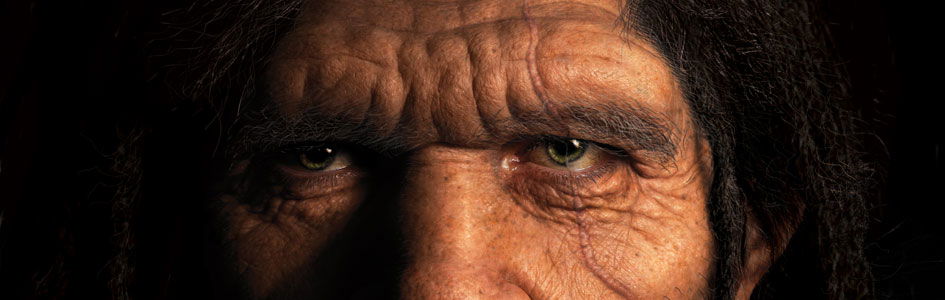
Neanderthal
Neanderthals were a group of humans, descended from Adam and Eve, who lived in the harsh post-Flood world. Archaeology confirms they made instruments, make-up, jewelry, weapons, and ritually buried their dead. Many humans today share DNA with Neanderthals. This fully human lineage died out sometime after the Flood.
Neanderthal DNA
A new genetic study, published in the journal Science, compared the Neanderthal genome to the genes of five humans alive today. The comparison revealed that in some individuals, up to 4% of the total genome was of Neanderthal origin.
Makeup for Neanderthals
Archaeologists uncovered shells containing yellow and red pigment residues at Neanderthal dig sites in southern Spain. Coupled with similar evidence found in Africa, the pigments paint a picture of Neanderthals far more sophisticated than their stereotype.
Neanderthal tools
Contrary to their reputation as some sort of sub-human brute, Neanderthals displayed a great deal of technological skill in the manufacture of their tools. Neanderthals were not only fully human but evidently were very skilled people coping with the harsh world of the post-Flood Ice Age.
Neanderthals Fully Human
The Neandertals are not mysterious, but rather incredibly intriguing. We view them as the fully human ancestors of some modern humans, probably some Europeans and western Asians. They were a post-Flood, Ice Age people, specializing in hunting the large, grazing animals that were abundant towards the end of the Ice Age.
Articles About Neanderthal
-
Dental Discovery Indicates Travel Among NeanderthalsFeb. 16, 2008
They may not have traveled in minivans and RVs, but a tooth found in Greece suggests Neanderthals roamed the earth more than was once thought, according to research published in the Journal of Archaeological Science.
-
In-Depth ArticleRed-Haired, Fast-Talking NeanderthalsNov. 21, 2007 from Answers in Depth
Recent research publications indicate that some Neanderthals may have had red-hair, fair complexions, and the capacity for speech and language.
PDF Download -
Neanderthals: the New Red-HeadsNov. 3, 2007 from News to Know
It’s a common caricature in textbooks, movies, and—more true than ever today—TV shows: a brow-ridged, (often) club-carrying Neanderthal, covered in thick, messy red hair.
-
Neanderthals: One of UsApril 28, 2007 from News to Know
Anthropologist Erik Trinkaus comments that the specimens considered to be the “earliest modern humans” in Europe “have shown obvious Neandertal ancestry.”
-
In-Depth ArticleThe Neandertals: Our Worthy Ancestors, Part IIApril 11, 2007 from Answers in Depth
Today, the majority of paleoanthropologists believe that the Neandertals were a species separate from modern humans.
-
In-Depth ArticleThe Neandertals: Our Worthy AncestorsNov. 29, 2006 from Answers in Depth
One hundred and fifty years have passed since the first Neandertal fossil individual was discovered in 1856 in the Neander Valley in Germany.
-
Are Europeans Neandertal?Sept. 18, 2006
The London Daily Telegraph reported in August 2006 that “People of European descent may be five percent Neanderthal.”
-
Magazine ArticleNeandertal Man—the Changing PictureSept. 1, 2003, pp. 10–14
Despite all the prejudice against including the Neandertals into Homo sapiens, even many evolutionists have become impressed with the evidence for Neandertal’s humanity.
-
Thumbs up for NeandertalsApril 4, 2003
In ‘Digital analysis: manual dexterity in Neanderthals,’ Nature magazine (27 March 2003) exposes yet another false assumption about these mysterious people.
-
Research PaperLagar Velho 1 Child SkeletonFeb. 1, 2000
When the parents of that four year old boy buried him many years ago, they could not have known how important his remains would be to their descendants.
-
What About the Neandertal DNA?Dec. 29, 1997
This article talks about the new neandertal DNA discovery, what it means, and how likely it is to be valid.
-
Magazine ArticleNeandertals ‘Must Have Had Advanced Skills’Sept. 1, 1996, pp. 25–26
A ‘complex quadrilateral artificial structure’ consisting of specially arranged pieces of stalactite and stalagmite was found in a cave in southern France.
-
Magazine ArticleThe Caring NeandertalSept. 1, 1996, pp. 16–17
The more we learn about the Neandertals, the more we are forced to conclude that although they may have looked brutish, they were very caring people.
-
Magazine ArticleNeanderthal Children’s FossilsDec. 1, 1994, pp. 40–44
Were the faces of Neanderthal children reconstructed accurately? Or, were they reconstructed with evolutionary beliefs in mind?
-
Technical Research PaperNeandertal Children’s FossilsAug. 1, 1994, pp. 166–178
In reconstructing fragmented bones of Neandertal children, evolutionists assume that rates of development were equal to or faster than modern children.
-
Magazine ArticleArmoured NeanderthalMarch 1, 1994, pp. 15–16
Mr K. Stolyhwo described the discovery of a human skull with classic Neanderthal features. The entire skeleton was in a tomb which also contained iron arrowheads and a suit of chain-mail armour.
Support the creation/gospel message by donating or getting involved!

Answers in Genesis is an apologetics ministry, dedicated to helping Christians defend their faith and proclaim the good news of Jesus Christ.
- Customer Service 800.778.3390
- Available Monday–Friday | 9 AM–5 PM ET
- © 2026 Answers in Genesis