

Lyell’s Atheistic War Against Genesis
What does Charles Lyell have to do with the moral and spiritual collapse of America?
What does the birth of Sir Charles Lyell over 200 years ago have to do with the moral and spiritual condition of America and the rest of the former “Christian West”? What does it have to do with the fact that only 4% of Americans have a biblical worldview?1 A LOT, as I will explain! But first we need to learn about Lyell and his ideas.
Charles Lyell’s Early Life and Education
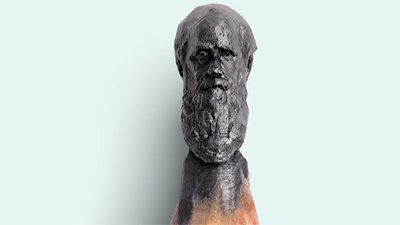
Charles Lyell was born into a wealthy family on November 14, 1797. His father was a translator and scholar of the works of the famous Italian poet Dante and also a recognized expert on botany, who introduced Charles to the study of nature.
In 1816, Lyell entered Oxford University, and in 1817–1819, he attended the eight spring-term geology lectures of William Buckland, who at the time offered the only lectures on geology in Britain. Buckland wrote two books (in 1820 and 1823) defending the global catastrophic flood of Noah. But he held to the gap theory, attributing most of the sedimentary rock record to multiple catastrophes over ages long before Adam.
This video from Dr. Mortenson’s video series “Defending a Young Earth” was made freely available by Answers TV for this publication. If you enjoyed it, you can watch the entire series and much more on Answers.tv! Subscribe now and get $20 off an annual subscription with promo code ATVORIGINS25 until February 14, 2026.
Lyell graduated with a BA in classics (ancient Greek and Roman studies) in 1819 and received an honorary MA in 1821. After graduation, he studied law at Lincoln’s Inn and became a practicing lawyer in London. In 1823, he was elected joint secretary of the Geological Society of London (which was a wealthy “gentlemen’s club” of amateur geologists formed in 1807—there were no professional, vocational geologists at this time). He traveled in rural England to study geological formations and presented his first geological paper in 1826. By 1827, he had abandoned law to focus full-time on geology (funded by his father’s wealth) as he applied and refined the ideas he had gained from James Hutton’s old-earth Theory of the Earth (1795), which Lyell was exposed to as a teenager. So before he knew much about the geology of Britain and Europe and when geology was in its infancy as a science, Lyell was already committed to long ages of earth history under the influence of Buckland, Hutton and other old-earth proponents.
Hutton’s Influence on Lyell
Before he knew much about geology, Lyell was already committed to long ages of earth history.
James Hutton, a medical doctor turned farmer turned geologist from Scotland, is considered by evolutionists to be the “Father of Modern Geology.” Historians of geology conclude from his writings that he was deist or secret atheist (which for this subject is essentially the same). Two statements Hutton made (reflecting such a worldview) have dominated old-earth thinking ever since his death in 1797.
In 1785, he wrote, “The past history of our globe must be explained by what can be seen to be happening now. . . . No powers are to be employed that are not natural to the globe, no action to be admitted except those of which we know the principle.”2 So here, Hutton lays down his law of geological reasoning. If we are going to reconstruct the history of the earth, it must be explained by presently observable, natural processes. He thereby ruled out the supernatural creation of the world and the global flood—when he knew almost nothing about the rocks of Scotland much less anywhere else.
In 1795, Hutton added, “But, surely, general deluges form no part of the theory of the earth; for, the purpose of this earth is evidently to maintain vegetable and animal life, and not to destroy them.”3 This too was a clear rejection of Noah’s flood.
Together, these statements reflected the principle that still controls geology today: “The present is the key to the past.” But this was a fundamental error (based on an anti-biblical worldview). The present is not the key to the past. Rather, the 100% infallible eyewitness testimony of the Creator (recorded in Scripture) is the key to understanding the past and the present.
Lyell embraced Hutton’s deistic/atheistic thinking and skillfully articulated them (in a way that Hutton could not) in his three-volume Principles of Geology (1830–1833). Lyell expressed his view succinctly this way:
I have always been strongly impressed with the weight of an observation of an excellent writer and skillful geologist who said that “for the sake of revelation [i.e., the Bible] as well as of science—of truth in every form—the physical part of Geological inquiry ought to be conducted as if the Scriptures were not in existence.”4
In a private letter to a friend, he said he wanted to “free the science [of geology] from Moses.”5
As a result of Hutton and Lyell’s work, three assumptions took control of geology. I call them uniformitarian naturalism. They are not derived from scientific research but are philosophical and religious in nature:
- Nature is all that exists.
- Everything can, and indeed must, be explained by time plus chance plus the laws of nature working on matter.
- The processes of geological change (erosion, sedimentation, earthquakes, volcanoes, etc.) have always been operating in the past at the same rate, frequency, and power as we observe today.
Lyell wanted to “free the science [of geology] from Moses.”
By about 1840, the combination of Lyell’s eloquence and apparently overwhelming geological evidence in his Principles of Geology convinced most old-earth catastrophists (including Buckland) to abandon their view in favor of his.
Lyell’s Influence on Darwin
In 1831, when Charles Darwin launched his five-year voyage to study the world, he took a copy of the first volume of Lyell’s Principles on the boat. And he thoroughly absorbed Lyell’s thinking:
I always feel as if my books came half out of Lyell’s brains and that I never acknowledge this sufficiently, nor do I know how I can, without saying so in so many words—for I have always thought that the great merit of the Principles, was that it altered the whole tone of one’s mind and therefore that when seeing a thing never seen by Lyell, one yet saw it partially through his eyes.6
In 1859, Darwin told the readers of his book on evolution to ignore it if they didn’t accept the millions of years advocated by Lyell: “He who can read Sir Charles Lyell’s grand work on the Principles of Geology, which the future historian will recognize as having produced a revolution in natural science, yet does not admit how incomprehensibly vast have been the past periods of time, may at once close this volume.”7 But by this time, not only did the whole scientific community accept the millions of years as fact, so did virtually the whole church, as I explain in my lecture, “Millions of Years: The Idea’s Unscientific Origin and Catastrophic Consequences.”8
So Lyell’s writings and influence advocating geological evolution in the early 1800s paved the way for the general acceptance of Darwin’s theory of biological evolution (including human evolution and the rejection of a literal Adam) in the late 1800s and eventually the acceptance of the big bang theory of cosmological evolution in the twentieth century.
Surprising Developments in the 1970s
Unexpectedly in the 1970s, some evolutionary geologists began to reject Lyell’s uniformitarian dogma of slow, gradual geological change and return to the ideas of some of the catastrophists of the early 1800s. They began to see evidence of catastrophism in the rocks and to expose the truth of what Lyell said in 1827: “It is almost superfluous to remind the reader that they who have a theory to establish, may easily overlook facts which bear against them, and, unconscious of their own partiality, dwell exclusively on what tends to support their opinions.”9 Lyell was guilty of doing exactly that.
One of the leading “neocatastrophists” was Dr. Derek Ager (1923–1993), a well-known, British geology professor at Swansea University in Wales. Referring to geology in the early nineteenth century, Ager says,
My excuse for this lengthy and amateur digression into history is that I have been trying to show how I think geology got into the hands of the theoreticians [i.e., uniformitarians] who were conditioned by the social and political history of their day more than by observations in the field. . . . In other words, we have allowed ourselves to be brainwashed into avoiding any interpretation of the past that involves extreme and what might be termed “catastrophic” processes.10
The great American paleontologist, evolutionary biologist, and historian of science at Harvard University, Stephen J. Gould (1941–2002), reveals:
Charles Lyell was a lawyer by profession, and his book [Principles of Geology] is one of the most brilliant briefs ever published by an advocate. . . . Lyell relied upon true bits of cunning to establish his uniformitarian views as the only true geology. First, he set up a straw man to demolish. . . . In fact, the catastrophists were much more empirically minded than Lyell. The geologic record does seem to require catastrophes: rocks are fractured and contorted; whole faunas are wiped out. To circumvent this literal appearance, Lyell imposed his imagination upon the evidence.11
Elsewhere Gould said,
Gradualism was never “proved from the rocks” by Lyell and Darwin, but was rather imposed as a bias upon nature. . . . [It] has had a profoundly negative impact by stifling hypotheses and by closing the minds of a profession toward reasonable empirical alternatives to the dogma of gradualism. . . . Lyell won with rhetoric what he could not carry with data.12
Lyell’s uniformitarianism was wrong, and the world has been brainwashed with a lie. While uniformitarianism still dominates, evolutionary scientists are now open to a catastrophic explanation for the very rapid deposition or erosion of some geological formations. However, they are still controlled by the anti-biblical bias of naturalism that rejects the Bible’s account of supernatural creation, Noah’s flood, and the Genesis genealogies that point to a young earth. But most evangelical Bible scholars are also still brainwashed with the idea of millions of years13 and are ignorant of the best young-earth explanations of the scientific evidence confirming the literal truth of Genesis 1–11.14
Lyell’s uniformitarianism was wrong, and the world has been brainwashed with a lie.
Two of many examples that could be cited are the highly influential theologian, Wayne Grudem, and equally prominent Old Testament scholar, C. John Collins. In his widely used Systematic Theology textbook in 1994, Grudem writes, “Although our conclusions are tentative, at this point in our understanding, Scripture seems to be more easily understood to suggest (but not to require) a young earth view, while the observable facts of creation seem increasingly to favor an old earth view.”15
But it is not the observable facts in geology that show the earth is billions of years old. It’s the anti-biblical assumptions used to interpret the observed rocks and fossils that deceive people into believing in such deep time. In his 2020 second edition, Grudem even more strongly instructs Christians to accept evolutionary geologists’ and astrophysicists’ claims about billions of years.16 He excels in exposing the serious errors of theistic evolutionists, but most of his reasons should also lead him to reject all old-earth views in the church, including the day-age view of Hugh Ross and the day-gap-day view of John Lennox.17
Collins is likewise blind to the philosophical assumptions controlling geology when he promotes his old-earth “analogical days” view of Genesis 1:
I conclude then that I have no reason to disbelieve the standard theories of the geologists, including their estimate for the age of the earth. They may be wrong, for all I know; but if they are wrong, it’s not because they have improperly smuggled philosophical assumptions into their work.18
On this point, he could not be farther from the truth.19
Lyell’s Connection to the Moral and Spiritual Decline of the West?
Like a crack in the dam, rejection of the biblical chronology and Noah’s flood—made pervasive because of Lyell’ deceptive writings in the early 1800s—led to the denial of the literal history in the rest of Genesis 1–11, which is foundational to all doctrine, even to the rejection of a literal Adam.20 This understandably has undermined the authority and truth of the rest of Scripture. Paganism now prevails in America and the rest of the former “Christian West” as biblical morality and the gospel have been rejected in the culture and in much of the church.
The world renowned, British, atheist evolutionist, Richard Dawkins put it this way: “The universe we observe has precisely the properties we should expect if there is at bottom no design, no purpose, no evil and no good. Nothing but blind, pitiless indifference. DNA neither knows nor cares. DNA just is, and we dance to its music.”21 But as the equally famous, American, atheist evolutionist Ernst Mayr reminds us, “The [Darwinian] revolution began when it became obvious that the earth was very ancient rather than having been created only 6000 years ago. This finding was the snowball that started the whole avalanche.”22 But it was not a “finding.” It was an invention in the minds of godless men. Charles Lyell, the persuasive, uniformitarian advocate of the myth of millions of years of geological history pushed the snowball.
To reverse the moral and spiritual decline of the West, the church needs to return to the inerrant, authoritative truth of Genesis 1–11 regarding creation, Noah’s flood, and the age of the universe.


Footnotes
- Barna study in 2003 revealed only 4% of Americans and only 9% of people who profess to be born again have a biblical worldview: Barna, “A Biblical Worldview Has a Radical Effect on a Person’s Life,” December 3, 2003, https://www.barna.com/research/a-biblical-worldview-has-a-radical-effect-on-a-persons-life/. A 2023 Barna study shows similar results: CRC Staff, “Biblical Worldview Among U.S. Adults Drops 33% Since Star of COVID-19 Pandemic,” Arizona Christian University, February 28, 2023, https://www.arizonachristian.edu/2023/02/28/biblical-worldview-among-u-s-adults-drops-33-since-start-of-covid-19-pandemic/.
- James Hutton, “Theory of the Earth,” Transactions of the Royal Society of Edinburgh, 1785; quoted in Arthur Holmes, Principles of Physical Geology (UK: Thomas Nelson and Sons Ltd., 1965), 43–44. A longer similar statement is in James Hutton, Theory of the Earth (Edinburgh: Cadell, Junior, and Davies, 1795), 546–547.
- James Hutton, Theory of the Earth, vol. 1 (Edinburgh: William Creech, 1795), 273.
- Charles Lyell, Lecture II at King’s College London on May 4, 1832, quoted in Martin J. S. Rudwick, “Charles Lyell Speaks in the Lecture Theatre,” The British Journal for the History of Science, Vol. IX, Pt. 2, No. 32 (July 1976), 150.
- Charles Lyell, letter to George P. Scrope on June 14, 1830, in Katharine Lyell, Life, Letters and Journals of Sir Charles Lyell, Bart. (London: John Murray, 1881), 268.
- Charles Darwin (in a letter to Leonard Horner on August 29, 1844), The Correspondence of Charles Darwin, Vol. 3 (Cambridge, UK: Cambridge Univ. Press, 1987), 55.
- Charles Darwin, The Origin of Species (London: Penguin Books, 1985, reprint of 1859 first edition), 293.
- This lectures is based on my PhD research published as The Great Turning Point: The Catastrophic Mistake on Geology—Before Darwin (Green Forest, AR: Master Books, 2004).
- Charles Lyell, “Review of Scrope’s Memoir on the Geology of Central France,” Quarterly Review 36, no. 72 (1827): 480.
- Derek Ager, The Nature of the Stratigraphical Record (London: Macmillan, 1983), 46–47.
- Stephen J. Gould, “Catastrophes and Steady-State Earth,” Natural History (February 1975): 15–17.
- Stephen J. Gould, “Toward the Vindication of Punctuational Change,” in W. A. Berggren and J. A. Van Couvering, eds., Catastrophes and Earth History: The New Uniformitarianism (Princeton, NJ: Princeton University Press, 1984), 14–16.
- See Terry Mortenson, “Why Don’t Many Christian Leaders and Scholars Believe Genesis?,” Answers in Genesis, May 31, 2010, https://answersingenesis.org/genesis/why-dont-many-christian-leaders-and-scholars-believe-genesis/.
- See for example, these lectures by geologist Dr. Andrew Snelling: “Rock Layers and Fossils Prove a Worldwide Flood,” Answers in Genesis, YouTube, June 19, 2018, https://www.youtube.com/watch?v=e0imsTv5Ez4&t=232s and “MIND-BLOWING New Grand Canyon Info Confirms Noah’s Flood,” Answers in Genesis, YouTube, April 5, 2024, https://www.youtube.com/watch?v=dESkfaURR38&list=PL1v9pqs4w1mxJK3nuG7FKRr7LHk4UcEJM&index=2.
- Wayne Grudem, Systematic Theology (Downers Grove, IL: IVPress, 1994), 307 (italics in the original).
- Wayne Grudem, Systematic Theology (Grand Rapids, MI: Zondervan, 2020), 338–413.
- See Terry Mortenson, “Theistic Evolution: A Response to Wayne Grudem, Making the Same Errors He Opposes in Others,” Answers Research Journal 14 (February 17, 2021): 11–36, https://answersresearchjournal.org/theistic-evolution-response-grudem/. A 3,500-word summary of this 20,000-word biblical and theological critique is here.
- C. John Collins, Science and Faith: Friends or Foes? (Wheaton, IL: Crossway, 2003), 250.
- To understand why Collin’s view should be rejected, see Terry Mortenson, “Are John Lennox and Jack Collins Right about the Age of the Earth?,” Answers in Genesis, April 11, 2025, https://answersingenesis.org/age-of-the-earth/is-john-lennox-right-age-earth/.
- See Terry Mortenson, “Adam, Morality, the Gospel, and the Authority of Scripture,” Chapter 16 in Searching for Adam (Green Forest, AR: Master Books, 2016), https://answersingenesis.org/adam-and-eve/adam-morality-gospel-and-authority-of-scripture/.
- Richard Dawkins, River Out of Eden (New York: Basic Books, 1995), 133.
- Ernst Mayr, “The Nature of the Darwinian Revolution,” Science vol. 176, no. 4038 (June 2, 1972), 988, https://www.science.org/doi/10.1126/science.176.4038.981.
Support the creation/gospel message by donating or getting involved!

Answers in Genesis is an apologetics ministry, dedicated to helping Christians defend their faith and proclaim the good news of Jesus Christ.
- Customer Service 800.778.3390
- Available Monday–Friday | 9 AM–5 PM ET
- © 2026 Answers in Genesis