

Dinosaurs Stomping on Deep-Time Dogma
How the world’s longest dinosaur trackways tread on millions of years
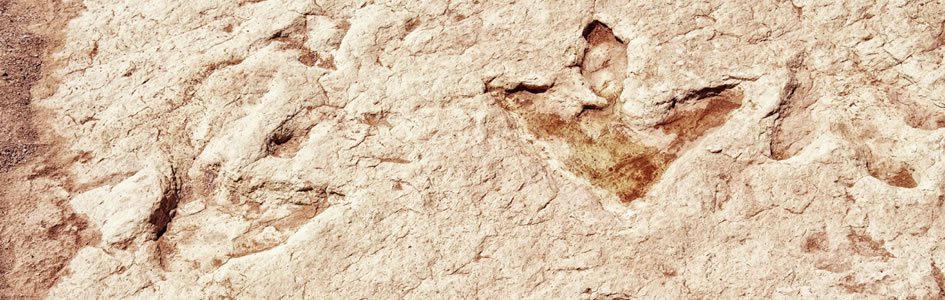
It’s currently the longest scientifically mapped dinosaur trackway in the world and the largest group of tracks ever discovered in the UK.1 A team of paleontologists and an army of student volunteers from the University of Birmingham (my alma mater) are busily exposing what has been dubbed the “dinosaur superhighway.”
The tracks, the longest of which runs for over 220 m (720 feet),2 were originally discovered in the 1990s at Dewars Farm Quarry, North Oxfordshire, England, by an observant quarryman, Gary Johnson. Last year, 200 more footprints were unearthed to the amazement of paleontologists.
“These footprints are insanely big,” explains Emma Nicholls from Oxford University’s Museum of Natural History. . . . “Even after being a palaeontologist for over 20 years, it still gives you that tingling feeling to see these footprints. . . . It’s humbling.”3
Dr. Emma Nicholls from Oxford University’s Museum of Natural History stated of the tracks, “They’re the massive footprints of a sauropod dinosaur; probably Cetiosaurus, which is a dinosaur that we know was found in this area.”4
Cetiosaurus was a large sauropod (four-footed) dinosaur, measuring about 18 m (60 feet) long.5 It is touted to have lived “166 million years ago,” from the Middle Jurassic Period, and roamed across what is described as a “lagoon,” part of a shallow marine environment. Four Cetiosaurus trackways have been discovered, crisscrossing each other, with the trackway of a Megalosaurus, another large, predatory theropod (two-legged, three-toed) dinosaur that is about half the length of Cetiosaurus.6 At one point, the tracks converge, raising questions about how they were interacting. From the evidence, it appears the Megalosaurus crossed over the Cetiosaurus trackway sometime later.
Video of the footprints has been captured from the air by drone. Using the images, a clever 3D computer animation of a Cetiosaurus walking has been produced by Professor Peter Falkingham, paleobiologist from Liverpool John Moores University. From his observations he concluded, “It’s not moving particularly fast, two metres per second [6.5 feet/second]. It’s about the same speed as a human would walk quickly—in this case it’s a stroll.”7
The footprints are all evenly spaced, meaning the dinosaurs walked at a steady pace. Of great interest, one footprint in the track is slightly off to the side, which seems to indicate the dinosaur stopped mid-stride, paused to look behind, then continued its journey.
Marine Preservation
It is the environment in which the trackways are preserved that is of great interest. Firstly, the tracks are in limestone, which is a marine rock. The footprints were thought to have formed when the dinosaurs ambled across mudflats of a shallow lagoon, which then baked dry in the sun, preserving them. However, even if that were the case, the imprints would require preservation from the next tide. The conundrum is described by University of Birmingham paleontologist Kirsty Edgar:
Footprints require the “Goldilocks effect.” . . . You need the sediment to be of the right consistency, the right type, and in the right environment to make the footprints. . . . It is quite unique to get that sort of confluence of events where they’re both made and then quickly preserved, particularly in this kind of quantity.8
But where did the sediment come from to preserve so many massive footprints?
But where did the sediment come from to preserve so many massive footprints? Professor Edgar doesn’t explain, but a BBC article, with a literary wave-of-the-hand, suggests, “Perhaps a tide of mud . . . washed over them as a storm blew in.”9
But what kind of a storm would produce a tide of mud? I’ve never seen one!
Furthermore, marine fossils have been found in the quarry floor where the trackways are. Dr. Duncan Murdock, from Oxford University’s Museum of Natural History, stated,
We’ve got little seashells—things like bivalves and brachiopods. . . . Right here is a little belemnite, which is a squid-like animal that was swimming through the water. . . . And we found this little sea urchin. It’s got this one spine that’s broken off, otherwise it’s an almost complete little, tiny sea urchin.10
Murdock notes that the sea urchin finding is “really important for us because it tells us that these were marine conditions in the open seawater before the dinosaurs came and walked here.”11 He then compares the past seascape to a modern environment, saying, “It would have been something like a lagoon, a bit like the Florida Keys or the Bahamas today.”12
However, as will be discussed below, we don’t think these marine conditions would have been so idyllic.
Professor Edgar makes a very important observation about the Oxfordshire trackways, “Most of what we know about dinosaurs comes from the skeleton. But often we find the body fossils and dinosaur tracks are preserved in different layers of rock” (emphasis added).13
Why different layers of rock? Aren’t we told that rock layers are separated by lots of time? So why would trackways be preserved in different layers than the animals who made them? This dilemma is not just an isolated incident; it is the norm. It is known all over the world that trackways made by all types of animals are consistently found in lower layers than the creatures who made them that are found in higher layers.14
Separating Fact from Fiction
The scientists in their measurements and 3D reconstructions have demonstrated what good operational science is—observable, measurable, repeatable—and they should be commended for this. However, it is the historical interpretation of the data that we would disagree with. You see, no one was there to directly observe what kind of environmental conditions the dinosaurs were walking in. Their trackways could only have been preserved if thick sediment, and lots of it, quickly covered the newly made footprints—obviously so because we don’t go down to the seaside today and find lots of fossilized footprints of people playing in the sand! The associated marine fossils and limestone rock in which they and the dinosaur tracks are preserved means they were covered in marine sediments. That it is the norm for trackways to be preserved in lower layers than the creatures who made them, who are preserved in higher layers, is a worldwide geological conundrum.
The Explanatory Power of the Flood
The dinosaurs were likely making their way to higher ground, away from the rising floodwaters.
All these mysteries are solved when we recognize that the Bible, God’s inerrant Word, describes the historical global flood, which alone could have produced such fossils. They don’t require millions of years to form—the evidence points to quick, watery preservation. The dinosaurs were likely making their way to higher ground, away from the rising floodwaters. The next tsunami wave would have provided the sediment required to quickly cover and preserve their tracks. When we start with God’s Word, things like land-dinosaur trackways preserved in marine sediment make perfect sense.


Footnotes
- Kirsty Edgar, in “One of the Longest Dinosaur Trackways Uncovered in Oxfordshire Quarry | University of Birmingham,” University of Birmingham, YouTube, October 14, 2025, https://youtu.be/X7XY2XbYDF4?si=DP196bIEfwtRth4x.
- The “superhighway” tracks run the entire length of the quarry and can only be further exposed by removing the rock overburden by explosives.
- Rebecca Morelle, Alison Francis, Kevin Church, and the Visual Journalism Team, “How a Huge Dinosaur Trackway Was Uncovered in the UK,” BBC, October 14, 2025, https://www.bbc.co.uk/news/resources/idt-5f8c77b0-92bc-40f2-bf21-6793abbe5ffe.
- Morelle, Francis, and Church, “How a Huge Dinosaur Trackway Was Uncovered.” Many Cetiosaurus bones have been found in Oxfordshire. See Oxford Museum Collections, “Cetiosaurus oxoniensis Phillips, 1871,” https://www.oumnh.ox.ac.uk/collections-online#/item/oum-catalogue-788226.
- Sauropod dinosaurs are thought by many creationists to be the Behemoth of Job 40:15–24.
- Megalosaurus bones have been found in Oxfordshire, see Oxford Museum Collections, “The Oxford Dinosaur That Started It All,” accessed October 2025, https://oumnh.ox.ac.uk/megalosaurus-0. Note the early reconstructions before modern more-accurate depictions.
- Morelle, Francis, and Church, “How a Huge Dinosaur Trackway Was Uncovered.”
- Morelle, Francis, and Church, “How a Huge Dinosaur Trackway Was Uncovered.”
- Morelle, Francis, and Church, “How a Huge Dinosaur Trackway Was Uncovered.”
- Morelle, Francis, and Church, “How a Huge Dinosaur Trackway Was Uncovered.”
- BBC News, “One of the World’s Longest Dinosaur Trackways Uncovered in UK | BBC News,” YouTube, October 14, 2025, https://www.youtube.com/watch?v=FicnEcccapM, 3:30–3:38.
- Morelle, Francis, and Church, “How a Huge Dinosaur Trackway Was Uncovered.”
- Edgar, “One of the Longest Dinosaur Trackways Uncovered.”
- Andrew A. Snelling, “Fossilized Footprints—A Dinosaur Dilemma,” Answers Magazine 5, no. 4 (October–December 2010): https://answersingenesis.org/dinosaurs/footprints/fossilized-footprints-a-dinosaur-dilemma/.


Support the creation/gospel message by donating or getting involved!

Answers in Genesis is an apologetics ministry, dedicated to helping Christians defend their faith and proclaim the good news of Jesus Christ.
- Customer Service 800.778.3390
- Available Monday–Friday | 9 AM–5 PM ET
- © 2026 Answers in Genesis