

Did Dinosaurs Once Swim from America to Africa?
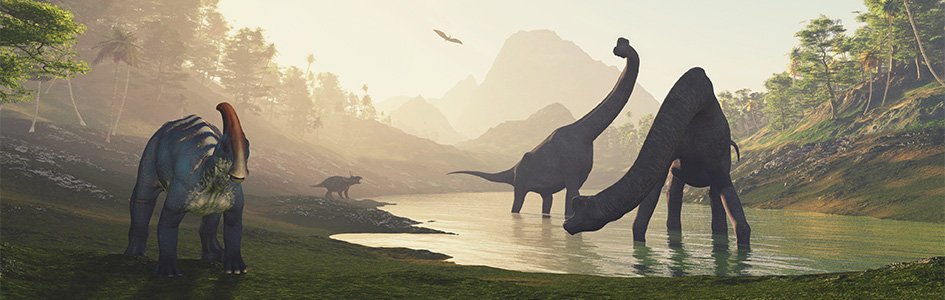
Did dinosaurs once swim across what’s now the Atlantic Ocean to colonize Africa? Well, according to a new study, they must have completed this “once-in-a-million year event,” because, well, the dinosaur fossils are found in North America and then they show up in Morocco (North Africa), so . . . of course they swam hundreds of miles and somehow survived! (It’s just typical evolutionary storytelling!)
According to evolutionary interpretations, 66 million years ago the continent of Africa was “a lone island continent,” like Australia is today, separated from what’s now North America by hundreds of miles of open water. But evolutionists have a problem.
The remains of a member of the duck-billed dinosaur family that evolved in North America were recently found in northern Africa—prompting questions as to how they got there.
So how did they get there? Researchers say, “A herd of pony-sized duck-billed dinosaurs must have either floated or swam across.” If that sounds impossible to you, you’re not alone—one of the researchers noted that it’s “extremely improbable.”
“It’s extremely improbable that dinosaurs could cross water to get to Africa,” he said. “But improbable isn’t the same as impossible. And given enough time, improbable things become probable.”
“Buy a lottery ticket every day, and if you wait long enough, you’ll win. These ocean crossings might be once-in-a-million-year events but the Cretaceous lasted nearly 100 million years.”
“A lot of strange things will happen in that time,” he suggested, “including dinosaurs crossing seas.”
In other words, it doesn’t matter how improbable something is, because time is the evolutionary hero. Just give it enough time and, sure, it must have happened! (Keep in mind that no one observed dinosaurs swimming across the ocean. This is an interpretation based on their assumptions regarding evolution and the ages of certain rock layers, along with assumptions regarding when and how the continents broke apart.)
Man’s word: With time, nothing is impossible.
God’s Word: “For nothing will be impossible with God” (Luke 1:37).
Without eons and eons of time—an incomprehensible amount of time, really—none of their ideas will work.
This is why evolutionists get so angry when anyone questions millions of years! Without eons and eons of time—an incomprehensible amount of time, really—none of their ideas will work. They must have millions and millions of years.
The popular science article reporting on this new research notes that much smaller reptiles have been observed surviving long trips at sea.
The researchers compared the anomaly of the crossing to the unusual journeys of some modern-day animals, such as a group of at least 15 iguanas swept off the shores of Guadeloupe in the Caribbean by a hurricane and washed up around 200 miles away on the island of Anguilla a month later in 2015, or a tortoise from the island of Aldabra that once drifted ashore in Tanzania, 700 kilometers away.
We believe that, after the global flood, many animals and plants, including reptiles like tortoises, were stuck on massive floating log mats made of vegetation ripped up during the flood and that’s how they were dispersed to other places. Larger animals likely colonized new places via land bridges or “island hopping.” Lower ocean levels due to the post-flood ice age would make this easier than it would be today.
Over the years, we’ve had evolutionists make fun of this idea—and yet ocean rafting has now been observed in some of the very species we suggested traveled this way, and evolutionists are forced to believe that a herd of 500-pound dinosaurs made the trek floating or swimming!
Those duck-billed dinosaurs found buried in North America and North Africa were all buried during the global flood. They don’t represent populations separated by millions of years on continents slowly drifting apart. They were catastrophically buried, and the single pre-flood continent broke apart into today's seven continents where they were rapidly and violently ripped apart and moved into different configurations during the global flood just 4,350 years ago.
As I’ve said over and over, it’s the same evidence, just two different interpretations because of very different starting points: God’s Word and man’s word.
Thanks for stopping by and thanks for praying,
Ken
This item was written with the assistance of AiG’s research team.
Support the creation/gospel message by donating or getting involved!

Answers in Genesis is an apologetics ministry, dedicated to helping Christians defend their faith and proclaim the good news of Jesus Christ.
- Customer Service 800.778.3390
- Available Monday–Friday | 9 AM–5 PM ET
- © 2026 Answers in Genesis