

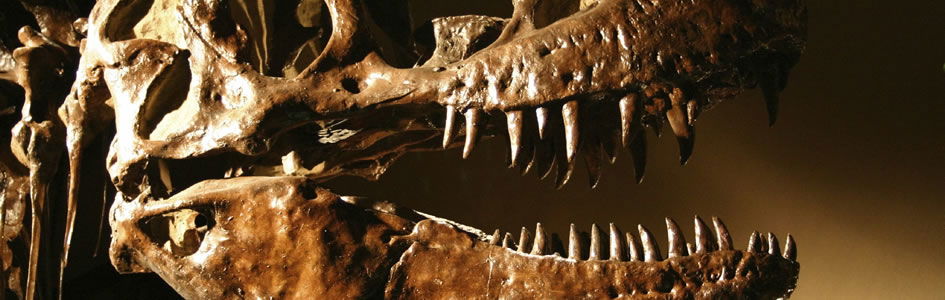
Dinosaur Bones
Dinosaur Bones with DNA
The survival of DNA within dinosaur bones would be powerful evidence against a millions-of-years age for those fossils. The findings support the view that these dinosaurs lived only 4,300 years ago and were buried during the global Flood.
Collagen and Keratin in Fossil Bones
A team in England confirmed the existence of soft skin tissue, known as keratin, in fossilized lizard skin. A team in Sweden showed that collagen has survived in the fossilized bone of a mosasaur. Since the researchers believe these fossils are 50 to 70 million years old, they need to explain how fragile biological molecules can survive so long.
Dinosaur Bones Hard for Evolutionists to Explain
Textbooks often show fossils slowly forming over time as animals lay on the ocean floor. However, real-life fossilization shows signs that it happened quickly. Soft-bodied animals like squid and jellyfish have been fossilized, as well as animals in the process of eating one another or giving birth. The global flood would have created the perfect conditions for fast fossils.
Articles About Dinosaur Bones
-
Dinosaur MummyJuly 4, 2009 from News to Know
A “mummified” dinosaur with soft tissues fossilized—evidence of watery disaster?
-
Antique ProteinMay 9, 2009 from News to Know
An incredible discovery that shocked the “millions of years” camp is back—with further verification.
-
Magazine Department ArticleTissue IssueJan. 1, 2009 from Answers Magazine
If dinosaurs were millions of years old, the soft tissue of the T. rex would have surely disappeared long ago.
-
Soft Tissue found In Dinosaur Sparks New DebateAug. 2, 2008
The much-publicized soft tissue found inside a T. rex thigh bone (supposedly millions of years old) may not be dinosaur protein after all.
-
Dec. 13, 2007 from Answers Magazine
The largest dinosaur grave in Europe has been unearthed.
-
Ireland's Sea DragonOct. 13, 2007
Found in Colin Glen, an area described by park ranger Paul Bennett as “rich in fossils and [...] of great geological interest,” the 2 3/4-inch (7 cm) section of backbone is from a plesiosaur said to have lived more than 144 million years ago and possibly as long as 190 million years ago.
-
Tyrannosaurus rex: a Big Chicken?April 14, 2007
Perhaps one of the most exciting recent discoveries for creationists has been the report of soft tissue found in a dinosaur fossil.
-
Marrow from a RexApril 14, 2007
Researchers have extracted and analyzed bone marror from a Tyrannosaurus Rex.
-
T. rex DrumstickApril 13, 2007
Finding T. rex soft tissue is compelling evidence that it was not 65 million years ago that dinosaurs died out, as given on the evolutionary timeline.
-
The Scrambling ContinuesMarch 6, 2006
Evolutionists continue to attempt to explain the presence of soft tissue in a T. rex bone a year ago.
-
“Ostrich-Osaurus” Discovery?March 28, 2005
Scientists have recently made the startling discovery of a dinosaur skeleton that still retains well preserved soft tissue.
-
Magazine ArticleA Living Dinosaur?Dec. 1, 2000, pp. 56–57
According to a report in Papua New Guinea's The Independent newspaper, a 'dinosaur-like reptile' was seen on two occasions in the Lake Murray area, in Western Province.
-
Magazine ArticleFresh Dinosaur Bones FoundJune 1, 1992, pp. 16–17
Fresh (not permineralized, meaning unfossilized) dinosaur bones had been found in Alaska. Such bones could never have lasted 70 million years.

Support the creation/gospel message by donating or getting involved!

Answers in Genesis is an apologetics ministry, dedicated to helping Christians defend their faith and proclaim the good news of Jesus Christ.
- Customer Service 800.778.3390
- Available Monday–Friday | 9 AM–5 PM ET
- © 2026 Answers in Genesis