

The Immediate Post-Exodus History of Egypt: The Amorite Fourteenth Dynasty
An interesting idea has been developed in recent decades that connects the Amorite Fourteenth Dynasty of Egypt with the Bible’s Exodus account. This fascinating time of history was when much of northern (lower) Egypt was overtaken by foreigners (that many ancient sources say were Asiatic hordes from the east). Some have recognized that the timing of this event may fit the aftermath of the biblical Exodus when Egypt was brought to its knees by the rapid succession of the 10 plagues—including the death of every firstborn—the loss (exodus) of Egypt’s massive slave force, and the destruction of a large portion of their army (and most importantly, their chariot cavalry) at the bottom of the Red Sea.
That hypothesis, further explored in this article, is that the Fourteenth Dynasty was comprised of foreigners who migrated to Egypt and, with a vulnerable Egypt following the events of the Exodus, took over the Nile Delta, which further weakened the native Thirteenth Dynasty. Then a few decades later, the Hyksos (Fifteenth Dynasty) came from outside Egypt to take advantage of the unique power vacuum created by these events and easily conquered parts of Lower Egypt and even parts of Upper Egypt (note that in Egypt the Nile River flows north, so “Lower Egypt” is the northern part where the Nile empties into the Mediterranean Sea).
Manetho described that these Asiatic “hordes” as leading an invading force sweeping in from the northeast and conquering the northeastern Nile Delta during the Second Intermediate Period in a time when Egypt as a country was vulnerable. However, Manetho described more than that. He also included the fascinating points that 1) the foreigners were able to take over Egypt without having to strike a blow and 2) that this event happened after “God smote” Egypt (Josephus, Against Apion Book 1, section 14, quoting from Manetho’s Aegyptiaca).
The Amorite Fourteenth Dynasty of Egypt
We know there were large numbers of Semitic migrants coming into Egypt both during and after the Twelfth Dynasty. These immigrants settled in Egypt when there was the opportunity. Some of these immigrants may have left with the Israelites during the Exodus, but many others may have stayed behind. It is almost certain that many of those who stayed behind comprised a significant portion of the Fourteenth Dynasty. In fact, a 2020 paper mentioned that there were more females than males immigrating into Egypt at the end of the Twelfth Dynasty (and early Thirteenth), and that makes sense of what we would expect of the Fourteenth Dynasty. The males were already in the Nile Delta working as miners and skilled workers, and their wives, sisters, and/or daughters migrated in afterward. This also makes sense of Manetho’s statement. He was correct that an invading force swept in from the northeast and conquered the northeastern Nile Delta, that the foreigners were able to take over Egypt without having to strike a blow, and that this event happened after “God smote” Egypt. What he was not correct about was that this was two separate events, with the latter invasion being the Fifteenth Dynasty Hyksos, because either he conflated the Fourteenth and Fifteenth Dynasties or viewed them as a single “foreign invasion” (which they were not). Although not described as such in Fig. 1 (below), the inset boxes in column 3 labeled as Nehsy and Kingdom of Avaris are the Fourteenth Dynasty.
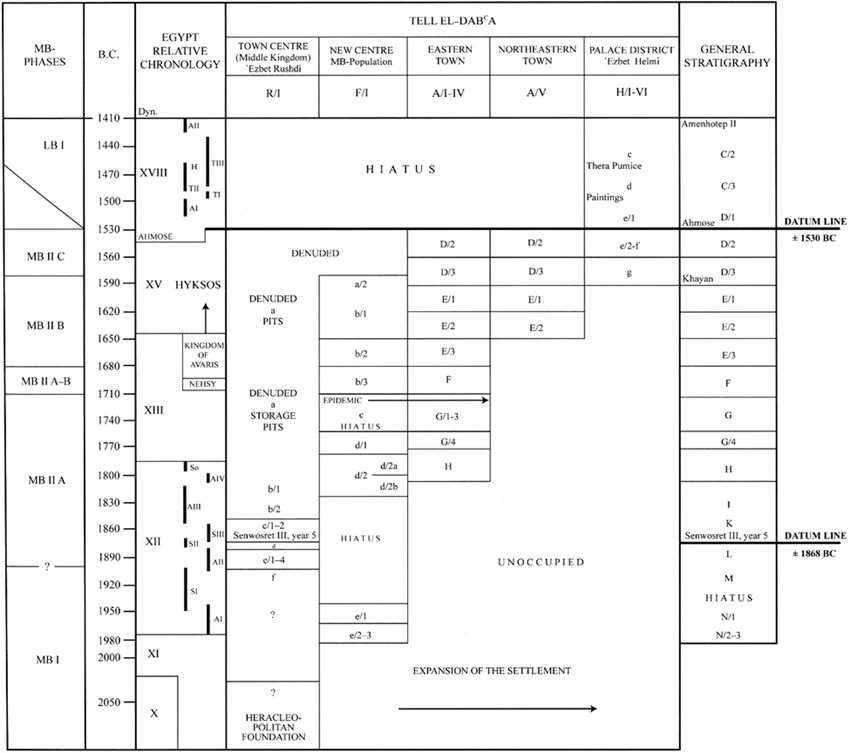
Fig. 1 The site stratigraphy system map of Tell el-Dabca. Courtesy of C. Stantis, A. Kharobi, N. Maaranen, G. M. Nowell, M. Bietak, S. Prell, et al., “Who Were the Hyksos? Challenging Traditional Narratives Using Strontium Isotope (87Sr/86Sr) Analysis of Human Remains from Ancient Egypt,” PLoS ONE 15, no. 7 (2020): e0235414, https://doi.org/10.1371/journal.pone.0235414.
Who were these people that took over the Nile Delta as the short-lived Fourteenth Dynasty? They were living in Tell el-Dab’a (near modern-day Avaris Egypt). Regarding the Thirteenth Dynasty, it was a mess from the very beginning although it remained somewhat stable until at least midway through. The south of Egypt (Upper Egypt) was in the process of coming under Kushite Nubian control (technically Nubia was always a threat to Egypt as far back as the reign of Eleventh Dynasty Pharaoh Mentuhotep II). When Egypt went through a second period of division and weakness (mid–late Thirteenth Dynasty), Kushite Nubia was able to take over the Egyptian forts and reoccupy the territory up to the First Cataract at the island of Elephantine and Aswan. At the same time, the Nile Delta was revolting and coming under control of “Asiatics.” The Fourteenth Dynasty is conventionally dated usually from either 1780 to 1650 BC or 1725 to 1650 BC. The Fourteenth Dynasty rulers had mostly Canaanite names and then added -ra or -re at the end to make them seem more Egyptian, and although 50 lines are allotted on the Turin Canon list, only 20 have their full names appear and just 9 have any mention of the length of their reigns and/or a contemporary attestation. If the ones with full reigns and attestations are added up, you could get a minimum of 25 years to a maximum of 66 years for the entire Fourteenth Dynasty.
Scripture tells us that the Amorites dwelt in the mountains (Numbers 13:29; Deuteronomy 1:44; Joshua 10:6); had numerous petty kings (Joshua 10:5); were often lumped together (and possibly confederates with) the Canaanites, the Girgashites, the Hittites, the Perizzites, the Hivites, and the Jebusites (Genesis 15:21; Exodus 3:17, 13:5; Deuteronomy 7:1); and were very warlike against any other (especially Semitic) neighbors (Numbers 21:23–26).
Some conventional and biblical archaeologists believe that the Amorites were a significant portion of the Fourteenth Dynasty. Using Egyptologist Kim Ryholt’s chronology, the first ruler of the Fourteenth Dynasty was an Amorite—Yakbim (“ia-ak-bi-im”)—or at least had an Amorite name. Interestingly several Fourteenth Dynasty kings included the words “bounty” (Merdjefare, Nebdjefare) or “provisions” (Webenre, Nebsenre, Sekheperenre) into their throne names, and this seems to indicate that food may have been a very important political factor.
According to Ryholt, “Among the prenomina of the immediate successors of Nehsy, it is conspicuous that no less than three are based on the word dß, ‘provisions of food, The fact that ‘provisions of food’ had become a topic of such political importance that it formed the subject of the prenomen, the most important royal name, clearly reveals that there was a shortage of foodstuffs in this period. The archaeological record at Tell el-Dab’a supplements this picture” (Ryholt 1997, 300). Food not only seemed to propel their legs when they were living in the mountains but also as Pharaohs of the Fourteenth Dynasty. Keeping in mind that this dynasty likely took over a weakened country due to a military but also economic collapse (because of the 10 plagues shortly beforehand), maybe it wasn’t as “good to be the king” as they would have thought.
We also know from Scripture that the Amorites were close to Egypt, living in the southern Judean mountains, and that several years (39 according to Ussher) after the Israelites routed the Amalekites, the Amorites attacked them (Numbers 21:21–24). We read of at least seven kings of the Amorites living in Canaan who Israel defeated, although a remnant of the Amorites survived until the time of Solomon (2 Chronicles 8:7–8) and were put into forced labor. I concur with the conventional identification that the Amorites were likely the largest component of the Fourteenth Dynasty. Their proximity to Egypt and apparent expertise in ironwork (Deuteronomy 3:3–5, 11; c.f. Deuteronomy 4:46–47) likely allowed them to enter Egypt during the Eleventh or Twelfth Dynasty as skilled laborers. And their warlike nature and their propensity to share power among themselves with several kings make them ideal candidates for the rulers of the Fourteenth Dynasty.
But rather than the accepted conventional (and sequential) strung-out dynasty, I propose that most of these kings ruled smaller sections of the delta concurrently. It is quite possible that there were three “capitals” of the Fourteenth Dynasty, Sais (modern-day Sa El-Hagar),1 Xois (modern-day Sakha), and Tell el-Dabca (Avaris). Having concurrent petty kings was how they did it in Canaan, so why change the ruling style that worked for them now that they were in Egypt? As mentioned earlier, the entire Fourteenth Dynasty could be compressed to a minimum of just 25–35 years, and it is likely that they started up immediately after the Red Sea miracle, which eliminated the immediate local ruling power—one of the mid–late Thirteenth Dynasty Pharaohs. It should be noted here that when Egypt went through this period of division and weakness (during the late Twelfth through Thirteenth Dynasties), they not only had to deal with the Fourteenth Dynasty coup in the north, but also their southern border was being threatened, and Kush (Nubia) was able to take over several Egyptian forts and reoccupy parts of (formerly Egyptian) territory up to the First Cataract. Interestingly enough, Rhyolt mentions that the Fourteenth Dynasty opened diplomatic relations and trade with the Nubians in Upper Egypt shortly after taking over the Nile Delta (Ryholt 1997, 300)
Most of the Fourteenth Dynasty rulers added the Egyptian god “Ra” to their names, which probably means that they endorsed Ra above the other gods and likely depleted or raided the temples devoted to Amun, Osiris, Set, Horus, etc. But money and power don’t mean much if you can’t keep yourself and your subjects fed. Recall that Egypt had just been devasted by 10 plagues and even the Exodus Pharaoh’s advisers had told him, “Do you not yet understand that Egypt is ruined?” (Exodus 10:7). And this was even before the plague of locusts who “ate all the plants in the land and all the fruit of the trees that the hail had left. Not a green thing remained, neither tree nor plant of the field, through all the land of Egypt” (Exodus 10:15).
The Amorites likely needed to set up several kings over small territories to quell outbreaks of rebellion. As mentioned earlier, the conventional chronology states that anywhere from 56 to 76 kings ruled during a period of 75–150 years (depending on the scholar). But if these kings ruled from three capitals, even taking the higher number of 76 kings and running their reigns as concurrent, this dynasty likely only lasted about 25–35 years (c. 1446–1411 BC) before the Fifteenth Dynasty took over.
Once the Amalekites (who comprised the Fifteenth Dynasty) grew powerful enough, after their utter defeat by Israel (Exodus 17:13), they noticed that the delta region of Egypt was ripe for the taking. By this time, delta crops had been growing again, and the land had rebounded. The Fourteenth Dynasty had been at war with the Thirteenth ruling from Itj-tawy (and then later Thebes) from the beginning. The time was right to attack the weakened Fourteenth Dynasty. Keeping in mind that the Amorites had attacked other Semitic peoples in the past: the Moabites (Numbers 21:26), Israelites (Numbers 21:23), and quite possibly, the Ammonites (Numbers 21:24 and Deuteronomy 3:11). It may also be likely that any Amalekites still living in Egypt had been put under hardship by the Amorite Fourteenth Dynasty. Any Semitic peoples still living in Egypt may have assisted the Amalekite Hyksos invasion from the inside.
But from an Egyptian perspective, it was just one group of Asiatics fighting with another. Most or all of the Fifteenth Dynasty were “outsiders,” and the influx of Amalekite conquerors was probably approximately offset by the exodus of the Amorites of the Fourteenth Dynasty (many of which had been in Egypt as skilled laborers before becoming the ruling class), who would have been considered part of the local delta population by this time. Many of the Amorite Fourteenth Dynasty probably fled back to the hill country of their homeland. And before long, the predictive prophecy of Genesis 15:16 was fulfilled: Those who weren’t killed by the Amalekite Hyksos invasion were killed just a short time later (4–14 years) when they attacked the Israelites in Numbers 21:21–35.
One could even view the Amalekite Hyksos Fifteenth Dynasty wiping out the Amorite Fourteenth Dynasty as a secondary fulfillment of Genesis 15:16.
Interestingly enough, one could even view the Amalekite Hyksos Fifteenth Dynasty wiping out the Amorite Fourteenth Dynasty as a secondary fulfillment of Genesis 15:16. God promised that Abraham’s descendants would return to Canaan (and most theologians believe that the Amalekites were the offspring of one of the sons of Esau, per Genesis 36:12), so this would also fall into the Genesis 15:16 promise. It is also implied in the same verse that judgment would come upon the Amorites at that time. “After four generations your descendants will return here to this land, for the sins of the Amorites do not yet warrant their destruction” (Genesis 15:16 NLT).2 Amalek routed the Amorites in Egypt (burning their temples, enslaving them, and chasing their armies out of Egypt, just as Manetho had said), while Israel wiped out or dispossessed the Amorites in Canaan. Both of these events would have occurred within a few years of each other. Looking again at the timing of the Fourteenth Dynasty in a Revised Egyptian Chronology of c. 1446–1411 BC, any survivors would have fled Egypt in 1411 BC and returned to their ancestral homelands just 4–5 years before the Israelites wiped out their cities on the east side of the Jordan.
Note: This article is adapted from Troy Lacey, “The Hyksos—Does the Bible Shed Light on Who They Were?,” Answers Research Journal 18 (February 2025): 97–124, https://answersresearchjournal.org/ancient-egypt/hyksos-bible-who-they-were/. For a more full treatment of the Twelfth through the Fifteenth Egyptian Dynasties, including tomb paintings and correspondence, concerning the (then-current) events in Egypt, please see this journal article.
Answers in Depth
2026 Volume 21

Answers in Depth explores the biblical worldview in addressing modern scientific research, history, current events, popular media, theology, and much more.
Browse VolumeFootnotes
- “2nd Intermediate Period: Dynasty XIV,” Dynasty Notes, accessed April 2026, http://www.phouka.com/pharaoh/pharaoh/dynasties/dyn14/dyn14.html.
- Many other English Bible versions of Genesis 15:16 stress this point, including the CEB, CJB, CEV, ERV, ICB, NOG, NCV, and the NIRV.

Support the creation/gospel message by donating or getting involved!

Answers in Genesis is an apologetics ministry, dedicated to helping Christians defend their faith and proclaim the good news of Jesus Christ.
- Customer Service 800.778.3390
- Available Monday–Friday | 9 AM–5 PM ET
- © 2026 Answers in Genesis