

Photo by Andreea Munteanu on Unsplash
The Controversial Case of Giza’s “Underground City”
Pioneers or “Pyramidiots”*?
Have giant underground structures been found beneath the Pyramids of Giza?
Like towering mountains of stone, the Pyramids of Giza—Khufu, Khafre, and Menkaure—rise from the timeless sands of Egypt. Khufu, the Great Pyramid, is one of the remaining wonders of the ancient world, dating from the Fourth Dynasty of the Old Kingdom. The Pyramids have provoked mystery and intrigue for Egyptologists and the public for centuries. Much has been found in recent decades to help explain their construction, but still, much more remains to be discovered.
However, recent “bombshell” claims by researchers have set the internet and “blogosphere” alight. The researchers believe they have discovered massive, ancient, artificial structures nearly 2,000 feet beneath the Pyramids, which until now, were entirely unknown to mainstream archaeology—or so they claim. Conspiracy theorists have clamored with explanations: ancient aliens, Giza power plants, lost civilizations, or pre-flood technology?
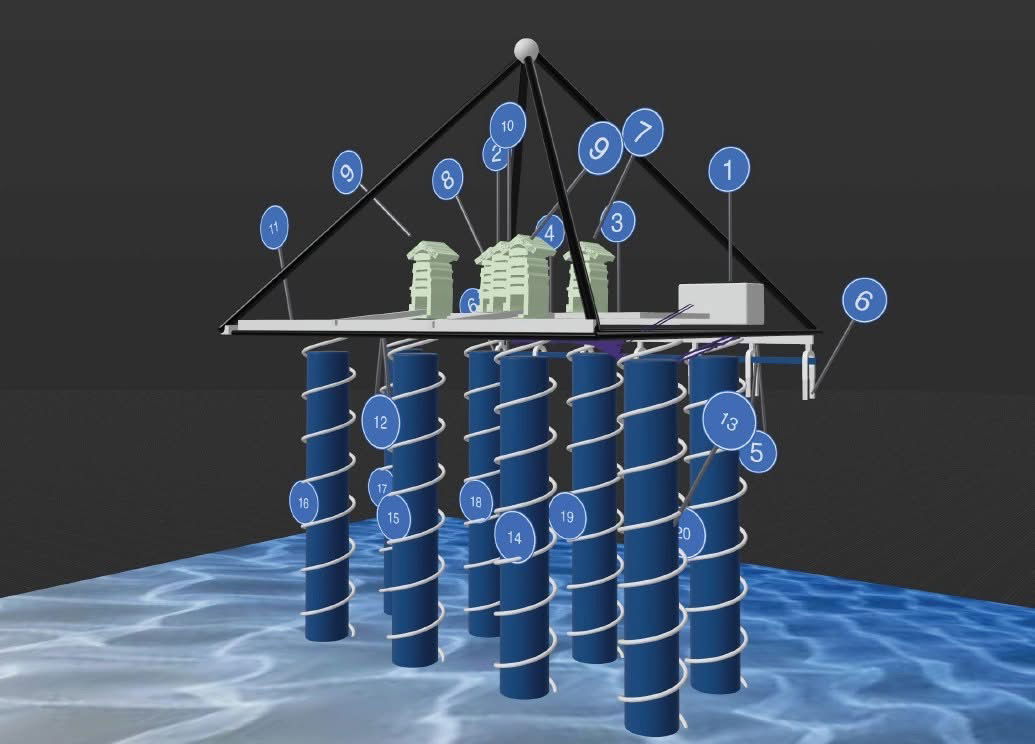
3D rendering of supposed underground complex (© Khafre SAR Project)
My interest was piqued by such astonishing revelations because of my personal connections to Egypt: exploring for oil and gas with the seismic industry (see later), a dozen or so visits to the pyramids (inside and out) while living in Cairo, and a master’s degree in Egyptology (2015).
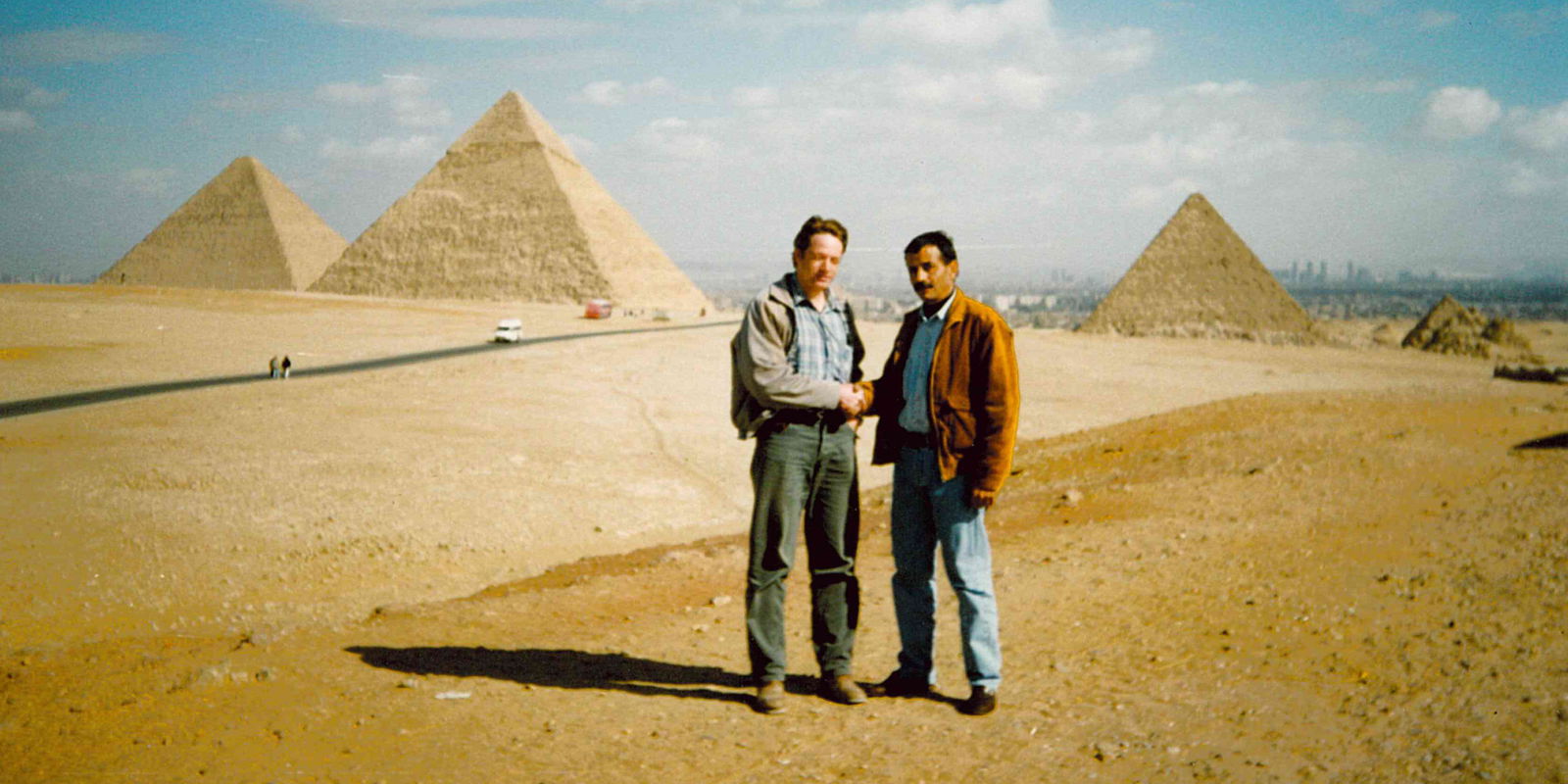
Gavin Cox (left) and colleague visiting Giza Pyramids, 1999.
Controversial Claims
On March 22, 2025, a group of Italian researchers—Corrado Malanga (University of Pisa), Filippo Biondi (University of Strathclyde, Glasgow), Armando Mei (explorer), and Nicole Ciccolo (head of communications)—presented, “The Khafre Research Project SAR Technology” to an audience of 1,000 delegates and live streamed as a lengthy press conference on YouTube.1 Here, information was presented for the first time that could shake up everything known about ancient Egypt—if proven true. The team contend certain satellite technologies combined with AI enabled them to visualize massive structures beneath the Pyramids.
This isn’t the first time such dramatic headlines have broken. On October 19, 2022, two of the team members (Biondi and Malanga) published research claiming they had found evidence for multiple new structures inside Khafre’s Pyramid using similar methods.2
Now, they say Menkaure’s Pyramid is sitting on top of something far bigger and more mysterious. Newly revealed images purportedly reveal eight hollow spiral pillars extending 648 meters (2,126 feet) below the surface, protruding from two 80 meter (262 feet) cubic foundations .
“We firmly believe that the Giza structures are interconnected. . . . The pyramids are merely the tip of the iceberg of a colossal underground infrastructural complex,” said Biondi, to Mail Online.3
Madness in the Method?
The researchers used the following methods and technology. Section 4 below explains the controversies:
1. Synthetic Aperture Radar (SAR)
- What It Is: A well-established technique typically used to monitor ground movements (e.g., landslides, earthquakes).
- How It Works: Radar pulses are sent from satellites, aircraft, or drones to the ground. Reflected signals are compared over time to detect tiny changes in solid surfaces within the study area.
- Limitations: The radar waves used (around 10 GHz) have millimeter wavelengths, so they can’t penetrate deep into dense materials like rock (a significant reason why phone signals are lost underground). SAR is therefore mostly useful for surface detection.
2. Doppler Tomography from Surface Vibrations
- What It Does: It analyzes “Doppler shifts”—tiny frequency changes in radar echoes caused by micro-movements (like seismic vibrations)—used to infer internal structures. SAR data is processed to detect tiny vibrations on the surface. These vibrations are interpreted as responses to subsurface features (e.g., voids, chambers). The technique involves the extrapolation of 3D images based on how these vibrations propagate.
- Claimed Innovation: The researchers combined SAR with Doppler scans to visualize 3D structures they claim exist beneath the pyramids—a novel technique they dubbed Synthetic Aperture Radar Doppler Tomography. The team used data from the COSMO-SkyMed satellite system and later Capella Space satellites to conduct their scans.
- Use of AI: In the latest study, they used AI to identify underground structures from the data, rather than human interpretation.
3. Not to Be Confused With: “Scan Pyramids”, an international project, led by Cairo University, employing noninvasive techniques including “muon tomography” (using cosmic ray muons to scan 2D and 3D images) to visualize inside Old Kingdom Pyramids. This project produced solid results that were thoroughly scrutinized and peer-reviewed.
4. Why Khufu Scan Claims Are Controversial:
- No New Peer-Reviewed Paper: (as of date of writing). Their bold 2025 claims were revealed via a YouTube press conference, not a published scientific study, raising concerns about transparency and peer scrutiny.
- Unverifiable Results: In their earlier 2022 paper, it can be noted that the tomographic images don’t match known structures in the Great Pyramid. The researchers highlight arbitrary areas in their images, leading to the possibility that they are just interpreting patterns in noise. Because their results have not been reproduced by other researchers, there remains a lack of control in data interpretation.
- Questionable Signal Sources: Without a strong and reliable source signal, the data could simply be random noise—especially problematic when using AI, which can find patterns even where none exist.
- Extraordinary Claims About Extraordinary Depths: The team claims to have found huge artificial structures 648 meters (2,126 feet) deep, which is far deeper than anything ever found under the Pyramids, yet no independent evidence supports this.
- Limited and Indirect: The method doesn’t “see” underground like X-rays; it infers structure based on surface behaviour. Accuracy decreases with depth—claims of detecting features hundreds of meters deep remain controversial.
- Researcher Worldview: One researcher (Corrado Malanga) is known for fringe theories about alien abductions, New Age, and UFOs, raising red flags about his scientific credibility.
- Incredible Dates Claimed for Structures: 38,000 years—far exceeds conventional dating of around 4,500 years for Khufu. Both scenarios predate Noah’s flood; therefore, both dating schemes should be rejected (see discussion below).
Why Age Matters
The researchers suggest these structures date back 38,000 years and were built by an advanced civilization that was later wiped out by a cataclysmic event. Their theory strays far from the mainstream that dates the Pyramids to around 4,500 years. However, as biblical creationists, we need to realize the Pyramids are post-flood and post-Babel constructions, so they aren’t much more than around 4,000 years old.
The physical evidence for drawing a post-flood construction date is that the Pyramids themselves are mostly made from material deposited by the flood—limestone,4 a sedimentary rock full of fossils. The Pyramids were constructed on a plateau made from the same rock. I have visited the Pyramids many times and have collected a particular kind of marine fossil called Nummulites5 that weather out of the limestone. These also appear within the Pyramid blocks. In other words, you can’t have Pyramids made of flood rock—full of fossils—that predate the flood!
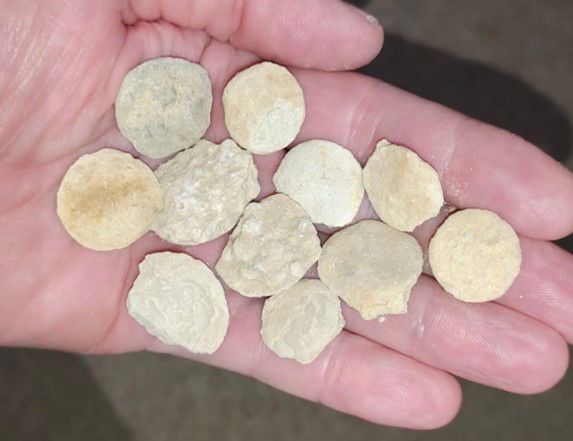
Gavin holding weathered out Nummulites fossils collected from limestone plateau near Khufu’s Pyramid.
Furthermore, Noah’s flood eroded entire continents, redepositing sediment into basins, meaning the Pyramids, despite their size, wouldn’t have stood a chance. The Bible’s date for the flood, according to the Masoretic chronology, places Noah’s flood at c. 2348 BC, so the Pyramids must have been constructed after this date. Additionally, dates for predynastic Egypt extend further back in time—3100–300,000 BC. Such dates are founded upon long-age assumptions made by researchers who did not directly observe such history. Therefore, dates for ancient Egypt exceeding the Bible’s date for creation of c. 4000 BC must be rejected.
Egyptologists Are Unconvinced
Unsurprisingly, the Khufu Scan’s claim of subterranean mega structures has triggered waves of scepticism in the academic world. For instance, Dr. Zahi Hawass, Egypt’s most-prominent (and controversial) archaeologist and former minister of antiquities, was blunt in his dismissal. Stating on his official website:
The rumors suggesting the presence of columns beneath the Pyramid of Khafre are nothing but fabrications propagated by individuals with no expertise in ancient Egyptian civilization or the history of the pyramids.6
Other Egyptologists and geophysicists agree about the worrying lack of peer-review. Many see it as part of a growing trend of “pseudoarchaeology”—wild claims that capture the public imagination but don’t hold up to scientific scrutiny.
Even experts who use SAR technology in archaeology note its limitations. While SAR can detect surface-level or near-surface features under ideal conditions, detecting fine details thousands of feet underground from space is well beyond its capabilities.
Personal Experience
My own professional experience of working a decade in the seismic industry includes a couple of years in Egypt. Here I was involved in land, transition zone (land and shallow marine mix), and deep marine surveying. This helps me to “sift the chaff from the wheat” regarding these Khufu Scan claims. Here’s the rub, to see deep into the earth requires lots of energy. This is achieved by several different methods:
- A fleet of “Vibroseis” trucks employ metal pads, which powerfully vibrate the ground beneath them (see photo). The energy from this source (typically ranging from 10–100 Hz per sweep) can propagate up to 2 km deep and reflect (and refract) to the surface from various structures within the earth. The reflected energy is picked up by arrays of geophones placed in the ground. The signals are recorded, filtered for noise, amplified, and along with geographical and time data, are built into 2D slices or 3D models that can be interpreted by geophysical experts.
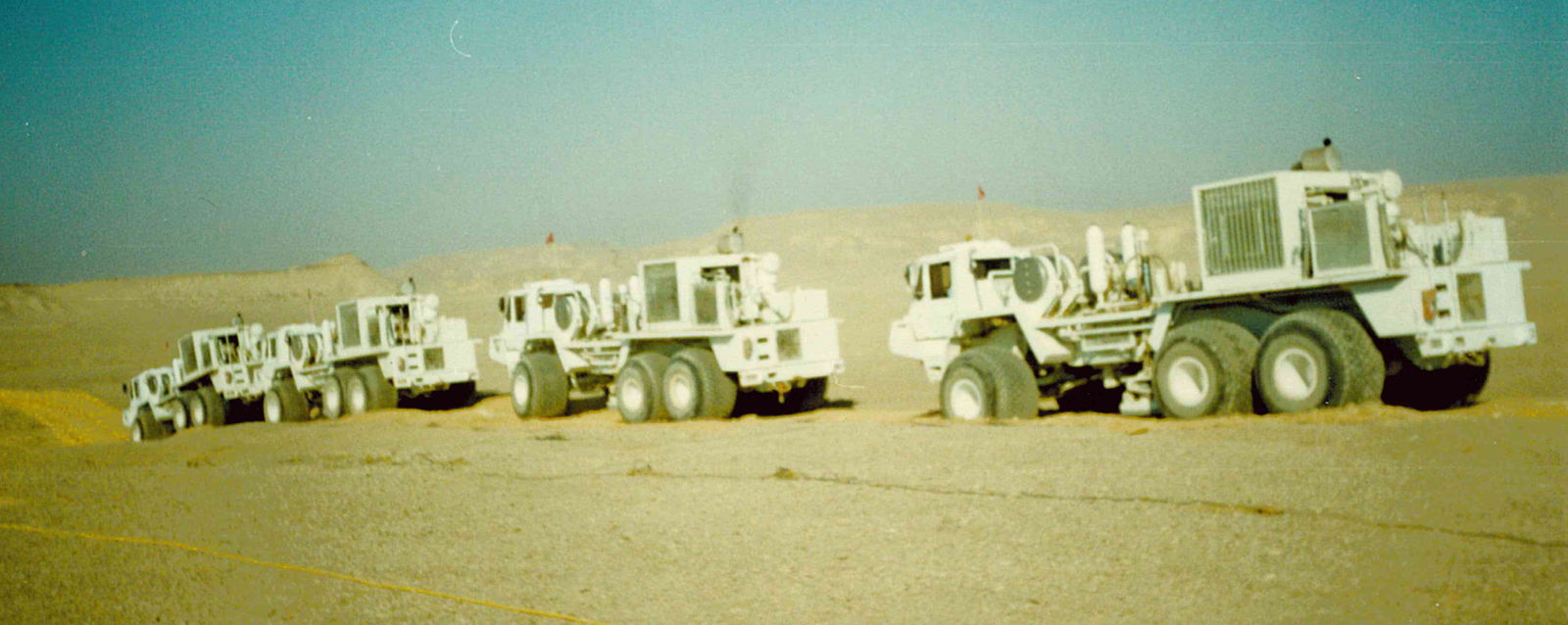
“Vibroseis” trucks in formation during geophysical survey, Egypt (Credit: Gavin Cox)
- When working through restricted or agricultural terrain, dynamite placed in shallow boreholes produce a similarly powerful source of energy.
- For shallow but high-resolution land studies, a borehole filled with water and a hydrophone can be used. Here the source energy can be produced by hammering a metal plate on the surface, and readings are recorded using a “seismic camera” (see photo).
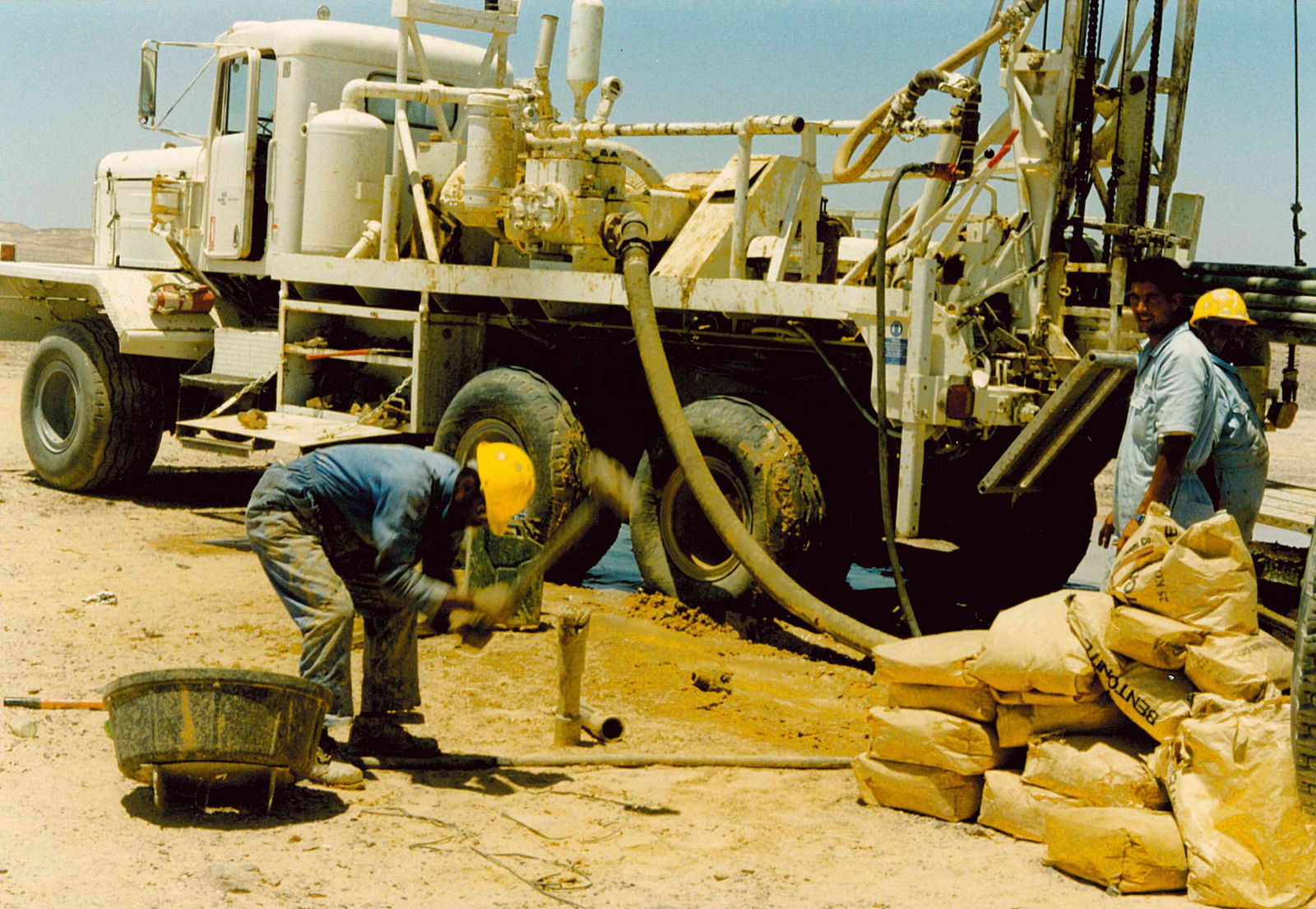
Seismic technician hits metal plate next to borehole, Egypt (Credit: Gavin Cox)
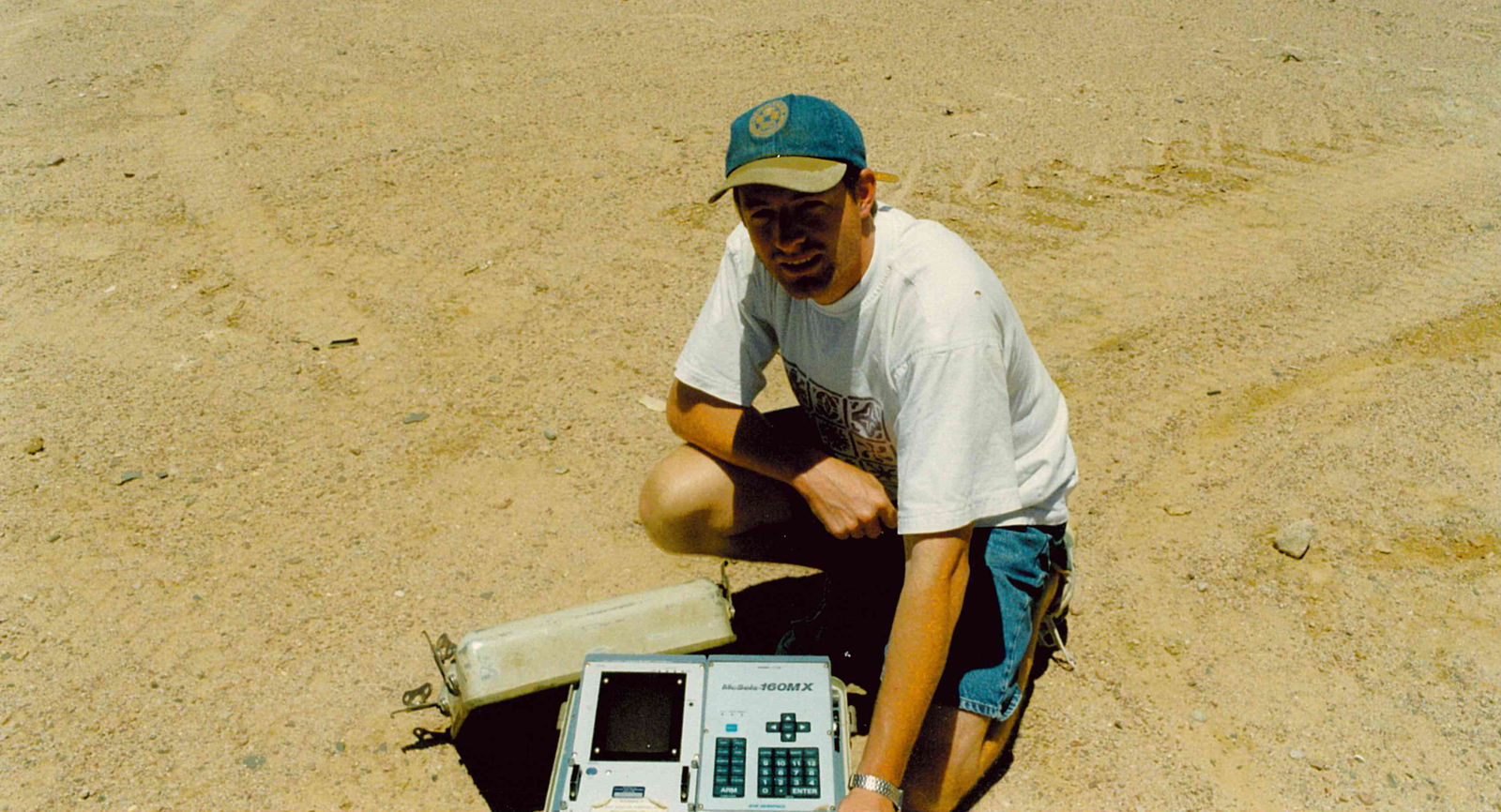
Gavin using a “seismic camera” to record traces from hydrophone, Egypt.
- For transition zone and shallow and deep marine surveys, typically an array of air guns produces seismic bursts of energy that propagate through water and into the earth. The returning reflected energy is recorded using hydrophones. These are either pulled along in long floating cables by boat or laid as ocean bottom cables.
Seismic theory explores how elastic waves move through the earth, revealing its internal structure. P-waves (primary/pressure) and S-waves (secondary/shear) travel at speeds that depend on the density and elasticity of the materials they pass through. In general, seismic waves move faster through denser, more rigid materials (like solid rock) and slow down in less dense or more ductile layers (like sediment or liquids). This variation in velocity helps geophysicists map layers deep underground, much like a medical scan of the earth’s body.
These are well-established technologies and have been used for decades to discover new sources of oil, gas, water, or mineral wealth. The take-home message is that to “see” very far below the surface requires powerful, consistent sources of energy. The interpretation of the data is only proven at the end of the day by “striking it rich.”
What’s Next?
Despite criticism, the Khufu Scans team stand by their findings, stating more analysis is on its way: “We’re still gathering information to thoroughly study the matter,” Biondi says.7
With no excavation, no physical evidence, and no new peer-reviewed data, the claims remain speculative at best.
Until then, Egyptologists urge caution. With no excavation, no physical evidence, and no new peer-reviewed data, the claims remain speculative at best. Nevertheless, the idea of a vast underground city beneath the Pyramids continues to fuel theories of the conspiracy minded. The controversies will no doubt rage on, so whichever side of the debate one takes will determine who the pioneers or “pyramidiots”8 are.
Conclusion
While the techniques the Khufu Scan team used are real in principle, their application, interpretation, and conclusions are highly questionable. The lack of measurable vibrations (weak, inconsistent energy source) or peer-reviewed validation and the reliance on AI to visualize structures, all adds up to serious skepticism in the scientific community—that all they are measuring and interpreting is “noise.”
The vast dates put on the underground structures must be rejected, but also as biblical creationists, we need to recognize Egyptian history is vastly overextended, not just beyond the flood but way before the Bible’s creation date. The history in the Bible is inspired and reliable. We can trust it from the very first verse and therefore reject claims of incredible antiquity for human-made structures, real or imagined.
Footnotes
- Expedition - Nicole Ciccolo, “Press conference #Giza. Armando Mei, Filippo Biondi, Corrado Malanga,” YouTube, March 22, 2025, https://youtu.be/xDpdJFlLpRE?si=BWKJDX3GqGTm0akH.
- Filippo Biondi and Corrado Malanga, “Synthetic Aperture Radar Doppler Tomography Reveals Details of Undiscovered High-Resolution Internal Structure of the Great Pyramid of Giza,” Remote Sensing 14, no. 20 (2022): 5231, https://doi.org/10.3390/rs14205231.
- Stacy Liberatore, “Scientists Uncover Second ‘Hidden City’ Beneath Egypt’s Giza Pyramids in Discovery That Rewrites History,” Daily Mail, June 9, 2025, https://www.dailymail.co.uk/sciencetech/article-14788441/Scientists-uncover-SECOND-hidden-city-beneath-Egypts-Giza-pyramids-discovery-rewrites-history.html.
- Except for the internal corridors and chambers, which are lined with granite.
- Lens-shaped foraminifers (single-celled marine organisms).
- Dr. Zahi Hawass, “A Statement from Dr. Zahi Hawass re: The Khafre Project,” accessed July 17, 2025, www.hawasszahi.com/news/a-statement-from-dr-zahi-hawass-re-the-khafre-project.
- Expedition - Nicole Ciccolo, “Press Conference #Giza.”
- * A derogatory phrase coined by archaeologist Osbert Guy Stanhope Crawford in 1935 to describe those who hold fringe theories regarding the Pyramids, also popularized by Dr Zahi Hawass.

Support the creation/gospel message by donating or getting involved!

Answers in Genesis is an apologetics ministry, dedicated to helping Christians defend their faith and proclaim the good news of Jesus Christ.
- Customer Service 800.778.3390
- Available Monday–Friday | 9 AM–5 PM ET
- © 2026 Answers in Genesis