

Evolutionary Atheistic Humanism: A Bloody Religion
There are several direct or indirect outcomes of all the ills that evolutionary and/or atheistic humanism has brought upon society. Many of these existed long before evolutionary thought pervaded much of society but all have increased dramatically since 1859 (after the publication of Darwin’s On the Origin of Species) and even more so by 1871 (after the publication of Darwin’s The Descent of Man). Just a few are listed below:
- Racism
- Genocide
- Eugenics
- Abortion
- Euthanasia
- Moral relativism
- Communism
- Atheism
- Satanism
- Homosexuality
- Transgenderism
- Collapse of traditional marriage
- Suicide
- Addiction (drugs/alcohol)
- Gambling
- Debt
- Prostitution
- Pornography
- Pedophilia
- Human trafficking
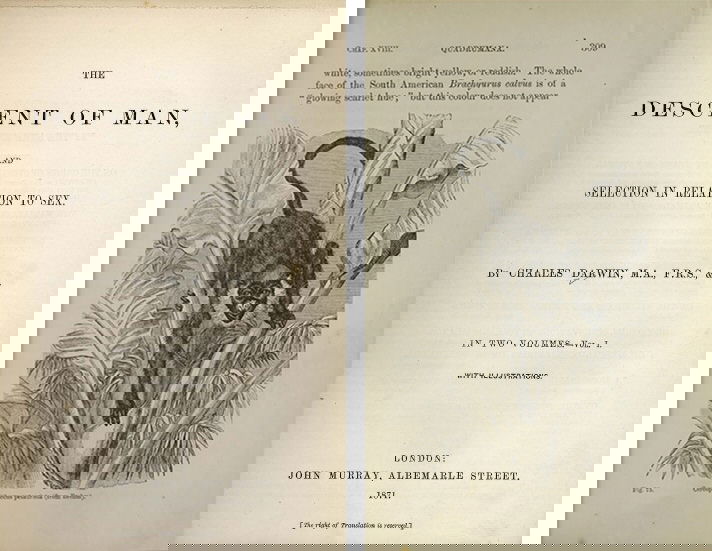
Public domain, via Wikimedia
What makes this list so lengthy is that the rationale for these things is often pinned to the belief that humans evolved via natural processes and that there are no absolute truths, ethics, or morality. In other words, once humanity decided to “shake off the shackles of religion,” they started down an inexorable path to all manner of sin.1 But what does Scripture have to say on this? Consider this extended quote:
And let me tell you this when materialism is [their] god, sex becomes the goddess. You see, history shows us—long history over thousands of years, and as much as we can trace it back—shows us again and again when nations and peoples are materially prosperous, they often become morally bankrupt.
And the moral bankruptcy, in turn, will destroy the prosperity. . . .
And [the Apostle] Paul says God’s wrath is shown by giving us over to sexual perversions, by giving us over to material preoccupation, and thirdly, he talks about being given over to self-promotion. In Romans 1:21, he says although they knew they claim to be wise, they became fools.
They have intellectual arrogance. They strutted around saying, “We’ve thrown off the shackles of God. We don’t need God anymore. We have a worldview that is detached from God. Aren’t we smart?” And Paul says they become fools.
[Their] thinking in Romans 1:20 becomes futile, and their foolish hearts become darkened. There’s only one thing worse than being a fool, and that’s being a fool and not knowing it, and thinking you’re smart. When we detach ourselves from God, we have no means of knowing what is true and what is right, because the fear of God is the beginning of wisdom. . . .
And he sums it up in Romans 1:28 describing 22 things that characterize the world that Paul’s readers in Rome knew was descriptive of their world, and if we’re to be honest, must recognize to be descriptive of our world. Romans 1:29—they’ve become filled with every kind of wickedness, evil, greed, depravity.
They’re full of envy, murder, strife, deceit and malice. They’re gossips, slanderers, God haters, insolent, arrogant, boastful, they invent ways of doing evil, they disobey their parents. They are senseless, tasteless, heartless, ruthless. And although they know God’s righteous decree that those who do such things deserve death, they not only continue to do these very things, but they also approve of those who practice them—of course they do.
If everybody else is doing it. It makes it easier for us. Without mock exaggeration, we can hold up this passage as a mirror to our society. Sadly. It tells us we’re under the wrath of God; he’s giving us over. He’s letting us go, and the consequences will be destruction and perversion.2
Ken Ham has said much the same thing in several blogs, for example in 2009, 2013, and 2020. The removal of any mention of God in public schools, science websites, and journals—and any discussion that dissents from preferred scientific consensus—has effectively promoted atheistic humanism. They have not removed religion from their curriculum; they have merely imposed another religion in the place of Christianity. The following quotes from evolutionist Sir Julian Huxley’s book make this plain:
A religion is essentially an attitude to the world as a whole. Thus evolution, for example, may prove as powerful a principle to coordinate men’s beliefs and hopes as God was in the past. Such ideas underlie the various forms of Rationalism, the Ethical movement and scientific Humanism. . . .
Humanism: An outlook that places man and his concerns at the centre of interest . . . Modern Humanism, which does away with traditional Christianity, is characterised by its faith in the power of human beings to create their own future, collectively and personally.3
And another quote from a leading humanist of several years ago really outlines the goals of the faith of humanism:
I am convinced that the battle for humankind’s future must be waged and won in the public school classroom by teachers who correctly perceive their role as the proselytizers of a new faith: a religion of humanity that recognizes and respects the spark of what theologians call divinity in every human being. These teachers must embody the same selfless dedication as the most rabid fundamentalist preachers, for they will be ministers of another sort, utilizing a classroom instead of a pulpit to convey humanist values in whatever subject they teach, regardless of the educational level—preschool day care or large state university. The classroom must and will become an arena of conflict between the old and the new—the rotting corpse of Christianity, together with all its adjacent evils and misery, and the new faith of humanism.4
What Are the Tenets of Atheistic Humanism?
Humanism is a progressive philosophy of life that, without true Christianity (as well as theism, deism, polytheism, and other supernatural beliefs, despite their deficits), asserts humanity’s ability and responsibility to lead ethical lives of personal fulfillment that aspire to the greater good of humanity. Atheistic humanist thought is the idea that when people are unshackled from religion and largely left free to pursue their own interests and goals, think for themselves, develop and hone their abilities, and operate in a social setting that promotes liberty, the number of beneficial discoveries and accomplishments increases and humanity moves further toward the goal of greater self-understanding, better laws, better institutions, and a good life.
Some declare humanism to be a religion, a life stance, or a worldview, while others profess it to be a progressive philosophy, an ethical perspective, or a belief system. Usually, an array of principles is provided as a list of what’s key to humanists—affirming human worth and dignity, reason, compassion, morality, ethics, democracy, scientific inquiry, naturalism, and critical thinking with no adherence or affirmation of a divine creator or other supernatural force. None of the definitions are entirely conclusive, and all are correct in outlining the fundamentals of humanism.5
In brief, they can be summed up as the Ten Commitments, which are listed below:
Critical Thinking, Ethical Development, Peace and Social Justice, Service and Participation, Empathy, Humility, Environmentalism, Global Awareness, Responsibility, and Altruism.6
At first, many of these “commitments” seem to borrow heavily from Christianity. Empathy, humility, responsibility, and altruism are core Christian values based on Scripture—especially the teachings of Christ and his apostles. But in the humanist religion, they are all based on introspection and have no real foundation or objective basis. Ultimately, humanists of all stripes decide for themselves what is right and wrong. The overarching question is this: Can humanity be good without God? Emeritus anthropologist C. R. Hallpike, of McMaster University (Canada), made some interesting observations on this subject.
Atheist humanists produce endless arguments for not believing in God, but it is curious that they never seem to ask themselves why we should believe in the existence of equality and human rights at all, which seem to be taken as a matter of faith. In a purely material, Darwinian universe, the whole idea of human rights is meaningless.
Concepts of human rights and dignity and worth emerged from the soil of the idea that humankind is made in the image of God. Without this theological foundation there is only the survival of the fittest or, at best, qualified co-operation with those we (or our genes) see as useful to our own ends.7
Track Record of Humanism in Governments: The French Revolution
Without a standard of absolute truth, morality ultimately collapses.
Going back to before Darwin’s books, one of the first purely humanist governments was that of the French Revolution. Without a standard of absolute truth, morality ultimately collapses. In most cases in history, it ends up consuming itself. The French Revolution (1789–1799) began with legitimate complaints against royal abuses and at first sought to reform the monarchy, making it more accountable. This led to the drafting of the Declaration of the Rights of Man, which the National Assembly of France approved on August 26, 1789.
This document, despite its similarities to both the Magna Carta and the US Declaration of Independence, was grounded in the philosophical and political ideas of Enlightenment thinkers like Jean-Jacques Rousseau and Voltaire. This led to a man-centered and morally relativistic definition of rights. For example, several of the articles appealed to human reasoning and natural rights apart from their creator.
- Article 1: “Men are born and remain free and equal in rights. Social distinctions may be founded only upon the general good.”
- Article 2: “The aim of all political association is the preservation of the natural and imprescriptible rights of man.”
- Article 4: “Liberty consists in the freedom to do everything which injures no one else; hence the exercise of the natural rights of each man has no limits except those which assure to the other members of the society the enjoyment of the same rights. These limits can only be determined by law.”
- Article 5: “Law can only prohibit such actions as are hurtful to society. Nothing may be prevented which is not forbidden by law, and no one may be forced to do anything not provided for by law.”
- Article 6: “Law is the expression of the general will.”
- Article 10. “No one shall be disquieted on account of his opinions, including his religious views, provided their manifestation does not disturb the public order established by law.”
- Article 11. “The free communication of ideas and opinions is one of the most precious of the rights of man. Every citizen may, accordingly, speak, write, and print with freedom, but shall be responsible for such abuses of this freedom as shall be defined by law.”8
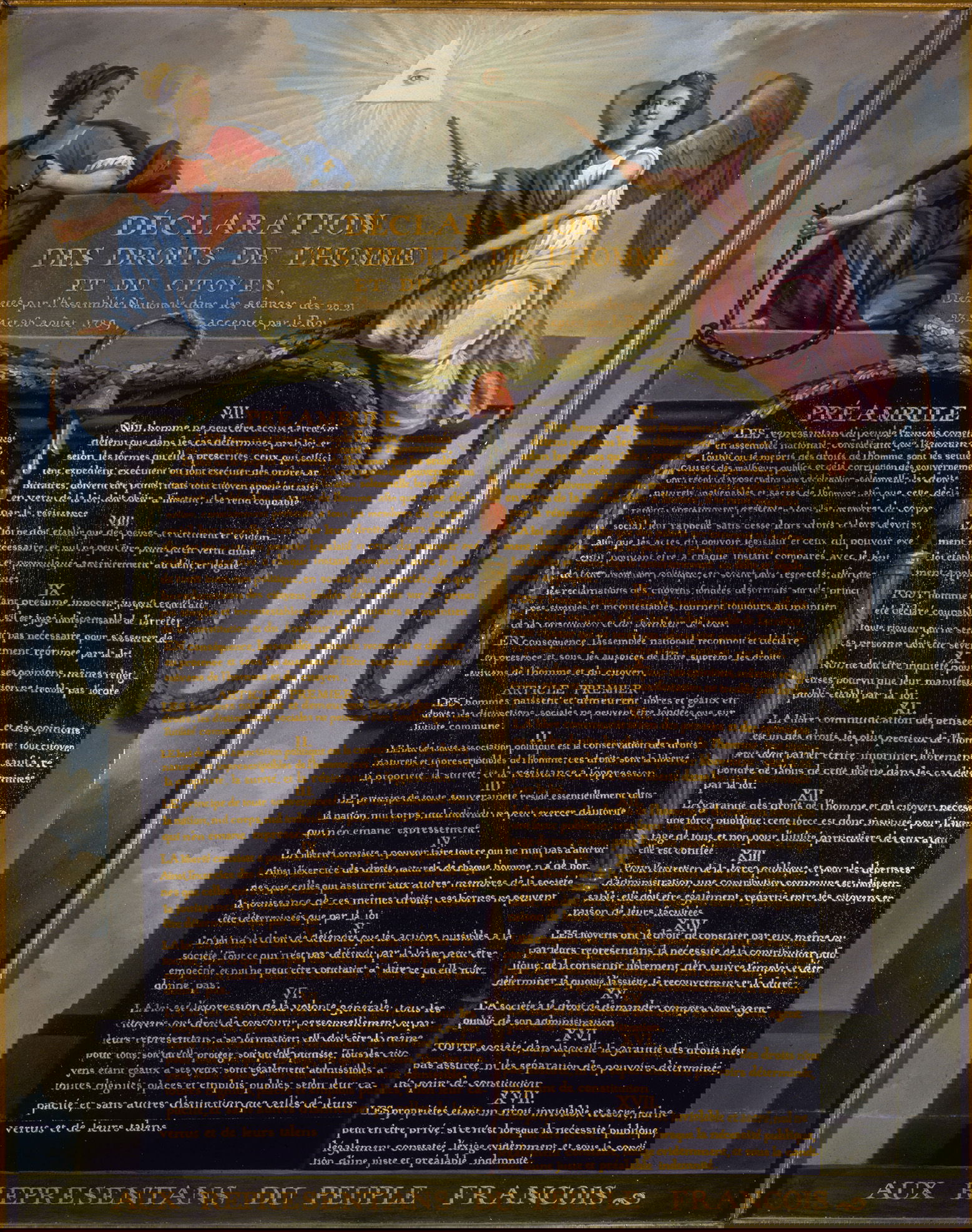 Jean-Jacques-François Le Barbier, Public domain, via Wikimedia Commons
It was the interpretation (and perversion) of these articles above that led to the bloodbath known as the Reign of Terror. If the aim of political association is based on the natural rights of man, and if those rights are the ability to do anything that doesn’t hurt society, and if one society deems another to be corrupt, then “nothing may be prevented which is not forbidden by law.” Furthermore, free speech and ideas cannot be tied to “public order established by law.” That then makes the government accountable to no one, so it can circumvent the rights of the citizenry by passing new laws that negate the essence of the previous “rights.”
Although the French Revolution began as vaguely deistic, it soon began to change into a “cult of reason” worshipping “philosophy.” On November 10, 1793, Antoine-François Momoro, Jacques Hébert, and their allies organized the Cult of Reason’s first festival. They seized churches and repurposed them as “Temples of Reason,” dedicated to the exaltation of the revolution’s more secular values of liberty and philosophy.9 Maximilien Robespierre later attempted to reinstate the deistic focus of the revolution by establishing the Cult of the Supreme Being, but with himself as the “high priest” of the new religion. One deputy of the National Convention, Jacques-Alexis Thuriot, is quoted as saying, “It’s not enough for him to be master, he has to be God.”10
It is easy to see the progression that led to the deposition and execution of King Louis XVI, and the trials of thousands of people as “enemies of the revolution.” Robespierre, who dominated the Committee of Public Safety (possibly the most ironic name ever given to a governing body) for a year (August 1793–July 1794), ordered the execution of several thousand people and eventually fell victim to his own relativistic worldview when another “government” deemed him an enemy of the state and ordered his execution on July 28, 1794. By then, the Reign of Terror had claimed somewhere between 20,000 and 40,000 lives, leaving much of France numb and weary of the incessant killings.11
One theologian summed up the differences between the American and French revolutions, which I believe is very pertinent to this discussion:
The only point I'm making here is how the French and American revolutionaries viewed Christianity and the church very, very differently.
Does the anti-Christian turn in France explain why the Reign of Terror came to France and not to America? Did the Christianity of the American revolutionaries save the colonies from the guillotine? Scholars have debated why the French Revolution turned out very differently from the American, despite both revolutions being founded upon secular, liberal, humanistic ideals [I would disagree here, because the American Revolution was founded on the Creator God’s giving of rights].
I think a lot about the French Revolution, how Liberté, Egalité, Fraternité [liberty, equality, fraternity] lead to the guillotine, and I wonder why more people don't talk about it. A humanistic ethic based upon universal human rights provided no protection from the darkness. Which makes me curious to know what guardrails humanism needs to keep itself on the side of the angels. Because if the French Revolution taught us anything, it's that humanism can easily create a Reign of Terror. Calls for equality and solidarity can go hand in hand with the guillotine.12
Track Record of Humanism in Governments: Twentieth-Century Naziism
As bloody as the French Revolution was, it paled in comparison to twentieth-century atrocities, carried out under evolutionary (and in most cases atheistic) humanism. Although consisting of diverse political spectrums (Marxism, state-run communism, national socialism, etc.), they were all influenced by social Darwinism and humanism.
Of course, the most notorious of these was Naziism (and for good reason), which (unlike the strictly atheistic communist regimes) would often paint a thin veneer of religiosity onto its propaganda. Soldiers would wear armbands and belt buckles with the phrase, “Gott Mit Uns” (God with us). See Figure 1 below:

Fig. 1
Remas6, Public domain, via Wikimedia Commons
But practically, Germany had closed many churches and nationalized the rest, forcing them to commit to the Fatherland more than any Christian ethics. They killed millions of people in death camps and yet thought God was with them (he was not!). While many of the existing churches in Germany at that time turned a blind eye to the growing atrocities of the Nazis (in large part because they had been infiltrated with Nazi “pastors” or closed down completely), one church denomination resisted and suffered because of it: the Confessing Church.
As it became clearer that National Socialism and Christianity were irreconcilable, the Confessing Church was ever more ready to see itself as independent of the state. It based its life on the essential foundation of the Bible, dissociated itself as far as possible from government measures and opposed the policies of the state.13
Nazi ideology was strongly based on social Darwinism (survival of the fittest), which was influenced by eugenics. Much has already been said about Hitler and other Nazi leaders’ fascination with “superior races” and eugenics, which was the natural outcome of biological and social Darwinism.
Track Record of Social Darwinism in Governments: Twentieth-Century Imperial Japan
While neither strictly atheistic nor strictly humanist, Imperial Japan was decidedly devoted to social Darwinism. They had been influenced by Darwin’s On the Origin of Species and the Descent of Man and had embraced “racial superiority” long before WWII.
Although some Japanese social groups were racist before, during, and even after World War II ended, the Japanese military worked the prisoners [of war] to death, or allowed them to starve or die from diseases brought on by malnutrition or even torturing the putative “inferior” races. In the end, Japanese racism was responsible for the deaths of millions of Chinese and other Asians, plus many thousands of Allied Prisoners of War.
As the superior race, during World War II Japan believed there was no such thing as “surrender” or “capture” because all Prisoners of War were considered, not only inferior humans, but also traitors to Japan. This is the reason why many thousands of Japanese soldiers committed suicide rather than surrender. They also treated American Prisoners of War cruelly, indiscriminately killing them due to the belief that they were an inferior race. The Americans were also believed to be inferior and weak, less than human for surrendering or allowing themselves to be captured, rather than dying in combat or by suicide.14
A military/scientific group conducted some of the more heinous social Darwinist crimes at a location called Unit 731. Unit 731 was established in 1936 and was located in Pingfang in Manchukuo, a Japanese puppet state at the time. Today, it forms part of Northeast China. This complex used prisoners captured in China, Russia, Korea, and Mongol (and elsewhere) as guinea pigs to develop bacteriological weapons, or simply for the “thrill” of torture. These prisoners were called “maruta,” meaning “logs” in Japanese, revealing Japanese sentiments that such prisoners were not even human.
The various types of experiments performed by Unit 731 were shocking. . . . [H]uman experiments to build weapons such as bacteriological weapons were common – they would inject germs “for vaccination” in the subjects’ bodies . . . . Approximately 600 Asian men and women fell victim to these inhumane crimes, and it was confirmed that at least 3000 “marutas” were killed during the Second World War.15
Both men and women were infected with sexually transmitted diseases, including gonorrhea and syphilis. Prisoners were also subjected to flea infestations, with the purpose of gathering huge amounts of disease-carrying fleas for use as a weapon. Away from the field of germ warfare, other weapons were tested on the prisoners . . . Research carried out at Unit 731 led directly to the development of bioweapons used against the Chinese population. Purposely discreet weapons, including infected food, infected water, infected clothing and plague-carrying fleas were used against Chinese civillians and led to the deaths of hundreds of thousands.16
From the invasion of China in 1937 to the end of World War II, the Japanese military regime murdered close to 10,000,000 people, most probably almost 6,000,000 Chinese, Indonesians, Koreans, Filipinos, and Indochinese, among others, including Western prisoners of war. This democide was due to a morally bankrupt political and military strategy, which was steeped in their belief in social Darwinism. Other factors included military expediency, custom, and national culture (such as the view that those enemy soldiers who surrendered while still able to resist were not even human).
Track Record of Atheistic Humanism in Governments: Stalin and the Communist USSR in the Twentieth Century
The overall number of people killed by Russian Marxism/communism in a 60-year period from 1917–1987 is estimated at 61,911,000 people.17 That number, though staggering, is based on reports from the Soviets themselves, mainly from forced labor camp records, which very well may have been underreported. University of Hawaii professor R. J. Rummel studied the extent of genocide and mass killing by governments since 1900. The results were shocking: According to these first figures, independent of war and other kinds of conflict, governments probably have murdered 119,400,000 people, Marxist governments about 95,200,000 of them (of which Soviets committed 61,000,000).18 The other 34,000 were committed by (mostly) Soviet-controlled and/or influenced dictators of Southeast Asian communist states like Tito (Yugoslavia), Pol Pot (Cambodia), North Korea, Vietnam, and other totalitarian states. By comparison, the battle-killed in all foreign and domestic wars in this century total 35,700,000. During WWII, the Soviets committed genocide against at least nine of their distinct ethnic-linguistic sub-nations, including ethnic Germans, ethnic Greeks, Crimean Tatars, various Slavs, Croats, Mongols, Jews, and Balkars.
Track Record of Atheistic Humanism in Governments: Mao’s China Purge of the Twentieth Century
According to the authoritative “Black Book of Communism,” an estimated 65 million Chinese died as a result of Mao Tse Tung’s repeated, merciless attempts to create a new “socialist” China. Anyone who got in his way was done away with—by execution, imprisonment, or forced famine.19
Chen Yizi was a communist party member who was an architect of the economic reforms of the 1980s and the founder of several government think tanks. During the pro-democracy movement in the spring of 1989, Chen urged the government to negotiate with the demonstrators. After the tanks rolled and thousands of people died in various protests, including the Tiananmen Square massacre, Chen became one of the seven most wanted—dead or alive—in China.
Chen, 54, fled to the United States and founded the Center for Modern China, based in Princeton, NJ. Using smuggled government documents, Chinese population statistics, and interviews with police and villagers in four Chinese provinces, Chen calculated that as many as 43 million people died during the famine that followed Mao’s absurd industrial campaign, the Great Leap Forward of 1958–1960.
“The truth will be much higher than this figure, believe it,” he said during a recent interview at his Princeton University apartment. “The biggest problem for the Communist Party is they never learned how to treat human beings like human beings.” Chen believes that from the Communist takeover in 1949 - through the landlord and intellectual purges of the 1950s, the Great Leap Forward, the Cultural Revolution and the prison system - at least 80 million met unnatural deaths.20
The Effects of Humanism on Current Society
Moral relativism, a main component of humanistic beliefs, permeates our culture. We see the worship of idols (the god of self), rampant sexual sin of all types, people redefining moral absolutes (which ultimately come from Scripture) so that the death of infants and the elderly is seen as good, and the right to life is viewed as antiquated at best or evil at worst. Even biological reality is denied as people decide to base their gender on what they perceive it to be. Feelings are elevated above truth, indeed, and are now classified as determining truth. Even the meanings of words are twisted to accommodate such views. Pedophiles are rebranded as “minor-attracted persons,” and the murder of children is termed as removing a “clump of cells.”

Photo by Harrison Mitchell on Unsplash
While the statistics in the previous two sections from (mostly) atheistic evolutionary humanism are staggering, they are (or will be) eclipsed by the humanistic religion of “self” as a god, including the exact same things we read about in Judges. Abortion, euthanasia, suicide, sex and drug trafficking, etc., are all affronts against a holy God. Around 73 million abortions take place worldwide each year, according to the WHO.21 Another organization has listed the estimate for total worldwide abortions from 1921 through December 2018, with the total standing at a staggering 1,052,572,155 (over 1 billion in 97 years), which averages to 10,851,259 (or 11,645,521 if allowing an average for underreporting) abortions per year.22 It’s hard to wrap your head around 10–11 million babies per year sacrificed to the god of self.
Euthanasia/assisted dying totals per year are harder to come by, but it is estimated that more than 30,000 people per year have been euthanized or used physician-assisted suicide to end their lives. Some countries list both together as one, while others divide them into two or three categories (euthanasia, doctor-assisted suicide, or assisted suicide). As of 2024, euthanasia was legal in Belgium, Canada, Colombia, Ecuador, Luxembourg, the Netherlands, New Zealand, Portugal (law not yet in force, awaiting regulation), Spain, and all six states of Australia (New South Wales, Queensland, South Australia, Tasmania, Victoria, and Western Australia). Although illegal in the US, nine states (and DC) have euthanasia laws, with at least 17 more having pending legislation.23
Total figures from around the world are hard to collate. Figures from Switzerland show that the number of those living in the country who underwent assisted suicide rose from 187 in 2003 to 965 in 2015.24 In Belgium, where euthanasia was legalized in mid-2002, cases rose from 236 in 2003 to 3,423 in 2023.25 Canada has an assisted dying law called MAID (which was enacted in 2016). In 2022, when 13,241 people requested assisted dying, that represented 4.1% of deaths in Canada.26 By 2025, that number had increased in Canada, and nearly 5% of all deaths are now the result of assisted suicide. Quebec is on track to eclipse 20% in just a few years.27 Euthanasia deaths in 2023 accounted for 7.3 percent of all deaths in Quebec, and in Lanaudière’s health region (just north of Montreal), it’s 12.4 percent.28
To put those numbers in perspective, if we took the US population (as of January 1, 2025), which was 341,145,670 people, and used Quebec’s rate of deaths, 7.3% of that number would be 249 million deaths by euthanasia. That is staggering! King Solomon said this about those who know the Lord (and those who do not):
For whoever finds me finds life and obtains favor from the Lord, but he who fails to find me injures himself; all who hate me love death. (Proverbs 8:35–36)
The atheistic, evolutionary humanist mindset is one that “loves death.”
Truly, as this article has attempted to illustrate, the atheistic, evolutionary humanist mindset is one that “loves death.” God cannot tolerate such evil as the killing of people made in his image (especially the most innocent and vulnerable) indefinitely. The only solution to this world’s fascination with death is forsaking sin, repenting, and trusting in Christ.



Footnotes
- “It’s enormously important to shake off the shackles of religion from the study of morality,” quoted from Richard Dawkins, “University of Miami Establishes Chair for Study of Atheism,” New York Times, May 20, 2016, https://wwrn.org/articles/45830/.
- Charles Price, “Now for the Bad News,” Charles Price Ministry, accessed October 2025, https://charlespriceministry.org/romans-5.
- Sir Julian Huxley, Growth of Ideas: The Evolution of Thought and Knowledge (Macdonald, 1965), 99, 336.
- J. Dunphy, “A Religion for a New Age,” The Humanist (Jan.–Feb. 1983): 23 (emphasis added); as cited by Wendell R. Bird, Origin of the Species—Revisited, Vol. 2 (Regency, 1991), 257.
- Kristin Wintermute, “Living Humanist Values: The Ten Commitments,” Humanist Magazine (August 2019): https://thehumanist.com/magazine/september-october-2019/features/living-humanist-values-the-ten-commitments/.
- Wintermute, “Living Humanist Values.”
- C. R. Hallpike, “The Moral Limitations of Atheistic Humanism,” Theos, February 18, 2016, https://www.theosthinktank.co.uk/comment/2016/02/18/the-moral-limitations-of-atheistic-humanism.
- National Assembly of France, Declaration of the Rights of Man – 1789, August 26, 1789, https://avalon.law.yale.edu/18th_century/rightsof.asp.
- Greg Pasciuto, “The Cult of Reason: The Fate of Religion in Revolutionary France,” The Collector, November 22, 2022, https://www.thecollector.com/fate-of-religion-french-revolution/.
- Harrison W. Mark, “Cult of the Supreme Being,” World History Encyclopedia, November 25, 2022, https://www.worldhistory.org/Cult_of_the_Supreme_Being/.
- Harrison W. Mark, “Thermidorian Reaction,” World History Encyclopedia, December 6, 2022, https://www.worldhistory.org/Thermidorian_Reaction/.
- Richard Beck, “Humanism and the Guillotine,” Experimental Theology, May 16, 2023, https://experimentaltheology.blogspot.com/2023/05/humanism-and-guillotine.html.
- Leonore Siegele-Wenschkewitz, “Christians Against Nazis: The German Confessing Church,” Christian History 9 (1984): https://christianhistoryinstitute.org/magazine/article/christians-against-nazis
- Jerry Bergman, “Japanese Genius Racist Masanobu Tsuji,” Creation Evolution Headlines, February 12, 2019, https://crev.info/2019/02/ww2-japanese-racism/.
- May We Speak, “Maruta Experiments,” March 19, 2014, https://maywespeak.com/maruta-experiments/.
- Jason Mitchell, “Code Name: Maruta – The Horrors of Unit 731,” What Culture, June 3, 2013, https://whatculture.com/offbeat/code-name-maruta-the-horrors-of-unit-731.
- R. J. Rummel, Lethal Politics: Soviet Genocide and Mass Murder Since 1917 (Transaction Publishers, 1990), https://www.hawaii.edu/powerkills/NOTE4.HTM.
- R. J. Rummel, Death by Government (Transaction Publishers, 1994), https://www.hawaii.edu/powerkills/NOTE1.HTM.
- Lee Edwards, “The Legacy of Mao Zedong Is Mass Murder,” The Heritage Foundation, February 2, 2010, https://www.heritage.org/china/commentary/the-legacy-mao-zedong-mass-murder.
- Beth Duff, “Mao Tse-Tung: Charges of 80 Million Dead Amid Murder, Starvation And,” The Roanoke Times, November 20, 1994, https://scholar.lib.vt.edu/VA-news/ROA-Times/issues/1994/rt9411/941120/11220007.htm.
- World Health Organization, “Abortion,” May 17, 2024, https://www.who.int/news-room/fact-sheets/detail/abortion.
- Wm. Robert Johnston, “Summary of Reported and Estimated Abortions Worldwide, Through December,” last updated December 31, 2018, https://www.johnstonsarchive.net/policy/abortion/wrjp3318.html.
- Theo Burman, “Map Shows Assisted Dying Laws Around the World,” Newsweek, last updated November 29, 2024, https://www.newsweek.com/which-countries-have-assisted-dying-suicide-map-1984916.
- Nicola Davis, “Euthanasia and Assisted Dying Rates Are Soaring. But Where Are They Legal?,” The Guardian, July 15, 2019, https://www.theguardian.com/news/2019/jul/15/euthanasia-and-assisted-dying-rates-are-soaring-but-where-are-they-legal.
- Jacques Wels and Natasia Hamarat, “Incidence and Prevalence of Reported Euthanasia Cases in Belgium, 2002 to 2023,” JAMA Network Open 8, no. 4 (April 23, 2025): https://jamanetwork.com/journals/jamanetworkopen/fullarticle/2833177.
- Campaign for Dignity in Dying, “Canada,” accessed October 2025, https://www.dignityindying.org.uk/assisted-dying/assisted-dying-around-the-world/canada/.
- Robert P. George, “Perspective: It’s Time to Hold the Line Against the Culture of Death,” American Enterprise Institute, July 19, 2025, https://www.aei.org/op-eds/perspective-its-time-to-hold-the-line-against-the-culture-of-death/.
- Morgan Lowrie, “Services at Quebec End-of-Life Care Home Reflect Growing Demand for MAID,” The Globe and Mail, August 31, 2025, https://www.theglobeandmail.com/canada/article-quebec-end-of-life-care-maid/.

Support the creation/gospel message by donating or getting involved!

Answers in Genesis is an apologetics ministry, dedicated to helping Christians defend their faith and proclaim the good news of Jesus Christ.
- Customer Service 800.778.3390
- Available Monday–Friday | 9 AM–5 PM ET
- © 2026 Answers in Genesis