
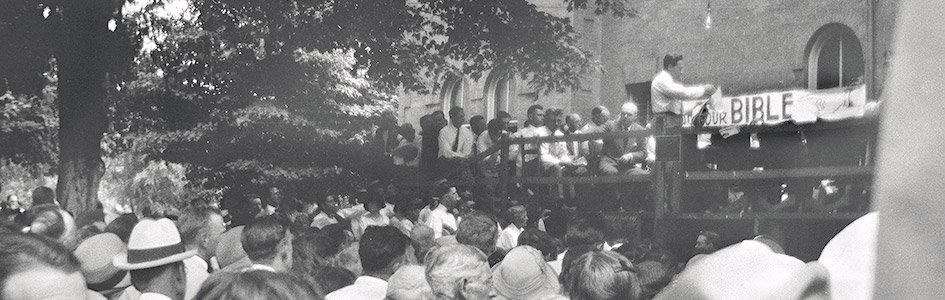
100 Years After the Scopes Trial: A Judge Reviews
What has been the cultural attitude toward Christianity since the famous trial? Have federal courts been monkeying around with the federal judicial oath?
“I take it you will tell the truth, Mr. Bryan.”
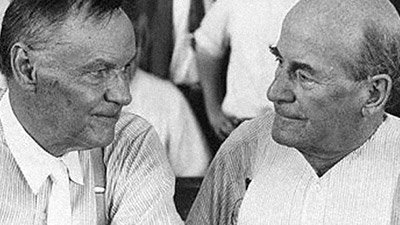
On the seventh day of the trial, William Jennings Bryan is called to the witness stand, and he fully intends to do just that—tell the truth. But having good intentions doesn’t mean he has all the right answers.
Clarence Darrow, representing the defendant John T. Scopes, begins asking Bryan questions about Jonah being swallowed by a fish, Joshua making the sun stand still, and the age of the earth.
“Do you think the earth was made in six days?”
“Not six days of twenty-four hours.”
“Doesn’t it say so?”
“No, sir.”1
The questioning reveals that Bryan, though a Christian, is unwilling and ill-equipped to stand firmly on Scripture and the plain meaning of Genesis.
In the end, Bryan wins the trial, meaning the Tennessee state law is (temporarily) upheld—the one that forbade teaching in public schools that man descended from a lower order of animals. But as Ken Ham observed,
Even though Bryan technically won the trial, in the whole scheme of things, it was a win for the secularists. In a real sense, the well-publicized trial showed the world that Christians couldn’t defend the history in the Bible—that they were willing to give in to the secular teaching of millions of years.2

For a proper understanding of all things “Scopes Trial,” readers are encouraged to examine Dr. David Menton’s videos. Dr. Menton was a well-respected and knowledgeable speaker on this topic and remains one of my personal heroes.
Inherently Wind
Why Is the Scopes Trial Significant?
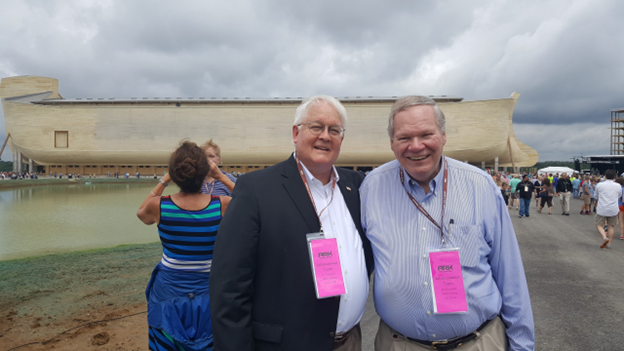
Dr. David Menton (right) and Judge Darrell White (retired) during the 2016 Ark Encounter dedication. Image courtesy Judge Darrell White.
After the Scopes Trial
Since that 1925 Scopes Trial, 100 years have passed and several generations of judicially imposed public secularism have given dominance to moral relativism, notwithstanding America’s national motto of “In God We Trust.”
Shockingly, only about 5% of Americans today possess a consistently biblical worldview according to the Cultural Research Center at Arizona Christian University.3 Public schools today reflect that low number. But ironically, the first public education law in America arose in 1647 and was called the Old Deluder Satan Act.4 This law wasn’t to silence biblical teaching in schools—quite the opposite. It was created by Puritans in Massachusetts, and it mandated families to educate their children and servants. Why? Because they believed that the “chief project of that old deluder, Satan,” was to keep people from reading and understanding Scripture.5
1947: 22 Years Later
Just 300 years after the Old Deluder Satan Act, a panel of unelected jurists possessed of supreme judicial authority at SCOTUS (each of whom took distinctly God-affirming judicial oaths themselves) misread history to pronounce a doctrine of “separation of church and state,” thus distorting the classical meaning of America’s First Amendment.
In this ill-advised Everson SCOTUS opinion, Justice Hugo Black misinterpreted the First Amendment by quoting from private correspondence between Thomas Jefferson and the Danbury Baptist Association. Black’s biographer reported that during this monumental case, Black did not even read the proceedings of the Congress that passed the First Amendment.6
Since that 1947 ruling, we’ve seen increasing hostility toward godliness in terms of abolishing public prayer, devotional use of the Bible, postings of the Ten Commandments, and balanced science education from America’s public schools.
As Justice William Rehnquist observed in an important 1985 dissent, “It is impossible to build sound constitutional doctrine upon a mistaken understanding of constitutional history.”7 Since that 1947 ruling, we’ve seen increasing hostility toward godliness in terms of abolishing public prayer, devotional use of the Bible, postings of the Ten Commandments, and balanced science education from America’s public schools.
1989: 64 Years Later
In Edwards v. Aguillard, SCOTUS nullified Louisiana’s “Balanced Science Education Act.” The act mandated that if evolution were taught in public schools, creationism must be taught alongside it, and vice versa. The court ruled summarily that requiring public school teachers to teach creationism under these circumstances violated the establishment clause.8
In his dissent, Justice Scalia noted that the Scopes trial likely influenced the majority opinion:
I am astonished by the Court’s unprecedented readiness to reach such a conclusion, which I can only attribute to an intellectual predisposition created by the facts and the legend of Scopes v. State, 154 Tenn. 105, 289 S.W. 363 (1927)— an instinctive reaction that any governmentally imposed requirements bearing upon the teaching of evolution must be a manifestation of Christian fundamentalist repression.9
2011: 86 Years Later
Justice Harlan gave his KJV Bible to the SCOTUS in 1906, and every justice since has signed its flyleaf pages after taking the oath of office. In honor of that tradition, the American Judicial Alliance works toward dedicating Bibles in courts across America, and I have had the privilege of leading that mission as director and founder.10
-
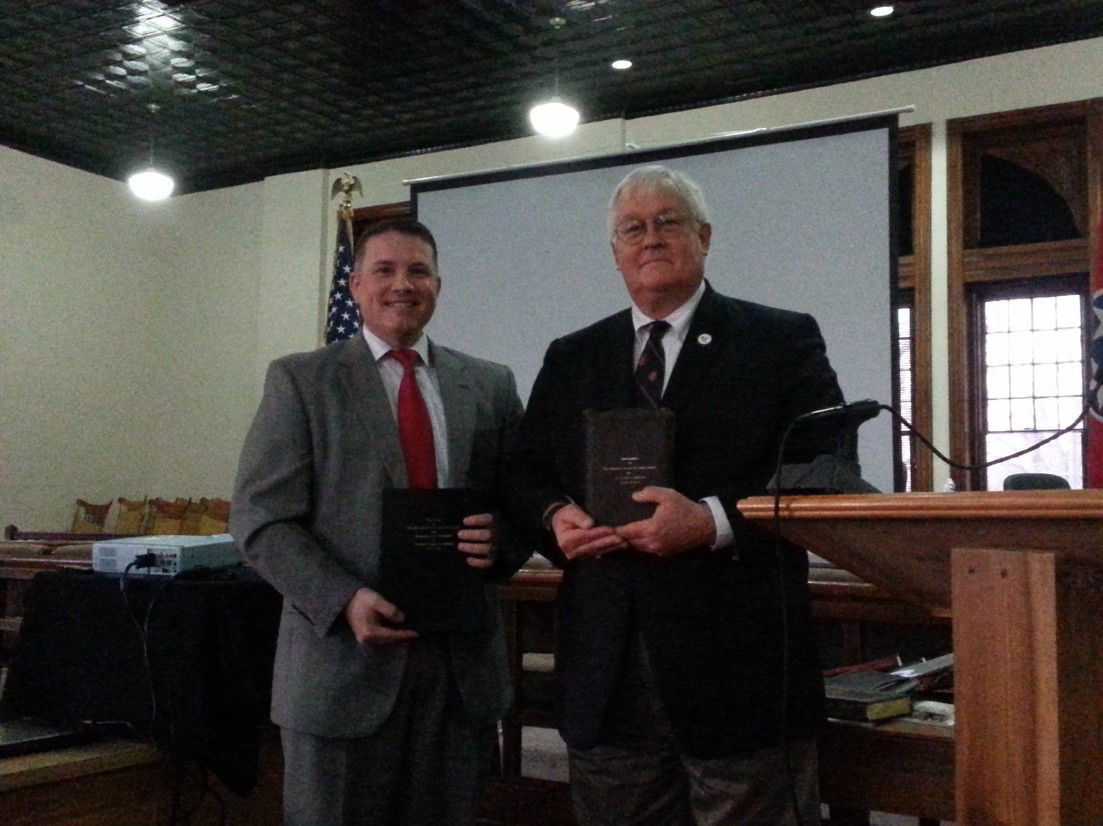
A photo of me (Judge White) with Trial Judge Justin Angel taken in his Scopes Trial courtroom (Dayton, TN) back in 2015 when we dedicated several Harlan Tradition Bibles, this one to the Rhea County, TN Court. I am holding an identical replica of the Harlan Bible that is maintained by the SCOTUS’ curator. Image courtesy Judge Darrell White (retired).
-
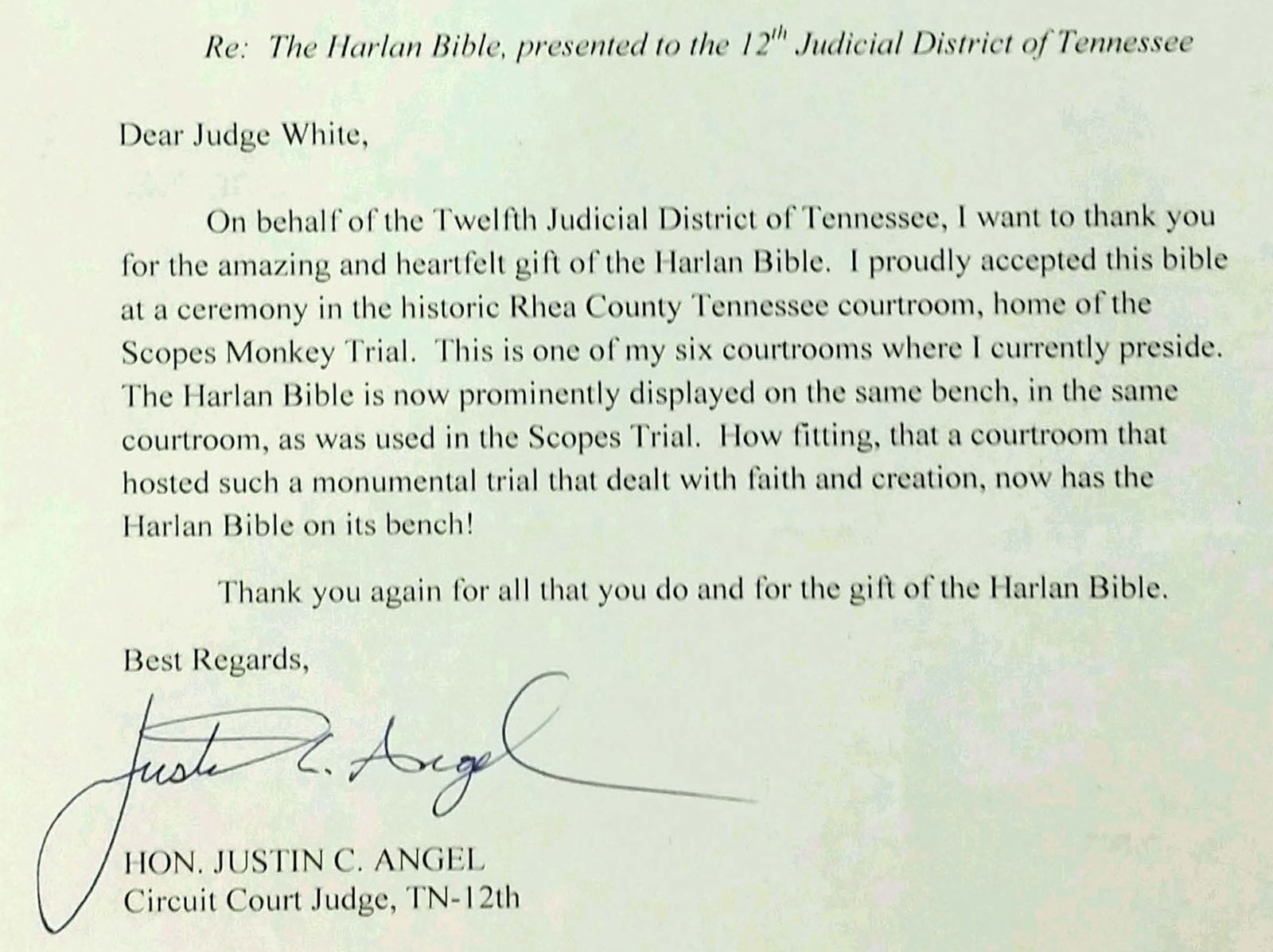
Letter from Trial Judge Justin Angel acknowledging receipt of a Harlan Tradition Bible for his historic courtroom. Image used with permission.
-
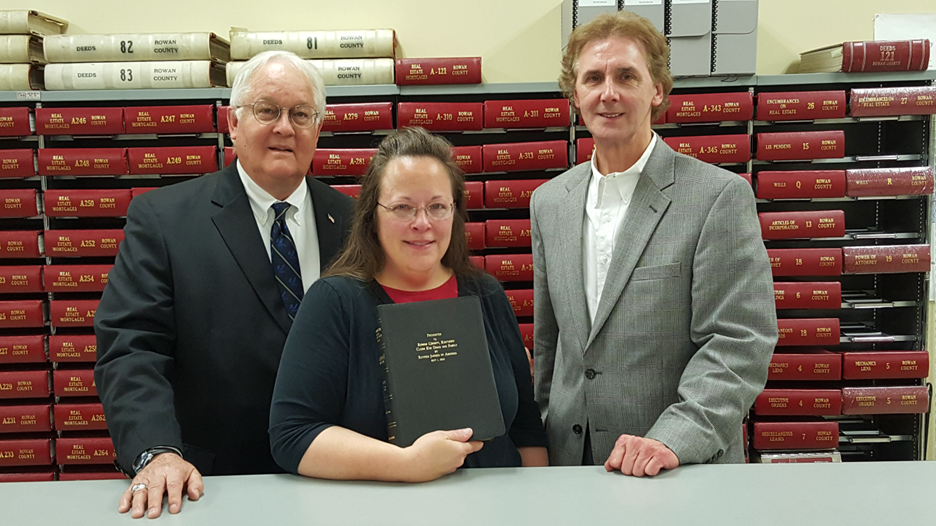
Myself (Judge White), Kim Davis, and John Pence with the Harlan Bible we dedicated to her several years ago. Image courtesy Judge Darrell White (retired).
I wrote a letter in 2011 to now-deceased Justice John Paul Stevens, reminding him that he had signed the Harlan Bible. Stevens was a graduate of humanist John Dewey’s University of Chicago Laboratory School. I urged him to publicly acknowledge that he made a mistake in his pivotal vote as junior justice in the 5/4 per curiam and summary ruling in Stone v. Graham (1980), which nullified a popular 1978 Kentucky law calling for the posting of God’s Ten Commandments in schools. I encouraged him to consider the importance of rules for an orderly and successful society. After all, it is no wonder that when American children are no longer taught God’s commandments, lawlessness and irresponsibility ensue. Unfortunately, Stevens did not recant his decision and simply replied to me that he was sure the case was decided correctly.
2025 and Beyond: The Cultural Horizon
Recently, the courts have been buzzing with more cases navigating religious beliefs in public schools, from the posting of the Ten Commandments to opting out of classes that use books with LGBTQ characters.11 Every new court case does not sway our hope, but they do remind us to stay diligent in praying for our nation’s leaders and public school teachers and to stand firm on the truth of Scripture ourselves.
Just this June (2025), the federal Fifth Circuit ruled on another Louisiana case. A three-judge panel ruled that Louisiana’s law requiring the Ten Commandments to be posted in public school classrooms was unconstitutional, citing the establishment clause’s “separation of church and state” and the 1980 Stone v. Graham case out of Kentucky.12 The court said that they didn’t want children to be a “captive audience” to religious ideas while in school.13 This may sound understandable—if this logic were applied equally among all belief systems. But as discussed in more detail in the next section, the religion of secular humanism is unapologetically taught in many classrooms. Why are Christian ideas silenced while humanistic ideas are encouraged?
The Judicial Oath: “Without Respect to Persons”
Supreme Court justices are required to take the following oath (28 US Code 453).
Each justice or judge of the United States shall take the following oath or affirmation before performing the duties of his office: “I, ___ ___, do solemnly swear (or affirm) that I will administer justice without respect to persons, and do equal right to the poor and to the rich, and that I will faithfully and impartially discharge and perform all the duties incumbent upon me as ___ under the Constitution and laws of the United States. So help me God.”14
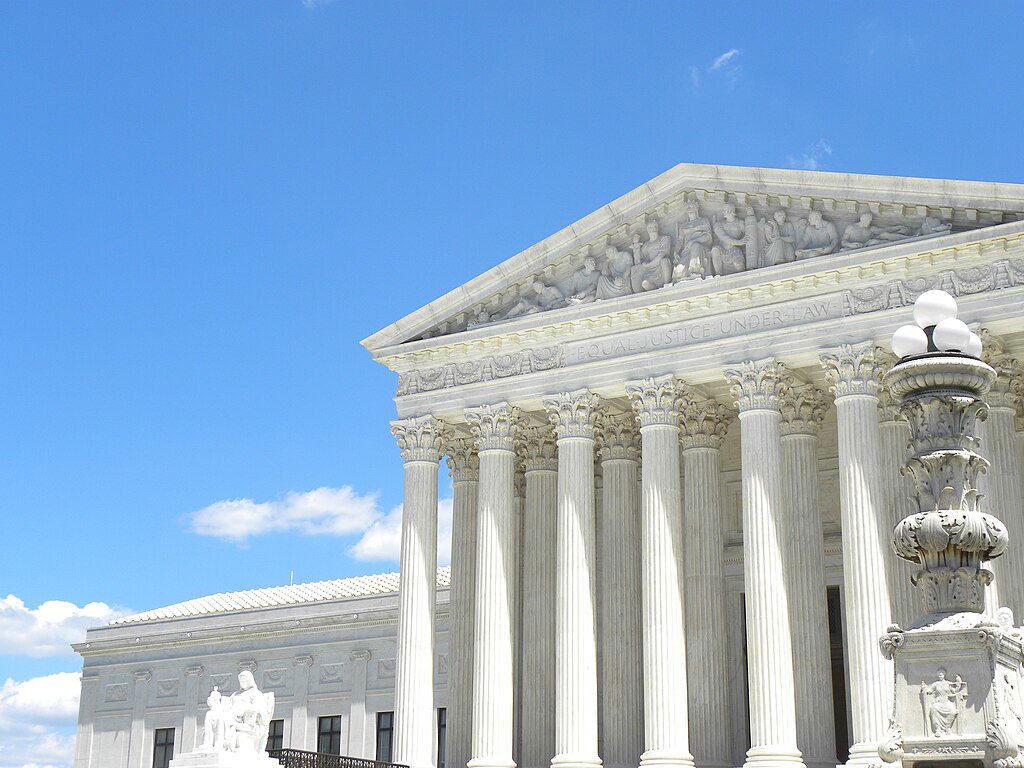
The Supreme Court building. Mathieu Landretti, CC BY-SA 4.0, via Wikimedia Commons.
“Respect of persons,” or a similar phrase, appears 14 times throughout the Bible’s King James Version. It signifies the act of showing favoritism or partiality.
- Leviticus 19:15 — “Ye shall do no unrighteousness in judgment: thou shalt not respect the person of the poor, nor honor the person of the mighty: but in righteousness shalt thou judge thy neighbour.”
- Deuteronomy 1:17 — “Ye shall not respect persons in judgment; but ye shall hear the small as well as the great; ye shall not be afraid of the face of man; for the judgment is God’s: and the cause that is too hard for you, bring it unto me, and I will hear it.”
- Deuteronomy 16:19 — “Thou shalt not wrest judgment; thou shalt not respect persons, neither take a gift: for a gift doth blind the eyes of the wise, and pervert the words of the righteous.”
- 2 Chronicles 19:7 —“Wherefore now let the fear of the LORD be upon you; take heed and do it: for there is no iniquity with the LORD our God, nor respect of persons, nor taking of gifts.”
- Proverbs 24:23 — “These things also belong to the wise. It is not good to have respect of persons in judgment.”
- Proverbs 28:21 — “To have respect of persons is not good: for for a piece of bread that man will transgress.”
- Lamentations 4:16 — “The anger of the LORD hath divided them; he will no more regard them: they respected not the persons of the priests, they favoured not the elders.”
- Acts 10:34 — “Then Peter opened his mouth, and said, Of a truth I perceive that God is no respecter of persons.”
- Romans 2:11 — “For there is no respect of persons with God.”
- Ephesians 6:9 — “And, ye masters, do the same things unto them, forbearing threatening: knowing that your Master also is in heaven; neither is there respect of persons with him.”
- Colossians 3:25 — “But he that doeth wrong shall receive for the wrong which he hath done: and there is no respect of persons.”
- James 2:1 — “My brethren, have not the faith of our Lord Jesus Christ, the Lord of glory, with respect of persons.”
- James 2:9 — “But if ye have respect to persons, ye commit sin, and are convinced of the law as transgressors.”
- 1 Peter 1: 17 — “And if ye call on the Father, who without respect of persons judgeth according to every man’s work, pass the time of your sojourning here in fear.”
How Did the Founders Understand Religion?
Now that we have defined respect to persons, let’s look at how the Unites States’ founders would have understood religion.
Our founders’ presuppositional meaning of religion is, as James Madison wrote, the “duty which we owe to our Creator and the manner of discharging it.”15 In Zorach v. Clauson (1952), Justice William O. Douglas penned this in the majority opinion of the court: “We are a religious people whose institutions presuppose a Supreme Being.”16 This statement is supported by the Declaration of Independence,17 otherwise called America’s first and fundamental “Organic Law” (as declared by Congress), which contains four distinct references to Divinity:18
- Creator
- Nature’s God
- Protection of Divine Providence
- Supreme Judge of the World
This proposition continues to be manifested in the so-called constitutional conundrum that though “no religious test” for oaths of office is sacramental per Article VI (since 1789), federal judges and justices are nevertheless obliged to conclude their judicial oaths with the utterance, “So help me, God.”
We have been cautioned what would happen if the “Supreme Being” were neglected by our nation. John Stormer’s book None Dare Call It Education notes a warning issued by the Elementary Textbook Evaluation Guide published in 1961 by the Textbook Study League, Inc. of San Gabriel, CA:
Withhold from the children for one generation the truth of “rights endowed by a Creator” and our Constitution could be altered and our freedom could be voted away without citizens ever knowing the cause of their slavery.19
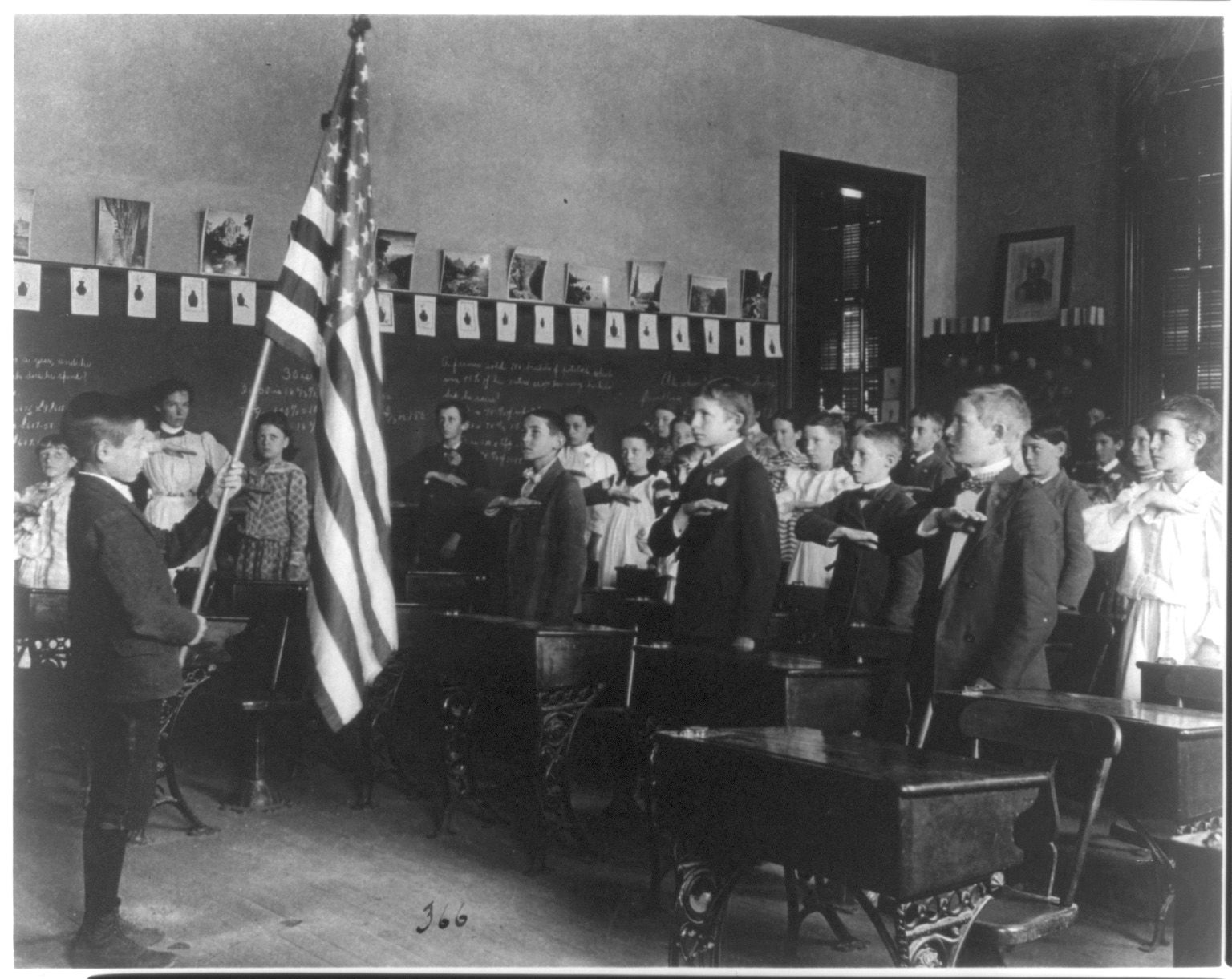
Students pledging to the flag, 1899. Pledge of allegiance to the flag, 8th Division, by Frances Benjamin Johnston, via Library of Congress.
Does Humanism Receive Preferential Treatment?
Finally, let’s examine the term secularism. It is “the doctrine that morality should be based solely on regard to the well-being of mankind in the present life, to the exclusion of all considerations drawn from belief in God or in a future state.”20
As defined above, secularism did not exist at the time of America’s founding, but it was introduced in 1851 by G. J. Holyoake who sought a word “expressing a certain positive and ethical element, which the terms, ‘Infidel,’ ‘Sceptic’ and ‘Atheist’ do not express.”21
In a 1961 opinion in Torcaso v. Watkins, SCOTUS took pains to specifically identify secular humanism as a “religion.” Secular humanism’s tenets, as seen in Humanist Manifesto I, include that the universe has not been created and that there is no creator and no moral absolutes.22
Since secular humanism is considered a religion by SCOTUS, why are its doctrines of no creator and no moral absolutes extended protection—even dominance—in the public marketplace of ideas?
Since secular humanism is considered a religion by SCOTUS, why are its doctrines of no creator and no moral absolutes extended protection—even dominance—in the public marketplace of ideas?23 Isn’t that showing the manner of favoritism forbidden by the judicial oath? Justice Elana Kagan recently declared in open court, “I thought it was pretty fundamental that we don’t treat some religions better than other religions. And we certainly don’t do it based on the content of the religious doctrine that those religions preach.”24
Secular humanists do not deserve preferential treatment by SCOTUS justices who are oathbound to “administer justice without respect to persons.” If humanism were a religion alongside Christianity and other faiths, then the judicial system has a duty to treat them equally, “without respect of persons.” But we see that humanism is heavily favored, for instance, when it comes to being taught in schools.
Conclusion
It may be apocryphal that Lenin counseled, “First, confuse the vocabulary,” but history teaches the unavoidable lesson that cultures are won and lost over the meaning of words. As Job says, “How forcible are right words!” (Job 6:25, KJV ). Historian Paul Johnson also expresses the impact of true, intentional words:
One principal way in which our civilization is rendered vulnerable to the assaults of its enemies (and false friends) is by the undermining of linguistic truth. Language is a curious thing. It is the bloodstream of our culture, the real infrastructure of civilization. . . . Words can be prostituted and debauched, damaged by use, misuse or intent, rendered untruthful or treacherous, devalued or aggrandized, stood, as it were, on their heads, or turned inside out.
So long as we have language, we cannot be wholly enslaved, or wholly uncivilized. . . . Language is the framework of reason; unless it is ordered and related to truth, reason cannot express itself.25
Judges take an oath not to show favoritism, and the court affirms that religions should be treated equally. But unfortunately, this has not played out. Instead, the court has sought to snuff out biblical teaching from public schools while simultaneously allowing and promoting humanistic ideas such as Darwinian evolution. The Scopes Trial is a reminder of this ongoing tension, and it is a reminder that Christians should pray for the governing authorities (1 Timothy 2:1–2) and diligently teach children the truth found in God’s Word.
We may not ever face a jury like Mr. Bryan did, but when we are called to our witness stand in our homes, workplaces, and communities to be questioned by the skeptic, may we respond with well-informed truth. Not with mere good intentions and ignorance. Not with half-truths that reek of favoritism and convenience. Rather, may we speak truth with boldness because we love and have studied God’s Word and are “prepared to make a defense to anyone who asks” us about our hope found in Christ (1 Peter 3:15).
Footnotes
- “Scopes Monkey Trial 1925 – Complete Trial Transcripts,” Professor Joe Cain, accessed July 10, 2025, https://profjoecain.net/scopes-monkey-trial-1925-complete-trial-transcripts/, 298.
- Ken Ham, “Partnering with Faithful Fathers,” Answers in Genesis, June 13, 2025, https://answersingenesis.org/blogs/ken-ham/2025/06/13/partnering-with-faithful-fathers/.
- Cultural Research Center, “Arizona Christian University Unveils Groundbreaking Worldview Assessment from Dr. George Barna and the Cultural Research Center,” Arizona Christian University, April 3, 2025, https://www.arizonachristian.edu/wp-content/uploads/2025/04/REPORT-Arizona-Christian-University-Unveils-Groundbreaking-Worldview-Assessment.pdf.
- Erin Blakemore, “America’s First Mandatory Education Law Was Inspired by Satan,” Mental Floos, March 2, 2017, https://www.mentalfloss.com/article/92710/americas-first-mandatory-education-law-was-inspired-satan.
- Blakemore, “America’s First Mandatory Education Law.”
- William Federer, “Wording of First Amendment and Who Twisted It,” The Patriot Post, March 18, 2019, https://patriotpost.us/opinion/61816.
- Wallace v. Jaffree, 472 U.S. 38, 105 S.Ct. 2479 (1985), http://www.belcherfoundation.org/wallace_v_jaffree_dissent.htm.
- Justia, Edwards v. Aguillard, 482 U.S. 578 (1987), accessed July 1, 2025, https://supreme.justia.com/cases/federal/us/482/578/.
- Edwards v. Aguillard (1987), https://supreme.justia.com/cases/federal/us/482/578/.
- American Judicial Alliance, “Bible Project,” accessed July 1, 2025, https://ajatoday.com/bible-project/.
- Nina Totenberg and Anuli Ononye, “SCOTUS: Parents Can Opt Kids out of Classes with LGBTQ Book Characters,” NPR, June 27, 2025, https://www.npr.org/2025/06/27/nx-s1-5430355/scotus-opt-out-schools;
Courthouse News, “Texas Classrooms Must Carry Ten Commandments,” Missoula Current, June 23, 2025, https://missoulacurrent.com/texas-ten-commandments/. - ACLU, “Court Blocks Louisiana Law Requiring Public Schools to Display Ten Commandments in Every Classroom,” June 20, 2025, https://www.aclu.org/press-releases/court-blocks-louisiana-law-requiring-public-schools-to-display-ten-commandments-in-every-classroom.
- ACLU, “Court Blocks Louisiana Law.”
- Supreme Court of the United States, “Oaths of Office,” About the Court, accessed July 10, 2025, https://www.supremecourt.gov/about/oath/oathsofoffice.aspx. Emphasis added. Though amended slightly since 1789, the bolded language remains the same.
- James Madison, Memorial and Remonstrance Against Religious Assessments, Amendment I, June 20, 1785, https://press-pubs.uchicago.edu/founders/documents/amendI_religions43.html.
- Zorach v. Clauson, 343 U.S. 306, (1952), https://supreme.justia.com/cases/federal/us/343/306/.
- Young homeschooler Asher Villar (age 12) may be among the few Americans alive today who can recite the “America’s Creed” from start to finish! https://ajatoday.com/asher-recites-entire-declaration-of-independence/
- See the Declaration of Indepedence with the references to divinity highlighted here: https://ajatoday.com/docs/organic.pdf.
- John Stormer, None Dare Call It Education, 1961, 99.
- Oxford English Dictionary Volume IX, 1978, 366.
- Oxford English Dictionary Volume IX, 1978, 366.
- American Humanist Association, “Humanist Manifesto I,” accessed July 1, 2025, https://americanhumanist.org/what-is-humanism/manifesto1/.
- For further reading on this topic, see Sam Blumenfeld, “Is Humanism a Religion?,” New American, February 23, 2010, https://thenewamerican.com/opinion/is-humanism-a-religion/.
- Amy Howe, “Supreme Court Likely to Embrace Expanded Tax Exemption for Religious Charities,” SCOTUS Blog, March 31, 2025, https://www.scotusblog.com/2025/03/supreme-court-likely-to-embrace-expanded-tax-exemption-for-religious-charities/.
- Paul Johnson, Enemies of Society (London: Weidenfeld & Nicolson, 1977), 102 and 116.
Support the creation/gospel message by donating or getting involved!

Answers in Genesis is an apologetics ministry, dedicated to helping Christians defend their faith and proclaim the good news of Jesus Christ.
- Customer Service 800.778.3390
- Available Monday–Friday | 9 AM–5 PM ET
- © 2026 Answers in Genesis