


Photo by Magda Pawluczuk on Unsplash
What Forensic Pollen Evidence Reveals About God’s Design
Tucked inside a single grain of pollen, a speck so small that thousands could rest on the head of a pushpin, is a story that begins with the wisdom of a Creator and ends in modern crime labs solving cases. Forensic palynology, the study of pollen and spores as trace evidence, is one of the most fascinating intersections of botany, criminal justice, and biblical design. When we look closely at the durability, structure, and purpose of pollen, we are not just examining one of the mechanisms for plant reproduction, but we are seeing the fingerprints of a Creator who planned ahead for the survival of His creation.
Designed, Not Accidental
We are seeing the fingerprints of a Creator who planned ahead for the survival of His creation.
Pollen is the fine, powdery substance released from the male part of a flower or cone, produced in the anther of a flowering plant or the male cone of a conifer. At first glance, it seems like an unremarkable by-product of plant reproduction, and a substance that causes many people to develop seasonal allergies in the spring. But a closer look at its structure reveals purposeful engineering. Each pollen grain is wrapped in a tough outer coating called sporopollenin,1 a substance so resilient that it protects the plant’s genetic material during the entire journey of fertilization. This includes things like wind, rain, insect travel, and even time itself.
This is not the kind of durability that emerges by chance. Scripture tells us that God spoke plants into existence on the third day of creation and declared that they would reproduce “after their kind” (Genesis 1:11–12). A world governed by random, evolutionary processes offers no explanation for why a microscopic grain would need armor capable of surviving in water for one to four years (or even up to a year in liquid nitrogen). But a world governed by a purposeful designer makes perfect sense of it. God, knowing that He would one day judge the earth with a global Flood, equipped every plant species with a reproductive strategy tough enough to survive catastrophe and repopulate the earth once the floodwaters receded. Today, that foresight is still visible in the more than 350,000 known plant species,2 each carrying its own unique pollen signature.
A Fingerprint for Every Region
Because every plant species produces a structurally distinct grain, an entire geographic region ends up with something like a botanical fingerprint, which is a unique mixture of pollen types tied to the plants growing there.3 Forensic scientists describe it as “a fingerprint for a region,”4 one built from the surrounding flora and nearly impossible to erase. Clothing can be laundered, hands can be washed, and evidence can be scrubbed away, yet pollen often survives the process because of its resistance to biological, chemical, and even mechanical destruction.
This resilience is a small but striking picture of God’s providence. The same Creator who designed the cycles of seasons and the boundaries of the land (Psalm 74:17) also designed a reproductive particle so tough it can outlast a washing machine,5 a flood,6 or centuries buried in sediment.
Is Pollen Evidence Trustworthy in Court?
Forensic palynology has quietly assisted investigations for more than 50 years, yet its legal standing varies from country to country. In the United States, expert testimony must clear a legal hurdle known as the Daubert standard, set by the Supreme Court in 1993.7 Judges weigh whether a technique has been tested, published, peer-reviewed, given a known error rate, and widely accepted by the scientific community before allowing it into a courtroom. Forensic palynology has not yet consistently cleared that bar in the United States.8 New Zealand and Great Britain, however, have relied on it in criminal trials since the 1970s,9 and the very first recorded case solving a murder with pollen evidence took place in Austria nearly 70 years ago.10
This gap between countries doesn’t make the science less valid: it simply reflects how cautious the American legal system is about admitting new forensic techniques. And nowhere has pollen’s evidentiary power been demonstrated more dramatically than in a discovery made not in a courtroom but high in the Alps.
Ötzi the Iceman: Pollen as a Witness
In 1991, hikers in the Ötztal Valley of the Alps, on the border of Austria and Italy, discovered a freeze-dried human body lodged in a trench some 10,500 feet above sea level.11 The man, named Ötzi after the valley where he was found, still carried the tools of his life and travels: a copper axe, a bow and arrows, a dagger, and bundles of dried grass fibers. Based on these artifacts, researchers date Ötzi’s remains at over 3,400 years old (he cannot be older than roughly 4,300 years due to the global Flood). This is older, by their estimate, than the pyramids of Egypt or the stones of Stonehenge.
Ötzi’s body told an unexpectedly violent story. He bore more than 50 charcoal tattoos, believed to be an early form of therapeutic treatment, and DNA testing has since identified 19 living relatives.12 Wounds on his hands suggested he had fought off an attacker shortly before he died. For years, scientists believed he had simply frozen to death until computer imaging in 2001 revealed an arrowhead lodged in his shoulder, one that had struck an artery and would have killed him within minutes.13 What began as a mystery of preservation became, in effect, the oldest cold case ever discovered, and one that will never be solved by an arrest, only by evidence.
This is a powerful illustration of what forensic palynologists do every day.
That is where pollen enters the story. Ötzi’s stomach still held the remains of his last three meals, eaten within the final 33 hours of his life, including grains, meat from an ibex and a red deer, and more than 30 different types of pollen.14 Because food travels through the digestive system on a fairly predictable timeline—roughly two hours in the stomach, four to five hours in the small intestine, nine to twelve hours in the large intestine, and up to fifty-five more hours before being eliminated from the rectum—scientists could match each stage of digestion to the pollen found there. Since different plants grow at different elevations and release pollen during different seasons,15 researchers were able to reconstruct where Ötzi had walked in the hours before his death, piecing together his final journey through the mountains more than 3,000 years later.
This is a powerful illustration of what forensic palynologists do every day. If pollen can testify silently to events thousands of years in the past, it should not surprise us that it can also testify to events from last week at a modern crime scene. The same durability that preserved evidence in Ötzi’s intestinal tract allows it to endure in soil, fabric, hair, and packaging material long enough for investigators to find it.
Collecting and Reading the Evidence
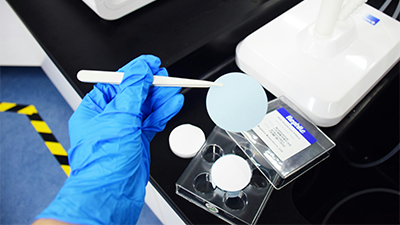
Because pollen is so easily disturbed, investigators must move quickly and carefully at a scene.16 Loose pollen on hard surfaces is collected with a clean brush, cellophane tape, or a specialized portable vacuum that traps pollen in a lint filter, allowing investigators to cover large areas quickly. Pollen trapped in hair, animal fur, or woven fabric fibers presents its own challenge. These materials are washed with detergent and warm water to dislodge the grains, and the wash water itself is carefully preserved and frozen to prevent microbes from destroying the evidence before it can be analyzed. Once collected, each grain is examined under a microscope. This work is slow and highly specialized. A single request for pollen analysis can take eight months to a year and a half to complete, in part because so few forensic scientists are trained in the field. Yet the payoff can be enormous.
Looking Ahead: Reading Pollen’s DNA
The field continues to advance. Recent developments now allow researchers to DNA barcode pollen, extracting genetic material from the male gamete carried inside each grain and running it through high-throughput sequencing, a process that can read many pieces of DNA at once. This matters because a single soil or dust sample often contains pollen from several different plant species mixed together, and DNA barcoding allows scientists to sort out and identify each one individually rather than relying solely on visual shape under a microscope. What was once a purely visual science, requiring years of specialized training to distinguish one grain from another, is now being paired with the same genetic tools used in DNA forensics. What a powerful reminder that the information God embedded in even the smallest parts of His creation goes far deeper than what the eye alone can see.17
Conclusion: Small Grains, Great Design
Forensic palynology is a field built entirely on the reliability of God’s design.
Forensic palynology is a field built entirely on the reliability of God’s design. A grain too small to see with the naked eye carries within it a durable record of geography, season, and history. And it is designed to survive floods, freezing, laundering, and the passage of thousands of years, as Ötzi the Iceman’s own body demonstrated. This is yet another testimony to a Creator who “richly supplies us with all things” (1 Timothy 6:17) and who built into creation the very durability needed for it to flourish after judgment. From the smallest forget-me-not grain to the naked-eye-visible pollen of the Cucurbitaceae, every particle points back to the one who formed it with purpose.
For more like this, see Dr. Jennifer Hall Rivera’s textbook Intro to Forensic Science: From a Biblical Worldview.


Footnotes
- ScienceDirect, “Sporopollenin,” in Agricultural and Biological Sciences, accessed September 2026, https://www.sciencedirect.com/topics/agricultural-and-biological-sciences/sporopollenin.
- World Plants, “Total Numbers of Accepted Species,” accessed September 2026, https://www.worldplants.de/world-plants-complete-list/total-species-count.
- Dallas Mildenhall, “Civil and Criminal Investigations: The Use of Spores and Pollen,” Siak Journal no. 4 (2008): 35–52, https://doi.org/10.7396/2008_4_E.
- Elon Green, “Fighting Crime, with Pollen,” The Atlantic, November 17, 2015, https://www.theatlantic.com/science/archive/2015/11/fighting-crime-with-pollen/416259/.
- Green, “Fighting Crime, with Pollen.”
- American Society of Agronomy, Soil Science Society of America, and Crop Science Society of America, “Preserved Pollen Tells the History of Floodplains,” Western Livestock Journal, November 1, 2019, https://www.wlj.net/preserved-pollen-tells-the-history-of-floodplains/.
- Cornell Law School, “Daubert Standard,” Legal Information Institute, last updated August 2023, https://www.law.cornell.edu/wex/daubert_standard.
- Green, “Fighting Crime, with Pollen.”
- Abigail Sawyer, “A Silent Witness: How Analysis of Pollen Can Solve Crimes,” BioTechniques, September 3, 2020, https://liberalarts.tamu.edu/blog/a-silent-witness-how-analysis-of-pollen-can-solve-crimes/.
- Richard Conniff, “The Science of Pollen,” Yale: School of the Environment, January 1, 2000, https://environment.yale.edu/news/article/the-science-of-pollen.
- National Geographic, “5 Surprising Facts About Otzi the Iceman,” October 18, 2013, https://www.nationalgeographic.com/history/article/131016-otzi-ice-man-mummy-five-facts.
- National Geographic, “5 Surprising Facts.”
- Jessica Leggett and Tom Garlinghouse, “Ötzi the Iceman: The Famous Frozen Mummy,” LiveScience, December 14, 2021, https://www.livescience.com/otzi-the-iceman.
- Alexandra Witze, “The Iceman’s Last Meal: Goat,” ScienceNews, August 22, 2011, https://www.sciencenews.org/article/icemans-last-meal-goat; Klaus Oeggl, Werner Kofler, and Alexandra Schmidl, “New Aspects to the Diet of the Neolithic Tyrolean Iceman ‘Ötzi,’” Journal of Biological Research 80, no. 1 (2005): https://doi.org/10.4081/jbr.2005.10243; National Geographic, “5 Surprising Facts.”
- Dr. Biology, “Pollen and Solving Crime,” ASU: Ask A Biologist, December 21, 2009, https://askabiologist.asu.edu/pollen-and-solving-crime.
- Dr. Biology, “Pollen and Solving Crime.”
- Karen L. Bell, Berry Brosi, and Kevin Burgess, “Pollen Genetics Can Help with Forensic Investigations,” The Conversation, September 5, 2016, https://theconversation.com/pollen-genetics-can-help-with-forensic-investigations-53426.



Support the creation/gospel message by donating or getting involved!

Answers in Genesis is an apologetics ministry, dedicated to helping Christians defend their faith and proclaim the good news of Jesus Christ.
- Customer Service 800.778.3390
- Available Monday–Friday | 9 AM–5 PM ET
- © 2026 Answers in Genesis