

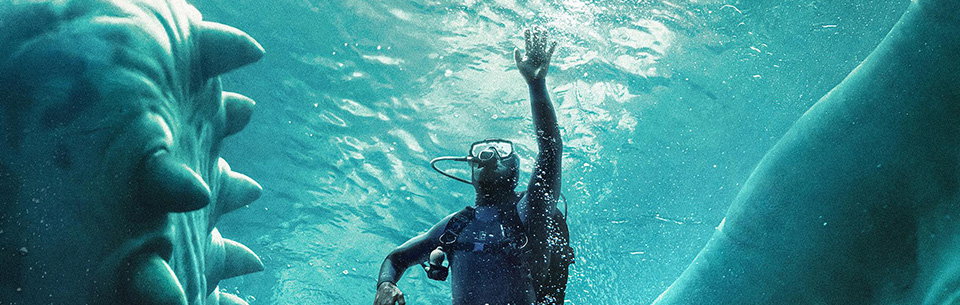
Image © 20th Century Studios.
Whalefall: A Modern Jonah Tale?
Let’s get one thing out of the way. The most generous estimate I could find of a sperm whale’s esophagus was about 16 inches, or 40 centimeters. That means that if you somehow get swallowed by a sperm whale, you’re probably not going to be anywhere near as intact as Jay is in this movie. You would likely die almost immediately and, mercifully, wouldn’t have to try to MacGyver your way out with hilariously convenient miscellaneous trinkets available.
But in an alternate universe where a person can get into a whale’s innards basically intact, Jay is struggling with his fractured relationship with his dad, who took his life a year before as he was dying of cancer. Jay goes diving alone to try to recover some of the remains of his father and, in the unlikeliest circumstance ever, catches himself between a deep-sea giant squid and a Moby Dick–sized monster of a whale. The squid attaches to Jay while being pulled into the whale’s mouth, and the rest of the movie consists of Jay understandably freaking out and suffering various traumas in the whale, which catapult the audience into flashbacks that explain both the strained relationship with his father and how Jay is going to get himself out of the current most pressing issue.
This movie is not for anyone young or with a weak stomach. There are a few instances of profanities and taking the Lord’s name in vain. The movie is full of viscerally uncomfortable body horror, and the camera angles highlight the pain and claustrophobia of Jay’s situation.
A Parallel with Jonah?
The similarity with the Jonah account is obvious, but this movie shows how unsurvivable a whale’s stomach is for just one hour with an oxygen tank and wet suit, let alone three days with nothing but the clothes on your back. The Bible does not specify that the animal that swallows Jonah was a whale; rather, it was a “great fish.” Jonah’s prayer actually leaves it ambiguous whether he died or was near death in the fish. Regardless of whether he was raised from the dead or kept alive, it is a clear miracle.1
Regardless of whether he was raised from the dead or kept alive, it is a clear miracle.
Jay, however, does not think about God or what comes after death at all and spends his time panicking, despairing, and remembering his dad. Sadly, his hallucinated conversation with the whale/his dad is the closest thing we get to a spiritual element.
The Importance of Dads
If Jay’s dad, Mitt, hadn’t ended his life by jumping into the ocean, Jay would have never been diving alone for his remains and thus would never have been swallowed. If Mitt had communicated well with his son at all, Jay would not be consumed by guilt over his tragic death and lack of remains and would not feel that it was his fault. It is ironic that over and over through the movie, Jay uses things Mitt taught him to survive another minute, but it’s also Mitt’s fault that he’s even in this predicament.
Some may say that Mitt had a right to end things on his own terms because his cancer was both terminal and took his ability to dive, something he loved.2 However, an option like hospice gives someone with a terminal illness appropriate medical care to manage pain and other symptoms while giving the patient and family precious time, which in this case could have helped to resolve things between them and, again, avoid Jay’s predicament in the movie entirely.
Ultimately, Whalefall has no real redeeming qualities, particularly for a believer.
Ultimately, Whalefall has no real redeeming qualities, particularly for a believer (despite some perhaps wanting this to be a proof of concept) and those who could be affected by the many deeply disturbing elements, so I can’t recommend seeing it. If you really want to watch a movie about someone who resolves his father conflict inside a whale, I recommend Pinocchio instead!

Footnotes
- For a more in-depth discussion about the true account of Jonah and its historical importance, please see “Jonah and the Bigger Fish” and “Could Jonah Have Survived in the Belly of the Fish?”
- For articles discussing euthanasia from a biblical perspective, see AnswersInGenesis.org/sanctity-of-life/euthanasia/.

Support the creation/gospel message by donating or getting involved!

Answers in Genesis is an apologetics ministry, dedicated to helping Christians defend their faith and proclaim the good news of Jesus Christ.
- Customer Service 800.778.3390
- Available Monday–Friday | 9 AM–5 PM ET
- © 2026 Answers in Genesis