

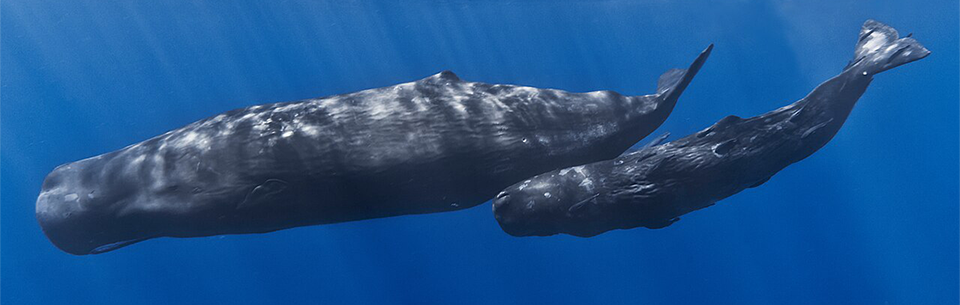
Image CC-BY-SA-2.0 by Gabriel Barathieu via Wikimedia Commons
Could Jonah Have Survived in the Belly of the Fish?
Could Jonah have survived three days and three nights inside the belly of a great fish?
Well, I think more people will be asking that question next month after a new survival thriller movie, Whalefall, hits the box office. This movie is based off a 2023 novel of the same name by author Daniel Kraus, and the premise is basically this: A young man diving in the Pacific Ocean is accidentally swallowed by a hunting sperm whale. He only has one hour’s worth of oxygen left and must find a way to escape the belly of the beast.
Of course, such a story immediately reminds viewers of the biblical account of Jonah—and the author apparently intended that. In an interview he said,
The impetus for the book was that I wanted to treat the Biblical Jonah story with scientific and biological accuracy. I talked with whale experts as I developed the plot, and they would listen to my ideas and say, “You know, that is theoretically possible.” So, that’s why it’s believable: We got the science right.
Now, we don’t know exactly what sea creature swallowed Jonah. It could have been a whale or another “great fish,” but a sperm whale is certainly a possibility because of the sheer size and the width of its esophagus (other whales of similar size are generally baleen whales, which have a much narrower esophagus because they are filter feeders). A great white shark is another possibility that’s been suggested.
But the protagonist in Krauss’ novel only has one hour to escape before he suffocates, so how could Jonah have survived three days and nights before the great fish/whale spit him out? Well, from a naturalistic perspective, it’s difficult to explain. But ultimately that doesn’t matter because we’re not talking about naturalistic circumstances.
Here’s how the book of Jonah describes the events that landed Jonah in the belly of the whale (emphasis added):
But Yahweh hurled a great wind on the sea, and there was a great storm on the sea so that the ship gave thought to breaking apart. (Jonah 1:4)
And Yahweh appointed a great fish to swallow Jonah, and Jonah was in the stomach of the fish three days and three nights. (Jonah 1:17)
The account of Jonah continues,
Then Yahweh spoke to the fish, and it vomited Jonah up onto the dry land. (Jonah 2:10)
So Yahweh God appointed a plant, and it came up over Jonah to be a shade over his head to deliver him from his miserable evil. (Jonah 4:6)
But God appointed a worm at the breaking of dawn the next day, and it struck the plant, and it dried up. Then it happened that as the sun rose up, God appointed a scorching east wind, and the sun struck down on Jonah’s head so that he became faint. . . . (Jonah 4:7–8)
And why could He appoint all these to do what He wanted? Because He created them all—He is the omnipotent Creator God.
The entire book of Jonah shows God sovereignly guiding the events.
The entire book of Jonah shows God sovereignly guiding the events. God hurled the storm; God appointed the fish; God spoke to the fish; God appointed a plant, a worm, and a scorching east wind. The God who divided the Red Sea and the Jordan River; saved Daniel from the lions; walked on water; calmed the storm; directed fish into a net; healed the blind, lame, and mute; raised the dead; and was Himself raised from the dead can have no trouble appointing nature to do His bidding and accomplish His purposes. Jonah is just one of many examples from Scripture that highlight God’s omnipotence and sovereign control over nature.
Yes, Jonah was a real person who really was swallowed by a great sea creature—and survived the ordeal by God’s supernatural intervention for His divine purposes. But Jonah’s life was bigger than just going to Nineveh to preach repentance. His time in the sea creature was a picture of Christ:
For just as Jonah was three days and three nights in the belly of the sea monster, so will the Son of Man be three days and three nights in the heart of the earth. (Matthew 12:40)
Just as there is no fully naturalistic explanation for how Jonah could have survived such an ordeal, there’s no naturalistic explanation for how Jesus could be crucified, die, be buried in a tomb, and then three days later walk out of that tomb alive. It was a miraculous event that was only possible because God is omnipotent and nothing is impossible for Him.
Let the account of Jonah remind you of the truth of Christ’s resurrection and what it means for us today: that anyone who turns from their sin and puts their faith in Christ is forgiven and given new and eternal life so that, even though someday we will physically die, we will still live.
Jesus said to her, “I am the resurrection and the life; he who believes in Me will live even if he dies, and everyone who lives and believes in Me will never die—ever. Do you believe this?” (John 11:25–26)
Thanks for stopping by and thanks for praying,
Ken
This item was written with the assistance of AiG’s research team.
Support the creation/gospel message by donating or getting involved!

Answers in Genesis is an apologetics ministry, dedicated to helping Christians defend their faith and proclaim the good news of Jesus Christ.
- Customer Service 800.778.3390
- Available Monday–Friday | 9 AM–5 PM ET
- © 2026 Answers in Genesis