

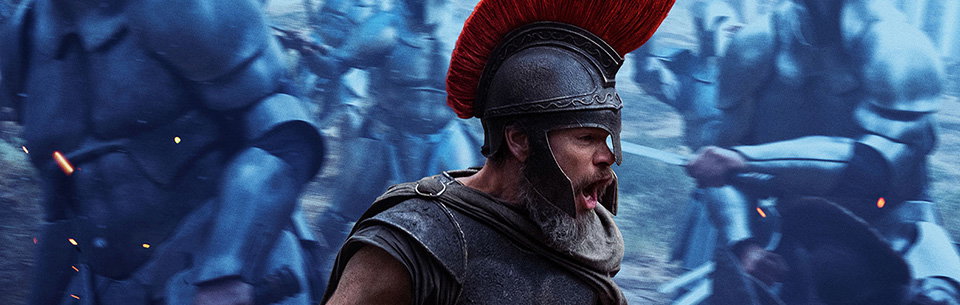
Image ©Universal Pictures.
Christopher Nolan’s The Odyssey: Epic or Epic Fail?
Homer’s classic tale of Odysseus’ long voyage home from the Trojan War just landed on the big screen. One of history’s most beloved stories, and in some ways, this classic Greek tale filled with heroes, gods, and monsters is foundational to Western civilization. And since it was made by one of Hollywood’s most respected directors, Christopher Nolan, it had the potential to be an incredible spectacle. But does this big-budget film faithfully capture the wonder, grandeur, or even the essence of this epic poem?
Although Christopher Nolan is widely regarded as one of Hollywood’s premier directors, I have never found his films particularly compelling. While I appreciate their technical excellence, they simply haven’t resonated with me. (Fans of our Answers TV show Tilt Shift know all about why movies resonate.)
When it comes to the Odyssey, I have enjoyed many aspects of the story since I first read portions of it in school, and I hoped that someone would someday create a faithful movie adaptation of it. In preparation for the new film, I brushed up on Homer’s Iliad and The Odyssey and rewatched the 1997 television miniseries, The Odyssey, starring Armand Assante. So let’s get into the review of this latest attempt to adapt Homer’s epic, which is rated R for violence and some language.
If you are wondering what a film review of a classic Greek tale has to do with biblical authority and are not interested in my review of this movie, skip down to the section titled “The Classic Myth and the Word of God” near the end of this article.
Starting Off on the Wrong Foot
The film opens with three consecutive failures. First, a statement appears on the screen: “A time of apparent magic . . .” Right away, the film signals that it does not respect the source material. If you are going to make a movie based on Homer’s story, then tell Homer’s story instead of undercutting it in the first few seconds. The Odyssey is a story filled with gods, goddesses, and magic, but Nolan’s film removes nearly all of this. There are no gods or goddesses in Nolan’s film. Yes, the actress Zendaya plays Athena, but she is depicted as a figment of Odysseus’ imagination, something more akin to a guilty conscience (more on this later). Calypso is also in the film, but there is no indication that she is a goddess. Many of the people believe that gods exist and interfere in the world, but this belief often comes across as though Nolan’s characters simply believe in “gods of the gaps” to explain storms and other natural forces. The result is a world in which belief in the gods functions more as a primitive attempt to explain natural phenomena than as a genuine supernatural reality.
The only magic that occurs in the film is when the sorceress Circe (or Kirke) transforms Odysseus’ men into pigs and then back again. While this scene is very different than how it was told by Homer, it at least shows her performing magic. So if the movie shows someone performing magic, how can it be a time of “apparent” magic? If you are willing to depict one act of magic, why ignore all the rest and open with a line that implies there was not really any magic? Or did Circe really transform Odysseus’ men into pigs? This scene, like the scenes with monsters and giants, is told from the perspective of Odysseus while he is trying to regain his memory on Calypso’s island. By placing these episodes in the mouth of an unreliable narrator, Nolan may be implying that monsters, magic, and deities are concoctions of a disillusioned and traumatized man.
Second, after the opening message fades, an American rapper, Travis Scott, appears on screen as a bard providing a very abbreviated recounting of the Trojan War. He performs in the main hall before rows of suitors who look like they were cast to match the ethnic diversity of modern Los Angeles. At one point later in the film, an Indian actor who is standing next to an African American actor tells someone that they are Greek warriors. This sort of casting immediately pulls the viewer out of the story because the characters do not look like Greek warriors. Similarly, Matt Damon’s unmistakable Boston accent does not help sell him as Odysseus either, even though he performed adequately in the role of the ancient hero.
Third, the next scene takes place on a nearly abandoned beach outside the walls of Troy. Soldiers from Troy ride toward the famed Trojan horse left on the beach by the Achaeans (Greeks) along with a single soldier, Sinon, who was instructed to convince the Trojans that the horse was a gift. Sinon, played by Elliot Page (formerly Ellen Page), awkwardly runs down the beach, and it is extremely obvious that this biological woman who now identifies as a man is not a Greek warrior. Although Sinon is killed almost immediately, the character plays a large role in the film. For example, when Odysseus travels to Hades to speak to Tiresias, he spends most of the time talking to Sinon instead of the spirit of the hero Achilles. Later, Nolan has Odysseus identify Sinon as “the bravest young man I ever met.” This last comment is so out of place and directly on the nose that it appears designed to provoke those who are not onboard with transgender ideology.
In other words, it is not Homer’s Odyssey.
So within the first few minutes of the movie, viewers are told that this is not going to be a story about ancient Greeks in a world full of heroes, gods, monsters, and magic. In other words, it is not Homer’s Odyssey. And it does not get much better from there. While there are a couple of monsters, they are barely shown, and I found them to be unimpressive. Scylla and Charybdis were onscreen for a few seconds, and the sirens were never shown. I know that Nolan does not like to depend on CGI, opting for practical effects instead, but Scylla looked no better than the troll-turned-two-headed-dragon in Willow from 1988 (for that matter, the men turning into pigs also occurred in Willow, and the transformation looked nearly as good almost 40 years ago). If Nolan is not willing to show Homer’s story, then he should have chosen to make a different movie.
Lack of Context
The Odyssey is a relatively long story that would be difficult to tell within the confines of one film, especially given the fact that backstory from the Iliad needs to be included to provide context that Odysseus is trying to return home after fighting for 10 years in the Trojan War. While Nolan’s film is nearly three hours long, it often fails to give the necessary context to make sense of the story. The frantic pacing in the middle of the movie combined with an overly loud score adds to the confusion. If you decided to watch this movie but were unfamiliar with Homer’s epic, you would probably struggle to understand what is going on and why Odysseus is having such a difficult time making it home.
This confusion is not helped much by Nolan’s characteristic nonlinear storytelling technique. While this can be an effective device to hold viewers’ attention by creating suspense, tension, and mystery, it made this film more difficult to follow. So much of this film is told through flashbacks, and these are not always from the same point of view, as both Odysseus and Menelaus are used this way. Yes, I am aware that Homer’s Odyssey is told from Odysseus’ perspective after the events of the story, but this is very different than the way Nolan’s film jumps around from time and place.
The reason why Odysseus has so much trouble reaching home is not revealed in Nolan’s film, but it is plainly told in one of the best-known stories of the Odyssey—the encounter with Polyphemus. This giant cyclops traps Odysseus and his men in his cave by placing a rock at the door that his men could never move. During their second evening in the cave, Polyphemus asks Odysseus for his name while getting drunk on wine, and Odysseus tells him that his name is Noman (or Nobody depending on translation). When the cyclops passes out from the wine, Odysseus and his men blind him with a stake they had heated in the fire. When the cyclops cried out in pain, his neighbors asked who was harming him that he should scream in such agony. Polyphemus replied that “Noman” was harming him. Odysseus then concocts a plan for him and his fellows to escape under the flocks in the morning.
This encounter shows Odysseus’ craftiness and strategic prowess. But the movie shows very little of this. He never speaks to the cyclops in the cave, and his men are astonished when Polyphemus cries out to his father Poseidon after being blinded because they didn’t realize he could talk. Yet the book has the cyclops speak to the men as soon as he notices them.
Despite Odysseus’ heroics in the cave, he allows his pride to get the best of him after escaping Polyphemus, and he pays dearly for it. Once aboard his ship and sailing away, he taunts the now-blind cyclops and tells him that his name is Odysseus the son of Laertes. Polyphemus then prays to Poseidon and begs him to not let Odysseus reach his home in Ithaca, but that if he eventually made it home, it would be after losing all of his men and ships. This encounter sets up so much of the Odyssey, and yet nearly all the elements necessary to the plot are missing from Nolan’s film. They are hinted at later by some of Odysseus’ men on the ship, but if one is unfamiliar with the story, this would make little sense.
Deconstructing the Hero
Homer repeatedly calls Odysseus a “master of stratagems,” and both the Iliad and Odyssey portray him as a capable, cunning, and brave hero. But Nolan follows modern Hollywood’s trend of tearing down and deconstructing heroes (think Luke Skywalker in The Last Jedi). Instead of a crafty warrior determined to reach home, Nolan portrays Odysseus as a broken man full of guilt and trauma who no longer commands the respect of his men. His foolish actions in the movie, such as shooting the cyclops with an arrow after escaping the cave (which is not in the book), led to the deaths of more of his men. In many ways, he is a passive character in the movie where the plot happens to him instead of an active character where his actions drive the plot.
The climax of the movie occurs after Odysseus finally returns home after 20 years away. Dozens of suitors have overrun his house, seeking to marry Odysseus’ wife Penelope, whom they assume is a widow since Odysseus had not returned from Troy. Prior to revealing himself as the long-lost king and defeating the suitors, Odysseus explains his grief and remorse over what he had done to the Trojans. It was not the fact that he had killed many Trojans in battle that bothered him. It was the fact that he violated the concept of “xenia” (or Zeus’ law related to hospitality, a concept repeatedly mentioned in the film). As described in the film, a traveler could expect food and shelter from a host. After all, for all the host knew, the traveler might be a god or goddess in disguise (see Hebrews 13:2 for a similar idea). By creating the ruse of the Trojan horse and hiding inside of it, Odysseus believes he has violated that most sacred of rules that will lead to the breakdown of their entire society. The Trojans accepted the gift in good faith and were then slaughtered after the Achaeans came out of hiding and opened the city gates to allow the rest of the army into the city. So even though his actions led to the end of a bloody 10-year war and likely saved the lives of thousands of Greek soldiers, Odysseus in Nolan’s film is traumatized by his strategy because it allegedly violated the law of hospitality. I say “allegedly” because one would assume that different rules may apply during war. Nolan’s guilt-ridden and depressed hero receives a drastically different and less satisfying ending than what Homer gave Odysseus.
Feminist Retelling
Nolan stated that he had read Emily Wilson’s translation of the Odyssey, which frequently retells the events through a feminist lens. This becomes obvious in the way men and women are portrayed in the films. Like the portrayal of Odysseus as being much less than Homer’s hero, Agamemnon, the king of Mycenae, is shown sacrificing his daughter to the gods for favorable winds as he sails to Troy. This detail does not come from Homer but is derived from later Greek tragedies. Upon his return, Agamemnon is murdered by his wife, Clytemnestra. From Nolan’s film, she kills him because he sacrificed their daughter. He briefly mentions that she and her lover had plotted Agamemnon’s murder. In the later tragedies, she kills him so that her lover could take the throne. Nolan’s revisionism paints her with a much more sympathetic brush.
Clytemnestra was the half sister of Helen of Troy, but in this film, the two are twin sisters, allowing Kenyan actress Lupita Nyong’o to play both roles. Controversy has long surrounded her casting since she does not fit Homer’s description of Helen, so that need not be rehashed here. It is another example that immediately pulls you out of the story and makes you wonder if Nolan was more concerned with Oscar nominations than making a good film. While Helen is hardly in the film (she played a much greater role in the Iliad, as her affair with Paris sparked the Trojan War), Helen’s role consists largely of sitting at a dinner table and repeatedly demanding that her husband, King Menelaus, tell Odysseus’ son Telemachus what her sister did to his brother. Instead of an unfaithful wife (per Homer), she appears to be a battered and scarred wife who is unafraid to stand up to the most powerful man in the kingdom.
Penelope spends much of her time arguing with Telemachus and withdrawing from the suitors. These actions are understandable given her situation. As the film builds to a climax, Telemachus tells her about a plan that he has hatched with Menelaus that will rid their palace of the suitors and allow him to assume the throne. He says, “Without me, the throne would be lost.” Penelope snarkily replies, “Because only a man can sit on it.” Then she raises her voice. “Empty throne? I’ve been sitting on an empty throne for 20 years! My knowledge, my years of experience, that’s all nothing compared to the bristles on your chin!” This is yet another example of Nolan reading Homer’s story through lens of twenty-first-century ideologies rather than allowing Homer to tell his own story.
Modern Movie Messaging
Speaking of Helen’s action of running away with Paris sparking the Trojan War, Nolan’s film largely dismisses that by claiming that Agamemnon simply used that as an excuse to attack Troy. Troy controlled the shipping lanes that the Achaeans wanted to oversee. So apparently, the root cause of the Trojan War was greedy capitalists instead of Paris stealing a king’s wife. The Trojans are eventually viewed as the people being oppressed by the Achaeans, even though one of their own triggered the war by stealing Helen from her husband.
It often seemed that many of Nolan’s creative decisions were driven more by contemporary Hollywood priorities than by fidelity to Homer’s epic: reshape female characters into modern ideological archetypes, tear down men (especially white men), promote LGBTQ ideologies, make subtle attacks on capitalism, deconstruct heroes, and remove the wonder from our world.
The Classic Myth and the Word of God
One reviewer stated that Nolan’s treatment of the Odyssey felt like what it would be like if an atheist decided to make a movie about the Bible. That summarizes many of my thoughts on the film as well. In fact, there were many times where I was reminded of the blasphemous Noah film by Darren Aronofsky. Both films portray their heroes in ways that are far less noble or heroic than their source material. Both films greatly downplay or ignore the role of God (Noah) or the gods and goddess (Odyssey). While this may not have much to do with the message, both films present a drab world that is largely robbed of its beauty. Neither film leaves the viewer with the sense of wonder, nobility, or aspiration that great epics have inspired for centuries. These films seem to rob the viewer of joy instead of captivating them with a classic tale known around the world. In the case of Noah, there was an opportunity to show our world’s true history as described in Genesis, but Aronofsky subverted the morality of that account in his film and turned Noah into an eco-warrior who sought to murder his own grandchildren. While Nolan’s Odyssey does not stray that far from its source material, it failed to faithfully portray one of the greatest stories in Western civilization, turning it into a modern three-hour slog filled with not-so-subtle social messaging.
This film reinterprets a beloved ancient text according to modern sensibilities rather than trying to understand it in its own culture.
To be clear, Homer’s Odyssey is not the Word of God. While this ancient myth may preserve echoes of genuine Bronze Age history along with some potential loose parallels to biblical details, it should not be viewed as the authoritative and inerrant record from God. There is a lesson Christians can learn from Nolan’s treatment of the Odyssey. This film reinterprets a beloved ancient text according to modern sensibilities rather than trying to understand it in its own culture. In much the same way, many scholars and professing Christians have reinterpreted the Bible in ways that make it more palatable to modern audiences rather than carefully seeking to understand the culture, grammar, history, and geography to arrive at the author’s intended meaning. Consider the following examples:
- Most scientists claim the earth is billions of years old, so let’s reinterpret the days of Genesis 1 to be long periods of time and claim that the Flood in Noah’s day was merely a local catastrophe.
- The Bible states that homosexuality is a sin, so let’s reinterpret these passages in a way that does not speak against this behavior.
- Jesus said that He is the way, the truth, and the life, and that no one can get to the Father except through Him, but that is unpopular in our pluralistic society, so let’s reinterpret His words to mean that He is just one of the ways to God.
These are analogous to the liberties that Nolan took with the Odyssey. Ironically, the allegorical method of interpretation was developed by ancient Greek thinkers who lived in the centuries following Homer. They admired Homer’s epics but were embarrassed by the immoral behavior of the gods. Rather than rejecting Homer outright, they reinterpreted the stories allegorically so that the gods became symbols of natural forces or virtues. Likewise, many modern interpreters admire the Bible but are embarrassed by miracles, judgment, or biblical morality, so they reinterpret those passages instead of accepting them as written.
Of course, one’s view of a fictional story (possibly containing some real events) has no bearing on his or her eternal destiny. But implementing a similar approach to the interpretation of Scripture can have disastrous eternal consequences.
Conclusion

Homer’s Odyssey tells of a world full of heroes, gods, goddesses, and monsters. Nolan’s Odyssey gives us a few monsters, but it demotes its heroes and eliminates the gods and goddesses. While there are some good performances, such as Robert Pattinson as the suitor Antinous, and some excellent set designs, the director’s refusal to create a faithful film adaptation of Homer’s epic is extremely disappointing. It would not be surprising if it were nominated for multiple Academy Awards because many of its creative decisions align with contemporary Hollywood priorities, but these are also the issues that will prevent it from being a memorable classic.
Great stories endure because they communicate timeless truths through the worldview of their authors. When modern storytellers replace that worldview with their own, they may produce an impressive spectacle, but they no longer tell the same story. Sadly, the low-budget 1997 television miniseries was a far better adaptation.

Support the creation/gospel message by donating or getting involved!

Answers in Genesis is an apologetics ministry, dedicated to helping Christians defend their faith and proclaim the good news of Jesus Christ.
- Customer Service 800.778.3390
- Available Monday–Friday | 9 AM–5 PM ET
- © 2026 Answers in Genesis