


Did Scientists Just Witness a Key Step in the Origin of Complex Life?
Evolutionists have several problems explaining the origin of life. One is explaining how complex cells evolved from simple cells. There are two major types of living organisms on earth: prokaryotes (considered “simple”) and eukaryotes (considered complex). Prokaryotes are bacteria and archaea, and eukaryotes are everything else, like fungi, plants, animals, and humans. The main differences between prokaryotes and eukaryotes are that eukaryotes have their DNA enclosed in a nucleus and have organelles (like mitochondria, lysosomes, etc.) but prokaryotes do not.
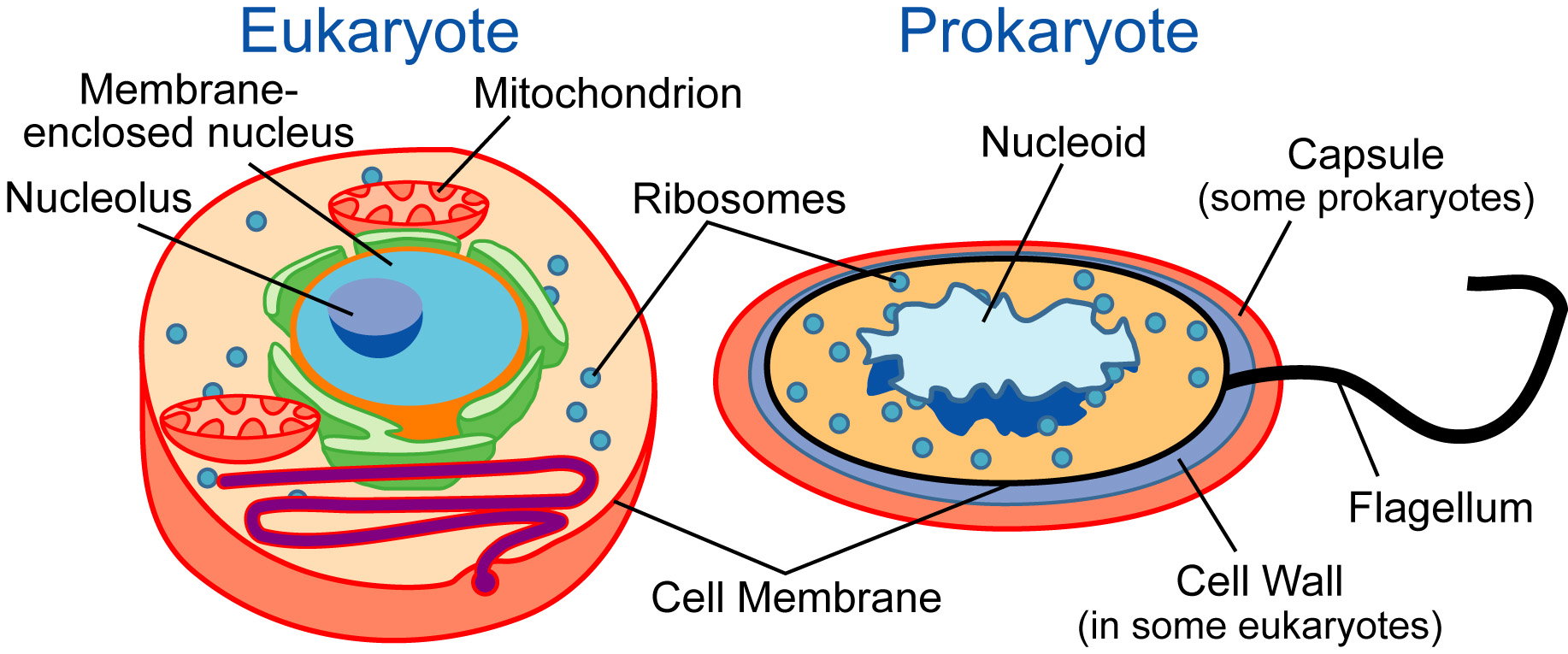
Fig. 1. Eukaryotes have their DNA enclosed in a nucleus but prokaryotes do not.
Public domain, via Wikimedia Commons
A recent headline suggested a breakthrough: “First Contact” That May Have Led to Complex Life on Earth Finally Witnessed by Scientists.1
Have researchers witnessed experimental support for the origin of complex life? Is the biblical account of creation now in question? Are there bacteria from Asgard on earth? Let’s see what the paper claims.
The Problem of “Simple” Cells
First, we need to clear up some misconceptions. Even though prokaryotes are considered “simple,” they aren’t! They are single-celled organisms that must carry out all essential functions to survive in a multitude of environments. That’s no easy task! And explaining how living cells arose from nonliving precursors, which is called abiogenesis, is one of the greatest problems for evolution.
In fact, the more we study microbes, the more complexity we discover. This causes scientists to keep pushing back their evolutionary origins. The earliest microbes are thought to be 4 billion years old—“just” 500 million years younger than earth! That’s an evolutionary blink of an eye. Some scientists have even speculated that microbial life is so complex it could not have originated on earth because there isn’t enough time. Instead, they believe in panspermia, that microbial life arrived here via asteroids or comets, or directed panspermia, that life was seeded on earth by aliens.
If scientists are challenged to explain the origin of so-called “simple” prokaryotes, imagine how difficult it is to explain the origin of even more complex eukaryotes? Think about a human being. We have many different cells, tissues, organs, and organ systems that must communicate and work together seamlessly for us to survive.
What Do “Living Rocks” Have to Do with the Evolution of the Cell?
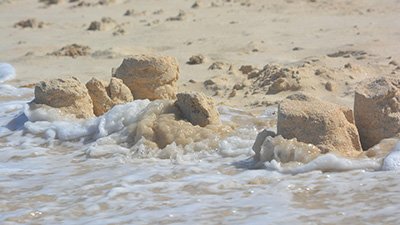
To try to explain this major evolutionary step from prokaryotic to eukaryotic cells, scientists studied stromatolites in Shark Bay, Australia. Stromatolites are layers of microbial mats living in bays or pools that are formed by a community of microbes including bacteria, fungi, algae, etc. Each member of the community produces different metabolic products that contribute to the health and life of the mats as a whole. Over time, the microbes trap and bind sand grains and precipitate minerals that results in lithification or literally the turning of the microbial mat into rock. The lower layers of a stromatolite are typically rock while the upper layers are the living microbial communities. Because of this, they are considered “living ‘relics’ of ancient ecosystems that thrived on Earth billions of years ago,”2 even saying we “owe our very existence to these piles of rocks.”3 How in their thinking can we owe our existence to rocks?
Stromatolites in Shark Bay, Australia, live in an area that has hot, dry summers and mild, wet winters. The evaporation exceeds the annual precipitation rate, and the seawater in shallow bays becomes very salty—1.5–2x saltier than surrounding ocean waters. Believing that early earth was probably a very harsh environment, they think these stromatolites are good “analogs” for microbial mats that supposedly existed billions of years ago.
Meet the Asgard Archaea
In these stromatolites, the researchers are hoping to find “our great microbial ancestors, the Asgard archaea.”4
To understand the Asgard archaea, we must start with their kingdom, Promethearchaeati, named for Prometheus from Greek mythology, a Titan who, in some versions of mythology, created humanity from clay. You can see the evolutionary assumptions even in the naming of this group of microbes! This Asgard group of archaea are named after Norse gods—Lokiarchaeota, Heimdallarchaeia, Thorarchaeia, and Odinarchaeia.
Archaea are a type of prokaryote (single-celled, no true nucleus), but they are not bacteria. The cell membrane and motility structures of archaea are unique. Their genes and metabolic pathways are more like eukaryotes. Many archaea are extremophiles—they can live in temperatures well above the boiling point, very cold conditions, very acidic, very basic, and even very saline.
Why do scientists think these Asgard archaea are our ancestors? Because they have proteins and a cytoskeletal structure that is more like eukaryotes than prokaryotes. The researchers speculate that “on an early Earth it was the ‘marriage’ of an ancient Asgard archaeon and a bacterium that led to the first eukaryotes.”5
The name given to this supposed “marriage” that occurred billions of years ago is endosymbiotic theory (Fig. 2).6 The story goes something like this: Once upon a time, a bacterium became engulfed or endocytosed by an Asgard archaeon but not digested or broken down. Then a symbiotic relationship developed between the two. Both the bacterium and archaeon made products that were shared and beneficial to both (Fig. 3). And just like that, we have the first eukaryotic cell. The bacteria eventually became what we call mitochondria in eukaryotic cells today.
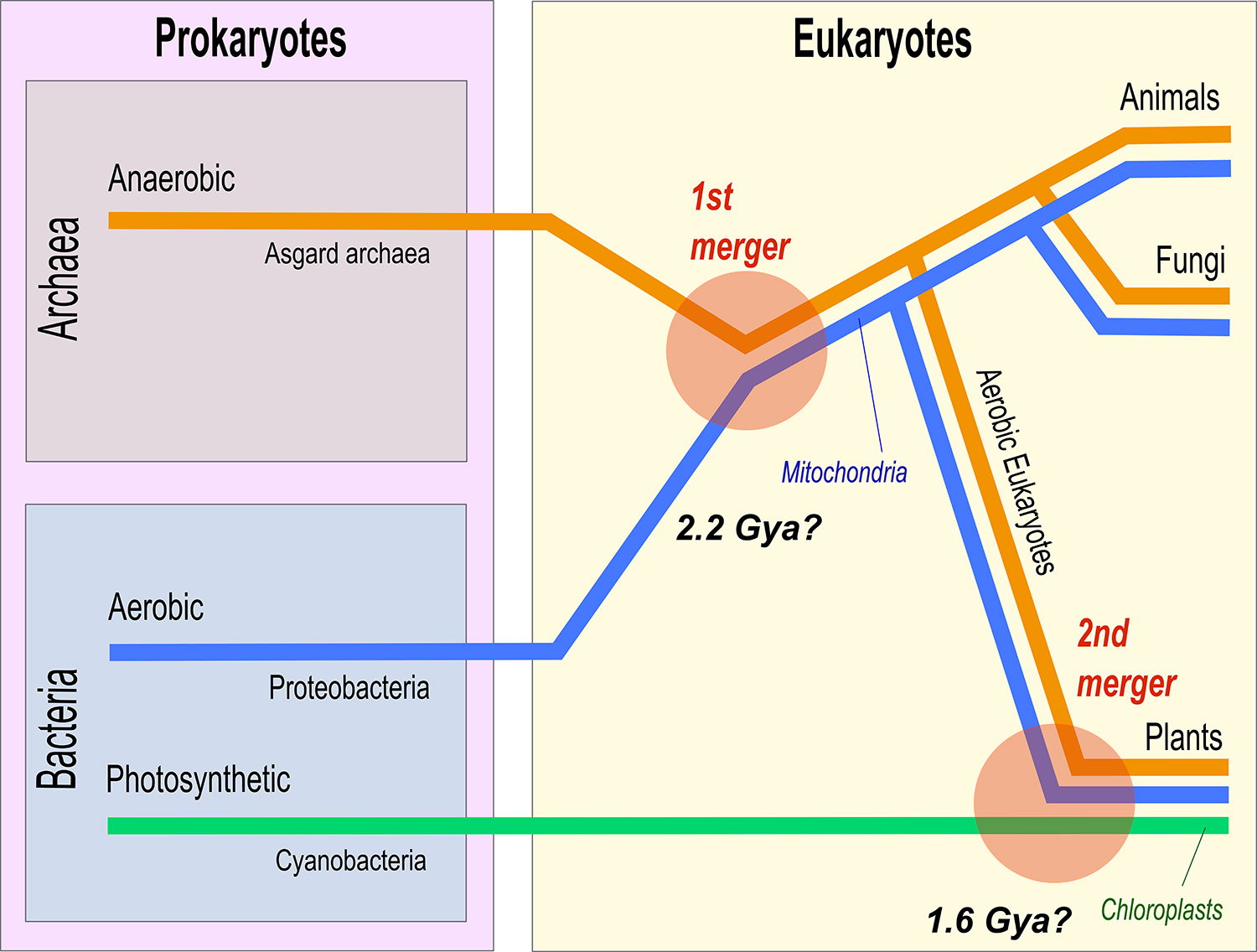
Fig. 2.
Chiswick Chap, CC BY-SA 4.0, via Wikimedia Commons
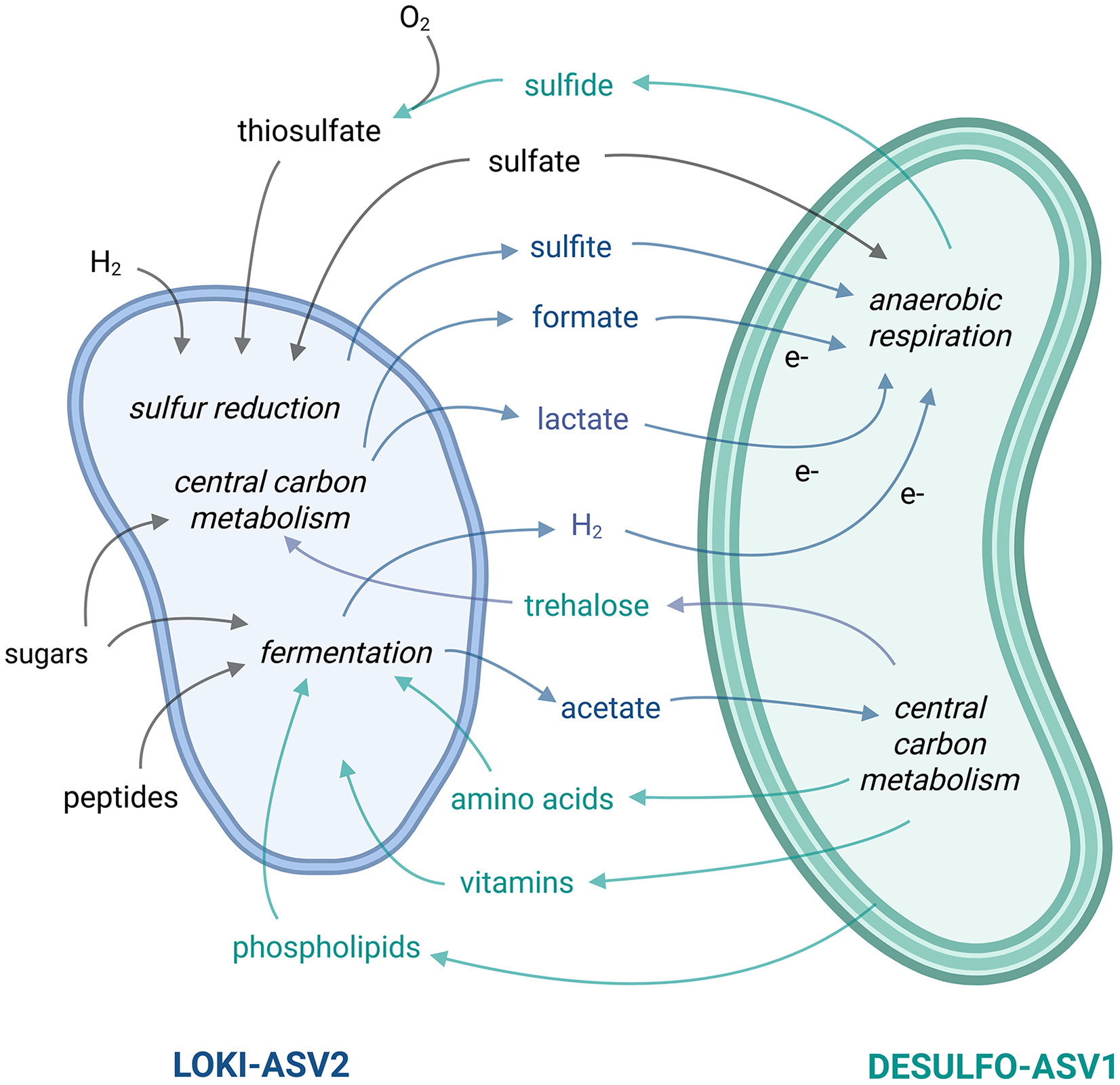
Fig. 3. Proposed interactions between N. marumarumayae (left) and S. nilemahensis (right).
Image credit: Nobs et al.
What Did They Actually Find?
The researchers used the microbes from the stromatolites as a “seed” to establish cultures of these ancient microbes. In their cultures, they found the Asgard archaea together with a sulphate-loving bacteria and thought maybe they were sharing nutrients. They used something called electron cryotomography that allowed them to observe cells and structures at high resolution.7
They found the Asgard archaea were directly interacting with sulfate-loving bacteria via tiny nanotubes or chains of vesicles connecting the two organisms (Fig. 4). They speculate that some of the unique products that both microbes synthesize could be exchanged between the two through these nanotubes and vesicles (Fig. 3). It may be an example of a symbiotic relationship that Asgard archaea are known to form.
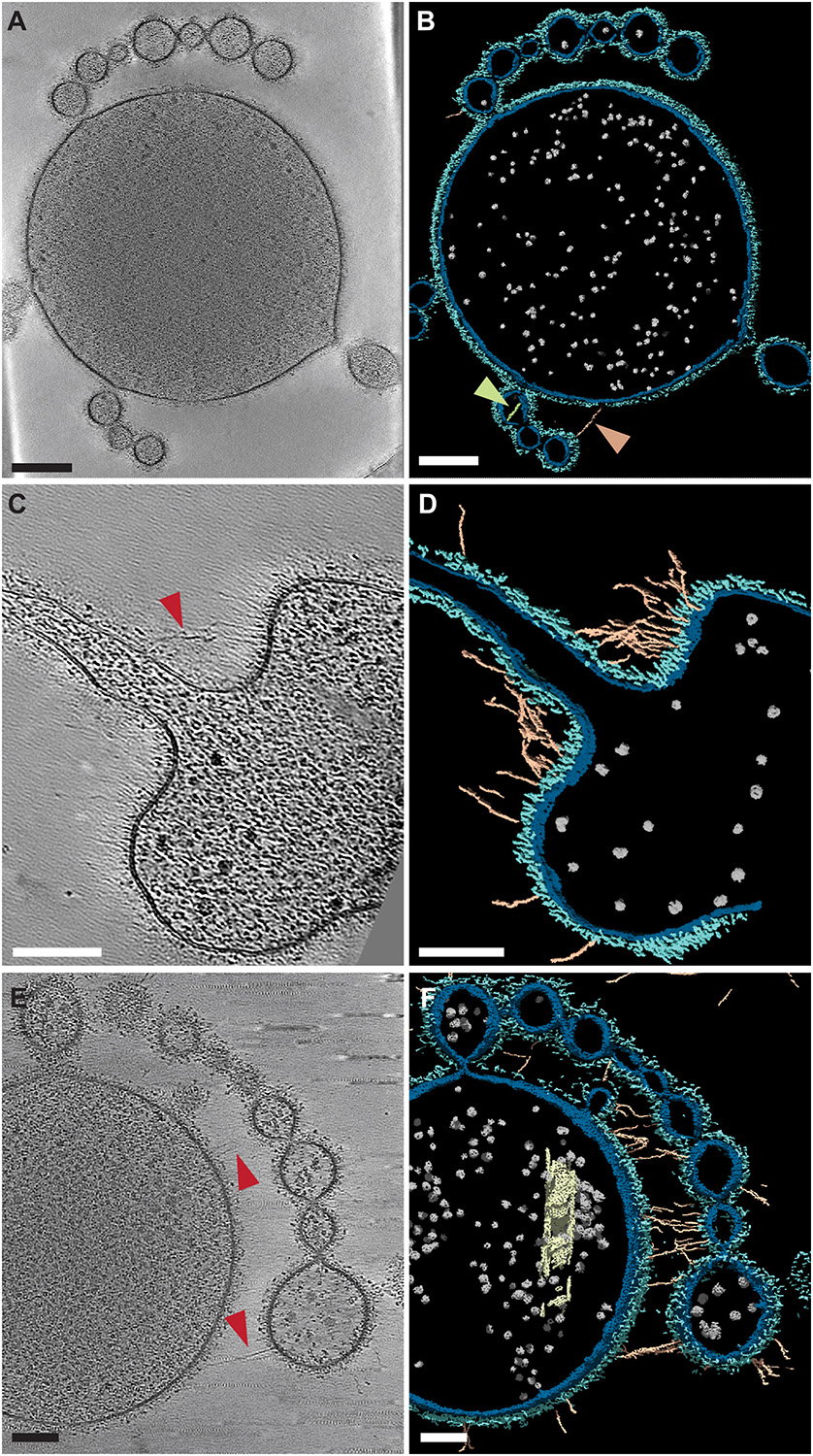
Fig. 4. Image and caption from Nobs et al.: “Electron cryotomography of N. marumarumayae cells.
(A) Representative 2D slice through a 3D reconstructed tomogram, showing a cell body with smaller budded envelope vesicles that often appear as chains.
(B) 3D segmentation analysis of the tomogram in (A), showing the identified inner membrane (blue), outer layer (teal), putative ribosomes (gray), extracellular fibers (light orange), and intracellular filament (light green).
(C) Tomographic slice of a cell body with tubular extension and a large number of surface fibers.
(D) 3D segmentation analysis of the tomogram in (C).
(E) Tomographic slice of a cell body showing extensive budded vesicles that are connected to the main cell body through a network of extracellular fibers.
(F) 3D Segmentation analysis of the tomogram in (E), showing envelope vesicle detail and extracellular fibers connecting them to the cell body (indicated by red arrowheads where present in the selected 2D slice). The cell body also contains a large helical tube-like cytoplasmic structure (colored pale yellow). Scale bars, 100 nm.”8
Although the researchers have yet to discover if the bacteria and Asgard archaea are sharing resources, it is possible since they have structures connecting them. This is good observational science.
From Good Science to Evolutionary Mythology
They speculate that maybe this is what our microbial ancestors “did on early Earth that ultimately led to the explosion of complex life as we know it.”9 To review, according to endosymbiotic theory, the sulfate-loving bacteria would have been endocytosed (the term for one cell being taken into another cell) but not digested by the archaea and eventually became the mitochondria of eukaryotic cells. They have taken what they observed in the present and tried to apply it to the unobservable past—a past that is based on man’s fallible ideas rather than the infallible Word of God.
They have taken what they observed in the present and tried to apply it to the unobservable past—a past that is based on man’s fallible ideas rather than the infallible Word of God.
Does their research really show what happened billions of years ago to form eukaryotic life? No! Observing two microbes connecting via small tubes or vesicles doesn’t explain how eukaryotic cells evolved in the unobservable past. The relationship between the mitochondria and the cell is extremely complex! Many of the proteins needed for mitochondria to function are encoded by the DNA in the nucleus of the cell. How did the Asgard archaea know in advance that the bacteria it was going to engulf would need those proteins to form a fully functional relationship with it? We’re talking over 1,000 proteins.10 These proteins could not have evolved slowly over time after the archaea engulfed the bacteria because there would have been no immediate advantage to having the bacteria. It would not have made the archaea more fit, so no differential reproduction, and just like that, eukaryotic evolution is back to square one.
What does this research show? It may show how two microbes are interacting with each other in a symbiotic relationship. Understanding microbial interactions has important practical applications as it relates to our environment, our health, and more. It shows us how God designed even some of the tiniest living things to be in beneficial relationships with each other.
How Do Their Findings Relate to Their Core Question: How Did Eukaryotic Cells Evolve?
While I think the authors would agree with most of my conclusions, they added this, “The physical interaction and potential for syntrophy [symbiosis] described here between an Asgard archaeon and a sulfate-reducing bacterium from a modern microbial mat environment aligns with hydrogen-sulfur syntrophy models for the origin of eukaryotes in ancient microbial mats.”11 It may “align” with models proposing how eukaryotes evolved, but it doesn’t confirm or prove this is what happened billions of years ago. Evolutionary models are nothing more than fairy tales that scientists have made up about the past to try to explain the origin of life. They are relying on their own fallible ideas about the unobservable past instead of relying on the infallible Word from the infallible God who has told us the truth about the origin of life in Genesis.
Next time you read a headline that appears to challenge your faith, look deeper. Don’t take it at face value. Understand what has been discovered and how that relates to the observable present and the unobservable past. Know that God’s world will never conflict with His Word and “marvel” at the wonder of God’s creation—including Asgard archaea!

Footnotes
- Brendan Paul Burns and Kymberley Oakley, “‘First Contact’ That May Have Led to Complex Life on Earth Finally Witnessed by Scientists,” The Conversation, April 9, 2026, https://theconversation.com/first-contact-that-may-have-led-to-complex-life-on-earth-finally-witnessed-by-scientists-280173.
- Burns and Oakley, “‘First Contact.’”
- Burns and Oakley, “‘First Contact.’”
- Burns and Oakley, “‘First Contact.’”
- Burns and Oakley, “‘First Contact.’”
- Georgia Purdom, “‘Non-Evolution” of the Appearance of Mitochondria and Plastids in Eukaryotes,” Answers in Genesis, October 11, 2006, https://answersingenesis.org/origin-of-life/non-evolution-eukaryotic-mitochondria-plastids.
- Burns and Oakley, “‘First Contact.’”
- Stephanie-Jane Nobs et al., “An Asgard Archaeon from a Modern Analog of Ancient Microbial Mats,” Current Biology 36 (2026): 2090–2103, https://www.cell.com/current-biology/fulltext/S0960-9822(26)00330-1.
- Burns and Oakley, “‘First Contact.’”
- The Human Protein Atlas, “Mitochondria,” accessed August 2026, https://www.proteinatlas.org/humanproteome/subcellular/mitochondria.
- Nobs, “An Asgard Archaeon.”


Support the creation/gospel message by donating or getting involved!

Answers in Genesis is an apologetics ministry, dedicated to helping Christians defend their faith and proclaim the good news of Jesus Christ.
- Customer Service 800.778.3390
- Available Monday–Friday | 9 AM–5 PM ET
- © 2026 Answers in Genesis