
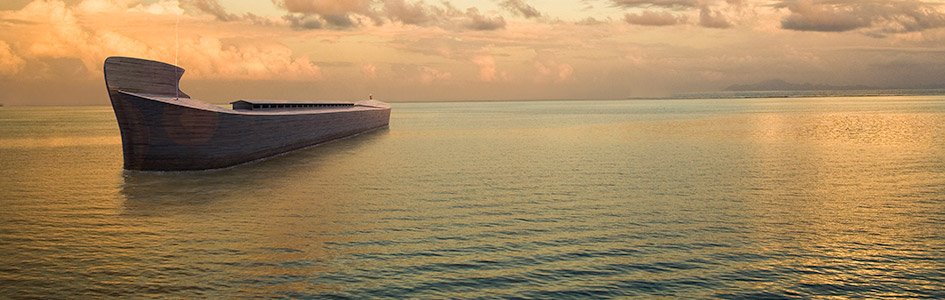
Did Noah’s Ark Lack Oxygen at Such a High Altitude?
Have you ever climbed a mountain and found yourself gasping for air? As you ascend a mountain, the amount of oxygen in the atmosphere decreases. At the top of the highest peaks, like Everest, oxygen bottles are required for climbers to reach the summit. In practice, humans cannot survive long at such high elevations. Yet we read this about the waters of Noah’s flood in Genesis 7:19–20:
And the waters prevailed so mightily on the earth that all the high mountains under the whole heaven were covered. The waters prevailed above the mountains, covering them fifteen cubits deep.
In other words, the floodwaters went 15 cubits (about 25.5 feet using a cubit of 20.4 inches) above the highest mountains. In the present, that would be 29,058.19 feet (Everest’s height of 29,032.691 feet + 25.5 ft). Oxygen assistance is necessary around 26,246 feet.2 So if the floodwaters covered Everest today, it would be almost 3,000 feet above the breathable limit. Basic logic seems to indicate that the flood should have pushed Noah above the breathable limit.3
However, this simple bit of reasoning overlooks a couple of wrong assumptions.
Assumption 1: Mount Everest and other peaks of similar height existed before the flood.
This assumption is flawed for several reasons. First, we know that the pre-flood world was different than the modern world. Some of the fossils we find are of plants, like lycopods, that are vastly different than any living plants, even modern lycopods, which are much smaller than their pre-flood types. Further, we think that the pre-flood world was a single supercontinent, called Rodinia, that broke apart during the flood.4 So the geography of earth would have been very different in the past compared to today.
If the earth’s geography was different in the past, then it is possible that the mountains we see today did not exist in the pre-flood world. Such an argument has been put forward for years in creationist circles. The mountains’ core rocks were formed during creation week. During the flood, due to tectonic uplift or the collision of tectonic plates, the mountains were raised to perhaps even slightly above their current height. Glacial and other erosion during the post-flood ice age led to slight decreases in mountain height until they reached approximately their modern heights.5
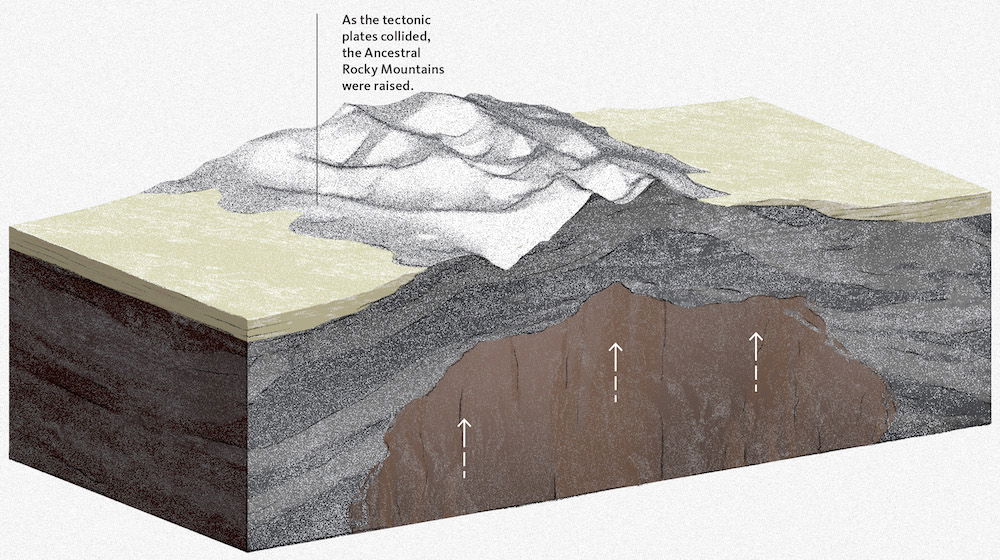
The mountains rising mid-flood.
(From an article by Dr. Snelling)
This is supported by the Bible talking explicitly about the mountains rising and valleys sinking during the flood.
You covered it with the deep as with a garment; the waters stood above the mountains. At your rebuke they fled; at the sound of your thunder they took to flight. The mountains rose, the valleys sank down to the place that you appointed for them. You set a boundary that they may not pass, so that they might not again cover the earth. (Psalm 104:6–9)
The last sentence makes it clear that the psalmist is talking about the global flood. It’s an echo of God’s promise in Genesis 9:11, where he tells Noah he will never flood the earth again. It is the sentence prior, however, that is most interesting for this article. It indicates that during the flood, the mountains rose and the valleys sank. In other words, the pre-flood mountains were shorter (and the pre-flood valleys and ocean basins were shallower) than the topography we see today.
The ark would not have needed to get to the height of Mount Everest.
Extending that idea one step further means that the ark would not have needed to get to the height of Mount Everest. In fact, it likely would have been considerably lower, below the line of breathable air. So the proposed oxygen problem is not a problem at all.
Assumption 2: Atmospheric oxygen concentration is not influenced by sea level rise.
The further from sea level you get, the thinner the atmosphere becomes. This is due to atmospheric pressure. While we do not feel it, air does have mass, and therefore weight. Due to gravity, the air further from sea level presses down on the air closer to sea level. This compacts the air, raising its density and therefore its concentration of oxygen. However, the higher you go, the less pressure is present from air above you, meaning that in a given area, there are fewer molecules of oxygen. This is a simplified version of what everyone, creationist and evolutionist alike, agrees with.
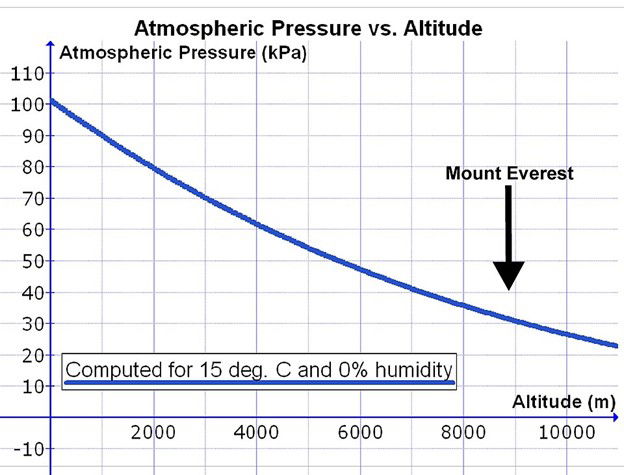
As altitude increases, atmospheric pressure decreases.
(CC BY-SA 4.0 by Cruithne9 via Wikimedia Commons)
Now assume that the sea level rises. What happens to the air? Some of it will dissolve in seawater. However, like all liquids, there is a saturation point, at which no more dissolved gases can go into the liquid, but on a global scale such as is being discussed here, this is negligible for air pressure, but it may have come into play for available oxygen.
In the ocean normally, oxygen is not saturated, due to use by living organisms.6 However, in the flood, many of those organisms would have been killed relatively early. That means oxygen rapidly would have hit its saturation point. The remaining oxygen in the atmosphere could not dissolve—as the water rose, it had no place to go but up, along with the other gases in the atmosphere. Thus, the rising water would apply a counterpressure on the lower portion of the atmosphere.
The pressure of the rising water would force the atmosphere upward, raising the atmospheric density at what had previously been higher elevations (but much lower than what are present-day high-elevation landforms). Because the flood occurred in stages, reaching its zenith by day 150,7 the oxygen levels at the previously high elevations would have had time to stabilize, or at least significantly increase, before Noah and the ark reached them. Oxygen content may have been slightly lower than what is normal at sea level, due to absorption up to saturation levels in the ocean waters, but there would have been plenty of oxygen for Noah. In fact, the oxygen lost to saturation may have been fully compensated for by the increased atmospheric pressure of the raised sea level.
We keep our atmosphere due to the gravity of earth itself; most of the gases do not have enough energy to escape into space.8 There is no reason to believe anything about gravity changed during the flood. Earth’s mass, which causes gravity, did not significantly change.9 Therefore, the gravitational pull would remain the same.
Oxygen concentrations, even accounting for the loss to oceanic saturation, actually may have been higher during the flood than they were before the flood.
This matters because of how gases work. Gases take the shape of their container. In the case of earth’s atmosphere, the container is the gravitational attraction of earth. However, gases can be compressed so that more gas fits in the same size container or, alternatively, that the same amount of gas fits in a smaller container. All that changes is the concentration of the gas. In practice, because the water level rose so much during the flood, the size of the container shrank dramatically. That means that the remaining oxygen would have been compressed due to a reduced area for the gas to fill. So oxygen concentrations, even accounting for the loss to oceanic saturation, actually may have been higher during the flood than they were before the flood.
Assumption 3: Death of plants would cause a catastrophic drop in atmospheric oxygen content.
Photosynthesis is the source of oxygen in our atmosphere. Plants, algae, and other photosynthetic organisms make the oxygen we need to stay alive.10 If photosynthesis were to cease tomorrow, humanity would have at most a couple decades to somehow find new ways of making oxygen before we’d die.11 However, the flood did not last decades—it lasted a bit over one year. So oxygen loss would not be an immediate problem. And we know from the olive leaf picked by the dove in Genesis 8:11 that plant life was recovering rapidly.
However, even if there were a problem here, the calculations of time before imminent collapse after the loss of photosynthesis assumes that all other biomass is still alive and using oxygen. During the flood, most biomass was killed relatively early, so oxygen consumption probably dropped off around the same time as oxygen production was reduced.
Further, phytoplankton could have continued to photosynthesize during the flood and thus produce more oxygen. In the nutrient-rich floodwaters, phytoplankton probably proliferated, particularly after day 150. Since the ocean was probably close to saturation, most of the oxygen they released would have gone into the atmosphere, further increasing its oxygen content.
Conclusion
Oxygen deficiency on the ark is a nonproblem. After all, mountain peaks wouldn’t have been as high in the pre-flood world, the rise in sea level would have negated any altitude effects, and reduced photosynthesis wouldn’t have been an issue. Anyone attempting to use oxygen deficiency as an argument against the Scripture’s historical account of the global flood has either not considered the argument very well at all or is being deliberately dishonest in the hope of scoring cheap debate points. Having breathable oxygen would not have been a problem for Noah and the animals on the ark—they may even have had more oxygen than they had before the flood.
Answers in Depth
2025 Volume 20
Answers in Depth explores the biblical worldview in addressing modern scientific research, history, current events, popular media, theology, and much more.
Browse VolumeFootnotes
- Venables, Stephen, and All Britanica Editors, “Mount Everest,” Britannica, November 4, 2025, https://www.britannica.com/place/Mount-Everest.
- Scott, Marcus, “What Is the Max Altitude at Which a Person Can Breathe?,” Healthfully, December 18, 2018, https://healthfully.com/what-is-the-max-altitude-at-which-a-person-can-breathe-7642287.html.
- Was there fresh air on the ark? Read about possible air-circulation methods here: Ark Encounter, “Fresh Air on the Ark?,” October 3, 2024, https://arkencounter.com/blog/2024/10/03/fresh-air-on-ark/.
- Snelling, Andrew A., “Noah’s Lost World,” Answers Magazine 9, no. 2 (April 1, 2014): 80–85, https://answersingenesis.org/geology/plate-tectonics/noahs-lost-world/.
- Snelling, Andrew A., “Raising the Rocky Mountains,” Answers Magazine 18, no. 4 (October 1, 2023): 52–60, https://answersingenesis.org/geology/raising-the-rocky-mountains/.
- Webb, Paul, Introduction to Oceanography, Roger Williams University, 5.4, https://rwu.pressbooks.pub/webboceanography/chapter/5-4-dissolved-gases-oxygen/.
- Lacey, Troy, “How Did the Events of Noah’s Flood Unfold?,” Answers in Genesis, May 24, 2025, https://answersingenesis.org/the-flood/how-did-noahs-flood-unfold/.
- Byrd, Deborah, “How Does the Earth Keep Its Atmosphere?,” EarthSky, March 5, 2011, https://earthsky.org/earth/what-keeps-earths-atmosphere-on-earth/.
- If the flood was initiated by meteor or asteroid impacts, they may have contributed a negligible amount of mass to the overall mass of the earth.
- De Naoum, Kat, “You May Be Surprised Where Most of Earth’s Oxygen Comes From,” Thomas, May 4, 2023, https://www.thomasnet.com/insights/you-may-be-surprised-where-most-of-earth-s-oxygen-comes-from/.
- IERE Team, “What Would Happen If Photosynthesis Stopped Happening on Earth?,” IERE, June 24, 2025, https://iere.org/what-would-happen-if-photosynthesis-stopped-happening-on-earth/.
Support the creation/gospel message by donating or getting involved!

Answers in Genesis is an apologetics ministry, dedicated to helping Christians defend their faith and proclaim the good news of Jesus Christ.
- Customer Service 800.778.3390
- Available Monday–Friday | 9 AM–5 PM ET
- © 2026 Answers in Genesis