

Photo by Maria Lysenko on Unsplash
Tonto Depositional Processes and Rates: Responding Again to “Peaceful Science” Critics
Part 2 of “A Detailed Response to ‘Examining Young Earth Creation Claims About the Grand Canyon’”
Stephen Michell and Dr. Kennen Tillman wrote three articles that were published on the Peaceful Science website in a 2024 series titled “Examining Young Earth Creation Claims About the Grand Canyon.”1 This series, authored by two professing Christian old-earth evolutionists and retired geologists, attempts to undermine biblical, young-earth creationism by critiquing three of my Answers Research Journal papers,2 which I produced to publish results of the initial stage of my research on four folds in the Tapeats Sandstone, Bright Angel Shale, and Muav Limestone of the Tonto Group in the Grand Canyon.
In Part 1 of my three-part response series, I set the stage by examining the critics’ worldview and the implications of the Tapeats Sandstone’s areal extent. I encourage you to read it first to understand helpful background information: “Responding to ‘Peaceful Science’ Critics on Grand Canyon Evidence.” Now, this Part 2 article will focus on Mitchell and Tillman’s Part 2 critique regarding Tonto depositional processes and rates.3
Contents
Two Questions with Contrasting Answers
In Part 2 of their critique, Mitchell and Tillman repeat and discuss two of the four questions they introduced in Part 1 for which they state that “the Snelling articles contrast with the consensus geologic understandings developed for these formations.” These questions are:
- How long did it take for the unit to be deposited? Thousands to millions of years vs. a few days.
- What depositional processes were dominantly involved? Fluvial and tidal processes vs. catastrophic flood processes.
In a telling admission, they state in their brief discussion of question #1 that “if the unit were demonstrated to have been deposited more quickly by orders of magnitude than typically proposed, this would be very interesting to geologists” but “it would not necessarily have much impact on the understanding of most other sedimentary rock units, either in this area or in other areas of the world.”4 That is reminiscent of the late Derek Ager, whose valiant efforts to champion the episodic catastrophic deposition of sedimentary layers5 have since largely been ignored. But like Ager, Mitchell and Tillman admit that no matter what evidence there might be for catastrophic deposition of sedimentary layers, the majority consensus of conventional uniformitarian geologists would still be the accumulation of the sedimentary layers over millions of years. Thus, Mitchell and Tillman have answered their own question #1 before they even discuss the claimed evidence! Groupthink, geological consensus rules out any evidence for catastrophism a priori!
Similarly, in briefly discussing question #2, Mitchell and Tillman state that “if geologists were to recognize that any of the formations of the Tonto Group were deposited in a different setting with processes dominated by very rapidly flowing water, it would be an interesting find that would certainly make them eager to re-evaluate some other units.”6 However, they go on immediately to admit that “again, it would say nothing about how most other sedimentary units around the world were formed.”7 Indeed, they assert “many processes would be incompatible with FG [Flood geology] models. For instance, thick alluvial deposits conceivably might have formed quickly, but not during a global flood because they would not have formed with rising flood waters.”8 In other words, case closed! From their perspective, because today we don’t observe sedimentary layers being deposited by catastrophic global flood processes, these Tonto sedimentary layers could only have been deposited by today’s observed tidal and fluvial sedimentation processes.
At least they then finally admit that “sedimentary rocks don’t come with speedometers that tell us how fast they were deposited.”9 Agreed! But neither do they come with labels describing how they formed and how old they are! Yet they acknowledge, “Snelling has provided many accurate mineralogical descriptions and observations regarding the thin sections” but then erroneously claim that “these do not directly address the depositional processes or rates.”10 Their latter claim is absolutely false! Any seasoned sedimentary petrologist will adamantly assert that microscopic descriptions of the mineralogy, grain sizes, grain shapes, pores, and textures are all highly relevant to deciphering the depositional processes and rates. Why then do all sedimentary petrology textbooks contain so many photomicrographs of sedimentary rocks and their textures?
For example, we describe a sediment as poorly sorted when under the microscope we observe grains of different sizes all mixed together (rather than grains of all the same size, which we would describe as well sorted). The sediment grains may also be angular or subangular, that is, we observe under the microscope the grains have jagged edges and corners, in contrast to smooth, rounded edges and corners. Some mineral grains are fragile, such as muscovite (white mica), which is a soft mineral with a Mohs hardness of 2.5 compared to the 7 of quartz (the predominant mineral in many sediments because of its durability). Other minerals such a K-feldspar easily weather to clay under prolonged surface exposure. And interlocking of the grains or texture may still consist of many open (unfilled) pores. All these observations are highly relevant to understanding the depositional processes and timing of those events.
All these observations are highly relevant to understanding the depositional processes and timing of those events.
Yet we consistently observe all these features in microscope thin sections of the Tapeats Sandstone (descriptions Mitchell and Tillman acknowledge as accurate): poorly sorted, subangular grains of quartz and K-feldspar with fragile muscovite flakes wedged between them but with many unfilled pores.11 These observations mean the Tapeats Sandstone was potentially deposited so quickly and/or the sediment was not transported very far, as the grains did not have time to be sorted or rounded nor did the muscovite and K-felspar have time to be destroyed or weathered. And if the Tapeats Sandstone had been buried under 10,000 feet (~3,050 meters) of overlying strata for >450 million years (geological consensus view), then the confining overburden pressure should have closed many pores, and the others should have filled with cement precipitated from trapped groundwaters.
Thus, the microscope observations are highly relevant to deciphering depositional processes and rates, contrary to Mitchell and Tillman’s fallacious assertion. It is a wonder they made such an outrageous assertion after all their many years of experience in the oil industry because oil company geologists routinely examine microscope thin sections of sedimentary layers in order to assess their suitability as oil source and reservoir rocks. While they are correct that “similar sediments can be deposited by several different processes and at different rates,” there is no denying these implications of the microscope observations of the Tapeats Sandstone.
The Great Unconformity
Mitchell and Tillman next discuss the erosion surface on which the Tapeats Sandstone was deposited (Fig. 1). It is called the Great Unconformity because it represents severe erosion of the Precambrian sedimentary layers (Grand Canyon Supergroup), and the basement schists and granites before the Tapeats Sandstone was deposited unconformably on top of that erosion surface. In most places, the Precambrian sedimentary layers (Fig. 1, left) have been totally eroded so that the Tapeats Sandstone sits directly on the basement schists and granites (Fig. 1, right). That represents at least 12,000 feet (3,660 meters) of Grand Canyon Supergroup layers that were eroded and removed, along with some depth of crystalline basement schists and granites. Thus, it is also called the Great Unconformity because, as Mitchell and Tillman rightly admit, “it certainly is widespread and at least roughly equivalent surfaces are present in multiple continents,”12 as documented by Peters and Gaines.13
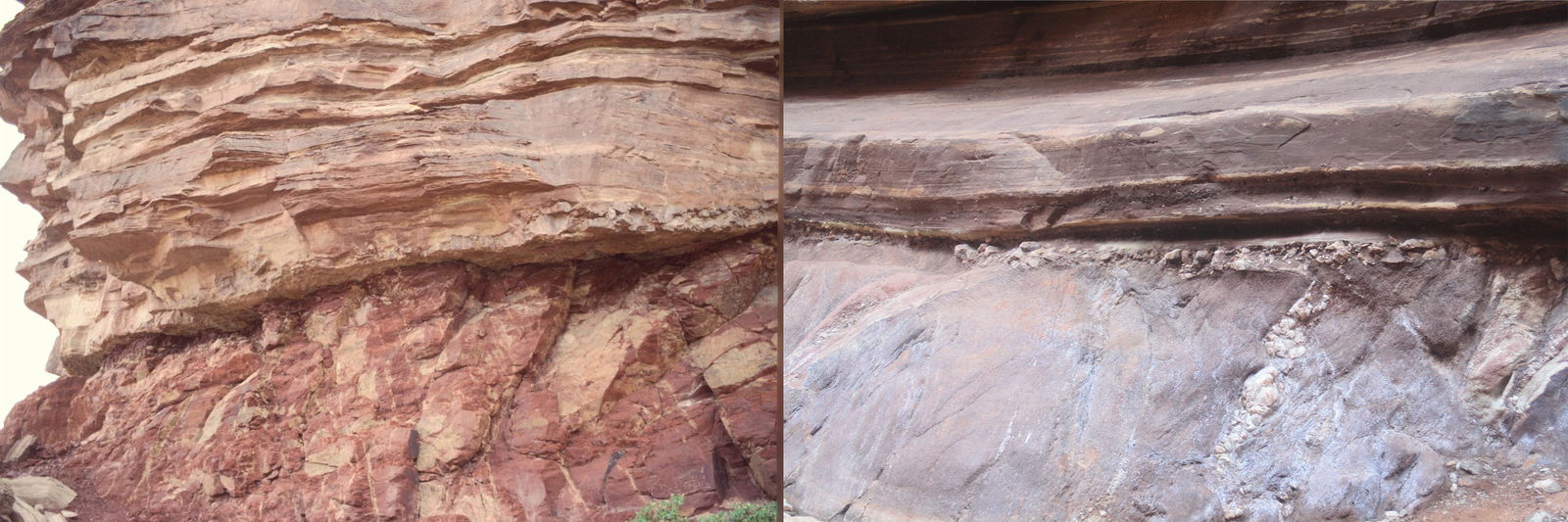
Fig. 1. The Great Unconformity, the erosion surface on which the Tapeats Sandstone was deposited. Left: The Tapeats Sandstone sits on Proterozoic Hakatai Shale of the Unkar Group at Ayres Point (river mile 79). Right: The Tapeats Sandstone sits on the Vishnu Schist in Blacktail Canyon (river mile 120.5).
As I have stated, correctly cited by Mitchell and Tillman, “Before the Tapeats Sandstone was deposited, there had to be a prolonged period (days or more) in which there was a significant amount of continental-scale erosion to bevel the Precambrian (pre-Flood) land surface to produce the Great Unconformity,” driven by continuous intensive high-energy storms and tsunamis.14 Of course, Mitchell and Tillman dispute that catastrophic time frame, instead relying on the claims of their uniformitarian colleagues that the Great Unconformity has been supposedly “demonstrated to be a composite surface that resulted from multiple widely separated phases of erosion,”15 that is, over hundreds of millions of years.16 This was determined using the maximum depositional dating method for sedimentary strata from U-Pb (uranium-lead) “ages” of detrital zircon grains. However, the fallacies of this method that produced an erroneous “age” for the Tapeats Sandstone have already been soundly presented in my Part 1 article. But their uniformitarian colleagues still used it to supposedly “date” the Grand Canyon Supergroup layers beneath the Great Unconformity and thus claim it is a composite erosion surface resulting from multiple widely separated phases of erosion over hundreds of millions of years. With that dating method comprehensively demonstrated as fallacious, my claim that a prolonged period (days or more) at the onset of the biblical global Flood cataclysm (in which there was a significant amount of continental-scale erosion to bevel the Precambrian land surface to produce the Great Unconformity driven by continuous intensive high-energy storms and tsunamis) is entirely reasonable.
Mitchell and Tillman’s next claim that the sharp angularity at the Great Unconformity “found in the Grand Canyon region goes away when it is correlated northward into the Great Basin”17 is a red herring because the boundary that is the Great Unconformity is still there, as it is around the globe.18 Angularity or not, it is still recognized as a near-global erosion surface.
Furthermore, Mitchell and Tillman’s analogy of the chunk of cheese left out for a long time is another red herring because it has absolutely not been demonstrated that the highly weathered Great Unconformity, which occurs on top of the Precambrian surface in several places in the canyon, represents a prolonged period of weathering. As I wrote in a journal article,
The only effort to understand the genesis of that potentially significant horizon is that of Sharp.19 His study suggested that extensive chemical weathering of Precambrian rocks occurred prior to deposition of the Cambrian Tapeats Sandstone. In places that apparently highly weathered surface or potential regolith is up to 15.3 m (50 ft) thick but elsewhere is generally less than 3.1 m (10 ft) thick. Sharp speculated that where the Tapeats Sandstone sits on unaltered Precambrian basement, that regolith was probably removed by the wave erosion associated with the initial Cambrian transgression. Sharp and McKee20 suggested that the presence of such a thick, apparently weathered horizon indicated that dominantly humid conditions existed during the earliest Paleozoic period prior to deposition of the Tonto Group. However, there have been no petrologic and geochemical studies [since 1940] that could substantiate that hypothesis. Furthermore, from a uniformitarian perspective during the hundreds of millions of years represented at the Great Unconformity the climate could have changed numerous times prior to deposition of the Tonto Group, and in the absence of terrestrial vegetation according to their evolutionary scenario of earth history weathering processes in soils would have been different,21 so a humid climate interpretation is quite tenuous.22
Deeply weathered horizons beneath the Great Unconformity are not unexpected within a biblical perspective.
On the other hand, during the roughly 1,656 years from creation to the global Flood cataclysm (Genesis 5:1–32), there would have been weathering of the surface rocks in the conducive pre-Flood climate, only adding to the erosion that likely occurred on day three of creation week. On day three, God caused the dry land to appear by lifting it up from beneath the waters, a process that would have caused great erosion (this is potentially seen on top of some of the basement schists and granites now exposed in the Grand Canyon).23 On that same day, God would have then created deep soil on this newly exposed land, into which He put the plants (Genesis 1:9–13). Thus, deeply weathered horizons beneath the Great Unconformity are not unexpected within a biblical perspective if, in some areas, erosion at the onset of the global Flood cataclysm was not as severe as in other areas. Mitchell and Tillman mention, “In other parts of North America, thick weathered regoliths are found beneath the GU [Great Unconformity],”24, 25 and they correctly acknowledge such surfaces may have been exposed for thousands of years, which fits with the length of the pre-Flood era and its climatic conditions.
The Huge Amount of Sediment
The next supposed challenge for Flood geology raised by Mitchell and Tillman is the sheer volume of sediment deposited above the Great Unconformity. They correctly maintain that the thickness of Phanerozoic layers in the Grand Canyon region was originally ~9,840–18,400 feet (~3,000–6,000 meters) but wrongly label the entire thickness as Flood sediments. Some of the uppermost layers may be post-Flood. In any case, the thickness of the Tonto Group in the Grand Canyon is ~900–1,700 feet (~275–500 meters). At least there is agreement on that. And Mitchell and Tillman acknowledge that my contention that the sediment was largely locally derived is consistent with most other published reports.
However, from their dogmatic uniformitarian perspective, Mitchell and Tillman understandably question how the necessary volume of sediment could be generated and deposited over a few days. Furthermore, the sediment had to include quartz sand (plus K-feldspar grains and muscovite flakes derived from the basement granites and schists), silt, mud, lime silt and mud, and also siliceous material that became the chert in the Sixtymile Formation, which in places underlies the Tapeats Sandstone. They claim that my proposed continental-scale erosion being caused by tsunamis and hurricanes is not supported by the evidence of what we know of the characteristics of tsunami and hurricane erosion and deposition today. It is obvious they make that claim because of their strict uniformitarian belief that only present-day processes and their rates can be invoked to explain the formation of past sedimentary layers. But of course, today’s evidence of tsunami and hurricane erosion and deposition does not match what we see in the Tonto Group layers if the latter were deposited during the global Flood cataclysm because today we do not experience any global floods, as per God’s promise never to destroy the earth again by a watery cataclysm (Genesis 9:8–17).
Nevertheless, as Mitchell and Tillman state, “If a global catastrophic flood eroded rocks and then deposited the sediment derived from this erosion, we would expect to see the tsunami and hurricane type processes, though perhaps scaled up.”26 Perhaps “these would be recognizable,”27 but how can we be sure when we have never seen a catastrophic global flood in action? Even present-day tsunami and hurricane deposits may not be a truly accurate key to the past, a thought these doctrinaire uniformitarian Christian geologists cannot accept because it means having to believe exactly what God’s Word says about the global Flood cataclysm.
Indeed, they taunt Baumgardner and me about using the Flood to account for limestone and other carbonate rocks, as well so-called evaporites and cherts, because they represent 20% of sedimentary rocks around the world. However, it has been amply demonstrated by Flood geologists that ancient limestones are distinctly different from today’s lime deposits that uniformitarians claim are their analogues.28 They are also totally ignoring God’s Word that describes the “fountains of the great deep” breaking up and remaining open for 150 days (Genesis 7:11, 24 and 8:2–3). As already explained by Flood geologists but ignored by Mitchell and Tillman, these superheated waters fountaining upward from the earth’s mantle most likely were supersaturated with lime, silica, and various salts derived from breaking down mantle and crustal rocks at depth and during their upward passage.29 When that superheated steam mixed with the cold ocean waters, the sudden drop in temperature would drastically change the supersaturation conditions so that the contained salts were precipitated rapidly and even transported by the surging humungous tsunamis generated by the devastating earthquakes due to the catastrophic plate movements.
Furthermore, Mitchell and Tillman note my reporting of the modeling research done by Flood geophysicist John Baumgardner on the catastrophic cavitation that could have eroded the needed clastic sediments (sand, silt, mud) and the humungous tsunamis that could have transported and deposited those sediments, but they omit or ignore his most recently published modeling research.30 In their refutation to discredit Baumgardner’s modeling, they could only muster a personal communication from another uniformitarian Christian geologist with unpublished, unsubstantiated claims, as if his opinions trump peer-reviewed, published research.
Mitchell and Tillman then calculate that a sedimentation rate of ~9–30 meters or 28–120 feet per day (0.5–1.4 meters or 1.5–4.6 feet per hour) for the Tapeats Sandstone is predicted from my research, which found that due to the mineralogy (fragile muscovite flakes) and textures (poorly sorted, subangular quartz and K-feldspar grains), the Tapeats Sandstone could have been deposited within a few days at water current flow rates of 1–1.5 meters per sec.31 However, Baumgardner’s published modeling research demonstrates that such sedimentation and water current flow rates could be achieved by the rapidly repeated tsunamis generated by devastating earthquakes due to the rapidly repeated catastrophic releases of locked plates as they were subducted rapidly during the global Flood cataclysm. As Mitchell and Tillman admit, “This proposal is that a lot of sediment was deposited in a hurry,”32 which is exactly what would be predicted from the description of the global Flood cataclysm in God’s Word.
Only the global Flood cataclysm can explain the deposition of such a sandstone layer.
In conclusion, Mitchell and Tillman agree that “such rates sustained over a broad area would have meant enormous discharge rates. . . . And depositional rates like these are vastly beyond normal rates.”33 Yet they don’t specify how broad an area. That is because the intercontinental distribution of “the Tapeats Sandstone and its equivalents . . . can be traced in outcrops and drill holes right across North America, across northern Africa into the Middle East (Fig. 2)”34 and to eastern China and South Korea35 is devastating to their old-earth uniformitarian model, as I have already discussed in my Part 1 response article. Where today do we see deposition of such a continuous sheet sandstone layer across several continents? Nowhere! Only the global Flood cataclysm can explain the deposition of such a sandstone layer. So much for the old-earth uniformitarian belief of these Christian geologists.
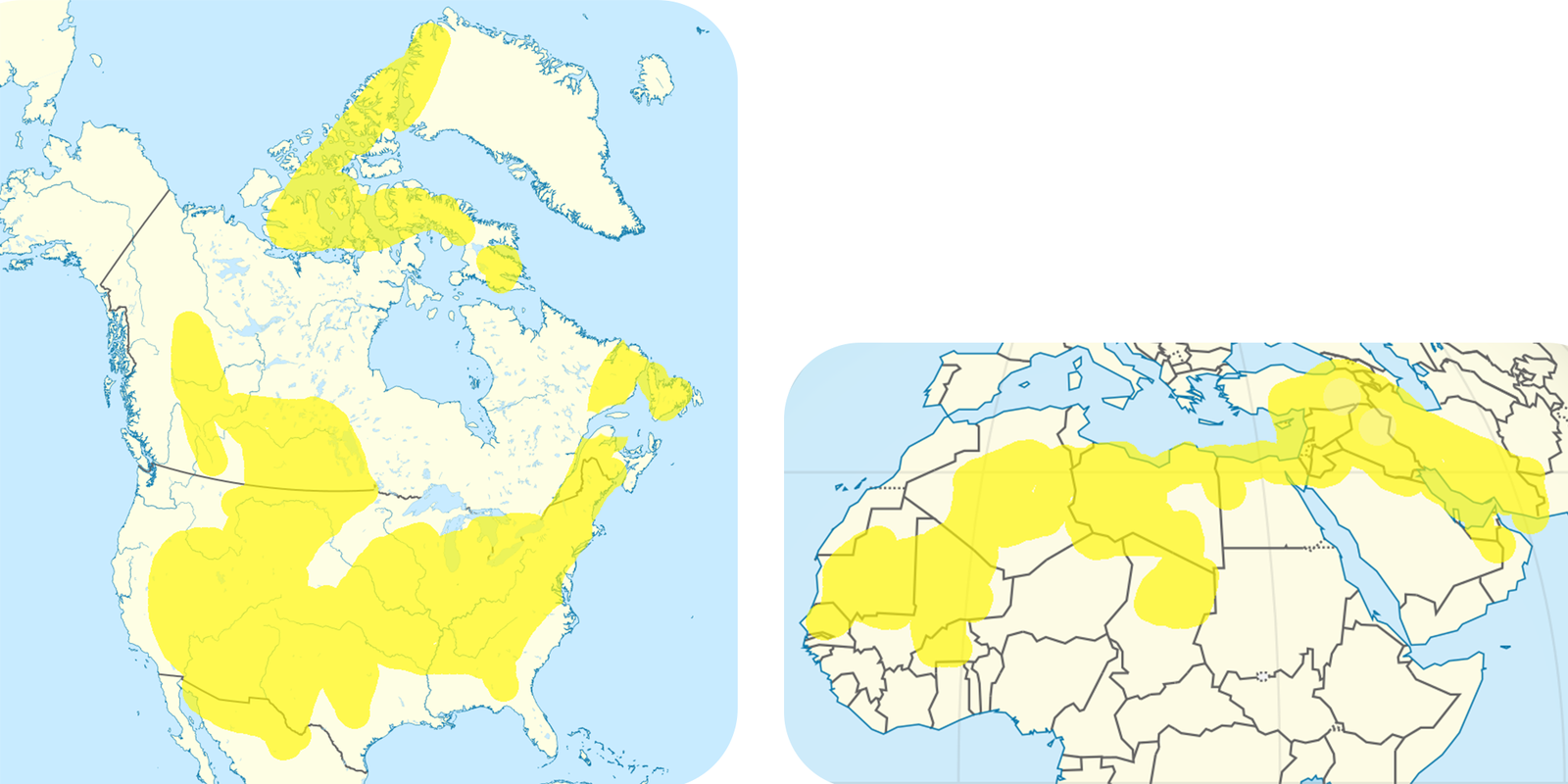
Fig. 2. The extent of the Tapeats Sandstone and its equivalents (rough outline) across North America and Africa to the Middle East as determined from both outcrops and drill holes (after Clarey 2020). TUBS, CC BY-SA 3.0, via Wikimedia Commons (cropped and yellow outline added)
Megaflood Deposits
Mitchell and Tillman try to defend the uniformitarian deposition of the Tapeats Sandstone by appealing to exceptional examples of recent hurricane and tsunami deposits where elevated flow rates (of 1–1.5 meters per sec) and depositional rates (of 0.5–1.4 meters or 1.5–4.6 feet per hour) are postulated to have occurred, showing us what to expect if processes were much bigger than what we see at present.36 However, these were only one-off localized events and thus cannot be analogues for the biblical global Flood cataclysm during which there were thousands of rapidly consecutive tsunamis that surged right around the globe accompanied by hurricane-force winds. As doctrinaire uniformitarians, Mitchell and Tillman endeavor to shoehorn any remotely comparable present-day localized depositional event into explaining every rock unit that was deposited in the past. They fail to comprehend that God’s Word, which they say they believe, maintains that what happened in the past explains what we see in the present, rather than what we see in the present being able to explain what happened in the past. As the Apostle Peter warned in 2 Peter 3:1–7, the latter reasoning is the error of the scoffers who deny that the global Flood cataclysm occurred just as God said it did and truthfully told us about it.
Undaunted, Mitchell and Tillman next provide examples of deposits produced by megafloods or superfloods and megaturbidites or megabeds when processes in the past were evidently much bigger than what we see in the present. They admit that “a global catastrophic flood would certainly be larger than typical floods that have occurred around the world in our lifetimes,”37 even suggesting that “in this case, like many others, the present is not the entire key to the past.”38 Notice the caveat “not the entire key” (my emphasis). In other words, they still cling to their uniformitarian belief. Sure, geologists have recognized that high flow rates forming large deposits have occurred. And it may be possible to “estimate how fast the flow was moving that caused a sand deposit by examining it.”39 But when there is repeated evidence within sediment layers of their catastrophic deposition such as in sandstones like the Tapeats Sandstone that can be traced across continents, such evidence demands catastrophic global flood conditions unlike today’s megafloods.
Their first examples are those in the geologic record that have been described as due to megafloods or superfloods.40 Mitchell and Tillman claim that such floods moved sediments at rates similar to what I claim for Noah’s Flood.41 They say that “such rare events have occurred and left distinctive deposits” and that “such large flows are high unidirectional events that extended over broad areas.”42 Yet the authors of the referenced study open their abstract with this:
The concept of “megafloods” and “superfloods” was introduced at the end of the last century to define exceptionally large-discharge floods, primarily those associated with the failure of Quaternary ice-dams. These floods exceeded, by one or two magnitudes, historically recorded floods.43
If Mitchell and Tillman were familiar with the Flood geology literature, they would already know that because the Quaternary ice age correlates with the post-Flood ice age, even these “exceptionally large-discharge floods” cannot be analogues of deposition during the global Flood cataclysm. Indeed, such megafloods exceeding historically recorded floods by only one or two orders of magnitude and only extending over broad areas are not directly comparable to the magnitude and global extent of the biblical Flood cataclysm.
Furthermore, Mitchell and Tillman focus on the grains produced in such events being unusual. The authors of the referenced study comment in their abstract that the grains are “distinctive, being dominated by comminuted (smashed) grain-size distributions, which contrast to the sediment deposits of more moderate floods.”44 This observation thus provides evidence for what we should expect in terms of lithologic characteristics in deposits from large, high velocity flows. Mitchell and Tillman then somewhat gleefully point out that “while some shattered (comminuted) clasts may be present in the Tapeats Sandstone, they apparently are exceptional”45 and that “we don’t see evidence [in the microscope slides pictured in Snelling’s paper] of the shattering of comminuted grains.”46 But we have already seen above that these Quaternary ice dams regional floods are not comparable to the magnitude and extent of the biblical global Flood cataclysm, so we would not expect the grains in them to necessarily be comparable to the grains in the Tapeats Sandstone when the latter was deposited by the global Flood cataclysm.
However, the quartz grains in the Tapeats Sandstone are sometimes angular and often subangular, which is consistent with shattering when eroded by catastrophic cavitation and then some abrasion during transport. For example, we observe such quartz grains in regional sample TSS-02, Carbon Canyon fold sample CCF-06, and Monument fold samples MF-01, MF-02, MF-03, MF-04, MF-06 and MF-10 in Appendix D, and in regional samples (b) TSS-01 and (d) TSS-04, Carbon Canyon fold samples (e) CCF-01, (i) CCF-05, and (k) CCF-08, and Monument fold sample (q) MF-06 in Fig. 28 of the paper, just to cite a few microscope images.47 These alone total 13 of the 26 samples, so it is disingenuous for Mitchell and Tillman to claim that they “don’t see evidence of shattering of comminuted grains” in the Tapeats Sandstone samples in my paper and that “the deposits just don’t show evidence of the predicted flow rates.”48 Thus, since the Tapeats Sandstone does share key characteristics with the referenced megaflood deposits, this is consistent with its deposition during the biblical global Flood cataclysm.
The second examples of rapid deposition that Mitchell and Tillman cite are those “in Spain described as ‘megaturbidites’ or ‘megabeds’ [that] can be up to 656 feet (200 meters) thick.”49 But again, these are only localized megabeds within a depositional basin, and being dated as Eocene means that they may well be early post-Flood deposits, which on both counts make these megabeds not necessarily comparable to the Tapeats Sandstone. Furthermore, Mitchell and Tillman cite another study50 and state that “such units are recognized in many basins and are recognized as ‘event deposits,’ such as might result from major earthquakes.”51 They summarize their case here by stating that “geologists recognize that such catastrophic events have occurred in the past [due to earthquakes] and resulted in thick depositional units that were formed quickly.”52 In other words, they do admit again that the present is not the entire key to the past!
The biblical Flood cataclysm was global in extent, not in localized areas within basins as in those cited studies.
Mitchell and Tillman then assert that Flood geology “demands that all the Tonto unit was formed by such events.”53 Actually, Flood geology makes no such demand. Flood geology envisages, based on the eyewitness testimony in God’s Word, that what occurred during the biblical Flood cataclysm was global in extent, not in localized areas within basins as in those cited studies. And if Mitchell and Tillman had read the Flood geology literature, they would know that during the global Flood cataclysm, rapid-fire devastating earthquakes were generating multitudes of rapidly consecutive humungous tsunamis that surged right across continents, which have been modeled to demonstrate the Tapeats Sandstone and all the overlying units could easily have been deposited within the Flood year.54
Mitchell and Tillman ask in reference to the megabeds and the Tonto unit, are they comparable? They then provide in their Fig. 2 representative stratigraphic and lithologic sections of three megabeds from the paper by Bozetti’s team55 (reproduced from three other separate studies) alongside an idealized similar section through the Tapeats Sandstone as suggested by Rose.56 They admit, “The figure from Rose has been squeezed to approximate the grain size through the Tapeats, making the channels look disproportionately steep.”57 But they have thus misrepresented Rose’s idealized lithologic section by diminishing the content of the basal Tapeats. So all the features in the Tapeats Sandstone can be seen more clearly, and to be fair to Rose, I have reproduced Rose’s idealized lithologic section at his scale and proportions in Fig. 3.
In any case, it is abundantly clear that the idealized Tapeats lithologic section is certainly not comparable to the lithologic sections of the three megabeds. But then, Flood geologists like me never expected them to be comparable because the cited megabeds are local and were apparently produced by one-off earthquakes, whereas the Tapeats covers several continents (Fig. 2) and, as Flood geologists infer from Genesis, was produced by many tsunamis generated by multiple earthquakes. Mitchell and Tillman admit that “the megabeds show what happens when something, such as a major earthquake, hits an area with a large amount of unstable sediment, generally with a sea level drop” and “such resulting deposits are normally deposited over limited areas (i.e., doesn’t cover a basin as the Tonto sediments do) and has several stages of development even though it results from a single event.”58 However, the Tonto sediments cover continents, not a limited area or a basin (see Fig. 2 and associated references), so they are not comparable nor expected to be comparable, and to quote Mitchell and Tillman, “The Tonto Group sediments do not have characteristics such as would be formed by megaturbidites.”59

Fig. 3. The idealized section of the Tapeats Sandstone as suggested by Rose, with descriptive details of various features found at different stratigraphic levels within the formation, including the distribution of the various constituent facies, sedimentary structures, and trace fossils
Yet Mitchell and Tillman have conveniently overlooked two field observations pertaining to the Tonto Group and its deposition. The first is the Sixtymile Formation that underlies the Tapeats Sandstone in a few places in the eastern Grand Canyon.60 It has been redefined by radiometric dating as basal to the Tonto Group, which immediately overlies the Great Unconformity, and in part consists of multiple horizons of breccias. And second, in numerous locations within the base of the Tapeats Sandstone are gravels and cobble and boulder breccias, some with boulders the size of a house (Fig. 4). Most of these boulders consist of Shinumo Quartzite of the Unkar Group within the Grand Canyon Supergroup. In each case, there is nearby exposed in the cliffs Shinumo Quartzite just below the Great Unconformity, indicating the derivation of the boulders that thus did not get transported very far. However, these boulder and cobble breccias basal within the Tapeats Sandstone are comparable to the basal sections of the three megabed sections in Mitchell and Tillman’s Figure 2, though those are very much thicker than the basal Tapeats breccias.

Fig. 4. Boulders at the base of the Tapeats Sandstone sitting on the Great Unconformity. Left: A huge boulder greater than the size of a small house (circled in red) in Ninety-One-Mile Canyon (man for scale).61 Right: Smaller boulders hand to lower-arm size at Ayres Point, in Fig. 1 left (hand for scale).
Mitchell and Tillman thus claim that because it primarily consists of many layers of sandy sediments with channels as depicted in the idealized lithologic section in Fig. 3 “The Tapeats Sandstone resulted from hundreds and probably thousands of separate depositional events of many types.”62 But how can they be so sure when no geologists were present to witness the deposition of the many sandy layers of the Tapeats Sandstone? Their claim is merely an interpretation based on assuming that what we see in the present can only be used to explain the formation of sedimentary layers in the past. But where do we see today the same sandy layers being deposited at the same time right across several continents (see Fig. 2). Such evidence is more consistent with the global Flood cataclysm for which we have an eyewitness’ testimony—that of God Himself.
Sedimentary Environments
Mitchell and Tillman next move into discussing sedimentary environments as seen today and the features within their deposits that uniformitarians then use to interpret how past sedimentary layers were deposited. This process seems reasonable and logical, except it is based on the uniformitarian assumption that a global flood as God describes in His Word never happened.
Mitchell and Tillman state that uniformitarian “geologists have studied the Tonto Group in a number of major studies over the area and described the environments in different ways. Most recognize that the depositional environments varied both around the area and through time (vertically).”63 For example, they quote Middleton and Elliott who “described the environments for the Tapeats Sandstone this way in what generally encapsulates the leading consensus of most geologists.”64 In their summary, they conclude that the Tonto Group was deposited
in a variety of fluvial, nearshore, and shallow shelf environments. Braided stream and intertidal-to shallow-subtidal deposits of the Tapeats Sandstone grade seaward into a complex array of shelf sands and muds of the Bright Angel Shale. Shelf sedimentation was influenced by both tidal and storm currents. Sand ridges, sand waves and broad areas where fine-grained siliciclastics were deposited from suspension settling following storms and during fair-weather periods characterized the shelf. Farther offshore, carbonate islands dotted the shelf. Here, the carbonate buildups were characterized by intertidal and possible supratidal zones separated by deeper water areas where tidal currents were active and finer-grained carbonate sediments were deposited.65
As Mitchell and Tillman state,
They [Middleton and Elliott] are describing a set of depositional process much like normal sedimentation today and suggest rates were not radically different. If the formations in the Tonto Group do not have characteristics of megabeds or megafloods, do the characteristics fit the model of slower deposition shaped by streams, tides and normal marine processes?66
Their next objective is to highlight several examples of features in sedimentary rocks that they “find fit the consensus [uniformitarian] models . . . characterized as sedimentary structures, features that developed during deposition that help us to understand the processes involved.”67 For a summary of such features, they refer readers to Wikipedia.68
They cannot be so dogmatic about their claims because they have never watched a flood of the scale of the biblical global Flood cataclysm.
Mitchell and Tillman admit that “many bedding types and sedimentary structures are non-unique in terms of the environment in which they form” but claim that “some form only under very limited conditions.”69 Yet they insist that “all features identified are consistent with ‘a variety of fluvial, nearshore, and shallow shelf environments’” and claim that “some are particularly diagnostic.”70 However, they cannot be so dogmatic about their claims because they have never watched a flood of the scale of the biblical global Flood cataclysm to rule out that under such conditions many of these same sedimentary features might also be produced. As it is, there is not total agreement in their list of the major studies of the Tonto Group as to the interpreted depositional environments in which these sedimentary features formed, as Kennedy et al. present evidence for its deep water deposition,71 which coincides with my model for its deposition in the global Flood cataclysm.72 So let’s now look at these sedimentary features.
Herringbone Cross-Stratification
When sediments are deposited today by moving water, the features of the deposited beds vary based on the sediment types and the water velocities. When the resultant layering within a bed is at an angle to the main bedding, this is called cross-bedding or cross-stratification. Often the direction of sediment transport is measurable from the orientation of the cross-bedding. Such cross-stratification is readily visible in sandstone layers, such as in the Tapeats Sandstone. Examples as recognized by McKee73 are reproduced in Fig. 5, while the patterns of bedding in outcrops is evident in Fig. 6. Notice in Fig. 6 that two patterns are dominant—planar flat beds (left) and trough cross-beds (right).
Sometimes, the cross-bedding shows that the current reversed direction repeatedly in successive beds in what may be interpreted as occurring at relatively short time intervals. This is known as herringbone cross-stratification. Such flow reversals correlate with tidal cycles, so herringbone cross-beds are considered diagnostic of tidal environments. Herringbone cross-stratification (Fig. 5J) has been reported in all of the Tonto Group formations,74 although it is not as common as Mitchell and Tilman claim (Figs. 5 and 6). I observed it in the Muav Formation and commented: “The herringbone cross-stratification appears to reflect the bimodal-bipolar flow of the tidal currents.”75

Fig. 5. Lamination patterns of cross-stratification in the Tapeats Sandstone bed as depicted by McKee. (A) 120 Mile Rapids, (B) Colorado River mile 214.5, (C) Colorado River mile 214.5, (D) East fork, Pipe Creek, (E) East of Pipe Creek, (F) 127 Mile Rapids, (G) 213 Mile Canyon, (H) Near Yaki trail, (I) West fork, Pipe Creek, and (J) 215 Mile Rapids.
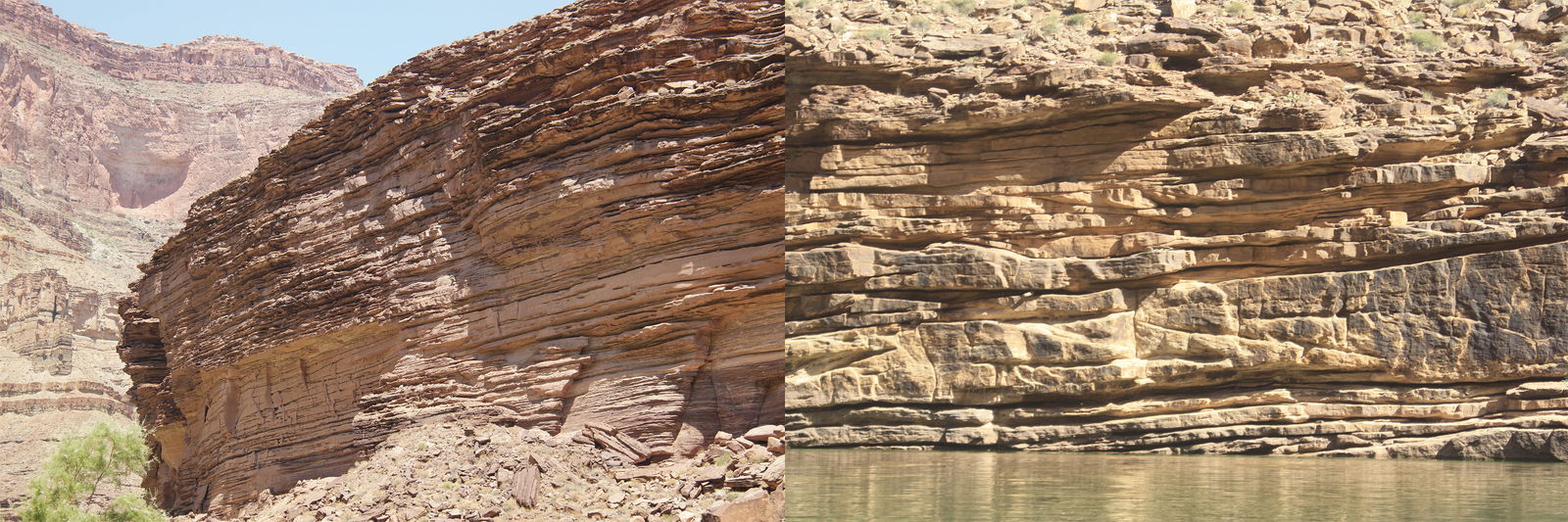
Fig. 6. The cliff-forming unit of the Tapeats Sandstone. Left: at river mile 61.5 where the dominant thin plain bedding is very evident due to weathering of softer levels in the sandstone producing ledges. Right: close view about river mile 59.5, where the thin horizontal sandstone beds of varying thickness making up the formation are visible, along with the planar and trough cross-stratification.
Mitchell and Tillman find it hard to understand why there would be flow reversals during deposition in a catastrophic flood deposit with water currents moving at the predicted rates. They insist that “herringbone cross-beds are one of several indicators of tidal deposits where we can count the cycles and be confident that the time represented by the sediments is no less than the number of cycles divided by four.”76 However, during hurricanes and tsunamis, the water beneath crests and troughs also moves in circles, including as the water moves into shallower depths approaching land (Fig.7). Furthermore, Flood geologists have demonstrated by their modeling of ocean water conditions during the global Flood cataclysm that global tides resonated to increase their ranges, super hurricanes were generated by the very warm ocean waters, and humungous tsunamis were generated repeatedly in rapid succession by super-powerful earthquakes as plates moved against one another in lock-steps due to catastrophic plate tectonics.77 Thus, alternating brief periods of vigorous back-and-forth flow would produce herringbone cross-beds and thus would be part of the catastrophic deposition from high flow rates during the biblical global Flood cataclysm.

Fig. 7. Circular motion of waves in the ocean produced by hurricanes and tsunamis, both in the open ocean and as hurricanes and tsunamis reach shallower water and approach the shore.
Another type of cross-bedding known as hummocky cross-stratification is found in the Bright Angel Formation. It is inconsistent with tidal deposition. Indeed, Mitchell and Tillman admit that “it is true that sedimentologists normally consider HCS [hummocky cross-stratification] to be indicative of storm deposition farther offshore.”78 Furthermore, I reported that “the hummocky cross-stratified sandstone beds pinch and swell along outcrop, grade laterally into herringbone cross-stratification beds, and both their lower and upper contacts are sharp or erosive.”79 In other words, the water motions of storm deposition that produced the hummocky cross-stratification also produced the herringbone cross-stratification. Yet Mitchell and Tillman claim that “beautiful examples of HCS are found in tidal deposits in South Korea”80 for which they do not provide a full reference so details can be checked. But they go on to admit that “the association with herringbone cross-stratification is consistent with storm deposits in settings with tidal deposits.”81 As I have repeatedly indicated, storms and tides are consistent with the devastating processes rapidly depositing these sediments during the biblical global Flood cataclysm.
Storms and tides are consistent with the devastating processes rapidly depositing these sediments during the biblical global Flood cataclysm.
Finally, it should be noted that Mitchell and Tillman do not mention the other bedding structures found in the Tonto Group, especially in the Muav Formation that I reported and argued are consistent with storm and tsunami deposition—nodular, wavy limestone beds with thin siltstone partings (Fig. 8) and megaripples, some with cross-stratification within them (Fig. 9).82 It is also highly significant that the Muav Formation in places consists of up to 50% quartz and K-feldspar grains with muscovite flakes, which is very different from the limestone supposedly deposited today in shallow tidal conditions as claimed by uniformitarians Mitchell and Tillman.

Fig. 8. Left: typical thin-bedded limestone with thin crinkly to nodular, wavy-bedded beds with sub-millimeter thick siltstone partings in the Muav Formation at river mile 168.5. Right: a closer view shows more clearly the nodular wavy beds of limestone with ultra-thin siltstone partings.

Fig. 9. The Muav Formation at river mile 152 with significant megaripples exposed in cross-section. Left: two megaripples with the immediately overlying laminae draped over them and internal cross-beds. Right: Two similar megaripples with no clear internal structure evident.
Mud Cracks
The next sedimentary structure in the Tonto Group layers that Mitchell and Tillman claim is key to their case for millions of years is observed polygonal fractures that they and other uniformitarians have interpreted as mud cracks due to supposed desiccation—drying out due to exposure to sun and air over lengthy time periods. These structures are sometimes observed in various layers elsewhere. Several studies have claimed they are also found in the Tonto Group layers in the Grand Canyon, especially in the Bright Angel Shale, where they have been interpreted as desiccation cracks or mud cracks.83
Today these polygonal features are indicators of at least some time of exposure and drying of sediment surfaces. Thus, such features in the Tonto Group layers, if validly interpreted, would be difficult to reconcile with either the rapid rate of sedimentation or the limited time available during the biblical, yearlong, global Flood cataclysm because their formation demonstrates periods when deposition stopped.
Mitchell and Tillman reproduce a photograph of supposed mud cracks infilled with calcite in the Tapeats Sandstone (their Fig. 4), as published by Hill and Moshier.84 However, the photograph was not taken by Hill and Moshier, nor are the location details provided. So Hill and Moshier (and Mitchell and Tillman) never actually observed these supposed mud cracks, and without location details provided, no one can go and check out these features for themselves. Can we even be sure that these supposed mud cracks are in the Tapeats Sandstone?
I have argued strongly already that “these cannot possibly be ‘mud’ cracks because these features are in a clay-poor sandstone, not mud. And as seen in [Hill and Moshier’s] photograph[s] [their figures on pages 66 and 67 and Mitchell and Tillman’s photograph (their Fig. 5)] of modern mud cracks, when the mud dries the polygonal shapes become concavely arched, whereas the claimed fossilized ‘mud cracks’ are flat.”85
However, Mitchell and Tillman cannot be persuaded because to admit the polygonal shapes cannot be mud cracks is detrimental to their uniformitarian case. They present several reasons. They agree with me that the pictured example is from the Tapeats Sandstone (which I have documented from analyses of samples) is largely devoid of clay. So they have to admit “it is true that some mud is essential.” But they then claim, “they can develop in sandy mud” using a century-old reference.86, 87 But how much mud is in “sandy mud,” especially as they have agreed with my documented lack of clay in the sandstone of the Tapeats Sandstone? Furthermore, their cited reference provides experimental observations that when a small quantity of sand is added to mud, the mud cracks formed are much smaller than those solely within mud. Yet the photograph of the supposed mud cracks in the Tapeats Sandstone (their Fig. 4) is of a sandstone almost devoid of clay (not a clay with some sand mixed in), and the supposed mud cracks are the same size as the modern mud cracks in mud (their Fig. 5), contrary to the experimental observations.
Mitchell and Tillman admit the location and lithologies for the example published by Hill and Moshier (Mitchell and Tillman’s Fig. 4) “have not been given,” yet those are crucial to their claim of these supposedly being mud cracks. Instead of then admitting they cannot substantiate their case, they lamely comment that I noted the presence of shaley beds and green muddy beds in the Tapeats Sandstone, as documented by McKee.88 But that is totally irrelevant because the photographed features they (and Hill and Moshier) claim are mud cracks are in sandstone and not in any shale or muddy beds. Adding to their sidestepping their obvious error, Mitchell and Tillman then suggest that “without knowing the location of the Hill [and Moshier] example, it is not possible to know the detailed lithology there and some clay in that location is possible.”89 However, the published photograph is of a sandstone that they have already admitted is devoid of clay (and which my laboratory analyses of samples have documented). This is nothing more than Mitchell and Tillman desperately grasping at straws.
Not to be defeated, Mitchell and Tillman then note my observation of the lack of concave arches apparent in the feature, which they (and Hill and Moshier) claim to be mud cracks (their Fig. 4). Their claim does not seem to be valid, as their modern example in their Fig. 5 illustrates. In experiments with drying muds, concave upward surfaces were always produced,90 and in Hill and Moshier’s photographs of modern muds (their pages 66–67), the mud cracks are also concave upward. In any case, the cracks in the modern muds in Mitchell and Tillman’s Fig. 5 are incomplete in their lateral extent so they do not form complete polygonal shapes, which means that they were still drying when photographed so no polygonal shapes had yet curled concave upward.
Mitchell and Tillman finally chide me for claiming “that limestones such as in the Muav Limestone cannot have mud cracks despite the reports by [uniformitarian] geologists.”91, 92, 93 Actually, those reports interpret those features in the Muav Limestone as mud cracks because mud cracks have been reported in modern lime mud tidal flats such as in the Bahamas.94 However, interpreting features in the Muav Limestone does not prove they are mud cracks.
Interpreting features in the Muav Limestone does not prove they are mud cracks.
Once again, Mitchell and Tillman are selective in what they report and critique, conveniently ignoring what Flood geologists have written concerning claimed fossilized mud cracks and alternative interpretations of how such fossilized crack features might have formed, such as diastasis cracks.95 They also conveniently ignore the full details of my response to the mud cracks reported in the Muav Limestone by Wanless and Rose.96 I stated that
these cannot possibly be desiccation cracks because these features are in clay-poor limestone and dolostone, not silicate mud. When silicate mud dries and cracks the polygonal shapes become concavely arched, whereas the claimed fossilized desiccation features are not adequately described for potential comparison. For any sediment to crack by desiccation, it must be dominated by clay-sized particles and must have certain clay minerals.97
In my reported analyses of the Muav Limestone, there are only insignificant amounts of illite, the most common clay mineral.
By comparison, modern soils that crack due to desiccation have significant amounts [13–58%] of clay minerals.98 . . . The Muav Formation limestones simply do not have the clay minerals necessary for any kind of desiccation to occur. Instead, these apparent shrinkage features in the Muav Limestone are more likely to be due to subaqueous shrinkage known as syneresis, which occurs when a liquid such as pore water is expelled from a gel-like substance such as water-saturated silicate and lime muds containing smectite in response to changes in salinity and possibly triggered by ground motion during earthquakes.99 . . . Thus, the apparent shrinkage features within the Muav Formation [and the other Tonto Group formations] . . . are not evidence contrary to deposition by high-energy, storm-driven water currents in a relatively shallow marine environment during catastrophic flood conditions [contrary to Mitchell and Tillman’s assertions].100
To try and salvage their supposed arguments that deposition of the Muav Limestone took a lengthy period, Mitchell and Tillman claim that “pauses in sedimentation of at least days are also indicated in the Muav Limestone as all investigators report the presence of ‘flat pebble conglomerates,’ often using them as important marker beds. They consist of pebbles with a distinct flattened dimension.”101 As Middleton and Elliott claim,
The origin of the clasts obviously required early lithification by cementation and/or compaction because they are likely derived by erosion of the earlier-deposited sediments within the same depositional basin.102
However, this is only an interpretation. How do they know the pebbles “are likely derived by erosion of the earlier-deposited sediments within the same depositional basin”? Which earlier-deposited sediments? Since the Tonto Group was deposited right across North America and beyond (Fig. 2), these pebbles could have been transported long distances after being eroded from pre-Tonto Group strata, that is, pre-Flood strata that obviously had more time to be cemented. Furthermore, pebbles require fast-moving water to transport them often under flood conditions, so these pebble conglomerates being deposited over large distances within the Muav Limestone is indicative of the global Flood cataclysm. Yet Mitchell and Tillman still want to argue that “regardless of how the Muav conglomerates formed, they demand that sedimentation paused for long enough for cementation to have taken place is valid.”103 They do not demand anything! The pebbles are just as likely to have been eroded from pre-Tonto Group strata. So no, the many flat-pebble conglomerate beds do not dictate that sedimentation paused many times, not even for several days at a minimum.
Mitchell and Tillman conclude that “overall, the presence of sedimentary structures like herringbone cross-bedding, mudcracks and flat-pebble beds demonstrate repeated pauses in sedimentation and are very problematic for Flood geology models.”104 But as I have shown, they do not demonstrate repeated pauses, and those sedimentary structures are not very problematic for Flood geology. Mitchell and Tillman have thus blithely ignored the detailed lengthy discussions in my papers on these sedimentary structures and the speed of deposition while using uniformitarian literature sources.105 For example, uniformitarians like Mitchell and Tillman assume that most mud (including lime mud) accumulates directly from suspension in the water column and hence it takes long periods of time to deposit the great thicknesses of mudstones, shales (and limestones) that make up the majority of the geologic record.106 However, flume experiments have now provided direct evidence of transport of mud-sized material in floccules and have shown that mud can accumulate as current ripples composed of grain aggregates under currents that can transport very fine sand. Furthermore, additional flume experiments have subsequently demonstrated that muds and carbonate muds can be transported in bed load as floccule ripples and deposited at current velocities that would suffice to transport and deposit sand.107 The resulting carbonate mud deposits accumulate in energetic conditions and show internal laminae and a pattern of cross-beds identical to those in sandstones, as observed in trough cross-stratification in the Muav Limestone108 as well as megaripples.109 Unfortunately, Mitchell and Tillman need to keep up-to-date with both the uniformitarian and Flood geology literature before criticizing Flood geologists.
Fossil Occurrence
Mitchell and Tillman next delve into fossils by briefly highlighting examples that, according to the evolutionary order they presume, are severe problems for Flood geology. They contend that the Tonto Group layers “do not contain tracks from dinosaurs or mammals because such animals were not living at the time,”110 due to supposedly not having evolved yet. However, as has been repeatedly pointed out by many others, the absence of evidence is not evidence of absence.111 It is also a matter of which creatures and their tracks were buried and preserved as fossils. Supposed Cambrian mud cracks have been found with fossilized trilobite tracks, and Mesozoic rocks include dinosaur tracks on or associated with supposed mud cracks in many places around the world. Mitchell and Tillman claim that “these make perfect sense in sediments in settings that [uniformitarians claim] developed over long periods of [evolutionary] time”112 and that this is not consistent with layers catastrophically deposited by the global Flood cataclysm.
However, Flood geologists have repeatedly explained over decades that this pattern of fossils represents the burial order of the global Flood cataclysm.113 Initially, bottom-dwelling shallow marine creatures were buried as the fountains of the great deep (ocean) opened up and tsunamis surged across the shallow ocean floor toward land. Only as the floodwaters eventually surged onto the land were land creatures then buried with marine creatures, although lowland land creatures (amphibians and reptiles such as dinosaurs) were buried before upland land creatures (other reptiles and mammals) were buried as the waters rose to their peak.
Furthermore, the evolutionary order and first appearances keep changing as new fossils are discovered. For example, fish were first thought to have evolved and fossilized in the Silurian then Devonian, but then fish fossils were found in the Ordovician and even the Cambrian. Indeed, the so-called “Cambrian explosion” still baffles uniformitarian evolutionists because all the major body plans (phyla) are found buried and fossilized suddenly all-at-once in the rock record without hints of supposed evolutionary ancestors. However, this is instead a glaring testimony to the onset of the global Flood cataclysm when all varieties of creatures alive at that time were suddenly swept away and buried. Mitchell and Tillman have conveniently ignored all these detailed explanations.
Mitchell and Tillman though rightly point out that “one important clue used to learn how rocks were laid down is to look at the fossils preserved in them.”114 For example, fossils in the Tonto Group include brachiopods, trilobites, other arthropods, and echinoids.115 These show that a variety of fauna were present together, not by evolution at the same time, but rather by being buried at the same time by the global Flood cataclysm. Additionally, trace fossils in the same layers demonstrate that soft-bodied animals were present too.
However, Mitchell and Tillman do not grapple here with the proverbial “elephant in the room.” After all, how these creatures were fossilized tells us how quickly they were buried and thus how fast these sedimentary layers were deposited. They never explain how fossils form! In their uniformitarian belief system, creatures are slowly and gradually buried by sediments. But do we see fossils forming today under such conditions? Resoundingly no! Unless creatures are buried rapidly under a lot of sediment, they either move away from danger, rot after death, or are eaten by scavengers. Furthermore, unless animal tracks and traces are rapidly buried and preserved, they are obliterated by the very tidal conditions Mitchell and Tillman maintain were responsible for deposition of the Tonto Group as proposed by their fellow uniformitarians.
Underscoring the need for rapid burial to ensure preservation and fossilization is the recent announcement of the discovery of “exceptionally preserved and articulated . . . probable algal and cyanobacterial photosynthesizers together with a range of functionally sophisticated metazoan consumers: suspension-feeding crustaceans, substrate-scraping molluscs, and morphologically exotic priapulids with complex filament-bearing teeth” in the Bright Angel Formation.116 Described as a Konservat-Lagerstätten, the discoverers admitted that such “assemblages do not typically capture the well-oxygenated, resource-rich environments sustaining most metazoan diversity in modern marine systems.”117 Even under anaerobic conditions in which still active anaerobic bacteria would consume any organic remains, the reported delicate preservation of finely detailed soft-tissue structures as these pictured in the discoverers’ report absolutely requires rapid burial en masse, which is the complete opposite of the uniformitarian slow-and-gradual burial over many years espoused by Mitchell and Tillman and their secular colleagues.
Mitchell and Tillman next claim that “assessing flood geology on the whole, it is difficult to understand why we do not find any indications of more modern lifeforms, particularly in the units deposited in the early flood.”118 However, their claim is very wrong. In the Cambrian, we find brachiopods such as Lingula, for example, which are still found on seashores today. Evolutionists have blurred the occurrences of so many “modern” life-forms throughout the fossil record by proliferation of species names, when in fact many of the same created kinds (baramins) alive today have their counterparts throughout the fossil record. The variations within these biblical kinds may have produced different varieties, but those preserved in the fossil record are equally in the same biblical kinds as their present descendants. No evolution transforming one kind into another has occurred.
Those preserved in the fossil record are equally in the same biblical kinds as their present descendants.
Mitchell and Tillman go on to observe, “We don’t find plant pollen or forams or fish fossils or many, many other forms that would be common today, even in rapidly deposited sediments.”119 They say, “Where were the clams or nautiloids?”120 Thus, they conclude that “it seems clear that they were not present, neither in the area that sourced the sands nor in the marine waters where much of the unit was deposited in.”121 However, the absence of evidence is not evidence of absence. Their absence is just evidence that they were not buried and fossilized in these sediments. In fact, we would not expect plant pollens to be buried on the shallow ocean floor by the initial surges of tsunamis when the fountains of the great deep (ocean) erupted explosively at the onset of the global Flood cataclysm. After all, we don’t find plant pollens on the shallow ocean floor today! This illustrates the tortured illogic and inconsistencies in reasoning of these uniformitarians. Furthermore, foraminifera, fish, and nautiloids free swim and float in the ocean waters, so we would not expect them to be buried and fossilized with bottom-dwellers like trilobites. And while clams may not be found fossilized in the Tonto Group strata, their traces are, and shell fragments and brachiopods are fossilized in both the Bright Angel Shale and Muav Limestone, all of which I have faithfully reported.122
It is interesting that the Bright Angel Shale does contain microfossils, spore-like fossils known as cryptospores, that are found in many samples.123 This certainly demonstrates that microorganisms were present and preserved as organic-walled microfossils. They include spores of probable land plants and terrestrial algae but, rather surprisingly, no spores of marine algae, in addition to cuticle fragments and probable egg cases of metazoans. Apparently, this represents the earliest evidence of land plants in the geologic record.124 So much for Mitchell and Tillman’s earlier lampooning of Flood geology claiming there is no evidence of land plants (“plant pollen”) in the Cambrian Tonto Group layers that Flood geologists identify as among the earliest layers deposited by the global Flood cataclysm.
Trace Fossils (Ichnofossils)
Mitchell and Tillman write, “The most common evidence for biologic activity that is found is in the form of trace fossils (ichnofossils) and these fossils are important in this discussion. These include grazing trails and various markings that were formed before the sediment hardened, typically on or near the surface at the time.”125 They show examples of these burrows and trails in the reproduced images in their Figs. 6 and 7.126 These are most common in the Bright Angel Shale but are also found in the Tapeats Sandstone, as shown in my Figs. 10–12.
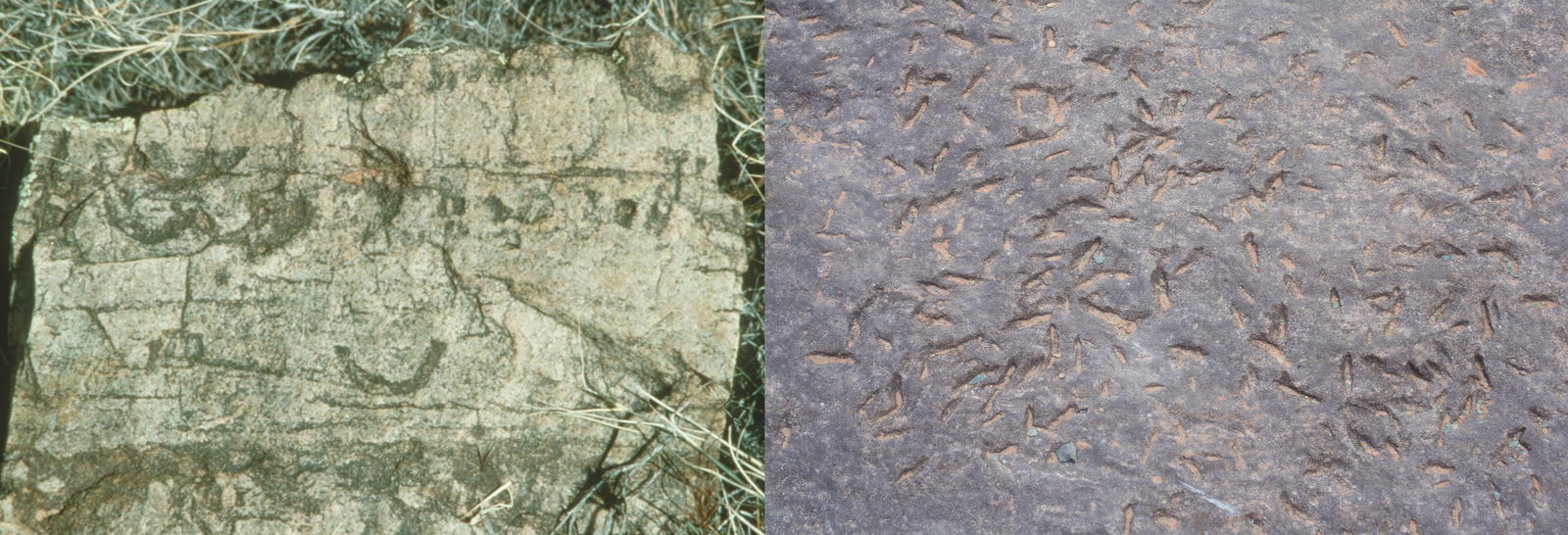
Fig. 10. U-shaped burrows designated as Arenicolites perpendicular to the bedding in the Tapeats Sandstone. Left: some as seen in cross-section in an outcrop at the top of the cliff-forming unit at the edge of Horseshoe Mesa above river mile 80. Right: many seen eroded to their bases on a bedding plane surface at the top of the cliff-forming unit at “The Patio” above Deer Creek Falls near river mile 137.
As Mitchell and Tillman suggest, it could be argued that “trilobites or brachiopod fragments were transported to their final position, perhaps rapidly,”127 as Flood geologists argue, although trilobites were likely rapidly buried alive in situ to be preserved. However, tracks and traces were not transported. These were formed after sediment deposition and then buried and fossilized. Mitchell and Tillman claim that like the supposed mud cracks, these traces and trails “reflect pauses in sedimentation of some duration,”128 though not necessarily months or years were required. But they then claim that deposition that averaged 0.4 to 4 m/hour (1.2–4 ft./hour) during the global Flood cataclysm would not have left time for grazing of invertebrates such as trilobites, worms, and brachiopods because the time available for pausing sedimentation would have been incredibly limited.
Indeed, “Flood geologists . . . recognize that trace fossils represent evidence that living animals were active during the period when the sediments were being laid down. Animals in marine, tidal and nearshore environments form similar features today.”129 While the cast of animals has changed, the ecological niches in which these animals lived prior to the Flood were very similar. However, Mitchell and Tillman sidestep the issue of just how these traces and trails were preserved as fossils. They are ignoring the fact that unless the traces and trails are almost immediately buried, they are obliterated by tides and waves as we observe today. Do we still observe the burrows and trails on a beach after a wave has swept across it? Usually not. So if Mitchell and Tillman were applying “the present is the key to the past,” they should have recognized that rapid burial is absolutely necessary for preservation of traces and trails. So Flood geologists rightly insist that the traces were preserved by very rapid deposition and burial, with any reworking of the sediment (bioturbation) accomplished by the animals caught up in rapidly deposited sediment flows. And the traces and trails would have been formed during the brief pauses between sediment-laden water current surges. Indeed, due to the rise and fall in water levels between tsunamis and tides, sediment surfaces could even have been temporarily exposed, allowing enough time for animals to leave their traces and trails.130
It is an interpretation that a complete ecosystem was present because no one was there to observe that.
Mitchell and Tillman go on to claim that “the simpler interpretation is that the trace fossils of the Tonto Group reflect large populations that existed for an extended time.”131 Agreed, these animals were living for an extended time just prior to the global Flood cataclysm. And yes, the traces and trails were formed at multiple levels in the Tonto Group strata, indicative of a period of biological activity as these strata were deposited. However, it is merely an interpretation when Mitchell and Tillman then claim, “The traces in units, particularly the BAS [Bright Angel Shale] show that a complete ecosystem was present.”132, 133 Agreed, the animals involved had the same feeding styles that we observe today, although trilobites are apparently now extinct. But it is an interpretation that a complete ecosystem was present because no one was there to observe that. The fossilized traces and trails are simply evidence that those animals were active during deposition of these strata.
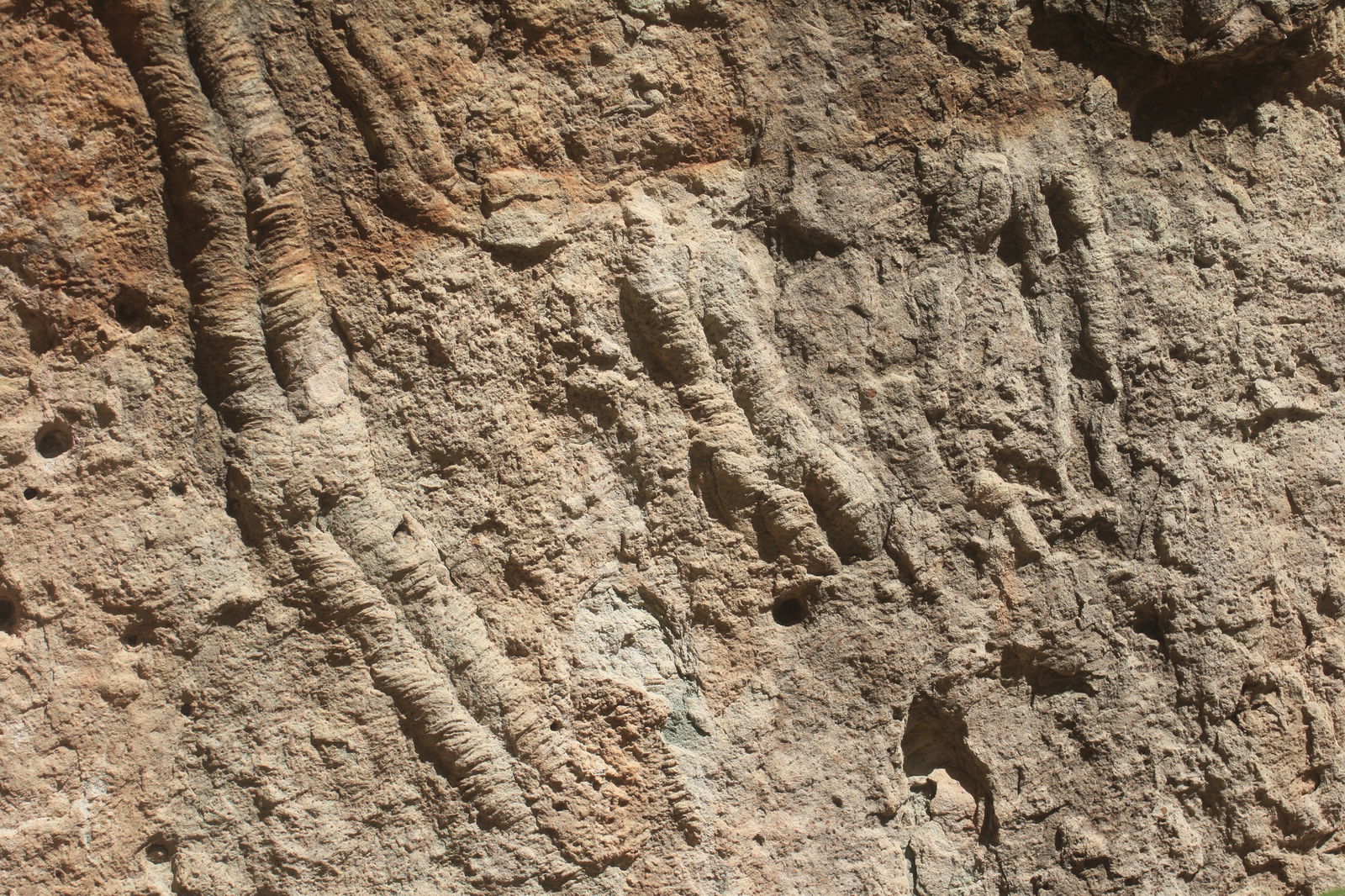
Fig. 11. Trilobite crawling Cruziana arizonensis traces,134 as seen on an upturned fallen block of Tapeats Sandstone from the transition interval at “The Patio” above Deer Creek Falls near river mile 137.
For Mitchell and Tillman to then claim that “multiple levels of highly active biogenic activity such as these are not compatible with the rates of deposition”135 demanded by Flood geologists is merely an opinion, biased by their uniformitarian mindset. No Flood geologist has argued that these were “some sort of death assemblage, transported into place, where a few survivors dug around before finally succumbing to the pressure of burial,”136 as claimed by Mitchell and Tillman. Flood geologists agree that these animals were actively making their traces and trails as they grazed on sediment surfaces during pauses in sedimentation. Again yes, these animals were part of thriving communities that lived for some period of time in the pre-Flood world before rapid sedimentation began at the onset of the biblical global Flood cataclysm and rapidly buried their traces and trails. Mitchell and Tillman close their “case” on this topic by claiming that “all [the trace fossils] are consistent with tidal environments, though certainly some could have formed over time in deeper water environments.”137 However, such claims about sedimentary environments are merely interpretations based on the uniformitarian assumption that only the present is the key to the past. The reality is that none of these trace fossils are inconsistent with the animals making the traces and trails while grazing briefly on sediment surfaces before these traces and trails were rapidly buried during the biblical global Flood cataclysm so that they were thus preserved.
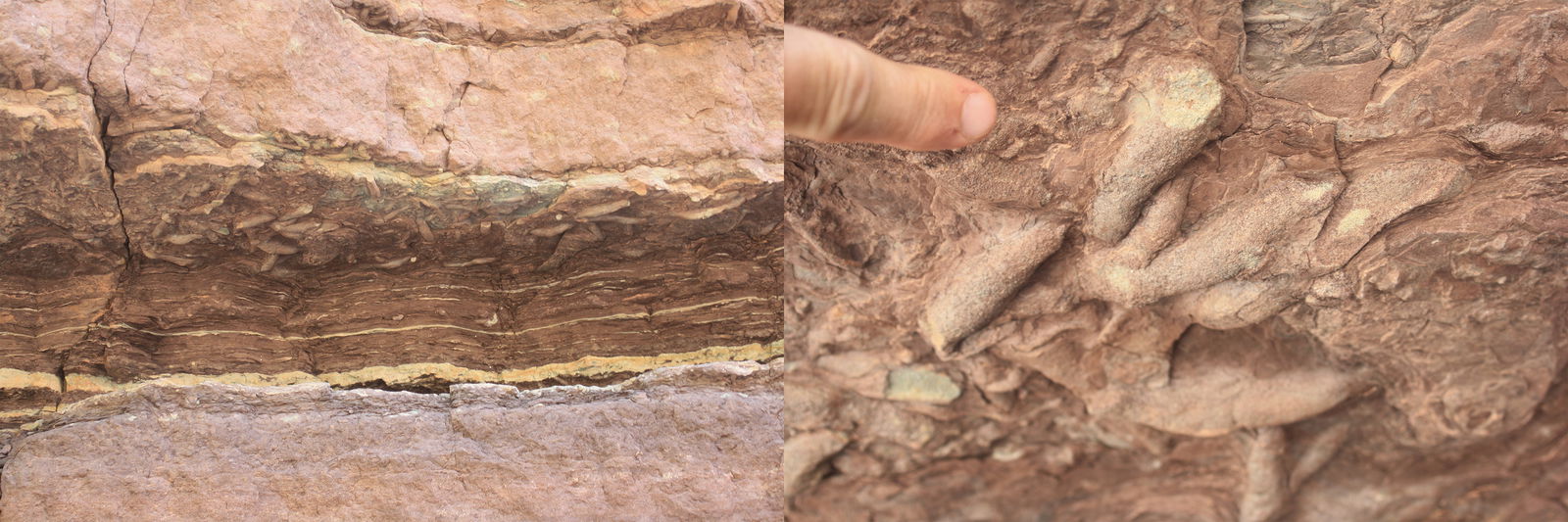
Fig. 12. The horizontal trace fossils called “fucoides” by McKee138 and designated as Treptichnus by Rose139 and Hagadorn et al.140 as found in the transition zone at the top of the Tapeats Sandstone, where there are interbedded thin shale and thicker sandstone beds. Left: as seen here at “The Patio” above Deer Creek Falls near river mile 137. Right: a closer view of these trace fossils on the sole of the overhanging bed as seen on the left (finger for scale).
Algal Mats (Stromatolites)?
It has been claimed that the Muav Limestone in at least some places includes banded units known as stromatolites.141 Mitchell and Tillman claim that “these laminated units formed as sediment was trapped by microbial mats of cyanobacteria (blue-green algae).”142 However, as I have already noted, as acknowledged by Mitchell and Tillman, “No one seems to have done detailed work to demonstrate that these features in these banded units were formed by algae.”143 I wrote, “Yet, Resser, nor anyone else, has checked the Muav Formation’s Girvanella limestone to confirm whether Girvanella filaments are present with these spherical structures.”144 It is certainly true that we find mounds of stromatolites growing today in tidal environments in Australia as well as fossilized stromatolites throughout the geologic record, primarily in Precambrian strata.
However, microscopic examination of both today’s stromatolites and many of the fossilized stromatolites reveals the algae and fossilized algae are responsible for building the stromatolites.145 No one has checked under a microscope that these banded units that have been interpreted as stromatolites to confirm whether any fossilized algae are present. So should we doubt the reports of stromatolites in the Muav Formation until this work is done? Absolutely! Until that is done, these banded units cannot be claimed to be stromatolites. Besides, the stromatolites being built by cyanobacteria today are mounds and not banded units built by algal mats.
Mitchell and Tillman are correct in asserting that true stromatolites “demonstrate alternate periods of flooding and exposure, typically by tides,”146 as seen for example in Hamlin Pool in Shark Bay, Western Australia today. And it is true that genuine stromatolites in the Muav Formation would be a challenge for the biblical global Flood cataclysm interpretation.147 So as Mitchell and Tillman point out, if there were genuine Cambrian stromatolites in the region, this might be a real concern. They say, “In fact, stromatolite development is extensive above the Tapeats in the Cambrian Carrara Formation in Nevada. Cambrian and earlier ‘stromatolitic reefs’ are present in many parts of the world”148 (for which Mitchell and Tillman footnote Palmer and Halley 1979 but provide no citation details in their reference list). Flood geologist Coulson certainly has “documented Late Cambrian stromatolitic reefs in the Notch Peak Formation in Utah in great detail.”149 But those thick intervals of “stromatolitic reefs” that are stratigraphically younger than the Muav Limestone and well above the Great Unconformity may not have grown in place as no geologist observed them growing. Thus, they do not necessarily indicate long periods of time were involved. And even though Coulson recounted Cambrian “stromatolitic reef development” in many parts of North America and suggested the “reef development” included stromatolites that may have genuinely grown in place, other Flood geologists maintain that does not necessarily make them incompatible with the biblical global Flood cataclysm.
They did not observe the fossil clusters to have grown as true reefs, but instead, they interpret them as “reefs.”
Finally, Mitchell and Tillman claim that supposed “reefs” “of many types are found throughout the Phanerozoic rock record making it difficult to include any significant section as a result of such a flood.”150 However, in making that claim, they ignored several robust responses to such claims.151 Once again, they have accepted the uniformitarian interpretation and presented it as if it were a proven fact. They did not observe the fossil clusters to have grown as true reefs, but instead, they interpret them as “reefs.” However, they can be viewed as clusters of fossils simply buried together rapidly during the biblical global Flood cataclysm.
Summary and Conclusions
At the outset of their concluding summary, Mitchell and Timan admit, “The depositional features that are observed in the Tonto Group do not prove millions of years were involved.”152 However, they go on to claim that “they do demonstrate that more than a few days or weeks were required.”153 All their supposed arguments that they then briefly summarize have been soundly refuted above.
In the end, Mitchell and Tillman continue to maintain that the sheer volume of sediment could not have been deposited in the biblical global Flood cataclysm. Instead, the three Tonto Group formations resulted from many different depositional events. And the features recognized in catastrophic deposits such as comminuted (smashed) grain-size distributions are supposedly not found in the Tonto Group, so fluid flow had to have been slower overall. Furthermore, they contend, “We found many smaller scaled features that demonstrate pauses in sedimentation”154 and claimed tidal deposition, such as herringbone cross-stratification, purported mud cracks, trackways, and supposed “stromatolitic reefs.”
Each of these claims have been examined in detail and soundly refuted. Mitchell and Tillman are often guilty of either ignoring or not consulting the alternate plausible explanations in the Flood geology literature or even in the very papers of mine they are purporting here to critique. Furthermore, some of these alternative explanations are proposed in the conventional uniformitarian literature.
In any case, we keep coming back to the bottom line; namely, because no geologists were present in the past when these layers were deposited, how are we to explain the formation of these layers? There are two diametrically opposed explanations, interpretations based on entirely different assumptions. On the one hand, there is the conventional uniformitarian interpretation based on assuming that only presently observed geological processes and their rates may be used to explain what happened in the unobserved past. On the other hand, there is the Flood geology interpretation based on the assumption that the biblical account of earth’s history in the book of Genesis is the eyewitness account of God the Creator (who is eternally present, all-knowing, all-powerful, and never lies) of what happened in the past. And Flood geologists do assume that rates of geological processes were not the same during the biblical, global Flood cataclysm as we observe today.
God’s Word will always trump man’s word, no matter the majority vote among geologists.
Ultimately, the question is this: What is our authority for interpreting the past? Will the word of finite, fallible scientists who never witnessed the earth’s past history be our authority? Or will God’s inerrant Word—the veracity of which is testified to by Jesus Christ Himself—be our supreme authority for testing truth claims about the past? Since Mitchell and Tillman openly claim to be Christians, and I sincerely don’t doubt they are, one would have thought the choice of which authority would be straightforward. God’s Word will always trump man’s word, no matter the majority vote among geologists. I rest my case until my third and final response.
Answers in Depth
2026 Volume 21
Answers in Depth explores the biblical worldview in addressing modern scientific research, history, current events, popular media, theology, and much more.
Browse VolumeFootnotes
- Mitchell, Stephen, and Kennen Tillman, “Examining Young Earth Creation Claims About the Grand Canyon,” Peaceful Science Series, August 15, 2024, https://peacefulscience.org/series/tonto/.
- Snelling, Andrew A., “The Petrology of the Tapeats Sandstone, Tonto Group, Grand Canyon, Arizona,” Answers Research Journal 14 (June 23, 2021): 159–254, https://answersresearchjournal.org/petrology-tapeats-sandstone-tonto-group; Andrew A. Snelling, “The Petrology of the Bright Angel Formation, Tonto Group, Grand Canyon, Arizona,” Answers Research Journal 14 (September 8, 2021): 303–415, https://answersresearchjournal.org/petrology-bright-angel-tonto-group; Andrew A. Snelling, “The Petrology of the Muav Formation, Tonto Group, Grand Canyon, Arizona,” Answers Research Journal 15 (August 10, 2022): 139–262, https://answersresearchjournal.org/geology/petrology-muav-formation-tonto-group.
- Mitchell, Stephen, and Kennen Tillman, “Tonto Depositional Processes and Rates,” Peaceful Science, August 15, 2024, https://peacefulscience.org/articles/examining-yec-claims-tonto-group-cambrian-2/.
- Mitchell and Tillman, “Tonto Depositional Processes and Rates.”
- Ager, Derek, The New Catastrophism: The Importance of the Rare Event in Geological History (Cambridge, England: Cambridge University Press, 1993).
- Mitchell and Tillman, “Tonto Depositional Processes and Rates.”
- Mitchell and Tillman, “Tonto Depositional Processes and Rates.”
- Mitchell and Tillman, “Tonto Depositional Processes and Rates.”
- Mitchell and Tillman, “Tonto Depositional Processes and Rates.”
- Mitchell and Tillman, “Tonto Depositional Processes and Rates.”
- Snelling, “Petrology of the Tapeats Sandstone.”
- Mitchell and Tillman, “Tonto Depositional Processes and Rates.”
- Peters, Shanan E., and Robert R. Gaines, “Formation of the ‘Great Unconformity’ as a Trigger for the Cambrian Explosion,” Nature 484, no. 7394 (April 18, 2012): 363–366, https://www.nature.com/articles/nature10969.
- Snelling, “Petrology of the Tapeats Sandstone”; Andrew A. Snelling, “The Carbon Canyon Fold, Eastern Grand Canyon, Arizona,” Answers Research Journal 16 (February 22, 2023): 1–124, https://answersresearchjournal.org/geology/carbon-canyon-fold-arizona.
- Mitchell and Tillman, “Tonto Depositional Processes and Rates.”
- Karlstrom, Karl E., Matthew T. Heizler, Mark Schmitz, Michael T. Mohr, Laura J. Crossey, Carol M. Dehler, et al., “Parsing Grand Canyon’s Great Unconformity—Composite Erosion Surface from at Least Three Episodes Between 1,350 and 508 MA,” Geological Society of America Abstracts with Programs 51, no. 5 (2019): 160–165, https://doi.org/10.1130/abs/2019AM-332195.
- Mitchell and Tillman, “Tonto Depositional Processes and Rates.”
- Peters and Gaines, “Formation of the ‘Great Unconformity’ as a Trigger.”
- Sharp, Robert P., “Ep-Archean and Ep-Algonkian Erosion Surfaces, Grand Canyon, Arizona,” Geological Society of America Bulletin 51, no. 8 (1940): 1235–1270, https://doi.org/10.1130/GSAB-51-1235.
- McKee, Edwin D., “Stratigraphy and Ecology of the Grand Canyon Cambrian: Part 1. Cambrian History of the Grand Canyon Region,” Carnegie Institute of Washington Publication 563 (Washington, DC: Carnegie Institute of Washington, 1945), 1–168.
- Basu, Abhijit, “Weathering Before the Advent of Land Plants: Evidence from Unaltered Detrital K-Feldspars in Cambrian-Ordovician Arenites,” Geology 9, no. 3 (1981): 132–133, https://doi.org/10.1130/0091-7613(1981)9<132:WBTAOL>2.0.CO;2.
- Snelling, “Petrology of the Tapeats Sandstone.”
- Snelling, Andrew A., Earth’s Catastrophic Past, vol. 1 (Green Forest, AR: Master Books, 2009), 194, 213.
- Pevehouse, Katie J., Dustin E. Sweet, Branimir Šegvić, Charles C. Monson, Giovanni Zanoni, Stephen Marshak, et al., “Paleotopography Controls Weathering of Cambrian-Age Profiles Beneath the Great Unconformity, St. Francois Mountains, SE Missouri, USA,” Journal of Sedimentary Research 90, no. 6 (2020): 629–650, https://doi.org/10.2110/jsr.2020.33.
- Mitchell and Tillman, “Tonto Depositional Processes and Rates.”
- Mitchell and Tillman, “Tonto Depositional Processes and Rates.”
- Mitchell and Tillman, “Tonto Depositional Processes and Rates.”
- Austin, Steven A., ed., Grand Canyon: Monument to Catastrophe (Santee, CA: Institute for Creation Research, 1994), 24–28; Andrew A. Snelling, Earth’s Catastrophic Past: Geology, Creation and the Flood (Dallas, TX: Institute for Creation Research, 2009), 493–499; Andrew A. Snelling, The Genesis Flood Revisited (Green Forest, AR: Master Books, and Petersburg, KY: Answers in Genesis, 2022), 288–291.
- Austin, Steven A., John R. Baumgardner, D. Russell Humphreys, Andrew A. Snelling, Larry Vardiman, and Kurt P. Wise, “Catastrophic Plate Tectonics: A Global Flood Model of Earth History,” Proceedings of the Third International Conference on Creationism, ed. Robert E. Walsh (Pittsburgh: Creation Science Fellowship, 1994), 609–621, https://cedarville.tind.io/record/20925?v=pdf; Snelling, Earth’s Catastrophic Past, 925–944; Snelling, The Genesis Flood Revisited, 551–563.
- Baumgardner, John R., “Numerical Modeling of the Large-Scale Erosion, Sediment Transport, and Deposition Processes of the Genesis Flood (Revised),” Answers Research Journal 11 (June 27, 2018): 149–170, https://answersresearchjournal.org/numerical-modeling-genesis-flood-2/; John R. Baumgardner, “Understanding How the Flood Sediment Record Was Formed: The Role of Large Tsunamis,” Proceedings of the Eighth International Conference on Creationism, ed. John H. Whitmore (Pittsburgh: Creation Science Fellowship, 2018), 287–305, https://doi.org/10.15385/jpicc.2018.8.1.29; John R. Baumgardner and Evan Navarro, “The Role of Large Tsunamis in the Formation of the Flood Sediment Record,” Proceedings of the Ninth International Conference on Creationism, ed. John H. Whitmore (Cedarville, OH: Cedarville University International Conference on Creationism, 2023), 363–386, https://doi.org/10.15385/jpicc.2023.9.1.22.
- Snelling, “Petrology of the Tapeats Sandstone.”
- Mitchell and Tillman, “Tonto Depositional Processes and Rates.”
- Mitchell and Tillman, “Tonto Depositional Processes and Rates.”
- Snelling, Andrew A., “Responding to ‘Peaceful Science’ Critics on Grand Canyon Evidence,” Answers in Depth 20 (November 7, 2025), https://answersingenesis.org/geology/rock-layers/grand-canyon-critic-response-1/.
- Lindberg, F. Alan, ed., Correlation of Stratigraphic Units of North America (Tulsa, OK: American Association of Petroleum Geologists, 1988); Andrew A. Snelling, “Transcontinental Rock Layers: Flood Evidence Number Three,” Answers Magazine 3, no. 3 (2008): 80–83, https://answersingenesis.org/geology/rock-layers/transcontinental-rock-layers/; D. Avigad, A. Sandler, K. Kolodner, R. J. Stern, M. McWilliams, N. Miller, et al., “Mass-Production of Cambro–Ordovician Quartz-Rich Sandstone as a Consequence of Chemical Weathering of Pan-African Terranes: Environmental Implications,” Earth and Planetary Science Letters 240, nos. 3–4 (December 2005): 818–826, https://www.sciencedirect.com/science/article/abs/pii/S0012821X05005947; Andrew A. Snelling, “The Geology of Israel Within the Biblical Creation-Flood Framework of History: 2. The Flood Rocks,” Answers Research Journal 3 (December 15, 2010): 267–309, http://www.answersingenesis.org/articles/arj/v3/n1/geology-of-israel-2; Timothy L. Clarey, Carved in Stone: Geological Evidence of the Worldwide Flood (Dallas: Institute for Creation Research, 2020), https://store.icr.org/carved-in-stone.html; J. Woo, H. S. Lee, S. K. Chough, “Deposition of Sandstone (Early Cambrian) Above the Great Unconformity in the Sino-Korean Block, Gondwana: Control of Antecedent Topography,” Gondwana Research 116 (April 2023): 212–228, https://doi.org/10.1016/j.gr.2022.12.006.
- Dietz, Marianne E., Kam-biu Liu, Thomas A. Bianchette, and Denson Smith, “Differentiating Hurricane Deposits in Coastal Sedimentary Records: Two Storms, One Layer, but Different Processes,” Environmental Research Communications 3, no. 10 (2021): #101001, https://iopscience.iop.org/article/10.1088/2515-7620/ac26dd; Stéphanie Cuven, Raphaël Paris, Simon Falvard, Elisabeth Miot-Noitault, Mhammed Benbakkar, Jean-Luc Schneider, et al., “High-Resolution Analysis of a Tsunami Deposit: Case-Study from the 1755 Lisbon Tsunami in Southwestern Spain,” Marine Geology 337 (March 2013): 98–111, https://doi.org/10.1016/j.margeo.2013.02.002.
- Mitchell and Tillman, “Tonto Depositional Processes and Rates.”
- Mitchell and Tillman, “Tonto Depositional Processes and Rates.”
- Mitchell and Tillman, “Tonto Depositional Processes and Rates.”
- Carling, Paul A., and Xuanmei Fan, “Particle Comminution Defines Megaflood and Superflood Energetics,” Earth-Science Reviews 204 (May 2020): #103087, https://doi.org/10.1016/j.earscirev.2020.103087.
- Mitchell and Tillman, “Tonto Depositional Processes and Rates.”
- Mitchell and Tillman, “Tonto Depositional Processes and Rates.”
- Carling and Fan, “Particle Comminution Defines Megaflood.”
- Carling and Fan, “Particle Comminution Defines Megaflood.”
- Mitchell and Tillman, “Tonto Depositional Processes and Rates.”
- Mitchell and Tillman, “Tonto Depositional Processes and Rates.”
- Snelling, “Petrology of the Tapeats Sandstone.”
- Mitchell and Tillman, “Tonto Depositional Processes and Rates.”
- Seguret, M., P. Labaume, and R. Madariaga, “Eocene Seismicity in the Pyrenees from Megaturbidites of the Southern Pyrenean Basin (Spain),” Marine Geology 55, nos. 1–2 (February 1984): 117–131, https://doi.org/10.1016/0025-3227(84)90136-1.
- Bozetti, Guilherme, Bryan T. Cronin, Benjamin C. Kneller, and Mark A. Jones, “Deep-Water Conglomeratic Megabeds: Analogues for Event Beds of the Brae Formation of the South Viking Graben, North Sea,” chapter 5 in Rifted-Related Coarse-Grained Submarine Fan Reservoirs; the Brae Play, South Viking Graben, North Sea, eds. Colin C. Turner and Bryan T. Cronin (Tulsa, OK: American Association of Petroleum Geologists, 2018), https://doi.org/10.1306/13652180M1153809.
- Mitchell and Tillman, “Tonto Depositional Processes and Rates.”
- Mitchell and Tillman, “Tonto Depositional Processes and Rates.”
- Mitchell and Tillman, “Tonto Depositional Processes and Rates.”
- Baumgardner and Navarro, “Role of Large Tsunamis in the Formation of the Flood Sediment Record,” 363–386.
- Bozetti, Cronin, Kneller, and Jones, “Deep-Water Conglomeratic Megabeds.”
- Rose, Eben, “Nonmarine Aspects of the Cambrian Tonto Group of the Grand Canyon, USA, and Broader Implications,” Palaeoworld 15, nos. 3–4 (August–November 2006): 223–241, https://doi.org/10.1016/j.palwor.2006.10.008.
- Mitchell and Tillman, “Tonto Depositional Processes and Rates.”
- Mitchell and Tillman, “Tonto Depositional Processes and Rates.”
- Mitchell and Tillman, “Tonto Depositional Processes and Rates.”
- Elston, Donald P., Late Precambrian Sixtymile Formation and Orogeny at Top of the Grand Canyon Supergroup, Northern Arizona (Washington DC: U.S. Government Printing Office, 1979) U.S. Geological Survey Professional Paper 1092, https://doi.org/10.3133/pp1092; Karl E. Karlstrom, James Hagadorn, George Gehrels, William Matthews, Mark Schmitz, Lauren Madronich, et al., “Cambrian Sauk Transgression in the Grand Canyon Region Redefined by Detrital Zircons,” Nature Geoscience 11, no. 6 (May 2018): 438–443, https://doi.org/10.1038/s41561-018-0131-7.
- Chadwick, Arthur V., “Megabreccias: Evidence for Catastrophism,” Origins 5, no. 1 (1978): 39–46, https://www.grisda.org/origins-05039.
- Mitchell and Tillman, “Tonto Depositional Processes and Rates.”
- Mitchell and Tillman, “Tonto Depositional Processes and Rates.” Some examples include Edwin D. McKee, “Stratigraphy and Ecology of the Grand Canyon Cambrian: Part 1. Cambrian History of the Grand Canyon Region,” Carnegie Institute of Washington Publication 563 (Washington, DC: Carnegie Institute of Washington, 1945), 1–168; Harold R. Wanless, “Cambrian of Grand Canyon—A Reevaluation,” American Association of Petroleum Geologists Bulletin 57, no. 4 (April 1973): 810–811, https://doi.org/10.1306/83D90D18-16C7-11D7-8645000102C1865D; Richard Hereford, “Deposition of the Tapeats Sandstone (Cambrian) in Central Arizona,” Geological Society of America Bulletin 88, no. 2 (February 1977): 199–211, https://doi.org/10.1130/0016-7606(1977)88<199:DOTTSC>2.0.CO;2; Donald P. Elston, George H. Billingsley, and Richard A. Young, “Correlations and Facies Changes in Lower and Middle Cambrian Tonto Group, Grand Canyon, Arizona,” in Geology of Grand Canyon, Northern Arizona (with Colorado River Guides): Lee Ferry to Pierce Ferry, Arizona (Washington, DC: American Geophysical Union, 1989), 131–136; Larry T. Middleton and David K. Elliott, “Tonto Group,” in Grand Canyon Geology, eds. Stanley S. Beus and Michael Morales (New York: Oxford University Press, 1990), 83–106; Rose, “Nonmarine Aspects of the Cambrian Tonto Group of the Grand Canyon,” 223–241.
- Mitchell and Tillman, “Tonto Depositional Processes and Rates.”
- Middleton and Elliott, “Tonto Group,” 83–106. They repeat this summary in Larry T. Middleton and David K. Elliott, “Tonto Group,” in Grand Canyon Geology, 2nd ed., eds. Stanley S. Beus and Michael Morales (New York: Oxford University Press, 2003), 90–106.
- Mitchell and Tillman, “Tonto Depositional Processes and Rates.”
- Mitchell and Tillman, “Tonto Depositional Processes and Rates.”
- Wikipedia, “Sedimentary Structures,” last edited January 30, 2025, https://en.wikipedia.org/wiki/Sedimentary_structures.
- Mitchell and Tillman, “Tonto Depositional Processes and Rates.”
- Mitchell and Tillman, “Tonto Depositional Processes and Rates.”
- Kennedy, Elaine G., Ray Kablanow, and Arthur V. Chadwick, “Evidence for Deep Water Deposition of the Tapeats Sandstone, Grand Canyon, Arizona,” in Proceedings of the Third Biennial Conference of Research on the Colorado Plateau, eds. C. van Riper III and E. T. Deschler (Washington, DC: U.S. Department of the Interior, National Park Service, 1997), Transactions and Proceedings Series NPS/NRNAU/NRTP-97/12, 215–228.
- Snelling, “Petrology of the Tapeats Sandstone”; Snelling, “Petrology of the Bright Angel Formation”; Snelling, “Petrology of the Muav Formation.”
- McKee, “Stratigraphy and Ecology of the Grand Canyon Cambrian,” 1–168.
- Baldwin, Christopher T., Paul K. Strother, John H. Beck, and Eben Rose, “Palaeoecology of the Bright Angel Shale in the Eastern Grand Canyon, Arizona, USA, Incorporating Sedimentological, Ichnological and Palynological Data,” in Application of Ichnology to Palaeoenvironmental and Stratigraphic Analysis, ed. Duncan McIlroy (London, United Kingdom: Geological Society of London, 2004), Special Publication 228, 213–236; Richard Hereford, “Deposition of the Tapeats Sandstone (Cambrian) in Central Arizona,” 199–211; Middleton, and Elliott, “Tonto Group,” (1990), 83–106; Rose, “Nonmarine Aspects of the Cambrian Tonto Group of the Grand Canyon,” 223–241.
- Snelling, “Petrology of the Muav Formation.”
- Mitchell and Tillman, “Tonto Depositional Processes and Rates.”
- Clark, M. E., and H. D. Voss, “Resonance and Sedimentary Layering in the Context of a Global Flood,” Proceedings of the Second International Conference on Creationism, eds. Robert E. Walsh and Christopher L. Brooks (Pittsburgh: Creation Science Fellowship, 1990), 53–64, https://cedarville.tind.io/record/20843?v=pdf; Larry Vardiman and Wesley Brewer, “Numerical Simulations of Hypercanes Charley and Fay in the Caribbean and the Gulf of Mexico over a Warm Ocean,” Answers Research Journal 5 (February 29, 2012), 13–24, https://answersresearchjournal.org/simulations-hypercanes-warm-ocean/; John R. Baumgardner, “Understanding How the Flood Sediment Record Was Formed: The Role of Large Tsunamis,” Proceedings of the Eighth International Conference on Creationism, ed. John H. Whitmore (Pittsburgh: Creation Science Fellowship, 2018), 287–305, https://doi.org/10.15385/jpicc.2018.8.1.29; Baumgardner and Navarro, “Role of Large Tsunamis in the Formation of the Flood Sediment Record,” 363–386.
- Mitchell and Tillman, “Tonto Depositional Processes and Rates.”
- Snelling, “Petrology of the Bright Angel Formation.”
- Mitchell and Tillman, “Tonto Depositional Processes and Rates.”
- Mitchell and Tillman, “Tonto Depositional Processes and Rates.”
- Snelling, “Petrology of the Muav Formation.”
- Wanless, “Cambrian of Grand Canyon—A Reevaluation,” 810–811; Rose, “Nonmarine Aspects of the Cambrian Tonto Group of the Grand Canyon,” 223–241; James W. Hagadorn, Joseph L. Kirschvink, Timothy D. Raub, and Eben C. Rose, “Above the Great Unconformity: A Fresh Look at the Tapeats Sandstone, Arizona-Nevada, U.S.A.,” in Cambrian Stratigraphy and Paleontology of Northern Arizona and Southern Nevada, The 16th Field Conference of the Cambrian Stage Subdivision Working Group, International Subcommission on Cambrian Stratigraphy, eds. J. Stewart Hollingsworth, Frederick A. Sundberg, and John R. Foster (Flagstaff, AZ: Museum of Northern Arizona, 2011), Bulletin 67, 63–76; Carol Hill and Stephen O. Moshier, “Sedimentary Structures: Clues from the Scene of the Crime,” in The Grand Canyon, Monument to an Ancient Earth; Can Noah’s Flood Explain the Grand Canyon?, eds. Carol Hill, Gregg Davidson, Tim Helble, and Wayne Ranney (Grand Rapids, MI: Kregel Publications, 2016), 66–71.
- Hill and Moshier. “Sedimentary Structures,” 66–71, Fig. 6-2.
- Snelling, “Petrology of the Tapeats Sandstone.”
- Mitchell and Tillman, “Tonto Depositional Processes and Rates.”
- E. M. Kindle, “Some Factors Affecting the Development of Mud-Cracks,” The Journal of Geology 25, no. 2 (1917): 135–144, https://www.journals.uchicago.edu/doi/abs/10.1086/622446.
- McKee, “Stratigraphy and Ecology of the Grand Canyon Cambrian,” 1–168.
- Mitchell and Tillman, “Tonto Depositional Processes and Rates.”
- Kindle, “Some Factors Affecting the Development of Mud-Cracks,” 135–144.
- Snelling, “Petrology of the Muav Formation.”
- Mitchell and Tillman, “Tonto Depositional Processes and Rates.”
- Wanless, “Cambrian of Grand Canyon—A Reevaluation,” 810–811; Rose, “Nonmarine Aspects of the Cambrian Tonto Group of the Grand Canyon,” 223–241.
- Shinn, Eugene A., “Tidal Flat Environment,” in Carbonate Depositional Environments, eds. Peter A. Scholle, Don G. Bebout, and Clyde H. Moore (Tulsa, OK: American Association of Petroleum Geologists, 1983), Memoir 33, https://doi.org/10.1306/M33429C8.
- Whitmore, John H., “Do Mud Cracks Indicate Multiple Droughts During the Flood?,” in Rock Solid Answers: The Biblical Truth Behind 14 Geologic Questions, eds. Michael J. Oard and John K. Reed (Green Forest, AR: Master Books, 2009), 167–183. Diastasis cracks are fracture networks that form in subaqueous environments, particularly within interbedded muddy and allochemical carbonates, without requiring shrinkage or dewatering of the sediment.
- Wanless, Harold R., “Carbonate Tidal Flats of the Grand Canyon Cambrian,” in Tidal Flats: A Casebook of Recent Examples and Fossil Counterparts, ed. Robert N. Ginsburg (New York: Springer-Verlag, 1975), 269–277; Rose, Eben C., “Depositional Environment and History of the Cambrian Tonto Group, Grand Canyon, Arizona” (master’s thesis, Northern Arizona University, 2003), (unpublished).
- Snelling, “Petrology of the Muav Formation.”
- Basma, Adnan A., Azm S. Al-Homoud, Abdallah I. Husein Malkawi, and Mohamed A. Al-Bashabsheh, “Swelling-Shrinkage Behavior of Natural Expansive Clays,” Applied Clay Science 11, nos. 2–4 (December 1996), 211–227, https://doi.org/10.1016/S0169-1317(96)00009-9; Tri Harianto, Shigenori Hayashi, Yan Jun Du, and Daisuke Suetsugu, “Effects of Fiber Additives on the Desiccation Crack Behavior of the Compacted Akaboku Soil as a Material for Landfill Cover Barrier,” Water, Air, and Soil Pollution 194, nos. 1–4 (April 2008): 141–149, https://doi.org/10.1007/s11270-008-9703-2; N. Yassoglou, Costas S. Kosmas, Nikolaos Moustakas, E. Tzianis, and Nikolaos G. Danalatos, “Cracking in Recent Alluvial Soils as Related to Easily Determined Soil Properties,” Geoderma 63, nos. 3–4 (1994): 289–298 https://doi.org/10.1016/0016-7061(94)90070-1; Nazli Yesiller, C. J. Miller, G. Inci, and K. Yaldo, “Desiccation and Cracking Behavior of Three Compacted Landfill Liner Soils,” Engineering Geology 57, nos. 1–2 (2000): 105–121, https://doi.org/10.1016/S0013-7952(00)00022-3.
- Samuel Boggs, Jr., Principles of Sedimentology and Stratigraphy, 2nd ed. (Upper Saddle River, NJ: Prentice-Hall, 1995), 79–107; J. F. Burst, “Subaqueously Formed Shrinkage Cracks in Clay,” Journal of Sedimentary Research 35, no. 2 (1965): 348–353, https://doi.org/10.1306/74D71271-2B21-11D7-8648000102C1865D; P. S. Plummer and V. A. Gostin, “Shrinkage Cracks: Desiccation or Synaeresis?,” Journal of Sedimentary Research 51, no. 4 (1981): 1147–1156, https://doi.org/10.1306/212F7E4B-2B24-11D7-8648000102C1865D; Brian R. Pratt, “Syneresis Cracks: Subaqueous Shrinkage in Argillaceous Sediments Caused by Earthquake-Induced Dewatering,” Sedimentary Geology 117, nos. 1–2 (April 1998): 1–10, https://doi.org/10.1016/S0037-0738(98)00023-2.
- Snelling, “Petrology of the Muav Formation.”
- Mitchell and Tillman, “Tonto Depositional Processes and Rates.”
- Middleton and Elliott, “Tonto Group,” (1990), 83–106.
- Mitchell and Tillman, “Tonto Depositional Processes and Rates.”
- Mitchell and Tillman, “Tonto Depositional Processes and Rates.”
- Snelling, “Petrology of the Tapeats Sandstone”; Snelling, “Petrology of the Bright Angel Formation”; Snelling, “Petrology of the Muav Formation.”
- Joe H. S. Macquaker and Kevin M. Bohacs, “On the Accumulation of Mud,” Science 318, no. 5857 (December 2007): 1734–1735, https://doi.org/10.1126/science.1151980; Juergen Schieber, John B. Southard, and Kevin Thaisen, “Accretion of Mudstone Beds from Migrating Floccule Ripples,” Science 318, no. 5857 (December 2007): 1760–1763, https://doi.org/10.1126/science.1147001.
- Juergen Schieber and John B. Southard, “Bedload Transport of Mud by Floccule Ripples—Direct Observation of Ripple Migration Processes and Their Implications,” Geology 37, no. 6 (2009): 483–486, https://doi.org/10.1130/G25319A.1; Juergen Schieber, John B. Southard, Patrick Kissling, Britt Rossman, and Robert Ginsburg, “Experimental Deposition of Carbonate Mud from Moving Suspensions: Importance of Flocculation and Implications for Modern and Ancient Carbonate Mud Deposition,” Journal of Sedimentary Research 83, no. 11 (2013): 1025–1031, https://doi.org/10.2110/jsr.2013.77.
- Wanless, “Carbonate Tidal Flats of the Grand Canyon Cambrian,” 269–277.
- Snelling, “Petrology of the Muav Formation.”
- Mitchell and Tillman, “Tonto Depositional Processes and Rates.”
- Two examples provide evidence for this statement. The coelacanth was thought to have gone extinct 66 million years ago with the dinosaurs because that was its last occurrence in the fossil record. But in 1938, living coelacanths were found swimming in the ocean off the coast of Madagascar. Thus, no one believes that they did not exist during the “66 million years” when younger rocks were being deposited. Similarly, the Wollemi Pine was said to have gone extinct “150 million years ago” (when it disappeared from the fossil record). But then, it was found alive in 1994 in a few isolated groves in remote canyons west of Sydney, Australia. No one thinks it evolved back into existence shortly before it was found alive. Yet how could it have survived during those “150 million years”?
- Mitchell and Tillman, “Tonto Depositional Processes and Rates.”
- Clark, Harold, The New Diluvialism (Angwin, CA: Science Publications, 1946); Harold G. Coffin, Origin by Design (Hagerstown, MD: Review and Herald Publishing Company, 1983); Leonard Brand, Faith, Reason, and Earth History (Berrien Springs, MI: Andrews University Press, 1997), 282–283; Kurt P. Wise, Faith, Form, and Time (Nashville, TN: Broadman & Holman, 2002), 170–175, 197–199; Andrew A. Snelling, “Doesn’t the Order of Fossils in the Rock Record Favor Long Ages?,” in The New Answers Book 2, ed. Ken Ham (Green Forest, AR: Master Books, 2008), 341–354, https://answersingenesis.org/fossils/fossil-record/doesnt-order-of-fossils-in-rock-favor-long-ages/; Andrew A. Snelling, “Order in the Fossil Record,” Answers Magazine 5, no. 1 (2010): 64–68, https://answersingenesis.org/fossils/fossil-record/order-in-the-fossil-record/; Andrew A. Snelling, “Paleontological Issues: Deciphering the Fossil Record of the Flood and Its Aftermath,” in Grappling with the Chronology of the Genesis Flood, eds. Steven W. Boyd and Andrew A. Snelling (Green Forest, AR: Master Books, 2014), 145–185.
- Mitchell and Tillman, “Tonto Depositional Processes and Rates.”
- Resser, Charles E., “Cambrian Fossils of the Grand Canyon: Part II. Cambrian History of the Grand Canyon Region,” Carnegie Institute of Washington Publication 563 (Washington, DC: Carnegie Institute of Washington, 1945), 168–232; John R. Foster, “Trilobites and Other Fauna from Two Quarries in the Bright Angel Shale (Middle Cambrian, Series 3; Delamaran), Grand Canyon National Park, Arizona,” in Cambrian Stratigraphy and Paleontology of Northern Arizona and Southern Nevada: The 16th Field Conference of the Cambrian Stage Subdivision Working Group, International Subcommission on Cambrian Stratigraphy, eds. J. Stewart Hollingsworth, Frederick A. Sundberg, and John R. Foster (Flagstaff, AZ: Museum of Northern Arizona, 2011), Bulletin 67, 99–120.
- Mussini, Giovanni, James W. Hagadorn, Anne E. Miller, Karl E. Karlstrom, Rhydian Evans, Carol E. Dehler, et al., “Evolutionary Escalation in an Exceptionally Preserved Cambrian Biota from the Grand Canyon (Arizona, USA),” Science Advances11, no. 30 (July 23, 2025): eadv6383, https://www.science.org/doi/10.1126/sciadv.adv6383.
- Mussini, Hagadorn, Miller, Karlstrom, Evans, Dehler, et al., “Evolutionary Escalation in an Exceptionally Preserved Cambrian Biota.”
- Mitchell and Tillman, “Tonto Depositional Processes and Rates.”
- Mitchell and Tillman, “Tonto Depositional Processes and Rates.”
- Mitchell and Tillman, “Tonto Depositional Processes and Rates.”
- Mitchell and Tillman, “Tonto Depositional Processes and Rates.”
- Snelling, “Petrology of the Tapeats Sandstone”; Snelling, “Petrology of the Bright Angel Formation”; Snelling, “Petrology of the Muav Formation.”
- Strother, Paul K., and John H. Beck, “Spore-like Microfossils from Middle Cambrian Strata: Expanding the Meaning of the Term Cryptospore,” in Pollen and Spores: Morphology and Biology, eds. Madeline M. Harley, Cynthia M. Morton, and Stephen Blackmore (Kew, United Kingdom: Royal Botanic Gardens, 2000), 413–424.
- Rose, “Nonmarine Aspects of the Cambrian Tonto Group of the Grand Canyon,” 223–241.
- Mitchell and Tillman, “Tonto Depositional Processes and Rates.”
- Miller, Anne, Lorenzo Marchetti, Heitor Francischini, and Spencer Lucas, “Paleozoic Invertebrate Ichnology of Grand Canyon National Park,” in Grand Canyon National Park Centennial Paleontological Resource Inventory: A Century of Fossil Discovery and Research, eds. Vincent L. Santucci and Justin S. Tweet (Salt Lake City, UT: Utah Geological Association, and Washington, DC: National Park Service, 2020), Utah Geological Association Special Publication 1, 131–170, https://giw.utahgeology.org/giw/index.php/uga-sp/article/view/87/115.
- Mitchell and Tillman, “Tonto Depositional Processes and Rates.”
- Mitchell and Tillman, “Tonto Depositional Processes and Rates.”
- Mitchell and Tillman, “Tonto Depositional Processes and Rates.”
- Snelling, Andrew A., “Fossilized Footprints—A Dinosaur Dilemma,” Answers Magazine 5, no. 4 (2010): 64–67, https://answersingenesis.org/dinosaurs/footprints/fossilized-footprints-a-dinosaur-dilemma/; Michael J. Oard, Dinosaur Challenges and Mysteries: How the Genesis Flood Makes Sense of Dinosaur Evidence Including Tracks, Nests, Eggs, and Scavenged Bones (Powder Springs, GA: Creation Book Publishers, 2011).
- Mitchell and Tillman, “Tonto Depositional Processes and Rates.”
- Baldwin, Christopher T., Paul K. Strother, John H. Beck, and Eben Rose, “Paleoecology of the Bright Angel Shale in the Eastern Grand Canyon, Arizona, USA, Incorporating Sedimentological, Ichnological and Palynological Data,” in The Application of Ichnology to Paleoenvironmental and Stratigraphic Analysis, ed. Duncan McIlroy (London, United Kingdom: The Geological Society of London, 2004), Special Publication 228, 213–236.
- Mitchell and Tillman, “Tonto Depositional Processes and Rates.”
- Seilacher, Adolf, “Cruziana Stratigraphy of Non-Fossiliferous Paleozoic Sandstones,” in Trace Fossils, eds. Thomas P. Crimes and J. C. Harper (London, United Kingdom: Geological Society of London, 1970), Geological Journal Special Issue 3, 447–476.
- Mitchell and Tillman, “Tonto Depositional Processes and Rates.”
- Mitchell and Tillman, “Tonto Depositional Processes and Rates.”
- Mitchell and Tillman, “Tonto Depositional Processes and Rates.”
- McKee, Edwin D., “Some Fucoids from the Grand Canyon,” Grand Canyon Study Notes 8 (1932): 58–161; McKee, “Stratigraphy and Ecology of the Grand Canyon Cambrian,” 1–168.
- Rose, “Nonmarine Aspects of the Cambrian Tonto Group of the Grand Canyon,” 223–241.
- Hagadorn, Kirschvink, Raub, and Rose, “Above the Great Unconformity,” 63–76.
- Resser, “Cambrian Fossils of the Grand Canyon,” 168–232; Wanless, “Cambrian of Grand Canyon,” 810–811.
- Mitchell and Tillman, “Tonto Depositional Processes and Rates.”
- Mitchell and Tillman, “Tonto Depositional Processes and Rates.”
- Snelling, “Petrology of the Muav Formation.”
- Purdom, Georgia, and Andrew A. Snelling, “Survey of Microbial Composition and Mechanisms of Living Stromatolites of the Bahamas and Australia: Developing Criteria to Determine the Biogenicity of Fossil Stromatolites,” in Proceedings of the Seventh International Conference on Creationism, ed. Mark Horstemeyer (Pittsburgh: Creation Science Fellowship, 2013), https://cedarville.tind.io/record/21078?v=pdf.
- Mitchell and Tillman, “Tonto Depositional Processes and Rates.”
- Wise, Kurt P., and Andrew A. Snelling, “A Note on the Pre-Flood/Flood Boundary in the Grand Canyon,” Origins 58 (2005): 7–29, https://www.grisda.org/origins-58007.
- Mitchell and Tillman, “Tonto Depositional Processes and Rates.”
- Mitchell and Tillman, “Tonto Depositional Processes and Rates”; Ken P. Coulson, “Using Stromatolites to Rethink the Precambrian-Cambrian Pre-Flood/Flood Boundary,” Answers Research Journal 14 (2021): 81–123, https://answersresearchjournal.org/stromatolites-precambrian-flood-boundary/.
- Mitchell and Tillman, “Tonto Depositional Processes and Rates.”
- Snelling, Earth’s Catastrophic Past, 931–936; John H. Whitmore, “Modern and Ancient Reefs,” in Rock Solid Answers: The Biblical Truth Behind 14 Geologic Questions, eds. Michael J. Oard and John K. Reed (Green Forest, AR: Master Books, 2009), 149–166; Andrew A. Snelling, “Ancient ‘Fossil Reefs’—Formed in the Flood?,” Answers Magazine 8, no. 1 (2013): 68–71, https://answersingenesis.org/fossils/how-are-fossils-formed/ancient-fossil-reefs-formed-in-the-flood/.
- Mitchell and Tillman, “Tonto Depositional Processes and Rates.”
- Mitchell and Tillman, “Tonto Depositional Processes and Rates.”
- Mitchell and Tillman, “Tonto Depositional Processes and Rates.”

Support the creation/gospel message by donating or getting involved!

Answers in Genesis is an apologetics ministry, dedicated to helping Christians defend their faith and proclaim the good news of Jesus Christ.
- Customer Service 800.778.3390
- Available Monday–Friday | 9 AM–5 PM ET
- © 2026 Answers in Genesis