

Can a Hypothetical Dino with Wings Fly?
Have you ever flown on an airplane where the flight crew repositioned people and cargo closer to the front? You may or may not have already understood the reason, but this is to ensure that the center of gravity (CoG) of the plane is within appropriate limits, or else the plane can enter an unstable upward pitch.
The airplane would still possess basic features and controls for flight, such as engines for thrust, wings for lift, elevators, ailerons, and so forth. However, if the CoG is too far aft of the aircraft’s “stick-fixed neutral point,”1 then those features and controls are not enough: The plane’s flight can become very unstable, possibly even leading to catastrophic loss. Aircrew and aeronautical engineers are aware of the critical importance of CoG location to keep an airplane properly balanced.
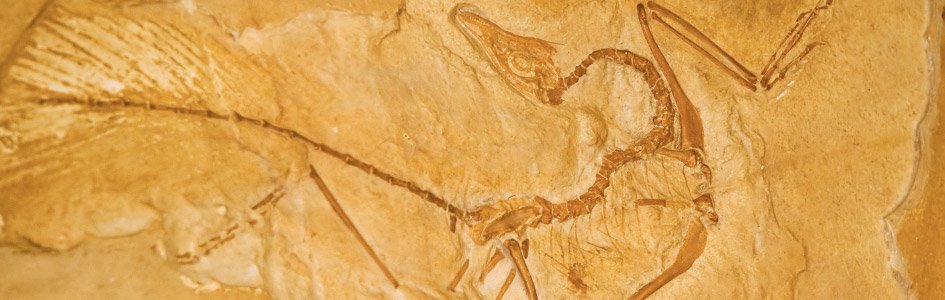
God invented and applied this CoG concept with His design of flying creatures such as Pteranodons and birds. The CoG of these flying creatures is close to the center of lift at the wings, enabling proper balance.2 This has significant implications for supposed dinosaur-to-bird evolution.
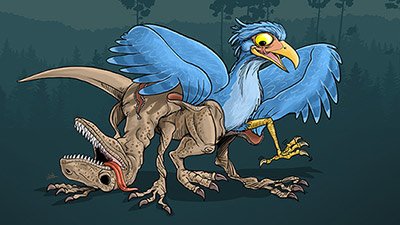
Evolutionary literature and media on the topic of dinosaur-to-bird evolution is proliferated with artwork depicting theropod3 dinosaurs with feathers. Yet the dinosaur limb orientation and overall morphology of the dinosaur remain the same. Can such a creature fly? If the supposedly feathered dinosaur is granted enough range of motion to flap its limbs, a pectoral girdle to support flight and flight muscles, a much lighter body, and a new part of the brain for flight control and spatial awareness, then is all of that enough?
No.
The CoG of theropod dinosaurs is too far aft for stable flight.
The CoG of theropod dinosaurs is too far aft for stable flight. In the same way that an airplane can have all the basic features and controls for flight but lack stability with its CoG in the wrong position, a theropod dinosaur can have the basic features and controls for flight but would lack stability because its CoG is very far aft, at the hip joint. The CoG for birds is much more forward compared to dinosaurs, within the chest area, enabling stable flight.
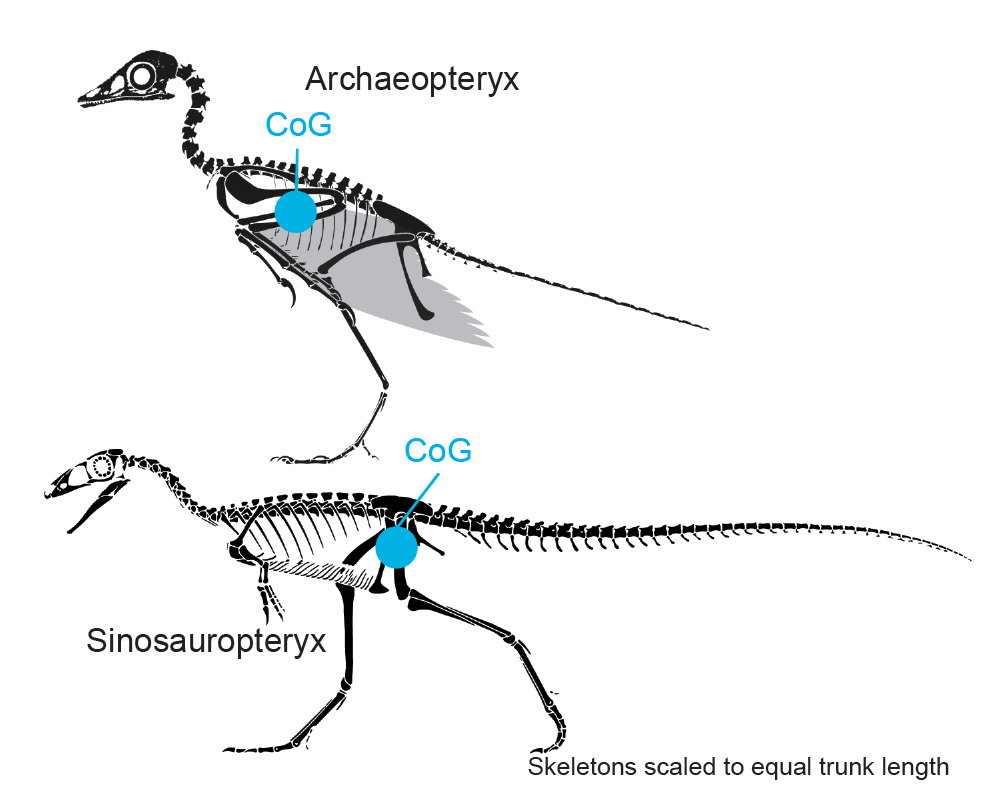
Estimated CoG location comparison between an extinct bird Archaeopteryx and a dinosaur Sinosauropteryx; skeletal drawing adapted from Scott Hartman (2020) reconstruction. https://www.skeletaldrawing.com/theropods/sinosauropteryx.
Evolutionists have acknowledged this problem in their research and attempt to explain how the CoG evolved in supposed dinosaur-to-bird evolution. To learn more about this topic and to see a fun flight stability demonstration, check out my presentation, “Did Dinosaurs Evolve into Birds? An Aeronautical Engineer’s Perspective” on the Answers in Genesis YouTube channel:
Also, to learn more about this topic in depth, check out my peer-reviewed research paper on this topic published in Answers Research Journal.

Footnotes
- The stick-fixed neutral point is the point at which the CoG location would result in zero pitching moment, assuming that the aircraft’s elevator is held in its neutral position.
- Flightless birds that are flightless by design can be an exception.
- This author is using the original 1881 definition of a theropod in which a theropod is a dinosaur. The more modern definition, since 1986, groups both birds and dinosaurs into the “theropod” category.

Support the creation/gospel message by donating or getting involved!

Answers in Genesis is an apologetics ministry, dedicated to helping Christians defend their faith and proclaim the good news of Jesus Christ.
- Customer Service 800.778.3390
- Available Monday–Friday | 9 AM–5 PM ET
- © 2026 Answers in Genesis