
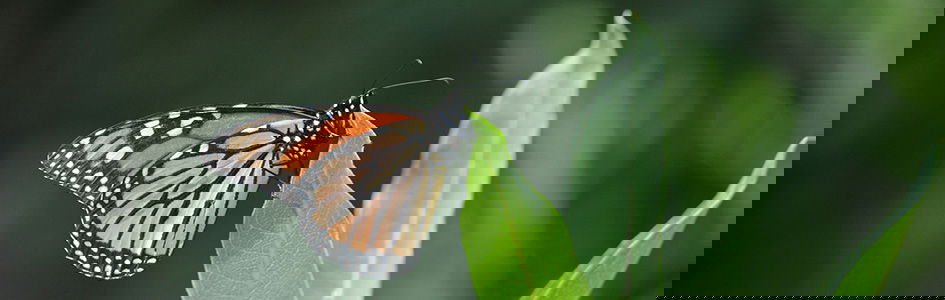
Butterflies: Beautifully Designed!
These insects show God’s ingenious and beautiful design
Butterflies are among the most beautiful and appealing insects on the planet. Their gentle beauty has enthralled humans since creation. Yet there is far more to butterflies than breathtaking colors and flittering around the garden. Butterflies present some incredibly unique and complex designs that show forth the glory of the Creator in his creation.
Before looking at the design in butterflies, it is important to remember that butterflies are small insects with pinhead-sized brains, no bones, no blood, and a minimal nervous system. These facts make many of the things they can do even more astounding and point strongly to God’s design in creation.
Butterflies must also maintain specific body temperatures to function. The black swallowtails (Papilio polyxenes) bask in the sun to raise their temperature, raising and lowering their abdomen depending on temperature. To reduce temperature, they can increase the circulation of hemolymph between their body segments to dissipate heat into the environment!1 Eastern tiger swallowtails (Papilio glaucus) lay eggs on the tips of branches facing the sun, which is very important as larvae exposed to sunlight develop up to 35% faster than those not exposed.2 Monarchs (Danaus plexippus), for which flight is essential to both migration and normal life, shiver to increase body temperature to a level where flight can occur.3 Painted lady butterflies (Vanessa cardui) also exhibit shivering, though there is a wide variation between individuals in its use.4
Designed Defenses
It is well-known that some butterfly species, like the popular monarch butterfly, are noxious to predators due to consuming plants with a foul taste as caterpillars. Other butterflies take advantage of this by mimicking the noxious butterfly. The black swallowtail mimics the blue swallowtail (Battus philenor). Females are better mimics than males in this instance,5 but males only fare worse when predators can see the dorsal surface of the wing. From beneath, protection is the same.6 The related eastern tiger swallowtail likewise exhibits female mimicry of B. philenor.7 The red-spotted admiral (Limenitis arthemis) also imitates B. philenor to varying degrees depending on the population.8
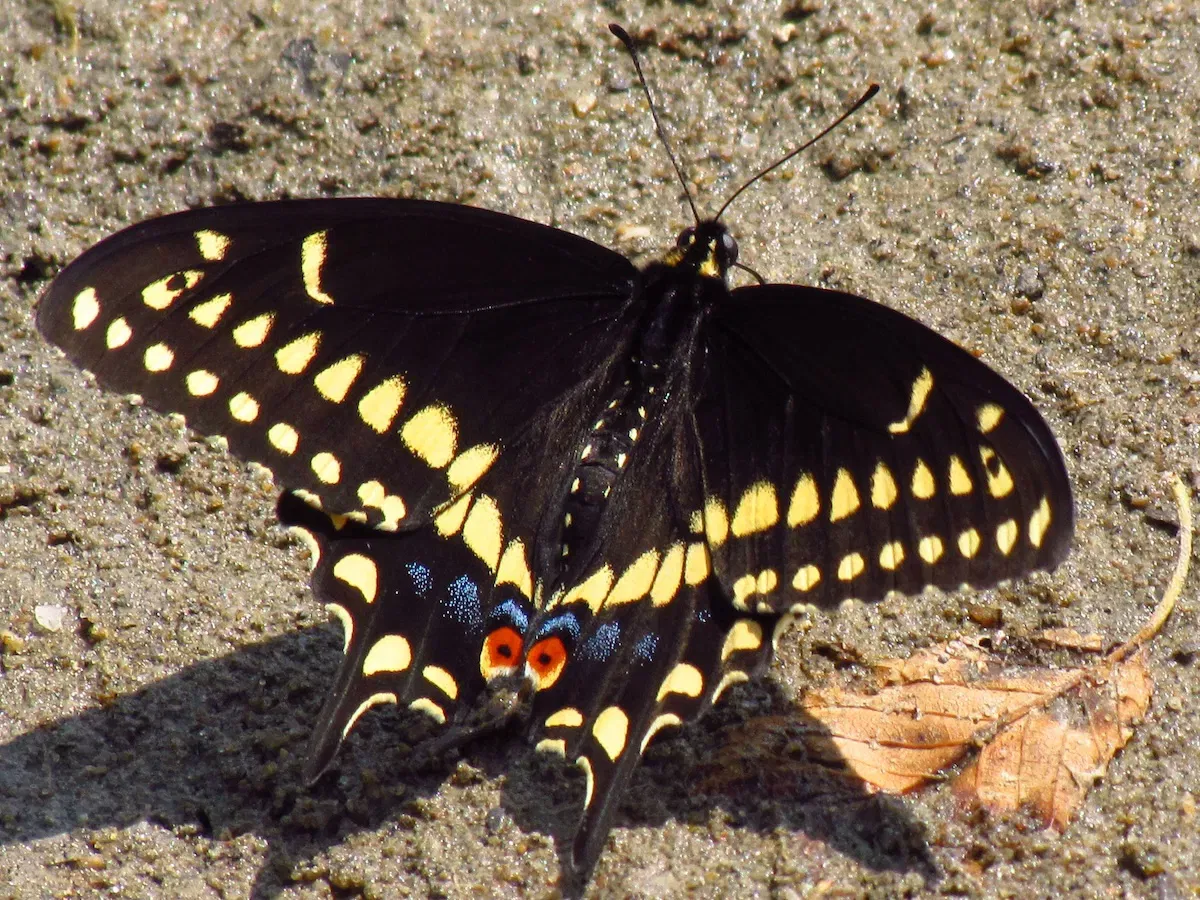
Black Swallowtail male. D. Gordon E. Robertson, CC BY-SA 3.0, via Wikimedia Commons
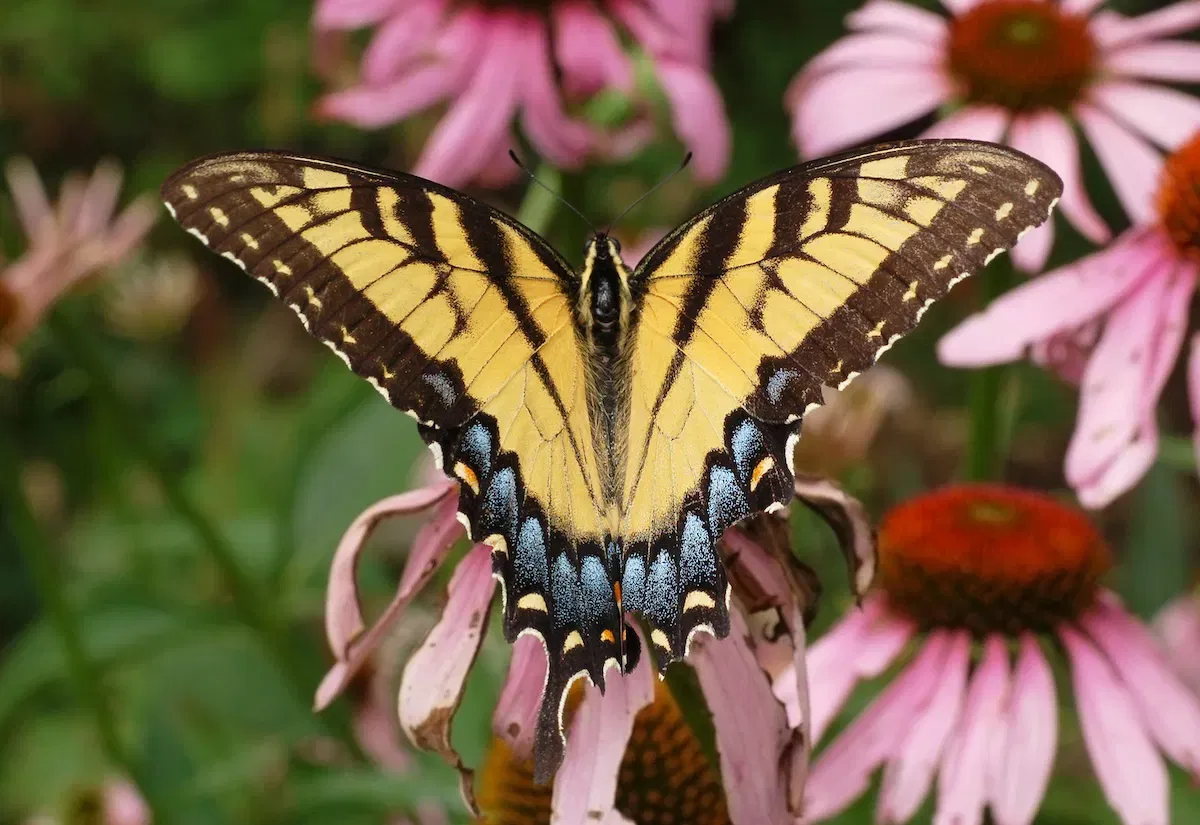
Eastern Tiger Swallowtail female. Photo by and (c)2007 Derek Ramsey (Ram-Man), GFDL 1.2, via Wikimedia Commons
Many caterpillars are designed to feed on plants with chemical defenses that make them unpalatable to other insects. The most obvious example of this is the monarch, which feeds on noxious milkweed, but there are others. The black swallowtail caterpillars feed on plants with chemicals that produce oxidative stress. As such, they have much higher levels of antioxidants to combat these chemicals than other insects.9 This species also has enzymes that are designed to quickly break down other toxins in the plants they eat.10 A subspecies of the related eastern tiger swallowtail can eat the highly toxic leaves of the Salicaceae family of plants and show good survival rates.11
Some butterflies can modify certain aspects of their behavior or coloration depending on their environment. In the black swallowtail, when the caterpillar forms its pupal stage, it tracks the amount of light it receives and alters the color of its pupa accordingly!12 The zebra swallowtail (Eurytides marcellus) pupa will modify its color to match its environment.13 Texture may also play a role in the coloration.14 The common buckeye (Junonia coenia) changes the color pattern on its wings in response to the seasons, helping it control its body temperature.15 The painted lady modifies the colors of its wings in response to environmental stressors.16 The eyespots on its wings also change in response to both cold and heat shock.17 Despite their tiny brains, cabbage whites (Pieris rapae) can learn to recognize flowers containing nectar and remember them for up to three days, even while learning a second flower!18
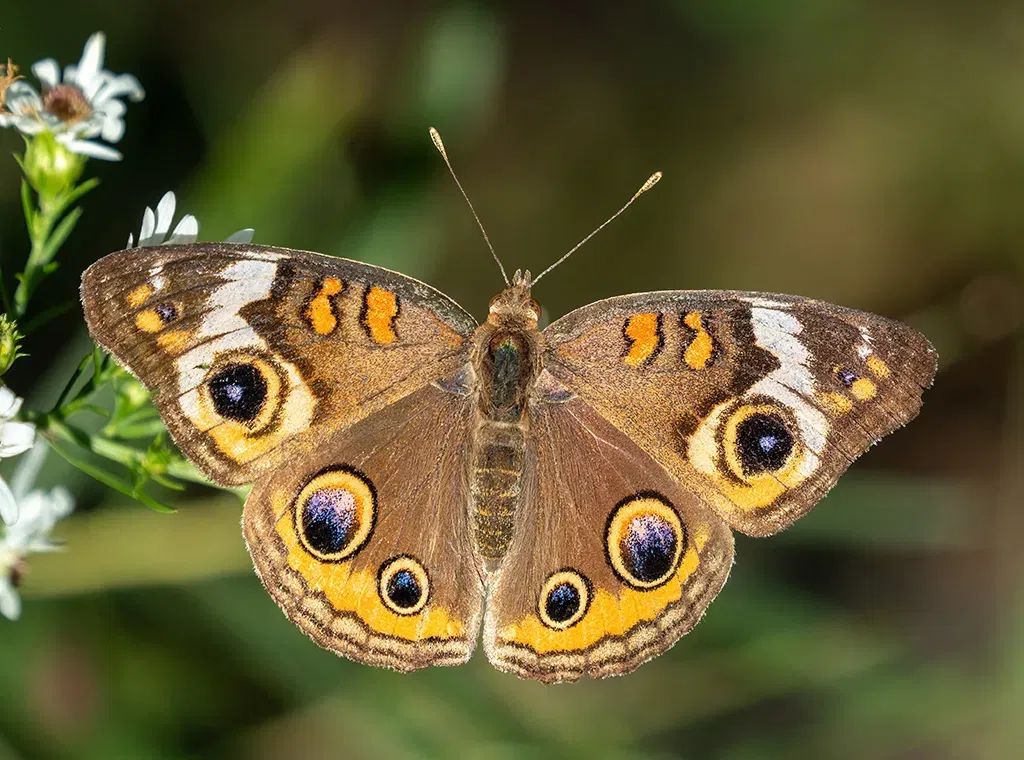
Common Buckeye. Rhododendrites, CC BY-SA 4.0, via Wikimedia Commons
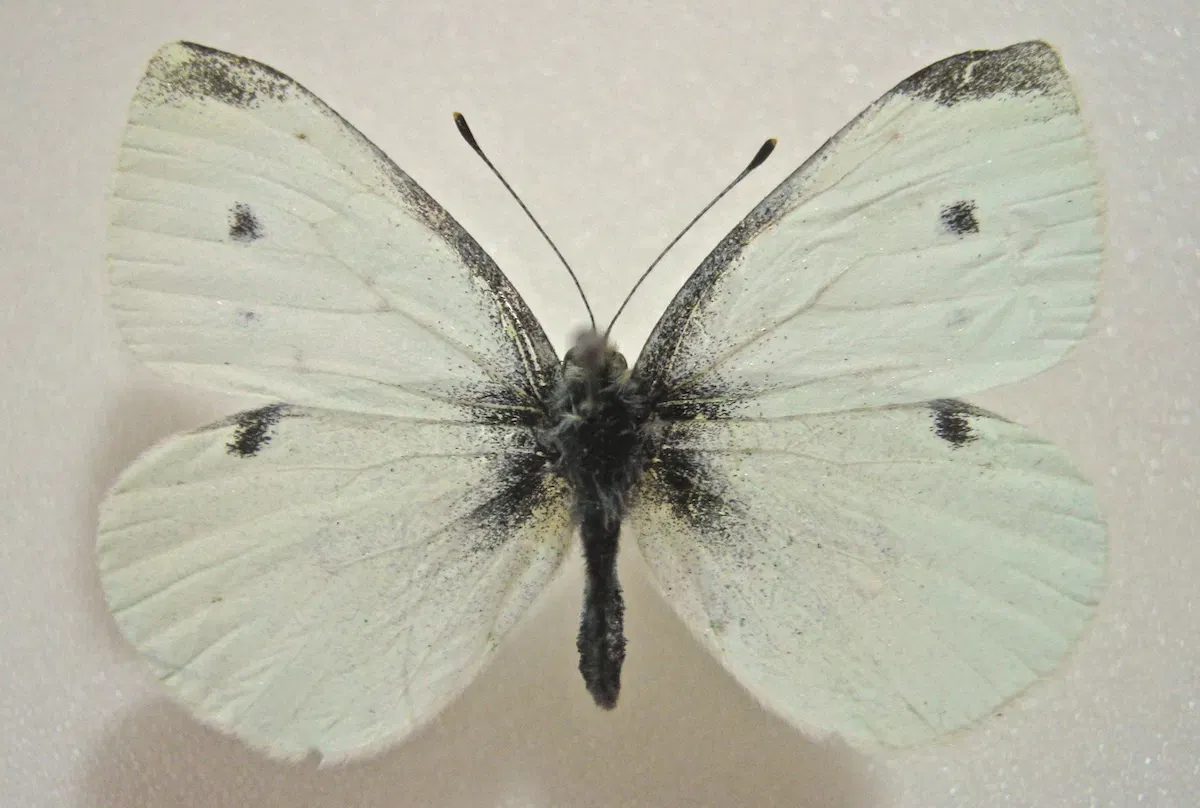
Cabbage White male. Ypna, CC BY-SA 3.0, via Wikimedia Commons
Butterfly Migration
Migration is well-known in some butterflies like monarchs, but they are far from the only ones. Painted lady butterflies also mass migrate, using the location of the sun as a compass for navigation.19 The butterflies also somehow know how to take advantage of wind currents to migrate more efficiently.20 Some of these migrations can be nearly 2,500 miles in a single generation21 for a butterfly smaller than a child’s hand! Some populations of the cabbage white butterfly (Pieris rapae) also migrate. They migrate largely with their backs to the sun, sometimes crossing mountain ranges regularly between spring and fall.22
Specialized Plant Preferences
Many butterflies require specialized host plants for their larvae. The obvious one is a monarch butterfly, but there are others. For the caterpillars to survive, mother butterfly must be able to identify the proper place to lay her eggs. Some species do this by tracking substances released by plants called volatiles. The black swallowtail can track the volatiles of its host from the time they first fly, and they get better at identifying the source of the volatiles as they get older.23 Male and female monarch butterflies do something similar, tracking volatiles of milkweed to find places to lay eggs.24 Females of the common buckeye also show preference for particular plants, sensing the presence of iridoid glycoside and preferentially laying their eggs where the highest concentration of it was located.25 Cabbage whites also can track their preferred host plants using their volatiles, showing a preference for a nonoptimal host treated with a host’s volatiles.26
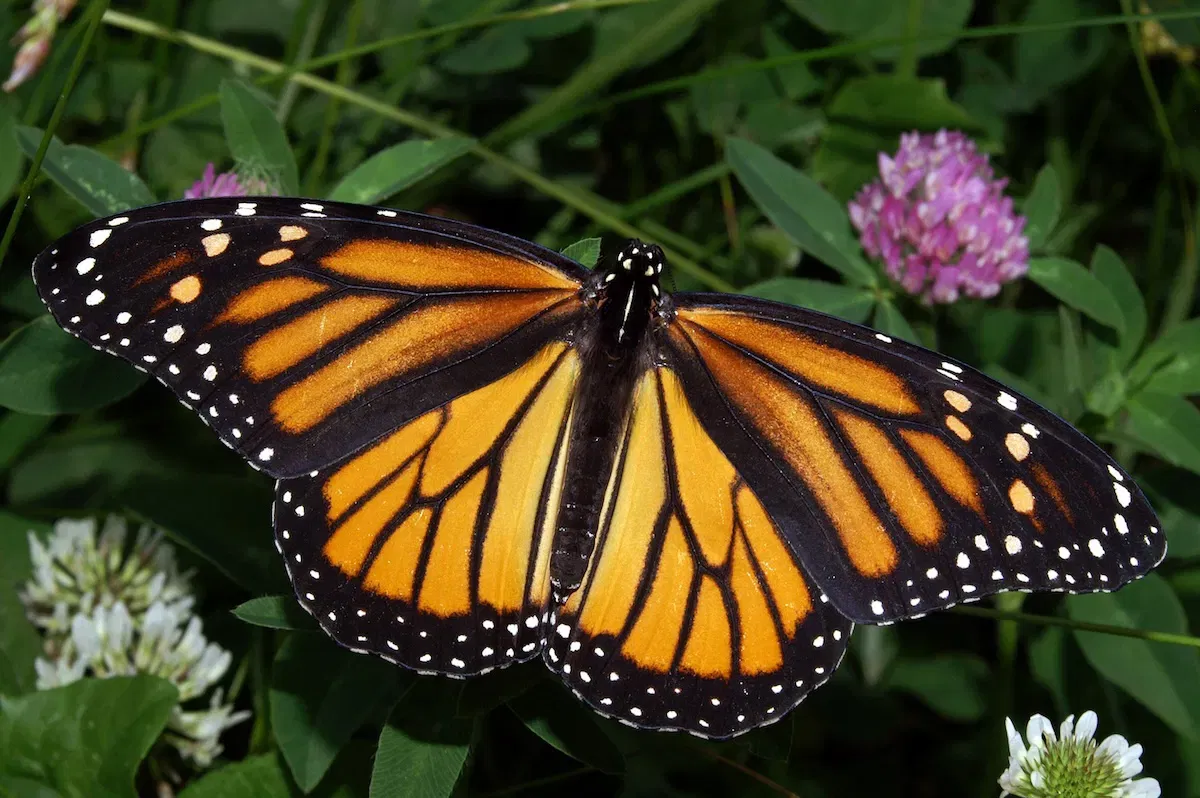
Monarch female
Only the almighty Creator of the universe could make something so beautiful and so brilliantly functional.
As we can see, butterflies have some very unique attributes that enable them to survive and even thrive in our fallen world. Their ability to track and control their body temperatures, mimic poisonous butterflies, modify their colors and behaviors at will, identify host plants by smell, and migrate long distances by relying totally on the position of the sun shouts God’s design. How does a tiny insect, with a brain the size of a pinhead, know how to use the sun as a compass? Something like that is far beyond the power of a human engineer and even further beyond the power of natural processes. Only the almighty Creator of the universe could make something so beautiful and so brilliantly functional.
Footnotes
- John E. Rawlins, “Thermoregulation by the Black Swallowtail Butterfly, Papilio polyxenes (Lepidoptera: Papilionidae),” Ecology 61, no. 2 (April 1980): 345–357, https://esajournals.onlinelibrary.wiley.com/doi/abs/10.2307/1935193.
- David W. Grossmueller and Robert C. Lederhouse, “Oviposition Site Selection: An Aid to Rapid Growth and Development in the Tiger Swallowtail Butterfly, Papilio glaucus,” Oecologia 66 (April 1985): 68–73, https://link.springer.com/article/10.1007/BF00378553.
- Alan R. Masters, Stephen B. Malcom, and Lincoln P. Brower, “Monarch Butterfly (Danaus plexippus) Thermoregulatory Behavior and Adaptations for Overwintering in Mexico,” Ecology 69, no. 2 (April 1988): 458–467, https://esajournals.onlinelibrary.wiley.com/doi/abs/10.2307/1940444.
- Simon Ducatez and Michel Baguette, “Inter-individual Variation in Shivering Behaviour in the Migratory Painted Lady Vanessa cardui,” Ecological Entomology 41, no. 2 (November 2015): 131–137, https://resjournals.onlinelibrary.wiley.com/doi/abs/10.1111/een.12283.
- Wade Hazel and Jennifer Herrell, “Female-Limited Variability in Mimicry in the Swallowtail Butterfly Papilio polyxenes Fabr,” Heredity 75 (1995): 106–110, https://www.nature.com/articles/hdy1995110.pdf.
- Sylvio G. Codella and Robert C. Lederhouse, “Intersexual Comparison of Mimetic Protection in the Black Swallowtail Butterfly, Papilio polyxenes: Experiments with Captive Blue Jay Predators,” Evolution 43, no. 2 (1989): 410–420, https://onlinelibrary.wiley.com/doi/pdfdirect/10.1111/j.1558-5646.1989.tb04236.x.
- J. Mark Scriber, Robert H. Hagen, and Robert C. Lederhouse, “Genetics of Mimicry in the Tiger Swallowtail Butterflies, Papilio glaucus and P. canadensis (Lepidoptera: Papilionidae),” Evolution 50, no. 1 (1996): 222–236, https://onlinelibrary.wiley.com/doi/pdfdirect/10.1111/j.1558-5646.1996.tb04487.x.
- Wesley K. Savage and Sean P. Mullen, “A Single Origin of Batesian Mimicry Among Hybridizing Populations of Admiral Butterflies (Limenitis arthemis) Rejects an Evolutionary Reversion to the Ancestral Phenotype,” Proceedings of the Royal Society of London, Series B: Biology 276 (2009): 2557–2565, https://pmc.ncbi.nlm.nih.gov/articles/PMC2686656/pdf/rspb20090256.pdf.
- Chris A. Pritsos, Sami Ahmad, Susan M. Bowen, Andrew J. Elliott, Gary J. Blomquist, and Ronald S. Pardini, “Antioxidant Enzymes of the Black Swallowtail Butterfly, Papilio polyxenes, and Their Response to the Prooxidant Allelochemical, Quercetin,” Archives of Insect Biochemistry and Physiology 8, no. 2 (1988): 101–112, https://onlinelibrary.wiley.com/doi/abs/10.1002/arch.940080204.
- J. J. Neal and May Berenbaum, “Decreased Sensitivity of Mixed-Function Oxidases from Papilio polyxenes to Inhibitors in Host Plants,” Journal of Chemical Ecology 15 (January 1989): 439–446, https://link.springer.com/article/10.1007/BF02027803.
- Matthew S. Lehnert and J. Mark Scriber, “Salicaceae Detoxification Abilities in Florida Tiger Swallowtail Butterflies (Papilio glaucus maynardi Gauthier): Novel Ability or Pleistocene Holdover?,” Insect Science (2011): 1–9, http://personal.kent.edu/~mlehner1/willow.pdf.
- David A. West, William M. Snellings, and Thomas A. Herbek, “Pupal Color Dimorphism and Its Environmental Control in Papilio polyxenes asterius Stoll (Lepidoptera: Papilionidae),” Journal of the New York Entomological Society 80, no. 4 (December 1972): 205–211, https://www.jstor.org/stable/25008827.
- Wade N. Hazel and David A. West, “Pupal Colour Dimorphism in Swallowtail Butterflies as a Threshold Trait: Selection in Eurytides marcellus (Cramer),” Heredity 49, no. 3 (1982): 295–301, https://www.nature.com/articles/hdy1982103.pdf.
- Wade N. Hazel and David A. West, “Environmental Control of Pupal Colour in Swallowtail Butterflies (Lepidoptera: Papilioninae): Battus philenor (L.) and Papilio polyxenes Fabr.,” Ecological Entomology 4, no. 4 (1979): 393–400, https://resjournals.onlinelibrary.wiley.com/doi/abs/10.1111/j.1365-2311.1979.tb00599.x.
- Robert D. Reed, Vilja V. Järvi, and Karin R. L. van der Burg, “Seasonal Plasticity in Junonia coenia (Nymphalidae): Linking Wing Color, Temperature Dynamics, and Behavior,” Journal of the Lepidopterists’ Society 73, no. 1 (2019): 34–42, https://www.researchgate.net/profile/Robert-Reed-3/publication/332581442_Seasonal_Plasticity_in_Junonia_coenia_Nymphalidae_Linking_Wing_Color_Temperature_Dynamics_and_Behavior/links/5f6b43b2299bf1b53eea2f51/Seasonal-Plasticity-in-Junonia-coenia-Nymphalidae-Linking-Wing-Color-Temperature-Dynamics-and-Behavior.pdf.
- Joji M. Otaki, “Stress-Induced Color-Pattern Modifications and Evolution of the Painted Lady Butterflies Vanessa cardui and Vanessa kershawi,” Zoological Science 24, no. 8 (August 2007): 811–819, https://bioone.org/journals/zoological-science/volume-24/issue-8/zsj.24.811/Stress-Induced-Color-Pattern-Modifications-and-Evolution-of-the-Painted/10.2108/zsj.24.811.short.
- Heidi Connahs, Turk Rhen, and Rebecca B. Simmons, “Physiological Perturbation Reveals Modularity of Eyespot Development in the Painted Lady Butterfly, Vanessa cardui,” PLoS One 11, no. 8 (2016): https://journals.plos.org/plosone/article/file?id=10.1371/journal.pone.0161745&type=printable.
- Ikuo Kandori and Naota Ohsaki, “The Learning Abilities of the White Cabbage Butterfly, Pieris rapae, Foraging for Flowers,” Researches on Population Ecology 38, no. 1 (June 1996): 111–117, https://link.springer.com/article/10.1007/BF02514977.
- R. L. Nesbit, J. K. Hill, I. P. Woiwod, D. Sivell, K. J. Bensusan, and J. W. Chapman, “Seasonally Adaptive Migratory Headings Mediated by a Sun Compass in the Painted Lady Butterfly, Vanessa cardui,” Animal Behaviour 78, no. 5 (November 2009): 1119–1125, https://www.sciencedirect.com/science/article/abs/pii/S0003347209003674.
- Constantí Stefanescu, Marta Alarcón, and Anna Àvila, “Migration of the Painted Lady Butterfly, Vanessa cardui, to North-Eastern Spain Is Aided by African Wind Currents,” Journal of Animal Ecology 76 (2007): 888–898, https://www.researchgate.net/profile/Anna-Avila/publication/6126234_Migration_of_the_painted_lady_butterfly_Vanessa_cardui_to_north-eastern_Spain_is_aided_by_African_wind_currents/links/5fd726fc299bf140880a71d0/Migration-of-the-painted-lady-butterfly-Vanessa-cardui-to-north-eastern-Spain-is-aided-by-African-wind-currents.pdf?_sg%5B0%5D=started_experiment_milestone&origin=journalDetail&_rtd=e30%3D.
- Gerard Talavera and Roger Vila, “Discovery of Mass Migration and Breeding of the Painted Lady Butterfly Vanessa cardui in the Sub-Sahara: The Europe-Africa Migration Revisited,” Biological Journal of the Linnean Society 120, no. 2 (February 2017): 274–285, https://academic.oup.com/biolinnean/article-abstract/120/2/274/2954916?redirectedFrom=fulltext&login=false.
- N. Gilbert and D. A. Raworth, “Movement and Migration Patterns in Pieris rapae (Pieridae),” Journal of the Lepidopterist’s Society 59, no. 1 (2005): 10–18, https://images.peabody.yale.edu/lepsoc/jls/2000s/2005/2005(1)10-Gilbert.pdf.
- Cheryl A. Heinz, “Host Plant Odor Extracts with Strong Effects on Oviposition Behavior in Papilio polyxenes,” Entomologia Experimentalis et Applicata 128, no. 2 (July 2008): 265–273, https://onlinelibrary.wiley.com/doi/abs/10.1111/j.1570-7458.2008.00717.x.
- Kristopher M. Garlick, “Visual and Olfactory Sensory Systems Employed by Monarch Butterflies (Danaus plexippus) to Locate Their Milkweed Host Plants” (graduate thesis, Queen’s University Ontario, Canada, 2007), https://www.collectionscanada.gc.ca/obj/thesescanada/vol2/002/MR37285.PDF?is_thesis=1&oclc_number=646562707.
- Patricia C. Pereyral and M. Deane Bowers, “Iridoid Glycosides as Oviposition Stimulants for the Buckeye Butterfly, Junonia coenia (Nymphalidae),” Journal of Chemical Ecology 14 (March 1988): 917–928, https://link.springer.com/article/10.1007/BF01018783.
- Hiromi Ikeura, Fumiyuki Kobayashi, and Yasuyoshi Hayata, “How Do Pieris rapae Search for Brassicaceae Host Plants?,” Biochemical Systematics and Ecology 38, no. 6 (December 2010): 1199–1203, https://www.sciencedirect.com/science/article/abs/pii/S030519781000219X.




.jpg)

Support the creation/gospel message by donating or getting involved!

Answers in Genesis is an apologetics ministry, dedicated to helping Christians defend their faith and proclaim the good news of Jesus Christ.
- Customer Service 800.778.3390
- Available Monday–Friday | 9 AM–5 PM ET
- © 2026 Answers in Genesis