
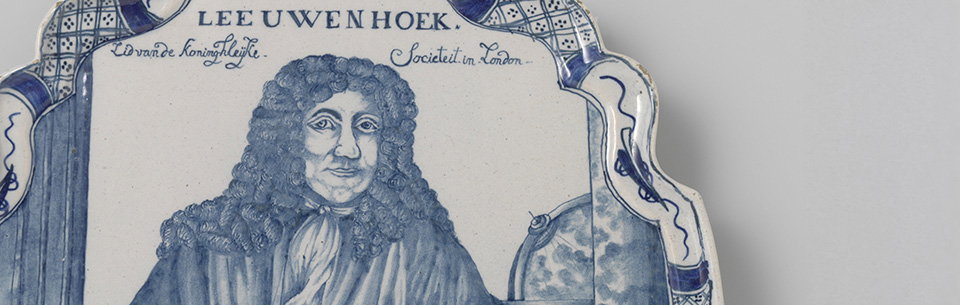
Rijksmuseum, CC0, via Wikimedia Commons

350 Years Later: A Creation Lens on the Birth of Bacteriology
Leeuwenhoek, Father of Microbiology: Chosen to Describe Curious Creatures
Abstract
Antonie van Leeuwenhoek steps 350 years ago were planned and ordered by providence. He was originally a draper who made use of a simple, well-crafted lens to observe the fine threads of men’s cloth and clothes. But soon, he would find himself examining living fabrics of cells and tissues. Perhaps, the Creator ordered his steps to make curious findings that would start the discipline of microbiology and protozoology in the spring of 1676. Antonie van Leeuwenhoek is credited with the first description of bacteria in 1676. In his Letter 18 sent to the Royal Society on October 9, 1676, he reported seeing Spirillum volutans and describing various microorganisms, including water protozoans, and probably other bacteria. This significant discovery marked the beginning of microbiology and laid the groundwork for understanding the microscopic world of bacteria. Leeuwenhoek’s innovative use of a simple microscope allowed him to observe and document these life-forms, which were not previously known to the scientific community.
-
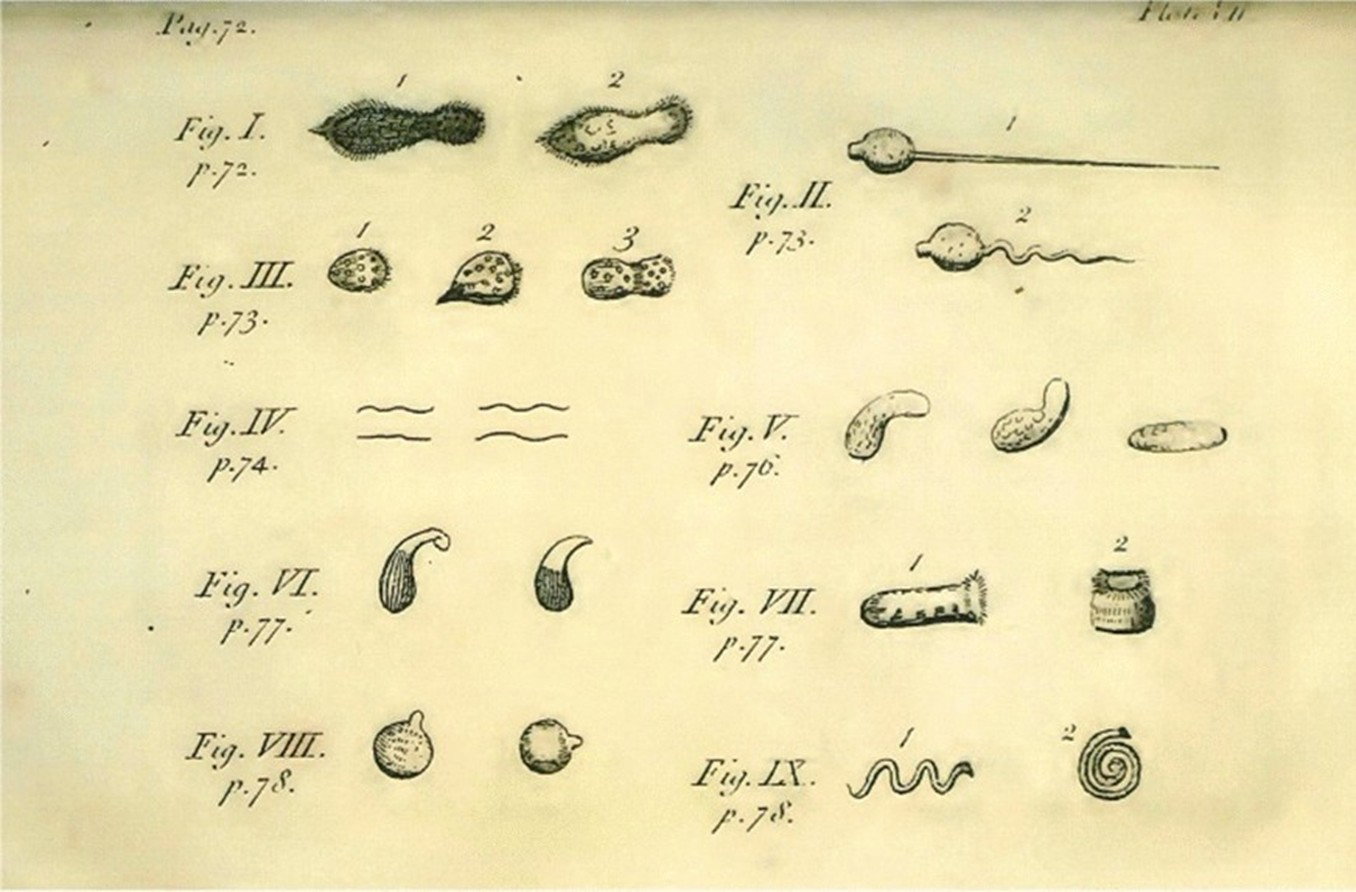
Figure 1. The drawing that accompanied van Leeuwenhoek’s letter about his pepper and rainwater experiments.1 The original drawing has not survived, but Henry Baker published his version as an exact copy.2 “Figure IV” among the various protozoa on the image is regarded as the first published drawing of bacteria. It appears to depict Spirillum volutans in its swimming mode (left) and coiled up mode (right).
-
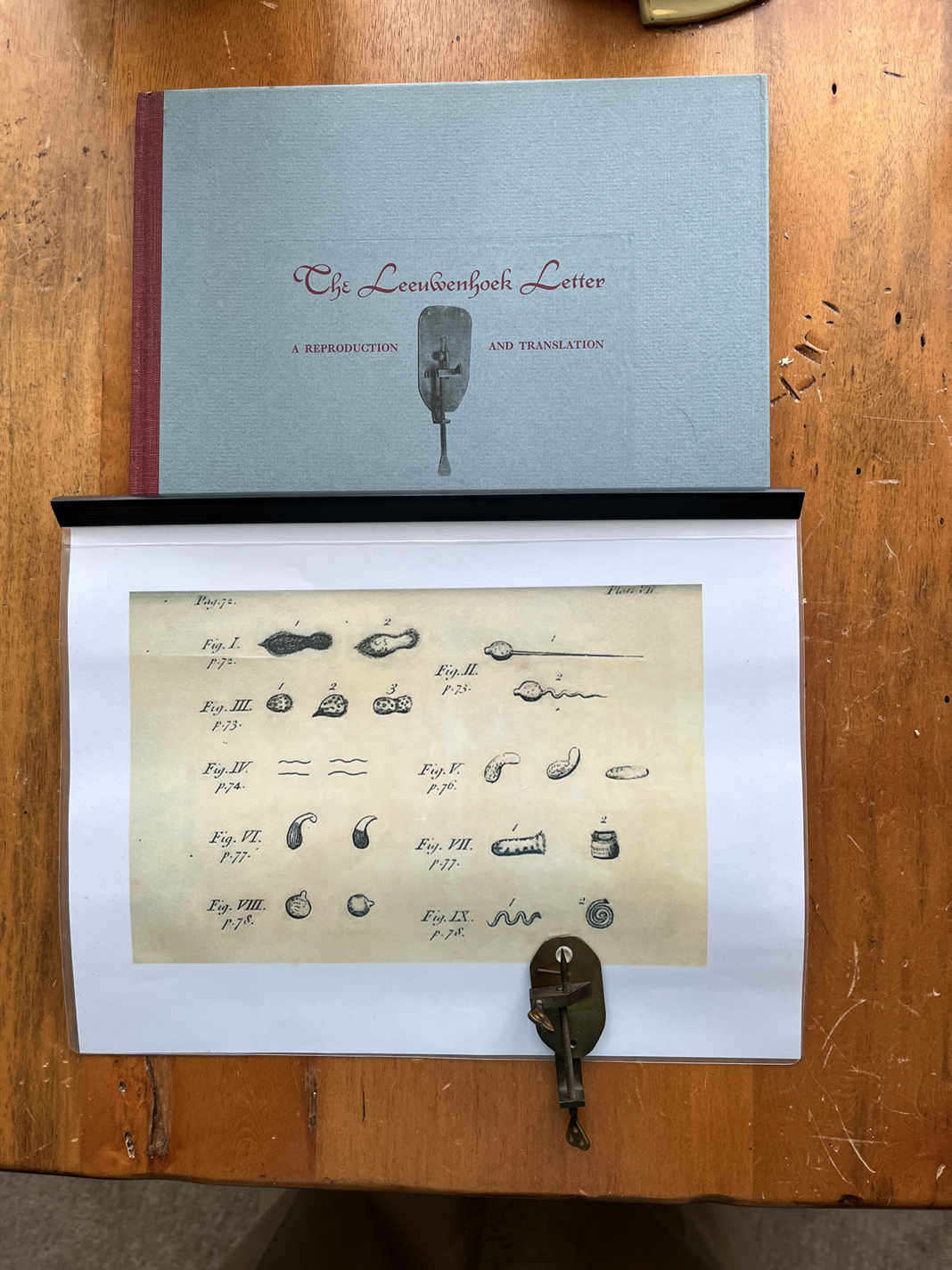
Figure 2. This is the 1937 The Leeuwenhoek Letter book with original Leeuwenhoek’s Dutch letter, an English translation of letter, and a replica near the spiral bacteria (probably Spirillum volutans). This book had a limited print run of a few hundred copies.
Although not formally trained as a scientist, the Dutch Draper would discover, describe, and declare to the world of minuscule. I appreciate that Leeuwenhoek was motivated by curiosity, not fame or fortune.3
In 1674, he likely saw protozoa from nearby water sources, and by 1675–76, he was looking at rainwater and pepper water.4 He is thought to have seen bacteria as early as the spring of 1676.5 According to Dobell’s interpretation, Leeuwenhoek’s first observation was on April 24, 1676, from pepper water alone.6 It appears that the larger, more significant observations were made the next month, on May 26, from a combination of pepper water, snow water, and rainwater (he frequently combined water sources and did not use pure culture as we know them today).7 In October of 1676, a letter with drawings clearly showing both protozoa and bacteria was published. He had seen blue green algae (cyanobacteria), mites, nematodes, and many other small animals8 with his simple microscope that was first used to examine fibers in men’s clothing.
When in 1676 he described finding microorganisms that were so small that “ten thousand of these living creatures could scarce equal the bulk of a coarse sand grain,” they [the natural philosophers of the Royal Society of London] requested corroboration from other eyewitnesses. Several friends sent affidavits that they also saw these things through Antony’s microscope. As Leeuwenhoek’s observations were found to be accurate, his reputation grew, and by 1680 he was elected a fellow of the Royal Society.
Though he never revisited London or attended a meeting, the amateur microscopist kept up a lively correspondence with the British scientists, who translated hundreds of his letters and published them in their Philosophical Transactions.
Leeuwenhoek’s letters sparkle with the excitement of discovery. Describing the “wee animalcules” (protozoa and bacteria) he observed in a drop of fresh water, he wrote, “The motion of most of them in the water was so swift, and so various, upwards, downwards, and roundabout, that I admit I could not but wonder at it. I judge that some of these little creatures were above a thousand times smaller than the smallest ones which I have hitherto seen. . . . Some of these are so exceedingly small that millions of millions might be contained in a single drop of water.”9
Early microbiologists like Antonie van Leeuwenhoek saw God’s “incomprehensible perfection” and “providential care” in animalcules (microorganisms), believing these tiny creatures clearly pointed to a wise Creator. Antonie van Leeuwenhoek was a devout Christian who saw his groundbreaking discoveries of microorganisms as profound evidence of God’s marvelous creation, believing life was divinely designed and created, not spontaneously generated. His faith emphasized Scripture and the beauty of nature, viewing his microscopic observations as uncovering God’s intricate handiwork, a perspective that aligned with, or at least didn’t challenge, the church’s teachings on creation. As one author noted, “Leeuwenhoek believed in God as piously as any Seventeenth century Dutchman. He always referred to God as the Great All.”10 I believe that Leeuwenhoek mysteriously and providentially had “ordered steps” 350 years ago. God was involved with the discovery of microbes.
Antonie van Leeuwenhoek was a devout Christian who saw his groundbreaking discoveries of microorganisms as profound evidence of God’s marvelous creation.
Leeuwenhoek was of the Dutch Reformed faith. In the 1600s, the Dutch Reformed Church held a strict, literal, and theological view of creation.11 They believed in creation ex nihilo (creation out of nothing) by the triune God, holding that God created all things in six days through his Word. Creation was considered perfect, designed for a specific purpose to glorify God, with humans as the pinnacle of this creation. Key aspects of the 1600s Dutch Reformed view of creation included:12
- Literal interpretation: The Genesis account was understood literally, with God establishing the universe in six days.
- “Good” creation: Everything created was initially declared “good,” though it was subsequently corrupted by the fall of man.
In essence, Leeuwenhoek’s religious beliefs provided the framework for his scientific inquiries, motivating him to explore the microscopic world as a way to understand the Creator better.
The Ordered Steps of Antonie van Leeuwenhoek Timeline
The following are the ordered steps of Antonie van Leeuwenhoek’s journey from a tradesman to the “Father of Microbiology”:13
- 1632: Born in Delft, Netherlands
Antonie van Leeuwenhoek was born on October 24, 1632, in Delft, Netherlands. He had four older sisters but no brothers. His family were Dutch dwellers of a highly respected type and church people. They were basket makers and brewers. Leeuwenhoek’s father died early. His mother read him a Dutch Bible and sent him to school until the age of 16. - 1648–1654: Apprenticeship in Amsterdam
At age 16, Leeuwenhoek was sent to Amsterdam to apprentice as a draper (cloth merchant). He learned the trade of measuring and selling textiles, which introduced him to simple magnifying glasses used to inspect the quality of thread. - 1654–1660s: Establishing Business and Public Service
He returned to Delft, opened his own drapery shop, and took on various municipal roles, such as chamberlain for the Delft sheriffs. - 1668: Inspiration from London
During a visit to London, he likely encountered Robert Hooke’s Micrographia (published in 1665), which featured detailed microscopic drawings of insects and textiles. This spurred his interest in creating more powerful lenses. - 1671: Crafting the First Lenses
He began grinding his own small, high-quality spherical lenses. Unlike the compound microscopes of the time, his were simple, single-lens devices that could magnify objects up to 300 times—far exceeding the 40–50x magnification of Hooke’s models. - 1673: Initial Correspondence with the Royal Society
Encouraged by Dutch physician Reinier de Graaf, Leeuwenhoek began writing to the Royal Society of London. His first letters described observations of bee stings, mold, and lice. - 1674: Discovery of “Animalcules”
While examining pond water from a lake near Delft (Berkelse Mere), he observed tiny, moving organisms for the first time, calling these single-celled organisms “animalcules.” - 1676–1677: Discovery of Bacteria and Spermatozoa
In 1676, he reported the first sighting of bacteria, which he found in rainwater and dental plaque. In 1677, he described human and animal spermatozoa, which he believed were the origin of life. - 1680: Election to the Royal Society
Despite being a tradesman with no formal scientific training, the Royal Society recognized his groundbreaking work by electing him a fellow. - 1683: First Record of Bacteria in the Human Mouth
He made his most famous bacterial observations using scrapings from his own teeth, illustrating different shapes (rods, spheres, spirals) of what we now recognize as bacteria. - 1723: Continued Research Until Death
He continued sending letters to London until the weeks before his death at age 90, even documenting the symptoms of his own rare disease.
Early Names for Bacteria
Antonie van Leeuwenhoek was the first person to observe and describe bacteria using single-lensed microscopes of his own design. Because the word bacteria did not exist in the seventeenth century, he used a variety of descriptive terms in his native Dutch to characterize the tiny, motile life-forms he discovered.
The most famous name associated with Leeuwenhoek’s discovery is animalcules, which literally translates to “little animals.” However, Leeuwenhoek himself wrote his scientific findings in letters using Dutch terms, which were later translated for the English-speaking scientific community.14,15
- Dierkens, diertgens, or diertjes: These were the original Dutch words Leeuwenhoek used to describe the organisms, meaning “small animals.”
- Animalcules: This Latin-derived term ( little animals) was used by Henry Oldenburg, the first secretary of the Royal Society, to translate Leeuwenhoek’s Dutch descriptions into English.
- Wee animalcules/wee beasties: These are colloquial variations often found in modern accounts of his work to capture the wonder in his descriptions.
- Kleine clootgens (small globules): Leeuwenhoek frequently used the word “globules” (clootgens or klootgens) to describe many microscopic structures, including red blood cells and various bacterial forms.
- Scurf: This was the term he used for what we now call biofilm, specifically referring to the “little white matter” (dental plaque) scraped from his teeth, where he found immense numbers of bacteria.
is a professor of biology at Liberty University.
Answers in Depth
2026 Volume 21
Answers in Depth explores the biblical worldview in addressing modern scientific research, history, current events, popular media, theology, and much more.
Browse VolumeFootnotes
- Leeuwenhoek, A. V., trans. B. Cohen, The Leeuwenhoek Letter: A Photographic Copy of the Letter of the 9th of October, 1676, Sent by Antony van Leeuwenhoek to Henry Oldenburg, Secretary of the Royal Society of London. (Baltimore: Society of American Bacteriologists, 1937).
- Robertson, Lesley A., “Antonie van Leeuwenhoek,” Journal of Microbiology 116, no. 10 (2023): 919–935.
- Gillen, A., and D. Oliver, “Antony van Leeuwenhoek: Creation ‘Magnified’ Through His Magnificent Microscopes,” Answers in Depth 7 (August 15, 2012): https://answersingenesis.org/creation-scientists/profiles/antony-van-leeuwenhoeks-microscopes-creation-magnified/; A. Gillen, “Celebrating Leeuwenhoek’s Life 300 Years Later,” Answers in Depth 18 (August 26, 2023): https://answersingenesis.org/biology/celebrating-leeuwenhoeks-life-300-years-later/.
- Antonie van Leeuwenhoek’s “pepper water experiment” involved observing an infusion of black peppercorns in water through his homemade single-lens microscope, which led to the discovery of bacteria and protozoa, which he called “animalcules” or “little animals.”
- Robertson, “Antonie van Leeuwenhoek.”
- Dobell, Clifford, Anthony van Leeuwenhoek and His “Little Animals” (London: Staples Press, 1932), 133.
- Leeuwenhoek, trans. Cohen, “The Leeuwenhoek Letter.”
- Leeuwenhoek, trans. Cohen, “The Leeuwenhoek Letter.”
- Coppedge, David F., “Microscopic Magnificence,” Christian History 76, 2002, https://christianhistoryinstitute.org/magazine/article/microscopic-magnificence.
- De Kruif, Paul, Microbe Hunters (New York: Harcourt, Brace, 1926), 12.
- Sproul, R. C., The Invisible Hand (Phillipsburg, NJ: Presbyterian & Reformed Publishing, 1996).
- Sproul, Invisible Hand; Roger E. Olson, The Story of Christian Theology: Twenty Centuries of Tradition & Reform (Downers Grove, IL: IVP Academic, 1999), 410–413.
- Timeline derived from Dekkers, Geertje, trans. Andy Brown, Myriad, Microscopic and Marvellous: The World of Antoni van Leeuwenhoek (London: Reaktion Books, 2025); De Kruif, Paul, Microbe Hunters; Lens on Leeuwenhoek, “Chronology of Events,” accessed May 2026, https://leeuwenhoek.net/timeline.
- Words from Dekkers, Myriad, Microscopic and Marvellous.
- Haaxman, P. J., [Antony Van Leeuwenhoek], and P. C. T. Snellen, Antony Van Leeuwenhoek. De Ontdekker Der Infusorien 1675–1875, first ed. (Leiden: S. C. Van Doesburgh, 1875).
Support the creation/gospel message by donating or getting involved!

Answers in Genesis is an apologetics ministry, dedicated to helping Christians defend their faith and proclaim the good news of Jesus Christ.
- Customer Service 800.778.3390
- Available Monday–Friday | 9 AM–5 PM ET
- © 2026 Answers in Genesis