

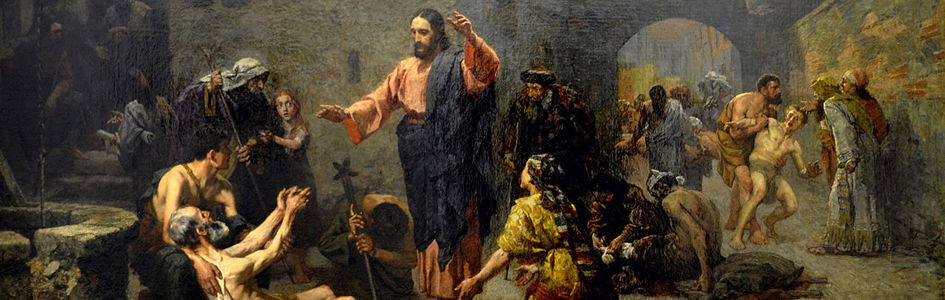
The Lord Jesus Christ: One Person with Two Natures
A recent survey of the state of theology (2025) showed that evangelical Christian’s knowledge of biblical doctrine is in an abysmal state. This is especially true when it comes to the person of the Lord Jesus Christ.1
Christians correctly refer to the Lord Jesus Christ (the Son of God) as one person with two natures, but what do they mean when they say this? Well, they are trying to explain that the Bible teaches that the Lord Jesus Christ is both truly God (John 1:1) and truly man (John 1:14).2 In his incarnate state, the Lord Jesus Christ is one divine person with two distinct natures—a divine nature and a human nature.3
The belief that the Lord Jesus Christ is both truly God and truly man is known as the hypostatic union, the union of two natures (ousia), divine and human, in the one person (hypostasis) of Jesus Christ.4 In Christology, person (hypostasis) refers to the “who” or acting subject, the divine Son of God, while nature (ousia) refers to the two distinct “whats” or the means (divine and human) by which that single person acts (see the Council of Chalcedon AD 451).
This is important to understand as some have mistakenly believed that because Jesus was both truly God and truly man that he was two persons (Nestorianism, see below). However, Jesus is one person with two natures, and those two natures do not mix so that he ceases to be truly God or truly man.
It is important to understand the person and nature of the Lord Jesus Christ as it keeps us from erroneous and heretical ideas.5 Heresy does not come from people who ignore the Bible but from people who misread and mistreat the Bible. Most Christological error and heresy are not new but have been refuted by church councils throughout history.
Denying Christ’s Divinity
In the early church, just as today, there were people who denied the divinity of the Lord Jesus Christ.
Adoptionism
The first reported denial of Christ’s divinity came from a Jewish group called the Ebionites (“the poor ones”) who existed in the first few centuries AD. The Ebionites regarded Jesus as a human prophet who justified himself by works of the law.6 They claimed Jesus was just an ordinary man who was born physically from the union of Mary and Joseph who was later adopted as the Messiah because of his righteous life. The Ebionites believed Jesus became the Son of God by adoption at his baptism.
Another form of adoptionism was known as Dynamic Monarchianism, which was held by men like the second century theologian Theodotus of Byzantium (AD 189). Monarchism (mono, “one,” and arche, “rule” = one ruler) taught the absolute unity of God the Father and rejected the deity of Christ. Like the Ebionites, Theodotus believed Jesus was just a man who was later adopted by the Father at his baptism or ascension. However, the Bible clearly teaches that Jesus was not adopted as the Son of God because of his righteous life but that he is eternally the Son of God by nature (Philippians 2:5–7; cf. Mark 1:11; John 1:1).
The Bible is clear that a man, no matter how righteous or exalted, cannot redeem another man. It is only God who saves and redeems.
The adoptionist heresy fails to give us a Savior who can reconcile us to God. The Bible is clear that a man, no matter how righteous or exalted, cannot redeem another man (Exodus 32:32–33; Psalm 49:7–8). It is only God who saves and redeems (Isaiah 43:11, 45:21–22; Jonah 2:9). For the Lord Jesus Christ to be our Savior, he must be truly God and truly man (Titus 2:13–14; Hebrews 2:14–18).
Arianism
In the fourth century, the Alexandrian presbyter Arius (AD 256–336) taught that the Son is not of the same essence as the Father. Arius argued that, before the world was made, the Son was the first and greatest of created beings and that God the Father created everything else through him. Arius’ view meant that the Son is subordinate to the Father, as he is a created being. However, it is not sound thinking to say that the Son is a creature and Creator; those two things do not go together. The authors of the New Testament clearly saw the Son as eternal and the Creator of all things (John 1:1–3; Colossians 1:16–17; Hebrews 1:2–3). Like all heretics, Arius quoted the Bible to try to prove his position (John 20:17; Colossians 1:15), but the texts he quoted do not agree with his position when rightly understood (John 20:28; Colossians 1:16).
In AD 325, the Roman emperor Constantine summoned the first ecumenical council (Nicaea) of around 300 bishops and many presbyters and deacons from all over the Eastern empire and some from the West to deal with Arius’ views. The Council of Nicaea rejected Arius’ claim that the Son was created and recognized that the Father and the Son are “of the same essence” (homoousios, Hebrews 1:3).
Denying Christ’s Humanity
In the early church, there were people, because of their Greek philosophical worldview, who denied the true humanity of the Lord Jesus Christ.
Docetism
The first real denial of Christ’s true humanity was the heresy of Docetism (dokeō, “to appear”). Docetism taught that Christ’s humanity was merely an appearance rather than real. This heresy took place in the days of the apostles. In his first epistle, the Apostle John had to deal with those who rejected the true humanity of the Son of God (1 John 4:2). One of these people was a man named Cerinthus who exhibited gnostic tendencies (see below) and believed Jesus became the “Christ” at his baptism and ceased being “Christ” prior to his death (see Irenaeus, Heresies 3.3.4). The Apostle John identified the denial that Christ came in the flesh as “the spirit of the antichrist” (1 John 4:3).
The Apostle John states that the Son of God—who was from the beginning, who was with the Father in eternity past—became incarnate and was heard, seen, touched, and proclaimed by the apostles (1 John 1:1–3). The message that the apostles proclaimed is that “eternal life” has been revealed as the audible, visible, real, incarnate Son of God. The gospel message is about the Son of God, who has revealed himself in time and history in the person of Jesus Christ.
Gnosticism
In the second century, one of the biggest spiritual threats to the early church was gnosticism. Gnosticism was not Christian but was an alternative religion to Christianity. Although gnosticism is not a unified system of thought, at the center of the gnostic creation myth is the belief that there is one true God who is pure spirit, and from this God, other (lesser) divine beings (aeons) came into existence. In a version of the creation myth, one of these divine beings (Elohim) rebels and creates the physical world as we know it. For gnostics, Elohim (the God of Judaism) is an evil god (demiurge) whose act of creation led to the evil that is in the world. Because of this view, it was common for gnostics to draw a contrast between the physical world (which is evil) and the spirit world (which is good). This dualism shaped their understanding of salvation. If humans were trapped in a physical body, then salvation is release from the physical body and back into the spiritual plane. This salvation came through secret knowledge, which was delivered by a special heavenly messenger, Jesus Christ (an aeon). Since Christ came from a heavenly world, he could not have a physical body as he would be trapped in it like the rest of humanity.
There are generally two forms of gnostic Christology, the “docetic” approach (see above) and another approach that made a distinction between the divine Christ and the man Jesus of Nazareth. In the latter approach, Christ was a heavenly messenger who briefly inhabited the physical body of the man Jesus of Nazareth. The divine Christ inhabited the man Jesus at his baptism and allowed him to perform miracles. Just before his crucifixion, the divine Christ left Jesus to die on the cross. In this view, Christ is a separate being from the man Jesus. Since gnostics rejected the true divinity and incarnation of the Son of God, they are outside of Christianity (1 John 4:2–3).7
Apollinarianism
In the fourth century, a theologian from Alexandria named Apollinaris (AD 310–390), bishop of Laodicea, taught Christ did not possess a true human mind or will. Apollinaris argued that the divine mind of the Son (logos) replaced the human mind in Christ. The denial of a human mind in Christ was Apollinaris’ way of keeping him from the possibility of sin. Apollinaris believed that if Christ had a divine and human mind, then he would be divided into two separate persons. Apollinarianism denied the true humanity of Christ.
The answer to Apollinaris’ position is that if Christ is to be the Savior of humanity, he must be truly human (Hebrews 2:14, 17–18, 4:15), and since human beings have minds, then Christ must have a mind. Gregory of Nazianzus (AD 329–390) famously argued, “That which he [Christ] has not assumed he has not healed; but that which is united to God is also saved.” Gregory is saying whatever aspect of humanity that Christ failed to assume to himself, he did not heal in his substitutionary atonement. If Christ was to heal the human mind, he must have assumed a human mind in the incarnation. Apollinarianism was condemned at the first Council of Constantinople (AD 381).
In modern times, Dr. William Lane Craig has argued for a “neo-Apollinarian” Christology where the logos serves as the rational soul/mind of Jesus, rather than Jesus having a separate human rational soul/mind.8 Dr. Craig’s neo-Apollinarianism opposes the orthodox Chalcedonian statements (AD 451) about Christology that defined Christ as having a complete human nature, including a rational soul.
Monothelitism
By AD 451, the Council of Chalcedon had already confessed that Jesus was one person uniting in himself two true natures—a truly divine nature and a truly human nature. However, in the late sixth and early seventh centuries, a debate arose over how many wills Christ had. Did he have one will because he is one person? Or did he have two wills because he is truly God and truly man?
Those who believed Christ only had one divine will were called Monothelites (monos, “one,” thelēma, “will”).9 Monothelitism contested the true humanity of Jesus by arguing that his human will was completely swallowed up and did not exist because of his divine will. However, this did not make sense considering the teaching of Scripture. The Bible teaches that God cannot be tempted (James 1:13), and yet Jesus was tempted (Matthew 4:1–11). Jesus was tempted according to his human nature and not divine. Jesus must have had a human will to which temptation offered sin, yet in his temptation, he did not sin (Hebrews 4:15). Monothelitism was condemned as a heresy by the third Council of Constantinople in AD 681.
On the other hand, the Dyothelites (duo, “two,” thelēma, “will”) believed Jesus had two wills (a set of desires that correspond to his two natures)—one divine and one human. Since will is a property of nature, not person, and Jesus has both a divine nature and a human nature, he has two wills: divine and human. These wills are not mixed, divided, confused, or separated.
Confusing the Two Natures
In the early church, there were people who confused the two natures of the Lord Jesus Christ.
Eutychianism
Jesus exists as one person in two natures—divine and human—that remain “unconfused, unchangeable, indivisible, and inseparable.”
The Alexandrian theologian Eutyches (AD 378–454) taught that after the incarnation, the human nature of Christ was absorbed up by his divine nature, resulting in a single united nature. The Eutychian heresy not only denies the true humanity of Christ but denies the true deity of Christ. If Christ’s divine nature absorbs his human nature, then we are left with a composite nature that is neither truly human nor truly divine. For example, in his earthly ministry, Jesus slept (Matthew 8:24), but if Christ’s deity absorbs his humanity, the human weakness of tiredness would have been overcome, and Jesus would have only been pretending to sleep. The teaching of Eutyches was rejected by the Council of Chalcedon (AD 451). The Council at Chalcedon stated that Jesus exists as one person in two natures—divine and human—that remain “unconfused, unchangeable, indivisible, and inseparable.”
Dividing the Two Natures
In the early church, there were also people who divided the two natures of the Lord Jesus Christ.
Nestorianism
In the fifth century, a bishop in Constantinople called Nestorius (AD 381–451) argued that in the incarnation, Christ not only had two distinct natures but was two distinct persons (the divine Son of God who indwelt the human son of Mary). Nestorius believed Jesus was the union of two persons—a human and divine person. This was a not a union of essence but a moral union.
In a sermon preached in AD 428, Nestorius said, “We confess God in a man” (Sermon 8). This is subtle language, but it is important because what Nestorius was saying is that it was not that Jesus is truly God but rather that the Son is alongside Jesus in an important way but not an incarnate way. Nestorius did not believe the Son incarnated himself in humanity, but that Mary gave birth to the man Jesus and the Son particularized himself with him in a spiritual sense. To protect the divinity of the Son, Nestorius made a radical separation of the human from the divine. This is because Nestorius simply could not believe the eternal Son could in any way indwell humanity. Nestorius believed Mary was the mother of Christ, but not the mother of God (theotokos).10 Nestorius denied the incarnation of the Son (John 1:14). By doing this, he was affecting the doctrine of salvation, that the eternal Son of God took on human nature to save people from their sins (Matthew 1:21).
In AD 431, the Council of Ephesus condemned Nestorianism as a heresy. Nestorianism helped to refine and solidify the church’s official stance on the nature of Christ, which was defined more fully at the Council of Chalcedon in AD 451.
Conclusion
The church throughout its history has had to deal with erroneous and heretical teaching regarding the nature of our Lord Jesus Christ. It is essential that as Christians we learn from history so that we may get the person and the nature of the Lord Jesus Christ right. If not, we will end up in the same error or, even worse, in heresy.
Answers in Depth
2026 Volume 21

Answers in Depth explores the biblical worldview in addressing modern scientific research, history, current events, popular media, theology, and much more.
Browse VolumeFootnotes
- See “The State of Theology,” Ligonier, accessed May 2026, https://thestateoftheology.com.
- The language of the creeds is not quantitative (fully God or fully human) but is qualitative (truly God). The Nicene Creed (AD 325) tells us that Jesus is “Deum verum de Deo vero” (“true God from true God”).
- The Son’s union with our humanity does not include sin; sinfulness is not an essential component of human nature (Ecclesiastes 7:29).
- The hypostatic union was canonized at the Council of Chalcedon in AD 451.
- Heresy is a departure from a core essential truth of the gospel that endangers the church’s confession of who God is or what salvation is.
- Eusebius, Ecclesiastical History, Book 3, Chapter 27:1–6.
- Kruger, Michael J., Christianity at the Crossroads: How the Second Century Shaped the Future of the Church (London: SPCK, 2017), 121–124.
- Craig, William Lane, “Neo-Apollinarianism and Mind/Body Dualism,” Reasonable Faith, January 27, 2019, https://www.reasonablefaith.org/writings/question-answer/neo-apollinarianism-and-mind-body-dualism.
- Dr. William Lane Craig favors a form of Monothelitism where Christ has one will. William Lane Craig, “Does Jesus Have One or Two Wills?,” Reasonable Faith Podcast, June 10, 2024, https://podcasts.apple.com/us/podcast/does-jesus-have-one-or-two-wills/id252618197?i=1000658463287.
- The term theotokos (theos, “God,” and tokos, “childbirth” or “bearer”) is simply referring to the fact that the eternal Son of God took on humanity in the womb of Mary.


Support the creation/gospel message by donating or getting involved!

Answers in Genesis is an apologetics ministry, dedicated to helping Christians defend their faith and proclaim the good news of Jesus Christ.
- Customer Service 800.778.3390
- Available Monday–Friday | 9 AM–5 PM ET
- © 2026 Answers in Genesis