

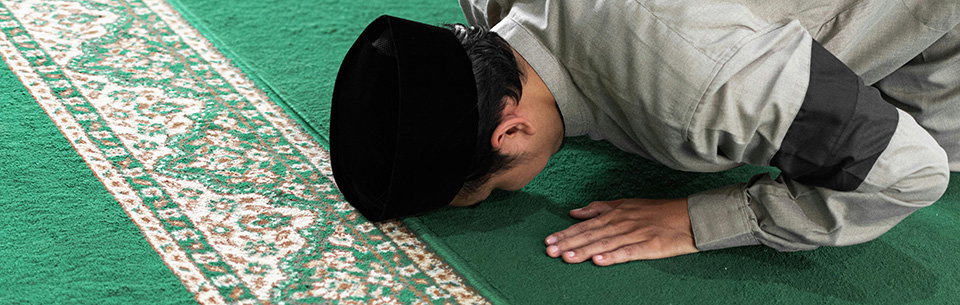
Photo by Masjid Pogung Dalangan on Unsplash
What Every Christian Should Know About Allah, Sin, and Salvation
Part 3 of “What Every Christian Should Know About Islam”
Islam, Judaism, and Christianity are all monotheistic religions, and some think they all worship the same God. However, the god of Islam, Allah, is not the same as the God of Christianity. It is important that we understand what Muslims believe about God so that we can share the gospel with them.
Allah
The foundational creed of Islam is summed up in the words, “There is no god but Allah, and Muhammad is His Messenger.” The first part of this creed makes a theological claim that Allah is the only God. The name Allah is thought to come from al-ilah, meaning “the god” (a title). It is unlike the personal salvific name “Lord/Yahweh” that God gave to Moses so that the children of Israel would know that he had sent him to redeem them out of Egypt (Exodus 3:13–15; Isaiah 43:11; John 8:58). The Islamic doctrine of monotheism (tawhid) comes from Surah 112:1–4:
Say, O Prophet, “He is Allah—One and Indivisible; Allah—the Sustainer needed by all. He has never had offspring, nor was He born. And there is none comparable to Him.”
Portions of this article have been adapted from Simon Turpin, Engaging Islam (Hebron, KY: Answers in Genesis, 2021).
The message of monotheism (unitarian monotheism) is what the Quran states was the message of the prophets: “We never sent a messenger before you O Prophet without revealing to him: ‘There is no god worthy of worship except Me, so worship Me alone’” (Surah 21:25). The Quran’s emphasis on the oneness of Allah is the reason why it has many negative statements against associating others with him (Surah 6:1; 31:13). Since the oneness of Allah is central to Islam, associating others with Allah is the unforgivable sin in Islam. In fact, for a Muslim person to associate others with Allah in their lifetime and not repent is to commit the unforgivable sin of Shirk (Surah 4:48). Shirk refers to the sin of practicing idolatry or polytheism (the worship of anyone or anything other than Allah). In Islam, Shirk is an unforgivable sin if remained unpardoned before death—Allah may forgive any sin if one dies in that state except for committing Shirk.
For Muslims, associating others with Allah is specifically seen in the Christian doctrine of the Trinity. The Quran explicitly rejects the triunity of God (even if it is misunderstood), as the author of the Quran seems to believe the Trinity is God the Father, Jesus, and Mary:
O People of the Book! Do not go to extremes regarding your faith; say nothing about Allah except the truth. The Messiah, Jesus, son of Mary, was no more than a messenger of Allah and the fulfilment of His Word through Mary and a spirit created by a command from Him. So believe in Allah and His messengers and do not say, “Trinity” [three]. Stop!—for your own good. Allah is only One God. Glory be to Him! He is far above having a son! To Him belongs whatever is in the heavens and whatever is on the earth. And Allah is sufficient as a Trustee of Affairs. (Surah 4:171)
The Quran goes on to give a warning to the “people of the book” (Jews and Christians):
Those who say, “Allah is the Messiah, son of Mary,” have certainly fallen into disbelief. The Messiah himself said, “O Children of Israel! Worship Allah—my Lord and your Lord.” Whoever associates others with Allah in worship will surely be forbidden Paradise by Allah. Their home will be the Fire. And the wrongdoers will have no helpers. Those who say, “Allah is one in a Trinity,” have certainly fallen into disbelief. There is only One God. If they do not stop saying this, those who disbelieve among them will be afflicted with a painful punishment. (Surah 5:72–73)
According to Allah, Christians believe in a Trinity made up of Allah, Jesus, and his mother, Mary (see also Surah 5:116). No Christians ever believed or taught this. Because of this, Muslims believe that Christians have gone “to extremes” in their religion by attributing worship to Jesus (cf. John 20:28). However, every single time the Quran says, “Trinity” (or “do not say three”), the next phrase is “there is only one God.” What is the Quran implying by three? Three Gods! It’s accusing Christians of being polytheists (worshipping three gods), but that is not what Christians have ever believed. Since the Quran was written 600 years after the days of Jesus, regardless of whether the Trinity is true or false, did Allah not know what the doctrine of the Trinity was in AD 632? The answer would have to be yes. So if the author of the Quran is Allah, then how did he not know what Christians believed about the doctrine of the Trinity in the seventh century?1
Although it should be obvious from the Islamic rejection of the Trinity, the question is often asked: Do Muslims and Christians worship the same God? Interestingly, the Quran says that we do:
Do not argue with the People of the Book unless gracefully, except with those of them who act wrongfully. And say, “We believe in what has been revealed to us and what was revealed to you. Our God and your God is only One. And to Him we fully submit.” (Surah 29:46)
The Quran says two things here: 1) The Scriptures of the Jews and Christians must be acknowledged and believed by Muslims, and 2) the God of the Jews and Christians is the same God who revealed himself to Muhammad. The dilemma here for Muslims is that if they believe that the God of the Bible and the Quran are the same, then Muslims would have to accept the Trinity (which they reject), but if they deny they are the same, then they have to deny the Quran and believe what Allah revealed to Muhammad was in error. Nevertheless, there should be no confusion about whether Christians and Muslims worship the same God, as the Bible and the Quran teach many differences in their nature and attributes.
| Yahweh (Triune) | Allah (Monad) |
|---|---|
| One being, three persons | Complete oneness |
| Transcendent and immanent | Transcendent |
| Can enter his creation | Cannot enter his creation |
| Reveals himself | Cannot be known |
| Man is made in his image | Man is not made in his image |
The disagreements between Christians and Muslims over the nature of God are not simply misunderstandings but involve irreconcilable conceptions of who God is and how he has chosen to reveal himself.
Even though Muslims believe Allah is unable to come to earth and always stays in heaven, the Quran teaches that Allah’s voice emanated from the burning bush when Moses came to investigate it (Surah 20:10–14; 28:30). The above disagreements between Christians and Muslims over the nature of God are not simply misunderstandings but involve irreconcilable conceptions of who God is and how he has chosen to reveal himself.
Jesus
Muslims are often quick to point out to Christians that they not only believe in Jesus but have great respect for him. Whenever a believing Muslim mentions the name of Jesus, they follow it up by saying “peace be upon him.” Muslims do this because they believe Jesus is one of the greatest prophets of Islam who preached the same message as Noah, Abraham, Moses, and Muhammad (Surah 42:13). The Jesus in the Quran, however, is very different to the Jesus of the Bible. While Muslims accept things like Jesus’ virgin birth and miracles, they reject his divinity, substitutionary atonement, crucifixion, and resurrection from the dead.
The Quran mentions Jesus by name (25 times) more than it does the prophet Muhammad (4 times).2 The name Jesus in the Quran is Isa Al-Masihu (Jesus the Messiah—Surah 3:45; 4:157, 171–172; 5:17, 72, 75; 9:30). This is somewhat strange because the Arabic translation of Yeshua (Jesus’ name in Hebrew) is Yasu (used even today by Arabic-speaking Christians). It is uncertain why the Quran uses the name Isa for Jesus. Nevertheless, because the word Messiah means “anointed one,” the question for Muslims is, what was Jesus anointed for? The Quran does not answer this. In the Bible, Jesus is the spirit-filled Messiah who brings salvation to his people through his atoning death and resurrection from the dead (Isaiah 11:1–3, 53:7–12; Luke 4:14–19).
For Christians, Jesus’ death on the cross and his resurrection from the dead are central to the Christian faith (1 Corinthians 15:3–4, 17). However, the Quran notoriously states that Jesus never died on the cross and therefore was never resurrected from the dead.
And for boasting, “We killed the Messiah, Jesus, son of Mary, the messenger of Allah.” But they neither killed nor crucified him—it was only made to appear so. Even those who argue for this crucifixion are in doubt. They have no knowledge whatsoever—only making assumptions. They certainly did not kill him. Rather, Allah raised him up to Himself. And Allah is Almighty, All-Wise. (Surah 4:157–158)
There are several problems with this text. The reference to “boasting” is speaking of the Jews, but most of the Jewish leaders in the first century did not believe Jesus was the promised Messiah. So they would not be boasting of killing the Messiah. But what does the Quran mean when it says, “But they neither killed nor crucified him—it was only made to appear so.” There are several theories about what happened to Jesus in the Muslim sources, but the main Muslim position today is known as the substitution theory. This is the belief that Jesus was not crucified because Allah took someone else and disguised him to make him look like Jesus, and then this other person was crucified in Jesus’ place.
The most popular view today is that this person was Judas, while Jesus was safely taken to heaven. But this is obviously not the case since the Bible tells us that Judas hung himself after betraying Jesus (Matthew 27:5). The reason for the substitution theory is that Muslims believe that Allah would never allow a special prophet like Jesus to die such a shameful death. If the Muslim view is correct, then from their point of view, Christians did not get their view of the crucifixion from the disciples or the Apostle Paul but from Allah, as he is the one responsible for convincing millions of people over the last 2,000 years to believe that it was Jesus who died on the cross. Given that Jesus’ death is foundational to Christianity, this means without Allah tricking people to believe that Jesus was crucified, there would be no Christianity. This is why a lot of Western Muslim scholars shy away from the substitution theory because if it is true, then it means Allah was the one who started Christianity by mistake. Nevertheless, if it was not for Surah 4:157, then the Quran would naturally speak of Jesus’ death and resurrection (see Surah 3:55; 19:33–34).
What is important to note is that the claim of the Quran goes directly against history when it denies the crucifixion of the Lord Jesus Christ. The Gospels were written at a time when there were still eyewitnesses alive who had seen these things happen and record that Jesus had predicted his own death and resurrection (Mark 8:31, 9:9, 10:32–34). It is not only Christian sources that testify to the crucifixion of Jesus but Jewish (Josephus, Antiquities of the Jews book 18, chapter 3) and Roman historians (Tacitus, Annals, book 15, chapter 44), and even critical scholars today agree that Jesus died on a cross. Atheist professor of the history and literature of early Christianity Gerd Lüdemann admits, “Jesus death as a consequence of crucifixion is indisputable.”3 Surah 4:157 is not a position that can be taken seriously.
The Jesus of the Quran (Isa) is also not the same as the Jesus of the Bible. Much of what the Quran says about Jesus is focused on his early life, specifically his childhood, when he is created by Allah (Surah 3:47). The Quran also states that Jesus was a righteous (sinless) and perfect man (Surah 19:19–20; cf. 1 Peter 2:22). In the Quran, the birth of Jesus is not just miraculous because of his conception but also because of the things that take place after it:
So she conceived him and withdrew with him to a remote place. Then the pains of labour drove her to the trunk of a palm tree. She cried, “Alas! I wish I had died before this, and was a thing long forgotten!” So a voice reassured her from below her, “Do not grieve! Your Lord has provided a stream at your feet. And shake the trunk of this palm tree towards you, it will drop fresh, ripe dates upon you. So eat and drink, and put your heart at ease. But if you see any of the people, say, ‘I have vowed silence to the Most Compassionate, so I am not talking to anyone today.’” (Surah 19:22–26)
In this chapter of the Quran, Jesus, as a baby, speaks and orders the palm tree to feed Mary. To Christians, this account sounds unfamiliar because it is not from the canonical Gospels but from the early seventh-century Gospel of pseudo-Matthew. In fact, in the Quran, Jesus starts his prophetic ministry preaching Islam when he was still a baby from the cradle (Surah 3:46; 5:110; 19:23–33). Not only that, but in those Surahs, the child Jesus creates birds from clay, which does not come from the canonical Gospels but is again borrowed from the second-century gnostic Infancy Gospel of Thomas.
The focus in the Quran on Jesus’ early life is contrary to the canonical Gospels. Although Matthew briefly focuses upon Jesus as a young child (Matthew 2:2–12) and Luke records his birth as a baby (Luke 2:1–21) and contains a section on him as a 12-year-old boy in the temple in Jerusalem (Luke 2:41–52), the focus on Jesus is when he begins his ministry when he was about 30 years old (Luke 3:23). The canonical Gospels also present Jesus as preaching repentance (not Islam) and calling people to deny themselves, take up their cross, and follow him (Luke 5:32, 9:23).
The Quran speaks of Jesus doing miracles such as giving life to clay birds, healing lepers, raising the dead, giving sight to the blind, and possessing supernatural knowledge (Surah 3:49; 5:110). Muslims would argue that Jesus could do this because he had the power of God on him. The Quran also teaches that Jesus had a successful ministry and several people who heard his message became Muslims (3:52; 5:111).
This, of course, raises a historical problem as no one has heard of any first-century Muslim followers of Jesus. Both Christian and non-Christian sources tell us what Jesus’ early followers believed, and none of them tell us that what they believed resembled Islam. In fact, Jesus’ followers not only worshipped him but also proclaimed his death and resurrection, which are both rejected by Islam (Luke 24:52; Acts 2:22–36, 7:59).
A common claim by Muslims today, to show Christians that Jesus was a Muslim, is that they pray like Jesus—quoting the account where Jesus is in the garden of Gethsemane and “he fell on his face and prayed” (Matthew 26:39). However, Jesus began his prayer by saying, “My Father.” No Muslim could ever pray this way as the Quran says Jesus is not the Son of God (Surah 9:30) and Allah is a father to no one (Surah 5:18; 21:26).
There are several other major differences between the Jesus of the Bible and the Jesus of the Quran. The Bible clearly teaches that Jesus is the divine Son of God (Mark 14:62; John 8:58, 10:36, 19:7), but the Quran says that Jesus is only a messenger of Allah (Surah 5:75). The Quran states that Jesus was the last of the prophets sent only to the children of Israel (Surah 3:49–51). Before his death and resurrection, Jesus did say, “I was sent only to the lost sheep of the house of Israel” (Matthew 15:24). However, in the same Gospel, after he had risen from the dead and fulfilled his mission, Jesus told his disciples, “Go therefore and make disciples of all nations” (Matthew 28:19).
Who is Jesus for the Muslim? Jesus is a virgin-born mighty prophet of God who was sent by Allah to preach the message of Islam. The Jesus of the Bible is vastly different. In the New Testament, Jesus is the divine Son of God sent into the world to preach a message of repentance and is the one who came to save sinners from their sins by dying on the cross and rising from the dead, who will return one day to judge the living and the dead (Acts 2:23–28, 3:14–16, 17:31).
Sin and Salvation
The understanding of sin and salvation in Islam is completely opposite to that which is taught in the Bible.
The understanding of sin and salvation in Islam is completely opposite to that which is taught in the Bible. The Bible teaches that because of Adam’s sin, mankind is born spiritually dead in trespasses and sin and is an enemy of God (Romans 5:10–12; Ephesians 2:1–3). According to the Bible, sin is the breaking of God’s holy law (1 John 3:4) and leads to death (Romans 6:23). Biblically, sin is not first and foremost a deed that is committed but is a condition that we have inherited by the fact that we are fallen sinners “in Adam” (Romans 5:12–19; 1 Corinthians 15:22). Therefore, sin cannot be reduced to “weakness” (see below) because the biblical understanding of sin is profoundly deep in its teaching on the condition of humanity (Genesis 8:21; Jeremiah 17:9; Matthew 12:34–35).
In Islam, mankind was created weak (Surah 4:28), and because of their weakness, they are lost and forgetful (Surah 30:30; 20:115). This is why mankind needs the guidance of the Quran: “These are the verses of the Book, rich in wisdom. It is a guide and mercy for the good-doers” (Surah 31:2–3). The Quran’s concept of sin is that of an act that is committed and not of a condition that has been inherited; there is no concept of original sin in Islam (cf. Romans 5:12–19). The Quran teaches that each person will bear his own burdens:
Whoever chooses to be guided, it is only for their own good. And whoever chooses to stray, it is only to their own loss. No soul burdened with sin will bear the burden of another. And We would never punish a people until We have sent a messenger to warn them. (Surah 17:17; cf. 1:164)
The word “burden” refers to the burden of sin (Surah 35:18; 39:7). However, the Quran is at odds with itself as it teaches that false teachers will bear the burdens of those they lead astray (Surah 16:22–25). Muslims generally have a low view of sin and will often explain it away as being ignorant or weak. In Islam, there are minor sins, major sins, and mortal sins (Shirk, see above). Even though there is a distinction between major and minor sins (Surah 53:31–32), the Islamic view is that everybody commits sin. In the Hadith, the prophet Muhammad is reported to have said, “Every son of Adam sins, and the best of the sinners are the repentant” (Jami`at-Tirmidhi 2499).
The goal for Muslims is not to be sinless but to be the best of sinners, and the best of sinners are those who repent. The purpose of repentance in Islam is for Allah to show his mercy and forgiveness. There are three actions that people can do to guarantee Allah’s forgiveness: (1) sincere repentance, (2) seeking forgiveness from Allah, and (3) doing good deeds.4 Even though repentance is necessary in Islam, the concept of an atoning sacrifice is seen as unnecessary:
Neither their meat nor blood reaches Allah. Rather, it is your piety that reaches Him. This is how He has subjected them to you so that you may proclaim the greatness of Allah for what He has guided you to, and give good news to the good-doers. (Surah 22:37)
Blood atonement plays no part in the forgiveness of sins in Islam, which is contrary to the teaching of the Bible (Mark 10:45; Luke 22:20–21; Hebrews 9:22). The way to show that you have been forgiven by Allah is to make up for sin by doing good deeds:
As for those who repent, believe, and do good deeds, they are the ones whose evil deeds Allah will change into good deeds. For Allah is All-Forgiving, Most Merciful. (Surah 25:70)
The good deeds that help accomplish repentance for sin are things like charity, the hajj, and fasting. In fact, the month of Ramadan is a time when Muslims can attain forgiveness through doing deeds. Despite all the good deeds a Muslim may do, the Quran teaches that Allah does not forgive those who are insincere in repentance and do so only to avoid hell:
However, repentance is not accepted from those who knowingly persist in sin until they start dying, and then cry, “Now I repent!” nor those who die as disbelievers. For them We have prepared a painful punishment. (Surah 4:18)
Just as the concept of sin is vastly different between Islam and Christianity, so is the understanding of salvation. To become a Muslim, a person simply needs to profess in Arabic and in the presence of other Muslims, the Shahada: “There is no god but Allah, and Muhammad is His Messenger.” The Shahada is basically a person’s profession of faith and how they become a true follower of Allah. According to the Bible, salvation occurs when a person is born again by the Spirit of God and exercises repentance and faith in the Lord Jesus Christ (John 3:3, 16, 14:1, 6; 1 John 5:1; Romans 10:9; Titus 3:4–7).
Since Islam teaches that man is not inherently sinful, mankind does not need a savior to redeem them but only a prophet to guide them. The guidance in the Quran speaks of three things necessary for possible salvation: repentance, faith, and good works (Surah 25:70). Faith in Islam is belief in Allah, angels, messengers (prophets), the books, and destiny, and it must be accompanied by works. The works a Muslim must do can be seen in the five pillars of Islam (see above). In the Hadith, Allah’s justice to sinners is that those who do not repent will pay for their sins in hell, but only temporarily (see Sahih al-Bukhari 22).
The general principle in Islam is that salvation comes from Allah being merciful to you and forgiving you. Mercy and forgiveness are something you are to seek and earn (Surah 5:9). Nevertheless, Allah does not simply forgive since there is a process to accumulate more good deeds than bad deeds (Surah 23:102–103). Good deeds in Islam show your intentions and Allah’s forgiveness. According to the Quran and the Hadith, it seems that there are three different ways to obtain salvation. The first and only direct way into Allah’s presence is martyrdom:
Should you be martyred or die in the cause of Allah, then His forgiveness and mercy are far better than whatever wealth those who stay behind accumulate. Whether you die or are martyred—all of you will be gathered before Allah. (Surah 3:157–158).
The second way is to go from death and then into the presence of Allah:
Hani’ the freed slave of ’Uthman said: When ’Uthman would stop at a grave he would cry until his beard was soaked (in tears). It was said to him: “The Paradise and the Fire were mentioned and you did not cry, yet you cry because of this?” So he said: Indeed the Messenger of Allah said: “Indeed the grave is the first stage among the stages of the Hereafter. So if one is saved from it, then what comes after it is easier than it. And if one is not saved from it, then what comes after it is worse than it.” And the Messenger of Allah said: “I have not seen any sight except that the grave is more horrible than it.” (Jami at-Tirmidhi 2308)
In the grave, different things can happen to help you have Allah’s mercy on judgment day. Someone can do good deeds on your behalf, and these are credited to the person who is dead (see Sahih al-Bukhari vol. 3, book 31, no. 174). Also, under certain conditions, someone else can bear your sins (Surah 16:25). The third way to salvation is that you die and go to hell, and then you go into paradise:
The Prophet (ﷺ) said, “Whoever said “None has the right to be worshipped but Allah and has in his heart good (faith) equal to the weight of a barley grain will be taken out of Hell. And whoever said: “None has the right to be worshipped but Allah and has in his heart good (faith) equal to the weight of a wheat grain will be taken out of Hell. And whoever said, “None has the right to be worshipped but Allah and has in his heart good (faith) equal to the weight of an atom will be taken out of Hell.” (Sahih al-Bukhari 44)
This fiery process of justice is final when a person with an atom’s weight of faith will be taken out of the fire and enters paradise—all others are condemned to eternity in the fire. Therefore, if a Muslim dies in a state of faith, they will eventually be taken out of hell and go to paradise.5
| Three Ways of Salvation in Islam |
|---|
| Martyr → Paradise |
| Grave → [your good works, good works of others, others bearing your sin, intercession] → Paradise |
| Grave → Hell → Paradise |
Muslims may have confidence in the end that they will have salvation, but where they lack confidence is knowing which path they are on. The only real guarantee of salvation in Islam is by being a martyr, but apart from this, there is not much assurance of salvation (Surah 9:111). This is one reason why in Islam, there must be war, terror, and fighting so that there is an opportunity for Muslims to die as a martyr. Ultimately, there is no hope for the Muslim as Allah may weigh a person’s good deeds against their bad deeds and still find them lacking. According to the Quran, even Muhammad was not sure of his own salvation:
Or do they say, “He has fabricated this Quran!”? Say, O Prophet, “If I have done so, then there is nothing whatsoever you can do to save me from Allah. He knows best what slurs you indulge about it. Sufficient is He as a Witness between you and me. And He is the All-Forgiving, Most Merciful.” Say, “I am not the first messenger ever sent, nor do I know what will happen to me or you. I only follow what is revealed to me. And I am only sent with a clear warning.” (Surah 46:8–9)
In the Bible, God deals with the problem of sin through Jesus’ substitutionary death on the cross.
Muslims try to argue that these verses are not talking about salvation, but the Hadith confirms this understanding (see Sahih al-Bukhari vol. 5, book 58, 266). In the Bible, God deals with the problem of sin through Jesus’ substitutionary death on the cross. Salvation comes about by God’s grace through faith alone and Christ alone and has nothing to do with our good works (Ephesians 2:8–10; Titus 3:5).
Footnotes
- See James White, What Every Christian Needs to Know About the Qur’an (Minneapolis, MN: Bethany House Publishers, 2013), 75–101.
- See Surahs 3:144; 33:40; 47:2; 48:29.
- Gerd Lüdemann, The Resurrection of Christ: A Historical Inquiry (Amherst, NY: Prometheus Books, 2004), 41.
- See Shaykh Yasir Qadhi, “The Actions That Guarantee Allah’s Forgiveness,” Prevail Islam, YouTube, April 7, 2025, https://www.youtube.com/watch?v=q5MoOUcsEK8.
- For these three ways of salvation, see Samuel Green, “Salvation in Christianity & Islam. Adnan Rashid & Samuel Green,” YouTube, November 5, 2018, https://www.youtube.com/watch?v=LlSeA7nsuOI.
Support the creation/gospel message by donating or getting involved!

Answers in Genesis is an apologetics ministry, dedicated to helping Christians defend their faith and proclaim the good news of Jesus Christ.
- Customer Service 800.778.3390
- Available Monday–Friday | 9 AM–5 PM ET
- © 2026 Answers in Genesis