

3 Reasons Evolutionists Need Transitional Forms
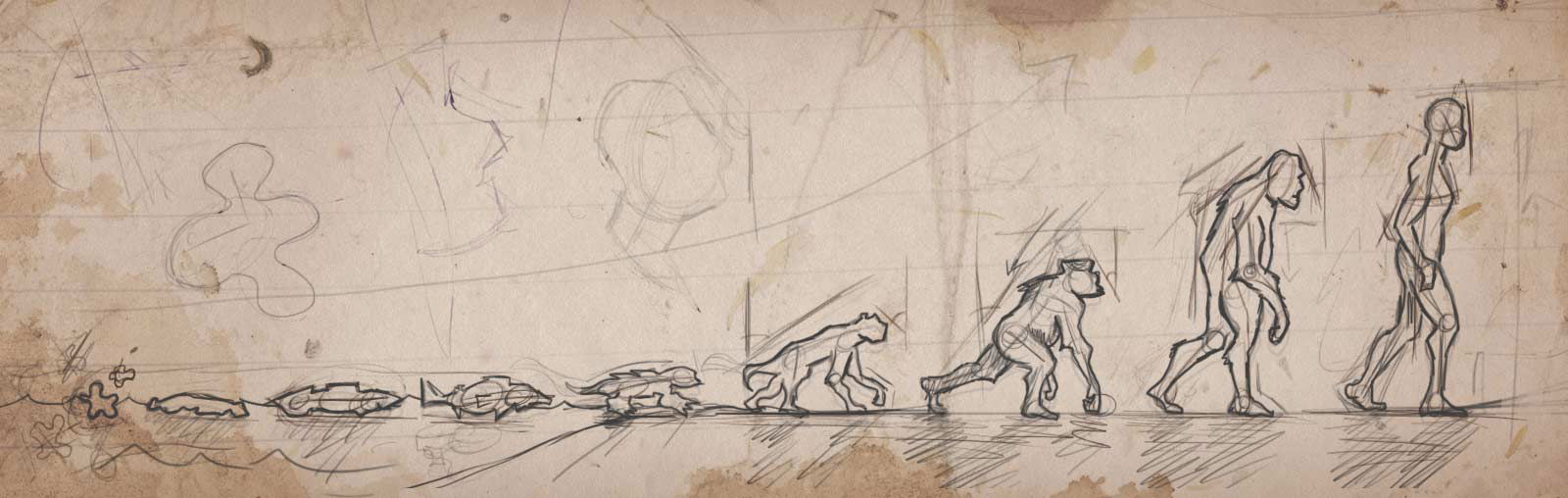
Are you familiar with the saying, “The evidence speaks for itself”? Evidence like fossils and rocks can’t actually speak. Since we were not alive when the world was created, we rely on our worldview to interpret evidence. Evolutionists interpret the world through their belief that the world came about over millions of years. The naturalistic worldview points to supposed transitional forms as evidence supporting their interpretation of the origins of the world.
1. Transitional forms provide supposed evidence of a common ancestor.
The idea of evolution argues that all living things evolved from a common root ancestor and developed over millions of years with different mechanisms to create the variety of organisms we have today. The image of a tree visualizes this common ancestor at the root with all the creatures that have ever lived as the various branches showing their supposed relationship to one another. Charles Darwin argued that we would expect to find transitional forms, for example, an apelike creature evolving into a man. Because of this belief, when creatures exhibit supposed crossover features, such as archaeopteryx being a link between birds and dinosaurs, evolutionists have used them as support for evolution.
2. Transitional forms would “show” the evolutionary process.
If you ask evolutionists to provide an example of a transitional form, they will pull from many examples. In whale evolution, they will point to Aetiocetus (from, they say, around 25 million years ago). This fossil’s nostrils are in the middle of the skull. Evolutionists claim that this is a transitional form possibly between Pakicetus, which had nostrils at the front of its skull, and a modern gray whale, which has nostrils at the back of the skull. According to the naturalistic perspective, these creatures must be related. However, no one observed one creature evolving into another, so again, this is not supporting data but merely interpretation.
3. Transitional forms negate the need for a Creator.
When we look at the fossil record through the lens of Genesis as literal history, we do not find one kind of animal evolving from a common ancestor into a completely different kind of animal. We expect to find animals within a created kind having many varieties through the process of speciation. And that’s what we find.
Answers Magazine
April–June 2025

There’s a whole world of beautiful places to explore. But what does Jesus’ earthly ministry teach us about truly seeing the world?
Browse Issue
Support the creation/gospel message by donating or getting involved!

Answers in Genesis is an apologetics ministry, dedicated to helping Christians defend their faith and proclaim the good news of Jesus Christ.
- Customer Service 800.778.3390
- Available Monday–Friday | 9 AM–5 PM ET
- © 2026 Answers in Genesis