
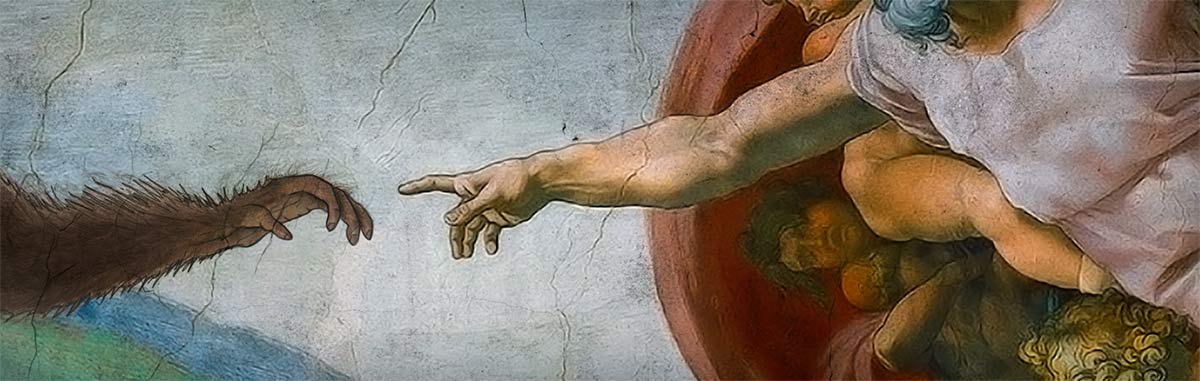
Evolutionary Syncretism: When Evolution Turns Christianity into Something Else
We affirm that evolutionists who trust in Christ are saved despite their error. However, a particular form of evolution can go beyond simply a false belief to becoming a different religion entirely.
Syncretism occurs when elements of two religions or worldviews are blended together, forming a new, modified religious system. For example, in some Latin American cultures, Catholicism has merged with indigenous religions, resulting in a syncretistic faith that contains distinct elements of both traditions. Interestingly, many people who practice a syncretistic religion do not recognize that they are following a modified form of the original religion.
The Bible records that this also happened in ancient Israel. In the Old Testament, the prophets spoke against idolatry, and archaeology reveals that at least some of this idol worship was syncretistic. For instance, Israelites worshipped in high places like the Canaanites, although God wanted them to worship at the tabernacle and, later, the temple (1 Kings 15:9–14, 22:42–43; 2 Kings 12:2–3, 14:4, 15:4, 15:35; 2 Chronicles 33:17). Also, ancient Israel worshipped the false goddess Asherah as the wife of Yahweh.1 The average Israelite may have thought that they were being faithful when they worshipped God along with Asherah, but in reality, their perversion of the religion meant that they were no longer truly worshipping God at all.
But we’re not worshipping idols like the Old Testament believers, and most Western Christians would think we’re not in danger of syncretism. But just like other cultures, Christians today are in danger of syncretizing with the common non-Christian religion of the day—and right now, that’s evolutionary materialism.
The Belief System of Evolution
Most people think about biology when it comes to evolution, but actually, there are several distinct aspects of evolution that make it an overarching attempt to explain all of existence.
Cosmological evolution is the process by which the universe is theorized to have developed from the big bang to its current state. As PBS Faith and Reason states:
Just as Darwin proposed that the evolution of life was a long, slow, and gradual process, so cosmologists now believe that our universe evolves by long slow processes.2
Geological Evolution is the process by which the earth is thought by evolutionists to have developed into its current form over billions of years. They claim that the majority of this development has been uniformitarian in nature, meaning that it was shaped by events that are mostly happening today. However, even uniformitarians acknowledge that catastrophic events can sometimes drastically shape the earth, as in the Mount St. Helens eruption and related geological events.
Chemical Evolution is the process by which evolutionists believe that simple, inorganic molecules became the complex molecules necessary for life to arise. This, they say, culminated in abiogenesis, the first living thing from nonliving chemicals.
Biological Evolution is the process by which evolutionists say life diversified from the first living thing to the variety of creatures we see today. Evolutionists point to the phenomenon of natural selection as a mechanism for evolution and propose mutations as a source of new information for natural selection to act upon.
It is important to note that every type of evolution relies on processes that we don’t see happening today. Even more than that, what we can observe today is a problem for every type of evolution. What we can observe today in geology fits the catastrophic model better than the uniformitarian model.
When someone has no empirical evidence that something happened but they believe it happened anyway, that qualifies as a faith!
The Evolutionary Worldview as a Non-Christian Belief System
To argue that evolutionary creationism à la BioLogos is a syncretistic religion, we need to establish that evolution is a distinct belief system that is not consistent with Christianity, meaning that when it is added to Christianity in a systematic, consistent way, a new religion results.
Others have shown that evolution fulfills the requirements of a religious worldview, with its own explanation of origins, eschatology, and other foundational elements of religion. These evolutionary explanations are inherently materialistic, meaning they exclude the spiritual realm. In fact, it is easy to find quotations from evolutionists and long-age geologists admitting that the reason behind their theories is to explain the universe without God and the Bible.
Charles Lyell sought to “free the science [of geology] from Moses.”3 Jerry Coyne said, “The fact of evolution is not only inherently atheistic, it is inherently anti-theistic. It goes against the notion that there is a god. . . . There are many religious people who accept evolution. I would say they’re guilty of cognitive dissonance, or at least of some kind of watery deism.”4 Dawkins goes even further. “Although atheism might have been logically tenable before Darwin, Darwin made it possible to be an intellectually fulfilled atheist.”5
Not only were the founders of the theory of evolution motivated by atheism and not only does evolution provide an intellectual scaffolding for atheism, but evolution, properly understood, does away with a need for God to explain the world and actively excludes the divine. As William Provine admitted:
As the creationists claim, belief in modern evolution makes atheists of people. One can have a religious view that is compatible with evolution only if the religious view is indistinguishable from atheism.6
So since evolution is a materialistic worldview, it is fundamentally incompatible with Christianity, which insists that God exists, created the world, and intervenes in miraculous ways.
Theistic Evolution as Syncretism
So does combining the religion of evolution with Christianity create a distinct religion that fundamentally alters it to become a new religion? Well, if the person who is doing so is intellectually consistent, yes. Many Christians simply do not have a coherent worldview and maintain the fundamentally incompatible beliefs alongside each other. This is not good either, but it is not the focus of this article.
Theistic evolutionists who attempt to create a coherent worldview necessarily have to reinterpret parts of the Bible, which results in fundamentally different conclusions. Table 1 lists just some ways that theistic evolution alters critical beliefs about origins.
| The Bible | Evolution | Theistic Evolution |
|---|---|---|
| The universe began when God supernaturally spoke it into being. | The first moment open to scientific inquiry is directly after the big bang, a phenomenon with no scientific explanation. | God caused the big bang. |
| God created the world in six 24-hour days. | The universe has been developing for billions of years, and life has been evolving for over a billion years. | God is behind the naturalistic processes at work in the universe and life. |
| The earth is about 6,000 years old. | The earth is billions of years old. | The earth is billions of years old. |
| God created Adam from dust and Eve from his side as the first humans. | Humanity evolved alongside other hominids and apelike creatures; there was no single “first human.” | Humans developed self-awareness during the evolutionary process, maybe with divine intervention.7 |
| Sin entered creation when Adam ate the forbidden fruit. | There was no single event that made humanity sinful. | Sinfulness may coincide with the evolution of self-awareness. |
| Death and disease are consequences of Adam’s sin. | Death and disease are enshrined in the fossil record millions of years before humans evolved. | Sin introduced spiritual death to humanity; physical death preceded the fall.8 |
Table 1
There is no way to maintain a biblical view of an original very good creation marred by the first human’s sin with an evolutionary worldview.
As you can see, adding evolution to the Bible fundamentally alters what someone must believe about origins. It also fundamentally alters what we must believe about salvation. Although some theistic evolutionists may have different beliefs about these items since they aren’t a monolithic group, there is no way to maintain a biblical view of an original very good creation marred by the first human’s sin with an evolutionary worldview.
Sin and Salvation in an Evolutionary Worldview
Christians believe that Jesus came to save sinners and reconcile us back with God. But without an initial event that introduced sin, the meaning of salvation is fundamentally different.
| The Bible | Evolution | Theistic Evolution |
|---|---|---|
| Jesus is the physical descendant of Adam. | There was no historical Adam. | There may have been no historical Adam. |
| Our sin problem started with Adam; Jesus is “the last Adam.” | There was no historical point at which sin became a problem nor any objective measure for what sin is. | There may have been no original sin.9 |
| Jesus died to redeem humans. He was raised from the dead as a sign that he had defeated death. | Death has existed for as long as life has existed. There’s nothing for humanity to be redeemed from. | The whole creation can be redeemed by Christ, but death is not an enemy.10 |
| Jesus is related to us through Adam and unites humanity with God. | Purely materialistic, so does not address spiritual concerns. | Jesus became incarnate to reconcile the whole creation back to Christ.11 |
Table 2
The Eschatology of Theistic Evolution
The Bible clearly teaches that the originally perfect creation was marred by sin and that Christ’s redemptive work will be completed at his return. There will be a new heavens and earth where resurrected believers will live in perfect relationship with God.
However, theistic evolution, as we saw above, a weak stance on historical Adam, original sin, and death doesn’t affect creation in any substantial way. Rather, if there will be a new heavens and earth without sin and death in a theistic evolutionary scenario, it’ll be at the end of a process that involved a lot of death and suffering that was supposedly “very good.”
This isn’t a small difference. Scripture tells us, “The last enemy to be destroyed is death” (1 Corinthians 15:26). But in theistic evolution, death is not only not an enemy—it is one of the primary tools to develop the world. These are two incompatible views.
The Ultimate Authority of Theistic Evolutionists
The biggest problem with theistic evolution, whether it results in syncretism or not, is that ultimately, the current secular scientific consensus is the authority for interpreting Scripture’s statements about creation. For instance, when BioLogos—one of the foremost theistic evolutionary organizations—speaks about biblical authority, it might seem like a strong statement:
The Bible is inspired by God, a true revelation of God to humankind, and authoritative for Christian faith and practice.12
This statement, however, does not touch on whether the Bible’s history is true or not—and one doesn’t have to read very far to find out that they do not believe the Bible’s history, especially regarding Genesis 1–11.
The problem is that if a theistic evolutionist wants to remain Christian at all, they will have to draw an arbitrary line to separate what they believe about science and what they believe about Scripture. BioLogos’ statement of faith affirms the bodily resurrection of Christ, yet the same science that insists that the earth is billions of years old also insists that dead men don’t rise after three days.
Ultimately, the theistic evolutionist himself becomes the authority because he deigns to judge which matters science is correct about and which things Scripture communicates accurately.
This is just the same temptation of Genesis 3 repackaged for an “intellectual” age. The serpent caused Eve to question God’s Word by appealing to her senses and reason and her desire to be wise.
The Jesus of Evolutionary Syncretists
Christians, by definition, claim to follow Christ. But evolutionists believe he was wrong about creation. Theistic evolutionists try to explain this by claiming that the incarnation limited Christ, meaning that he could err sometimes. They then leap from this conclusion to denying inerrancy entirely. Kenton Sparks said, “If Jesus as a finite human being erred from time to time, there is no reason at all to suppose that Moses, Paul, John wrote Scripture without error. Rather, we are wise to assume that the biblical authors expressed themselves as human beings writing from the perspectives of their own finite, broken horizons.”13
However, if Jesus was wrong about, say, the global flood of Noah’s day or the existence of a historical Adam and Eve (see Matthew 24:37–39, 19:4–5), why should we assume he is correct when he tells us that “no one comes to the Father except through me” (John 14:6). Just where are the boundaries of this fallibility? And conveniently, it is the theistic evolutionist who is the judge of where the Lord erred.
Because God claims to have acted in history, we can’t separate “theological knowledge” and “scientific knowledge” into neat little boxes. Jesus being wrong about something we could verify would be a huge problem for our faith. Jesus believed that there was a global flood and that Adam and Eve had the first marriage. If he could be so wrong, according to theistic evolutionists, why would we believe him when he claimed he is the only way to be saved? Maybe he didn’t know anything about Buddhism!
Biblical creationists have an easy answer—Jesus was not wrong and his beliefs about origins are in line with reality, including Adam and Eve, original sin, the global flood, and the rest of the biblical record.
The “Blessed Inconsistency” of Non-Syncretistic Theistic Evolutionists
A consistent theistic evolutionist who tries to blend the Bible and evolution will become a syncretist, but many theistic evolutionists avoid this with a fundamental inconsistency in how they interpret the Bible. They simply have a fundamentally different way of reading Genesis 1–11, but they read the rest of the Bible as if they had a biblical view of creation.
Many respected evangelical scholars, pastors, and influencers have this sort of inconsistency. Their exegesis of the Gospels is largely sound, but they have a fundamentally different way of reading Genesis 1–11 that is thoroughly shaped by what they believe “science” proves.
It is important to note that most scholars with this sort of view of Genesis have good intentions. They want to show that someone can believe in Jesus without all the “un-scientific” things that they believe will be a stumbling block to unbelievers. But in reality, compromise does not bring anyone to Christ, and it can be discouraging to Christians who notice this inconsistency.
Can’t We Just “Unhitch” from the Old Testament?
Some people say that origins aren’t a big deal for Christians because we follow the New Testament, and the Old Testament is obsolete. Andy Stanley famously suggested that Christians can “unhitch” from the Old Testament.14 However, even a cursory reading of the New Testament shows this wasn’t the view of Jesus and the (human) authors of the New Testament. They grounded important doctrines like marriage, the resurrection, and the return of Christ in Genesis 1–11.
The New Testament deepens our doctrine of creation by revealing the trinitarian nature of God’s creative work and revealing how Christ’s sacrifice redeems us and how God’s plan of redemption is consummated in the new heavens and earth, which is a complete defeat of Satan and reversal of the curse of death. So rather than unhitching, the New Testament uses the Old Testament as a foundation on which to build our Christology.
Syncretism with Evolution Is Futile and Unnecessary
A coherent worldview that seeks to blend Christianity and evolution will be a different religion altogether, at least in some cases, leading to an entirely different Jesus and false gospel. This resultant hybrid will satisfy neither serious Christians nor atheistic evolutionists. As theologian Wayne Grudem states:
In Genesis 1–3, Scripture teaches essential truths about the activity of God in creation, the origin of the universe, the creation of plants and animals on the earth, the origin and unity of the human race, the creation of manhood and womanhood, the origin of marriage, the origin of human sin and human death, and man’s need for redemption from sin. Without the foundation laid down in those three chapters, the rest of the Bible would make no sense, and many of those doctrines would be undermined or lost. It is no exaggeration to say that those three chapters are essential to the rest of the Bible.15
We should rather keep a consistent hermeneutic, which demands that we take Genesis 1–11 as straightforward history.
It is impossible to change one’s interpretation of Genesis 1–11 and not impact the rest of the Bible, while maintaining a coherent worldview. We should rather keep a consistent hermeneutic, which demands that we take Genesis 1–11 as straightforward history.


Footnotes
- William Dever, “Asherah, Consort of Yahweh? New Evidence frum Kuntillet ‘Arjûd,” Bulletin of the American Schools of Oriental Research no. 255 (Summer 1984): 21–37.
- PBS Faith & Reason, “Cosmology,” accessed March 2026, https://www.pbs.org/faithandreason/intro/cosmo-body.html.
- Charles Lyell, quoted in Katherine Lyell, Life, Letters and Journals of Sir Charles Lyell, Bart., vol. 1 (London: John Murray, 1881), 268.
- Jerry Coyne, “Evolution and Atheism: Best Friends Forever, Jerry Coyne,” Freedom from Religion Foundation, accessed March 2026, https://ffrf.org/fttoday/january-february-2017/articles-january-february-2017/evolution-and-atheism-best-friends-forever-jerry-coyne/.
- Richard Dawkins, The Blind Watchmaker: Why the Evidence of Evolution Reveals a Universe Without Design (New York: W. W. Norton, 1996), 6.
- William Provine, “No Free Will,” Isis 90(1999): S117–32, S123.
- Jim Stump with Loren Haarsma, “Four Approaches to Original Sin,” Language of God, BioLogos, May 5, 2022, https://biologos.org/podcast-episodes/loren-haarsma-four-approaches-to-original-sin
- BioLogos, “Did Death Occur Before the Fall?,” accessed March 2026, https://biologos.org/common-questions/did-death-occur-before-the-fall.
- Wayne Grudem, “Can Theistic Evolution and Original Sin Coexist?,” Crossway, April 23, 2022, https://www.crossway.org/articles/can-theistic-evolution-and-original-sin-coexist/.
- Niels Henrik Gregersen, “Deep Incarnation and the Cosmic Story of Christ,” BioLogos, January 9, 2024, https://biologos.org/articles/deep-incarnation-and-the-cosmic-story-of-christ.
- Gregersen, “Deep Incarnation and the Cosmic Story.”
- BioLogos, “What We Believe,” last updated June 25, 2024, https://biologos.org/about-us/what-we-believe.
- Kenton Sparks, “After Inerrancy: Evangelicals and the Bible in a Postmodern Age,” The BioLogos Foundation, 7, accessed March 2026, https://web.archive.org/web/20100620103938/https:/biologos.org/uploads/static-content/sparks_scholarly_essay.pdf.
- Ken Ham, “Andy Stanley Says We Need to ‘Unhitch’ the Old Testament from Our Faith,” Answers in Genesis, May 17, 2018, https://answersingenesis.org/christianity/andy-stanley-says-we-need-to-unhitch-the-old-testament-from-our-faith/.
- J. P. Moreland et al., eds., Theistic Evolution : A Scientific, Philosophical, and Theological Critique (Wheaton, IL: Crossway, 2022), 61–62.

Support the creation/gospel message by donating or getting involved!

Answers in Genesis is an apologetics ministry, dedicated to helping Christians defend their faith and proclaim the good news of Jesus Christ.
- Customer Service 800.778.3390
- Available Monday–Friday | 9 AM–5 PM ET
- © 2026 Answers in Genesis