

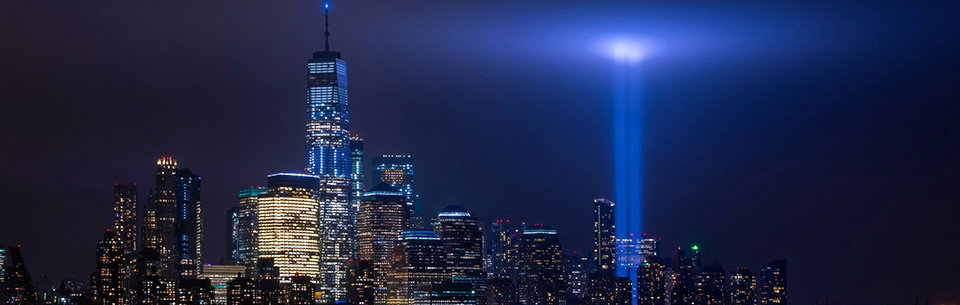
Photo by Jesse Mills on Unsplash
25-Year Anniversary of 9/11: Do You Remember Where You Were on That Day?
There are some moments in history when people are keenly aware that what they have just witnessed or watched on TV is very significant. Your memory becomes bonded with that experience, whether positive or negative. These events include major battles from WWII (Pearl Harbor, D-Day), battles in Korea or Vietnam, and tragic or triumphant cultural events, like the assassination of President Kennedy (November 23, 1963), the Apollo 11 moon landing (July 20, 1969), the Iran hostage crisis (November 4, 1979–January 20, 1981), and the fall of the Berlin Wall (November 9, 1989). We could list numerous others.
I consider myself fortunate to have seen many of these events. In addition to the last two above, I could add the first Super Bowl (really the AFL–NFL championship game) between Green Bay and Kansas City in 1967, the opening of Walt Disney World near Orlando on October 1, 1971, and the first broadcast day of MTV (August 1, 1981). But with the good also comes the sad, including the space shuttle Challenger disaster (January 28, 1986) and Columbia disaster (February 1, 2003).
And the one that really sticks with me (and millions of other Americans) is the terrorist attacks on the Twin Towers and the Pentagon and also the crashing of a hijacked plane near Shanksville, Pennsylvania, on September 11, 2001. According to one government site:
At 8:46 a.m. on September 11, 2001, out of a clear blue sky American Flight 11 crashed into the North Tower of the World Trade Center in New York City. Seventeen minutes later, United Flight 175 struck the South Tower. Over the next 90 minutes, American Flight 77 hit the Pentagon in Washington, DC; United Flight 93 crash landed in a field near Shanksville, PA; and both Twin Towers collapsed. As the deadliest terrorist attack in U.S. history unfolded over 102 harrowing minutes, most Americans were helpless to do more than bear witness to the previously unfathomable act of terror.1
Nineteen members of the terrorist group al-Qaeda hijacked four commercial airplanes and committed the atrocities described above. On top of that, the US (and most of the world) saw many more disturbing images that day, especially as the World Trade Center burned and collapsed.
911 Was Instantly Seared into the Memory of Americans
At the time of those terrorist attacks, I had been working at BGSU (a college in NW Ohio) for less than six months, and all work just about immediately stopped. We watched news broadcasts the rest of the day. Many cried openly, many seethed with rage, and many questioned why our airport security screening process was so woefully inadequate. I realize that in today’s world of the Transportation Security Administration (TSA) bureaucracy, that may be hard to envision, but to put things into perspective, in 2001, the hijackers carried knives and box cutters onto their planes. Now TSA uses metal detectors and X-rays to check your shampoo, soap, deodorant, and any other liquids. For those who were too young to remember, or somehow missed the media blitz that accompanied this tragedy, I would recommend the 9/11 Memorial site, which has a timeline, including pictures, videos, and interviews with survivors.
Since I was working in a USPS contract station (meaning we had special access to the city USPS office for pickup and delivery of university mail), we had frequent meetings with the Postal Service over the next two to three years about things like anthrax, explosives, and corrosive chemicals. Nothing seemed to be untouched by the events of that day, from what could be taken aboard a plane, to what could be mailed vs. sent by a parcel carrier, and numerous other daily tasks and routines, like the restriction of terminals for passengers only and not families and friends (who used to be allowed).
What I remember most about that day was, of course, the Twin Towers collapsing and the massive loss of lives, as well as the amount of dust that obscured and covered much of the area. But by far the most disturbing images of 9/11 occurred when many people chose to jump from the towers rather than face death by fire, intense heat (estimated by some to be over 1,000°F), or asphyxiation.
How many jumped? That depends on whom you ask, and who’s doing the asking, and why you want to know.
While researching an article about the identity of one particular jumper, investigative journalist Tom Junod of Esquire magazine discovered wildly varying estimates. The New York Times conservatively estimated that 50 people had jumped to their deaths. USA Today used video sources, eyewitness accounts, and forensic evidence to estimate at least 200, with perhaps as many as one out of six deaths from the North Tower—the first hit and the last to collapse—resulting from the death plunge. “And yet,” wrote Junod in 2003, “if one calls the New York Medical Examiner’s Office to learn its own estimate of how many people might have jumped, one does not get an answer but an admonition: ‘We don’t like to say they jumped. They didn’t jump. Nobody jumped. They were forced out, or blown out.’”2
Death and Suffering
As Ken Ham wrote on the 11-year anniversary of 9/11,
In a modern context, we could take this passage [Luke 13:1–5] and apply it this way: Those people at the World Trade Center, the Pentagon, and Pennsylvania who were killed by the terrorists—were they worse sinners than others? The answer would be, “No, not at all. But you need to repent!”
Digging deeper, we need to understand that every person is a sinner.
For all have sinned and fall short of the glory of God. (Romans 3:23)
Ken has also said that
It’s not God’s fault there is terrorism and death—the groaning world is our fault; we sinned against a holy God and now it’s a fallen world. However, because of His infinite love for humans, God, in the person of His Son Jesus, stepped into history to save us from this fallen world caused by our sin.
People will not understand a loving God and all the death and suffering in the world until they acknowledge God’s holiness and our sin in Adam that resulted in death (Romans 5:12). Christians need to be salt and light to those who are in darkness (Matthew 5:13–16).3
As tragic as that day was, it seemed to be a catalyst to get people thinking about their own mortality (Ecclesiastes 7:2). AiG sent some relief and counselors to the area within a month, along with supplying free booklets to pastors and chaplains.4 Of course, this unique tragedy generated the question, “If God is all-loving, good, and all-powerful, how could He allow such suffering?” and the follow-up, “Why didn’t God stop this from happening?” It is darkly ironic that people who want nothing to do with God, deny His existence, or actively claim that they are the “captain of their own destiny” will complain when God doesn’t get directly involved in human events. Of course, we recognize that many providential miracles did take place that day, with many surviving even from within the WTC Twin Towers.
American Atheists Didn’t Wait Long to Protest
Just two days after the 9/11 terrorist attacks on the World Trade Center in New York City, a worker at the rubble of Ground Zero discovered a two-ton, 17-foot-high cross that emerged during the debris clearing. The steel cross became a symbol of hope amid the devastation. But the group American Atheists filed a lawsuit in 2011 to exclude the cross from the planned (and now completed) museum section of the 9/11 memorial. Edwin F. Kagin, the atheist group’s national legal director (at that time), said that “the remedy is whatever it takes not to get the government to endorse a religion on private property. . . . Let them all in, or keep them all out.”5
Rep. Michael Grimm (Manhattan) made a comment about the American Atheists lawsuit: “I find it reprehensible that this group would disgrace the beliefs of millions of people in an effort to garner a little media attention for their cause. By establishing the 9/11 Memorial Cross as a national monument, we ensure this symbol of freedom continues to stand for all those we lost and those whose faith remains to this day.”6
God Was Working in This Tragedy
When you read the biblical book of Esther, you can see God’s providence at work, even though He is never mentioned at all. God can be seen in His overruling in the affairs of men, even the Persian king (either Xerxes or Artaxerxes) and several circumstances that appear to have been divinely orchestrated. The best example is the king being unable to sleep, so he listened to the reading in the Persian chronicles that Mordecai had saved him from an assassination attempt, and the fact that Haman was the only one at the court when the king decided to honor Mordecai (Esther 6).
But what does that have to do with 9/11 you may ask (and I’m glad you did). God influenced and utilized many people on 9/11 during the darkest times of this tragedy because, like Esther, they were placed in a position for “such a time as this” (Esther 4:14). Firefighter John Picarello recounted actively reciting or singing the words of Psalm 23 to find a sense of calm and bolster his faith while trapped during the collapse of the Twin Towers. And as one writer said, “Todd Beamer was an evangelical Christian and one of the heroes of Flight 93 on September 11” (famously giving the “let’s roll” injunction to his fellow passengers).7 He was on the phone with a telephone operator during the hijacking, and when it was decided that they needed to wrest control of the plane back, he first recited the Lord’s Prayer, then he (and others with him) started reciting Psalm 23.8 Although everyone on board the plane died in the crash, Todd and other passengers denied the terrorists the chance to strike a target, which would have caused more collateral damage to civilians.
God raised up many heroes that day, some of whom died (like many of the first responders at the WTC, when the buildings collapsed). But their actions saved numerous lives. Other firefighters and first responders survived and aided the wounded and got them to safety. Others, many of them civilians, donated blood, brought food and water to shelters, and helped in any way they could. Even President George W. Bush in his national address that night said: “I pray they will be comforted by a power greater than any of us, spoken through the ages in Psalm 23: ‘Even though I walk through the valley of the shadow of death, I fear no evil, for You are with me.’”9
God was not absent during 9/11, but He raised up people to help others, and He put certain passages in people’s minds. Just before American Flight 77 hit the Pentagon, a civilian asked Lt. Col. Mark Onsei what his favorite Psalm was. He said “Psalm 91” and read it with the civilian. Apparently, the conversation was overheard, and several other servicemen also read Psalm 91. It was a passage he believes “stayed with him throughout the chaos that followed.”10
Compromised Clergy Failure
There were other lessons for Christians that came out of the tragedy of 9/11. The more-liberal Christian leaders on TV and other media outlets got flustered when they tried to give answers as to why horrible events happen in this world. They did not stand strong on the authority of Scripture or, in particular, the book of Genesis, which provides the answer to why bad things happen.
Many Christian leaders at that time (and sadly, even today) did not fully understand Genesis 3 and the Fall, and they did not connect it to real events in the real world. By and large, they simply didn’t have answers to the “why?” questions. It appears that very few Christians can answer the question of death and suffering. For those on the outside of Christianity looking in, it makes it appear that Christians cannot explain a good God with a broken world of death and suffering.
Answers in Genesis’ Response to Death and Suffering
We have answers for why there is death and suffering, while also affirming the goodness of God.
Unlike those who deny the book of Genesis as authentic and authoritative history, we have answers for why there is death and suffering, while also affirming the goodness of God. God created a perfect world and a perfect human pair who subsequently rebelled against God’s lone command (Genesis 3:6–7). Their disobedience brought pain, suffering, and death to this world. We now live in a broken and fallen world.
For those who wish to see more about what AiG says about death and suffering in the world, I want to share with you a PDF of the booklet that Ken coauthored right after the tragedy of 9/11 (also available in print from our online store). This resource clearly lays the blame of sin, death, suffering, and pain on the shoulders of Adam, who brought sin and death into the world (Genesis 3:17–19; Romans 5:12–19; 1 Corinthians 15:22). But as descendants of Adam, we also carry a sin nature within us and sin willingly, which is an affront to God, but He offers forgiveness through faith in His Son, Jesus Christ (Ephesians 1:7–9; Colossians 1:13–14, 2:13–14; 1 John 1:9, 2:12), and life eternal with Him in a new heavens and earth where there will be no more sin, death, or suffering (Revelation 21).

Footnotes
- National Archives, “Remembering 9/11,” accessed September 2026, https://visit.archives.gov/whats-on/explore-exhibits/remembering-911.
- Graley Herren, “Flying Man and Falling Man: Remembering and Forgetting 9/11,” Faculty Scholarship 3 (2014): 159–176, https://www.exhibit.xavier.edu/cgi/viewcontent.cgi?article=1002&context=english_faculty.
- Ken Ham, “We Live in a Sad Fallen World,” Answers in Genesis, June 13, 2016, https://answersingenesis.org/blogs/ken-ham/2016/06/13/we-live-in-a-sad-fallen-world/.
- Ken Ham, “AiG’s ‘Relief Effort’ to New York City!,” Answers in Genesis, October 29, 2001, https://answersingenesis.org/ministry-news/ministry/aigs-relief-effort-to-new-york-city/.
- John M. Annese, “Staten Island Rep. Michael Grimm Fights for 9/11 Cross,” SILive, September 6, 2011, https://www.silive.com/september-11/2011/09/staten_island_rep_michael_grim.html.
- Annese, “Staten Island.”
- Denny Burk, “Lisa Beamer’s Account of Todd Beamer on Flight 93,” September 11, 2021, https://www.dennyburk.com/transcript-of-todd-beamer-on-flight-93/.
- Burk, “Lisa Beamer’s Account.”
- The White House, “Statement by the President in His Address to the Nation,” September 11, 2001, https://georgewbush-whitehouse.archives.gov/news/releases/2001/09/20010911-16.html.
- Dylan Henson and Isabel Martin, “Survivor Says Bible Found Unscathed at the Pentagon After 9/11 Attack,” 7News WSPA, updated July 2, 2026, https://www.wspa.com/news/psalm-91-pentagon-attack/.



Support the creation/gospel message by donating or getting involved!

Answers in Genesis is an apologetics ministry, dedicated to helping Christians defend their faith and proclaim the good news of Jesus Christ.
- Customer Service 800.778.3390
- Available Monday–Friday | 9 AM–5 PM ET
- © 2026 Answers in Genesis