

Have Scientists Built a Cell from Scratch?
According to recent news headlines, the curiously named SpudCell can feed, grow, reproduce, and undergo selection. These are important hallmarks of life, but was it really built from scratch, and can it help us understand the origin of life?
Not the First Synthetic Cell
This isn’t the first time headlines have announced the supposed creation of synthetic life. In 2010, the late Craig Venter (who helped sequence the human genome) was credited with creating the first synthetic cell. He synthesized a copy of a known bacterial genome, made a few tweaks, and inserted it into a closely related bacterium that had its own genome removed. The inserted DNA effectively “took over,” creating what was called the first synthetic cell.1 But this isn’t the creation of life in the lab. The late creation scientist, Dr. David Menton, said it was a form of “genetic plagiarism” and that “they have taken God’s created handiwork and refashioned it.”2 Even Venter acknowledged that he had not created life from scratch.3
What Is SpudCell and Just How Lifelike Is It?
A CNN article said that SpudCell can “feed, grow and replicate like a natural cell.”4
No, not even close.
Its genome is a mere 90,000 base pairs.5 Compare that to Mycoplasma genitalium, which has the smallest genome of a free-living bacteria, at 580,000 base pairs. SpudCell is missing a LOT of genetic information needed for it to grow and reproduce on its own. Additional needed materials are supplied by “feeder liposomes” (think cargo packages). They fuse with SpudCell supplying it with ribosomes (needed to produce proteins), lipids (needed for cell membrane formation), enzymes, etc.6 Without this external feeding, SpudCells would die.
It also doesn’t divide like natural cells. Cell division in natural cells is orchestrated by a dynamic complex of proteins that compose the cytoskeleton. SpudCell doesn’t make or get fed those proteins. Instead, proteins crowd “together on the membrane surface until the mechanical stress makes the membrane split.”7 It can only replicate for about 5–10 generations before it dies.8 Most natural cells (except stem cells) divide ~50 times before death.
Katarzyna Adamala at the University of Minnesota whose lab created SpudCell said it’s “an incredibly wimpy organism that right now basically does nothing other than to eat and occasionally make a daughter cell.”9 Maybe a more appropriate term would be DudCell!
What Could SpudCells Be Useful For?
This is not an example of “evolution in action” as the cells aren’t gaining any information needed for new structures or functions.
SpudCells could be used to study how cells respond to mutations and change over time. Researchers introduced a mutation in the DNA of SpudCells that caused the cells to make more of the protein needed for fusion to the feeder liposomes. Those cells grew faster and produced more offspring. When they starved the cells of nutrients, the advantages to those cells with the mutation increased.10 This is a form of selection such that those cells with the mutation were more fit and outgrew those cells that did not have the mutation. However, this is not an example of “evolution in action” as the cells aren’t gaining any information needed for new structures or functions. The scientists are just modifying currently existing information and observing the outcomes.
There is also the possibility of bioengineering the cells. “Scientists argue synthetic cells are the next frontier; they could potentially lead to the development of new cancer treatments and novel ways to capture carbon or manufacture chemicals.”11 Synthetic cells are preferred since everything is defined and controlled.
Do SpudCells Help Us Understand the Origin of Life?
One scientist (not directly involved with the research) stated, “Making a synthetic cell helps us understand the exact minimum requirements for life and how life might have emerged from chemistry—that’s a cool thing to try to understand.”12 He is referring to the process of abiogenesis in which life emerged from nonlife (Darwin’s “warm little pond”) on early earth.
But does SpudCell meet the “minimum requirements for life”? Maybe minimum requirements for life in a lab where environmental conditions can be controlled and the cells can be fed. However, the lab environment is very different from the real-world where environments and nutrient availability change on a regular basis. This is especially true of the conditions evolutionists propose were on earth billions of years ago, which were much more extreme than today.
Life only comes from life, and the complexity of life demands the design of the intelligent Creator God of the Bible!
The reality is that even so-called simple bacteria are very complex. A detailed study of the bacteria Mycoplasma pneumoniae (genome size—816,000 base pairs) resulted in “surprising complexity” with a “lot going on” that scientists don’t understand.13 Animal and plant cells are much, much more complex with genome sizes in the billions of base pairs. SpudCell is a far cry from a free-living cell that could survive outside the lab, and considering the intelligence of the scientists involved in creating it, it doesn’t show how life could randomly come into existence from nonliving chemicals. Life only comes from life, and the complexity of life demands the design of the intelligent Creator God of the Bible!
What Can We Learn from the Media Frenzy over SpudCell?
The media always likes a good story because that’s what sells. However, it’s important to look beyond the headlines and know what the authors themselves say about their research. Most research papers are broken down into parts: abstract (summary of the article), introduction, methods, results, and discussion. You don’t need to read the whole paper (unless you’re a science nerd like me!), but I would recommend reading the abstract, introduction, and the last few paragraphs of the discussion to get a good overview. Sometimes technical journals will even provide a layman summary of research papers.
For example, the authors of the SpudCell paper made no claim that their work will lead to understanding how life emerged from chemicals on earth billions of years ago. They focused more on the practical applications of the research. It was other scientists imposing origin of life ideas on the research that appeared in the news media articles.
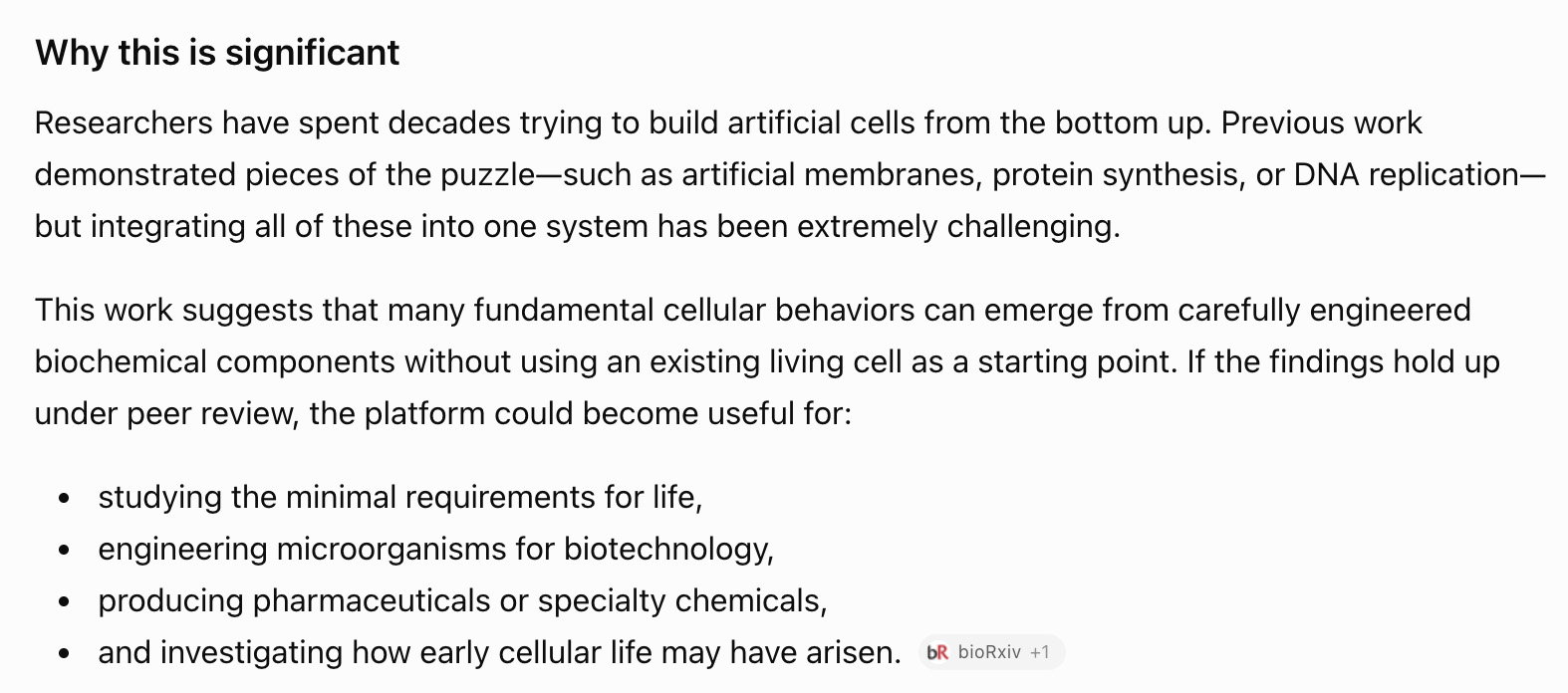
Also, don’t depend solely on AI summaries. AI can be a useful tool to summarize research papers that may be out of your depth of understanding, but AI has a worldview, and it’s not biblical. For example, I asked ChatGPT to summarize the SpudCell paper, and in its response, it had a subheading titled, “Why this is significant.” It gave me the following list:
- studying the minimal requirements for life
- engineering microorganisms for biotechnology
- producing pharmaceuticals or specialty chemicals
- and investigating how early cellular life may have arisen.14
The first three are consistent with the research paper, but the last one is an idea being imposed on the paper. ChatGPT listed its sources, and it’s synthesizing multiple articles about the research paper and not summarizing the paper based exclusively on the research paper itself.
I appreciate the time, effort, and skill it took for scientists to make SpudCell, and I believe it can have some useful applications. However, it’s a “wimpy” copy of the amazing design and complexity of living cells and helps us know that only God could have created life, and He did so by His spoken word: “Then God said,” let there be life (Genesis 1)!
Footnotes
- Associated Press, “Scientists Create Synthetic Life in Lab,” Fox News, updated January 8, 2015, https://www.foxnews.com/science/scientists-create-synthetic-life-in-lab.
- Answers in Genesis, “Life Has Not Been Made in a Laboratory,” May 22, 2010, https://answersingenesis.org/origin-of-life/synthetic-life/life-not-made-in-laboratory/.
- CNN Reports, “Scientist: ‘We Didn’t Create Life from Scratch,’” May 21, 2010, https://edition.cnn.com/2010/HEALTH/05/21/venter.qa/index.html.
- Katie Hunt, “Scientists Say They Have Built a Cell from Scratch for the First Time,” CNN Science, July 1, 2026, https://www.cnn.com/2026/07/01/science/synthetic-cell-research.
- Nathaniel J. Gaut et al., “A Chemically Defined Synthetic Cell Capable of Growth and Replication,” bioRxiv, July 2, 2026, https://www.biorxiv.org/content/10.64898/2026.07.01.735724v1.full.
- Gaut et al., “A Chemically Defined Synthetic Cell Capable of Growth and Replication.”
- Nathaniel J. Gaut et al., “A Chemically Defined Synthetic Cell Capable of Growth and Replication,” Biotic, https://biotic.org/research/spudcell/.
- Gaut et al., “A Chemically Defined Synthetic Cell Capable of Growth and Replication.”
- Hunt, “Scientists Say They Have Built.”
- Gaut et al., “A Chemically Defined Synthetic Cell Capable of Growth and Replication.”
- Hunt, “Scientists Say They Have Built.”
- Hunt, “Scientists Say They Have Built.”
- Brandon Keim, “There’s No Such Thing as a ‘Simple’ Organism,” Wired, November 30, 2009, https://www.wired.com/2009/11/basics-of-life/.
- Response to “Summarize this paper https://www.biorxiv.org/content/10.64898/2026.07.01.735724v1.full,” ChatGPT, OpenAI, July 6, 2026.
Support the creation/gospel message by donating or getting involved!

Answers in Genesis is an apologetics ministry, dedicated to helping Christians defend their faith and proclaim the good news of Jesus Christ.
- Customer Service 800.778.3390
- Available Monday–Friday | 9 AM–5 PM ET
- © 2026 Answers in Genesis