

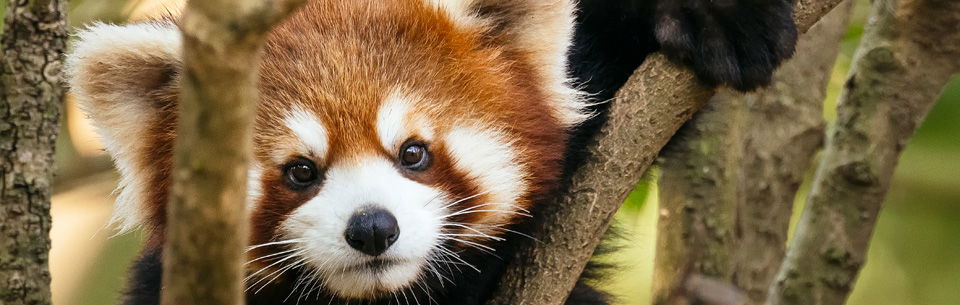
Red Panda or Red Imposter?
Two hundred years ago, French zoologist and paleontologist Frederic Cuvier was the first European to discover the red panda in the Himalayan mountains. Charmed by the creature’s face markings and bushy tail, he described the red panda as the most beautiful animal he had ever seen. Today, many zoo guests around the world agree.
God designed red pandas with lots of interesting features to help them thrive in a fallen world. You know they’re adorable, but how well do you really know red pandas?
Check your red panda prowess with these questions.
1. Red pandas are closely related to giant pandas.
b) False. Despite sharing a name, red pandas are not closely related to giant pandas. Red pandas were originally thought to be part of the raccoon family, but they are the only living members of their kind, represented by the taxonomic family Ailuridae.
2. There is more than one subspecies of red panda.
a) True. There are two subspecies of red panda, the Himalayan red panda (Ailurus fulgens fulgens) and the Chinese red panda (Ailurus fulgens styani). The Chinese red panda is typically larger and darker in color than the Himalayan red panda.
3. Which is not another name for the red panda?
4. A red panda’s diet consists mainly of _________
a) Bamboo. Over 90% of red pandas’ diet is bamboo. They supplement their diet with things like fruit, insects, eggs, and grasses.
5. Red pandas live in colonies.
b) False. Red pandas live a solitary lifestyle, except during mating season.
6. What are red panda babies called?
7. Before giving birth, a female red panda creates a nest for her babies to be born in.
a) True. A female red panda makes a nest in a tree hollow or rock crevice before giving birth.
8. A litter of red pandas is typically 4–6 cubs.
b) False. Red pandas typically give birth in the summer to 1–4 cubs.
9. Young red pandas typically stay with their mother for how long after birth?
c) About a year. Mothers and cubs typically remain close until the next breeding season.
10. A red panda mother cleans her baby with her tongue and carries her baby in her mouth by its neck.
a) True. Red pandas exhibit many cat-like behaviors, including cleaning themselves with their tongues, carrying their babies in their mouths, and curling up while sleeping.
11. Red pandas have ________ digits on their front paws.
c) Six. Red pandas have six digits on their front paws. The extra digit is called a pseudo-thumb but is really an enlarged wrist bone. The pseudo-thumb is useful for climbing trees and grabbing bamboo stems.
12. A red panda’s long, fluffy tail helps it balance in treetops. What else does it use its tail for?
b) Keeping warm. A red panda’s tail can measure 12–20 inches (about 30–50 cm) long. They sometimes wrap their tails around themselves like a blanket to keep warm.
13. Red pandas make a variety of sounds, including quacks.
a) True. Red pandas make a quack-snorting sound when they feel threatened.
14. When provoked or threatened, red pandas may stand on their hind legs to appear larger.
a) True. In an intense conflict, red pandas might stand on their hind legs and bat each other with their front paws.
15. Red pandas are endangered.
a) True. Red pandas need our stewardship. Protecting their habitats, raising awareness, and enforcing anti-poaching measures are all ways that humans can practice dominion over the earth and protect red pandas from extinction.
Answers Magazine
October–December 2025
When invasive species clash with native ecosystems, biologists face tangled questions about biblical dominion.
Browse Issue
Support the creation/gospel message by donating or getting involved!

Answers in Genesis is an apologetics ministry, dedicated to helping Christians defend their faith and proclaim the good news of Jesus Christ.
- Customer Service 800.778.3390
- Available Monday–Friday | 9 AM–5 PM ET
- © 2026 Answers in Genesis