


Five Things We Learned About DNA in the Last 25 Years
I am a grandpa, so it shouldn’t surprise me that I graduated from college over 25 years ago, but it still seems a bit odd. On this National DNA Day, I thought I would take a look at five things I learned about DNA in college that are absolutely wrong today.
Remaining the Same
The core structure of DNA is a double helix with a polymer pattern of a phosphate and deoxyribose sugar backbone. Bridging the rungs of the ladder structure are pairs of nitrogen bases that complement one another; the guanine and cytosine form three mutual bonds, and the adenine and thymine form two bonds. This sequence of A’s, T’s, G’s, and C’s provide the code that makes DNA the information of all living things created by God. Each of these segments of sugar, phosphate, and nitrogen base is called a nucleotide, forming the nucleotide pairs that make up the DNA sequence.
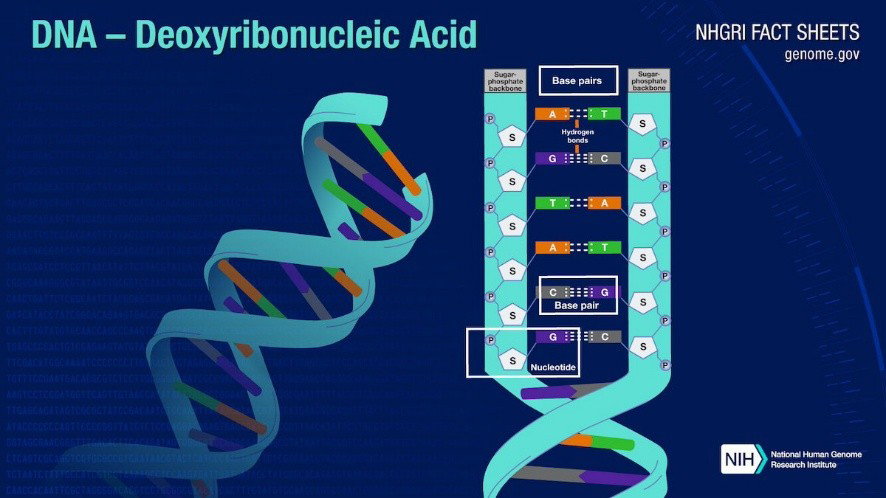
The basic components of DNA
This coded sequence is read in triplets (e.g., GCC, ATC, GAT, etc.), providing the complexity to build the myriad proteins needed by creatures. And that brings us to the “central dogma” of biology, which still stands. DNA is replicated to make more copies of DNA, which is then transcribed into RNA (which undergoes modification in the nucleus to remove intron segments and add caps and tails) and is then translated into a sequence of amino acids (based on that triplet coding), which form the peptides and proteins essential for life.
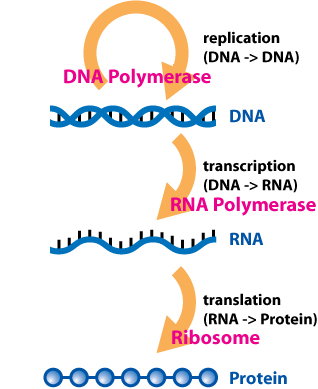
The central dogma of biology
Dhorspool at en.wikipedia, CC BY-SA 3.0, via Wikimedia Commons
The irreducible complexity of this system comes from the fact that the cell needs proteins to duplicate, transcribe, and translate the DNA/RNA sequences. But the DNA has to code for those proteins that promote, unzip, modify, and build the DNA and proteins. One of the most perplexing questions for those who espouse a naturalistic evolutionary view of origins is how to solve this chicken-and-egg puzzle.
What Has Changed
It is not surprising that our understanding of this complex system has changed—that is the very nature of scientific inquiry. What is shocking is how wrong we were about so many key ideas. It seems like almost everything I was taught about DNA was WRONG!
1. The Number of Genes
Complex organisms like humans have a multitude of proteins that come from the DNA sequence. Before the Human Genome Project (HGP), it was expected that we would find at least 50,000 and as many as 140,000 gene coding regions.1 This is reflective of the number of proteins; if there are 100,000 proteins in the human body, we should find 100,000 genes.
After the draft of the HGP and the subsequent revisions, there were far fewer. How far? Only 80% error if we use the median values. The number has stabilized around 20,000, but it is likely to be adjusted down as the expectations are checked against reality.2
How the genome dictates the proteome has become a significant area of research (which we will touch on below). Post-translation modifications (PTMs) where various side chains are added to influence the protein’s function are the new frontier in the relationship between DNA, proteins, and their function.
2. Get That Junk Out of Here
Don’t look in my garage, especially on my father-in-law’s side. There is a lot of accumulated “junk” in there. After decades, boxes of treasured parts from old cars and power tools have gathered in various boxes. Imagine what it will look like after millions of years!
That is what evolutionists used to believe was the origin of a vast majority of DNA. As much as 98% of human DNA was considered junk since it had no apparent function in coding for proteins.3 This “junk” supposedly accumulated as retroviruses embedded their DNA into animals. These endogenous retroviruses (ERVs) stopped functioning as viral elements as mutations accumulated.
From a biblical perspective, we assume that God designed DNA with the correct structure and format to accomplish what he intended.
These evolutionary assumptions actually delayed our understanding since there was no need to study junk that had just muddied our DNA. From a biblical perspective, we assume that God designed DNA with the correct structure and format to accomplish what he intended.
Publication of the ENCODE study in 2007 and 2012 exposed the error—there was very little of the DNA sequence that was “junk.” These regions were responsible for promoting and enhancing the expression of various genes as well as creating the important 3D structure of DNA.4 The code has a code that tells it how to structure itself to transcribe the right DNA at the right time in the right cells. It was much more complicated than the simple three-base reading frame that I was taught to think of.
3. 3D Gene Expression
Far from being a simple string of symbols like morse code, DNA has turned out to have a very complex code structure. When the physical structure and coding framework was first explained in the 1950s through the work or Franklin, Wilkins, Watson, and Crick, the simple elegance of compiling such complexity into a molecule was stunning. It seemed that random, chance events in the evolutionary process could have produced this core molecule of life. But subsequent studies showed codes within the code and layers of 3D interactions.
DNA is typically coiled into tight structures called chromosomes. The DNA is coiled around histone proteins and then coiled again to compress the DNA. In this form, genes are not accessible for transcription, so several proteins act together to modify the histone to release the coil. But now, transcription factor proteins have to attach to the DNA and do so in a promoter region with a very specific order of nucleotides where there are lots of A-T bonds. The transcription factor has 3D geometry that allows regulatory molecules to attach to the activation domain and regulate gene expression.
At varying distances, thousands to millions of nucleotides away, enhancer regions bind to activator proteins, and a different protein folds the DNA strand back on itself to bring these activators near the promoter region. This forms the transcription initiation complex, and the process of making the RNA complement can now begin as RNA polymerase unzips DNA to prepare RNA. The location of the genes on the chromosome and the coiled-coil structure act to cross-regulate the expression of various genes. Expression of the genes that produce activator proteins—some of which are hormones like testosterone that produce certain cellular and metabolic changes during puberty—is controlled by feedback loops that inhibit or enhance gene expression.
The layers of complex 3D interaction of the multitude of proteins, sequence of the DNA, and structure of the chromosomes are almost dizzying. Careful analysis through the 3C (Chromosome Conformation Capture), Hi-C, ChI-A PET, and other analytic tools allowed scientists to describe these long-range 3D interactions.5 (The 80s kid in me is a little giddy about the clever names scientists use for their methods.) It stretches credulity to suggest this all happened by accidental laws of nature that came about simply because the big bang happened.
4. Lamarck Revived
Basic biology textbooks pit Lamarck against Darwin in the early discussions of evolutionary change. Lamarck proposed that acquired traits were inherited by offspring to cause change in creatures over time. The classic example is a giraffe ancestor stretching its neck to reach leaves, lengthening its neck, and passing that on to future generations. Eventually, long-necked giraffes became the norm.
Darwin believed the changes were random, resulting from natural variation and selective environmental pressures that made some individuals more fit to survive and pass on that trait. While neither knew about DNA or genes, the transfer of traits was obvious from observation. Over time, Darwin’s view became accepted and was incorporated into the modern evolutionary synthesis as genetics provided the mechanism of inheritance. Random mutations and natural selection won the day to explain survival of the fittest.
Enter epigenetics.
The PTMs can add chemical tags that are outside (epi-) of the genes but influence their expression. Epigenetics has less impact in mammals than in plants, worms, and insects, but these factors can be passed along. For example, addition of methyl groups to DNA and proteins during the formation of gametes (egg and sperm) and early development of the embryo influences certain genetic expression.
One of the clearest human examples is the effect of offspring of famine survivors from natural disaster or war. Various studies have shown impacts in obesity, lifespan, schizophrenia, and others as a result of DNA methylation.6
While this isn’t exactly what Lamarck was proposing as a model, it certainly brings in the idea that what a parent experiences can clearly impact the offspring. There is still a lot more to understand, but it reminds us of the intricate design God has placed in the laws of nature.
5. Crispy Critters
In my university days, the newest tool available to analyze DNA was polymerase chain reaction (PCR). Sanger sequencing allowed small segments around 1,000+ bases to be analyzed, but PCR creates millions of copies from a small sample and allows for much longer segments. Computer tools and massive databases like BLAST (still a gold standard today) allowed sequence comparison of much larger segments and eventually whole genomes for bacteria.7 This made the Human Genome Project possible but still required a multitude of parallel groups working on small stretches of DNA compiling their work. Sequencing the human genome initially cost billions—today, we can sequence a whole genome for hundreds of dollars in a matter of minutes.8
To change a creature’s genetic code, physical insertion through viral elements like plasmids or injection via the “gene gun” was involved. CRISPR technology has allowed direct editing of a targeted DNA region in a living organism.9 Adapted from an existing system in bacteria that controls immune responses, gene segments can be attached and then inserted into living cells to repair genetic defects.
This has, of course, raised significant ethical concerns. If we can fix bad genes that resulted from the fall, then we can also enhance traits that were intended by God’s original good design. The specter of eugenics is alive and well, and only a firm moral foundation in God’s design and Word can help us avoid those disastrous consequences.
Summarizing the Shift
While there are other things we have learned and technology we have developed since my college days, these five are certainly some of the most impactful. But the most significant change for me had nothing to do with my study of biology or chemistry. Sitting in a biochemistry class as an atheist who thought science was the only path to truth, the professor showed an image of cellular chemical pathways and snidely commented, “And this all just happened by chance.”
That complexity could only come from the all-knowing Creator who developed the layers of interrelated systems we have discovered in DNA and its companion molecules.
He was trying to get the students to consider the existence of an intelligent Designer. And it worked for me—I moved from an atheist to a deist in considering that comment and the complexity represented in that diagram. It would still be several more years before I would turn to the triune God and submit to his will for my life, but the intricacies within the cell and the laws of nature governing everything in perfect harmony were a pebble in my naturalistic shoe. That complexity could only come from the all-knowing Creator who developed the layers of interrelated systems we have discovered in DNA and its companion molecules.
But the primary thing that I have learned with new spiritual eyes is that I now have the privilege and opportunity to share that our Creator stepped into history to become our Savior. Jesus took on a body with the same DNA that each of us has, but unlike ours, his life was lived in perfect obedience to his Father. I love teaching about the amazing things God has created, but proclaiming the hope of the gospel and knowing him as Savior is the greatest discovery I can point others to.


Footnotes
- Hugues Roest Crollius, Olivier Jaillon, Alain Bernot, Corinne Dasilva, Laurence Bouneau, Cécile Fischer, et al., “Estimate of Human Gene Number Provided by Genome-Wide Analysis Using Tetraodon nigroviridis DNA Sequence,” Nature Genetics 25 (2000): 235–238, https://doi.org/10.1038/76118.
- Ruedi Aebersold, Jeffrey Agar, Jonathan Amster, Mark Baker, Carolyn Bertozzi, Emily Boja, et al., “How Many Human Proteoforms Are There?,” Nature Chemical Biology 14, no. 3 (2018): 206–214, https://pmc.ncbi.nlm.nih.gov/articles/PMC5837046/.
- Georgia Purdom, “Decoding the Debris,” Answers Magazine 9, no. 3 (2014): https://answersingenesis.org/genetics/junk-dna/decoding-debris/.
- The ENCODE Project Consortium, “An Integrated Encyclopedia of DNA Elements in the Human Genome,” Nature 489 (2012): 57–74, https://doi.org/10.1038/nature11247.
- Natalia Naumova, Emily Smith, Ye Zhan, and Job Dekker, “Analysis of Long-Range Chromatin Interactions Using Chromosome Conformation Capture,” Methods 58, no. 3 (November 2012): 192–203, https://www.sciencedirect.com/science/article/abs/pii/S1046202312001788.
- Alexander Vaiserman and Oleh Lushchak, “Prenatal Famine Exposure and Adult Health Outcomes: An Epigenetic Link,” Environmental Epigenetics 7, no. 1 (2021): dvab013, https://pmc.ncbi.nlm.nih.gov/articles/PMC8648067/; M. Cheng, D. Conley, T. Kuipers, C. Li, C. P. Ryan, M. J. Taeubert, et al., “Accelerated Biological Aging Six Decades After Prenatal Famine Exposure,” Proceedings of the National Academy of Sciences U.S.A. 121, no. 24 (2024): e2319179121, https://www.pnas.org/doi/10.1073/pnas.2319179121.
- For an explanation of PCR, see https://www.genome.gov/genetics-glossary/Polymerase-Chain-Reaction-PCR.
- Shannon Gunn, “How Our Beginning Is Shaping Our Future: 25 Years on from the Human Genome Project,” Sanger Institute, June 26, 2025, https://sangerinstitute.blog/2025/06/26/how-our-beginning-is-shaping-our-future-25-years-on-from-the-human-genome-project/.
- A helpful summary of the stages in CRISPR development can be found from the Broad Institute at https://www.broadinstitute.org/what-broad/areas-focus/project-spotlight/crispr-timeline.
Support the creation/gospel message by donating or getting involved!

Answers in Genesis is an apologetics ministry, dedicated to helping Christians defend their faith and proclaim the good news of Jesus Christ.
- Customer Service 800.778.3390
- Available Monday–Friday | 9 AM–5 PM ET
- © 2026 Answers in Genesis