


The Hidden Universe Secretly Shaping Our Lives: Noncoding RNA
The Remarkable Importance and Applications of ncRNA in Gene Regulation
Introduction
It’s no surprise that our understanding of the cellular world is advancing rapidly. Thanks to astonishing technology and ever-increasing computational ability, research biologists continue to discover the intricacies of the trillions of cells that make up our bodies. Pick up any cell and molecular biology textbook, and you’ll immediately see that each of our cells is packed with a vast array of components, from mitochondria to the Golgi apparatus, all of which provide an environment for the storage and copying of the cell’s deoxyribonucleic acid (DNA), which holds the genetic information for an organism’s growth, development, and continual maintenance.
James Watson and Francis Crick only identified the double-helix structure of DNA in 1953, yet this discovery stimulated an explosion of research into how information is stored and used within our cells. At its core, this research focuses on a statement known as “the central dogma of molecular biology,” which explains how genetic information flows from being stored in the DNA to actually being used by a cell. Simply put, the central dogma states that genetic information starts out as strands of DNA in the cell’s nucleus, is first copied (transcribed) into complementary ribonucleic acid (RNA), and is then transported to the cell’s ribosomes to be translated into the amino acids that are used in protein formation and function. This process continuously occurs for the approximately 19,000–20,000 protein-coding genes found in the human body.1 Through this process of gene expression, the information stored in the genes becomes actively useful for the organism.
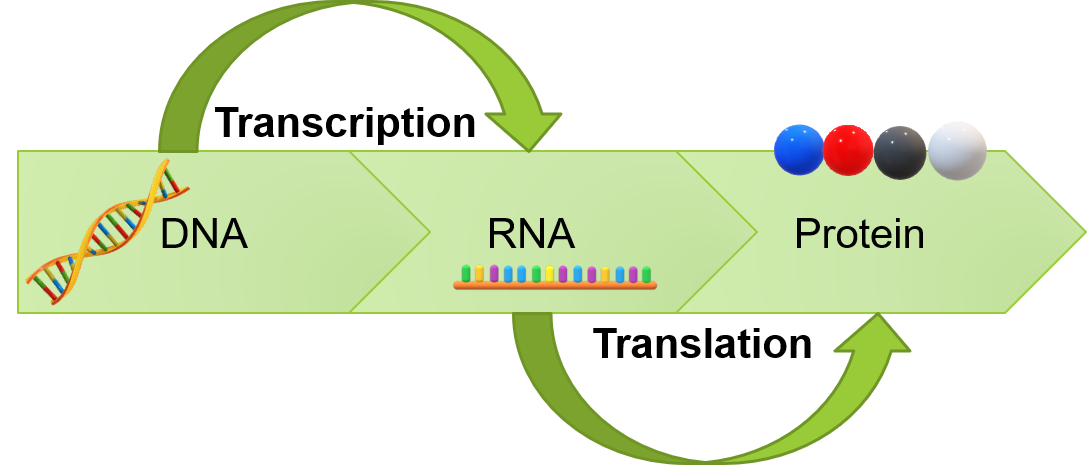
The central dogma of molecular biology. Image by Christinelmiller, CC BY-SA 4.0, via Wikimedia Commons
Rather than being simple carriers of information, they are instead incredibly designed to perform complex and essential functions.
Originally, RNA was only seen as a messenger in gene expression, a mere carrier of the information from the nucleus’ DNA to the ribosomes. However, as with so many aspects of the human body and molecular biology, that was too simple of a description of RNA’s function. In the decades after RNA’s discovery, we’ve found that not only does RNA carry information for protein formation, but some RNAs—known as noncoding RNAs (ncRNAs)—are involved in numerous other cellular processes, including the regulation of gene expression itself. Though these noncoding RNAs vary in size, they all function to help an organism adapt to the world around them. Rather than being simple carriers of information, they are instead incredibly designed to perform complex and essential functions.
These ncRNAs are an amazing testimony to God’s creativity and ingenuity, and by exploiting the natural functions of some of these RNA pathways, scientists are beginning to develop exciting new biotechnology products, including in the realms of medicine and pest control. Even in the smallest of RNAs, there are powerful opportunities that God has provided for us to harness to help make human life better. As we explore these different types of noncoding RNAs and see the cutting-edge developments that they provide, we will see how God has carefully designed both humans and animals to function in incredible ways!
Key Terms
Due to the natural complexity of molecular biology, it’s easy to get bogged down in terminology and jargon. (Even that is a testimony to how detailed and awe-inspiring our God is!) To help with the reading of this article, especially if you are not a biologist, here is an overview of some of the key terms that will provide a foundation to build upon.
| Term | Overview |
|---|---|
| Nucleotide | These are the core elements of DNA and RNA. Each nucleotide consists of a five-carbon sugar (deoxyribose in DNA and ribose in RNA), a phosphate group, and one of four nucleobases: adenine (A), cytosine (C), guanine (G), or thymine (T). In RNA, the thymine is replaced with uracil (U). Since DNA is double stranded, two nucleotides will be bound together by means of hydrogen bonds, with adenine pairing with thymine (A-T) and cytosine pairing with guanine (C-G). Each of these pairs is known as a nucleotide base pair. In contrast, mRNA is typically single stranded. |
| Genome | This is the entirety of an organism’s DNA, which is comprised of thousands of specific regions known as genes, the fundamental units of information that offspring inherit from their parents. Each person’s genome consists of ~19,000–20,000 protein-coding genes and ~3 billion nucleotide base pairs.2 |
| Enzyme | An enzyme is a protein that is the catalyst for biochemical reactions in the cell, such as starting the transcription process. |
| Transcription | The process of copying a section of DNA to become RNA. During transcription, an RNA polymerase enzyme temporarily unzips the two strands of DNA by breaking the hydrogen bonds of the nucleotide base pairs, exposing an individual strand from which a complimentary strand of RNA is copied from the DNA by the RNA polymerase enzyme. Through this process, messenger RNA (mRNA) and all other types of RNA are produced. |
| Transcript | A specific sequence of an RNA strand. The length of an individual strand can range from 20–30 nucleotides to thousands of nucleotides. The entire collection of all RNA transcripts in a cell is known as a transcriptome. |
| Ribosome | A structure in the cytoplasm (gelatinous part) of the cell that is specifically designed to convert RNA nucleotide sequences into amino acids, which are the building blocks of protein and of life. |
| Translation | The process of converting mRNAs into amino acid sequences. During translation, the ribosome “reads” the mRNA sequence. Every three nucleotides correspond with an amino acid molecule. As we will see below, ncRNAs play a key role in facilitating this process. |
| Coding RNA | In biological terms, the “code” is the information stored in DNA that must be transmitted to provide a blueprint for protein, allowing the cell to create a useful product. RNA that carries this information is known as coding RNA. In particular, coding RNA consists of messenger RNA, which provides the information needed to form protein. |
| Codon | Three sequential RNA nucleotides that represent the code for a single amino acid. Each of the 22 amino acids has its own distinct set of three nucleotide codes. |
| Noncoding RNA | There is a large amount of RNA transcribed from DNA that does not provide code for protein formation. Instead, these RNA transcripts provide a variety of other functions that we’ll discuss below. |
| X Inactivation | In therian mammals (non-egg-laying, so all mammals except monotremes), X-inactivation is when one of the X chromosomes in females is silenced to balance the number of gene copies (gene dosage) in females to correspond with males who only have one X chromosome. |
Types of Non-coding RNA
Over the last several decades, numerous types of noncoding RNAs have been discovered, to the delight of molecular biologists and the chagrin of college students who continue to have more and more terms that they need to memorize! But regardless of where you stand with the memorization of terms, it’s clear that God has designed our bodies to be incredibly efficient with the usage of resources. The very transcription processes that are used to create mRNA are also used to create the elements that will process, translate, and even regulate it. Let’s take a look at several of the most prominent types of noncoding RNAs.
Ribosomal RNAs
As mentioned, ribosomes are crucial for the translation of mRNAs into amino acids. However, the ribosomes themselves are made up of a mix of proteins and ribosomal RNAs (rRNAs). In order to function properly, ribosomes rely upon two major components—a large subunit and a small subunit. These subunits are categorized by how fast their particles take to settle after being suspended, which is calculated as a Svedberg unit (S).
In prokaryotes (e.g., bacteria), the large subunit is 50S and smaller subunit is 30S, while in eukaryotes (e.g., animals and humans), the large and small subunits are 60S and 40S respectively. During translation, the two subunits will work together to hold an RNA in place while they translate the RNA nucleotides into amino acids. Assisting in this translation are the rRNAs, which can vary in size and function, with rRNAs ranging from hundreds to thousands of nucleotides in length. Ribosomal RNAs are the most abundant RNA, with ~80% of total RNA in a cell being rRNA.3
Two examples of rRNAs are the 23S rRNA and 5S rRNA, both of which interact with the 50S subunit in prokaryotes. The 23S rRNA helps the enzyme peptidyl transferase with the binding of peptide bonds between amino acids, which is required for the amino acid sequence to be properly synthesized.4 Without this critical rRNA, amino acids and subsequent proteins would not be able to form, leading to the premature death of the organism. Meanwhile, while 5S rRNA’s function has not been fully identified, there is some indication that it helps bind transfer RNAs (tRNAs) to the ribosome, and this rRNA has been confirmed to be required for the ribosome to function properly.5 In the human body, rRNAs are just as critical. Ribosomal RNAs include 18S rRNA, which interacts with the small 40S subunit, and 5S rRNA, 5.8S rRNA, and 28S rRNA, all of which interact with the large 60S subunit. Though many of the exact functions of these rRNAs are not known, they all work together to play a critical role in amino acid synthesis.
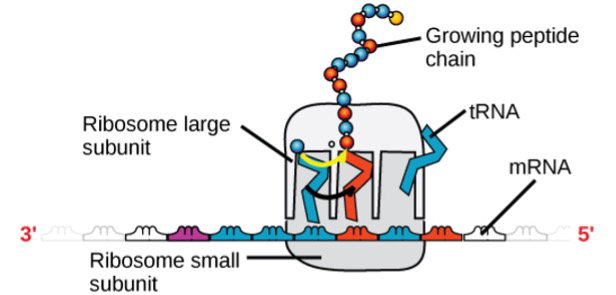
Ribosomes are made up of proteins and rRNA. tRNAs link mRNA with the amino acid sequences (peptide chain). Image by CNX OpenStax, CC BY 4.0, via Wikimedia Commons
Transfer RNAs
Transfer RNAs (tRNAs) are 75 to 90 nucleotides in length and function as a link, or adaptor, between the mRNA and amino acid sequences. These tRNAs bind exactly to their mRNA codon counterparts on one end, while binding to the corresponding amino acid sequence on the other, ensuring that the proper amino acid sequence is synthesized by the ribosome.6 This straightforward process is vital in translation since their absence would prevent proper translation of the mRNA into protein.
Long ncRNAs
As their name suggests, long noncoding RNAs (lncRNAs) are “long,” typically over 200 nucleotides, which distinguishes them from small RNAs (sRNAs) that are under 200 nucleotides in length. (Since form determines function, broadly classifying structures by their length is common practice in molecular biology.) While lncRNAs are generally considered nonfunctioning, some potential function has been found in the lncRNAs known as Xist and HOTAIR.
Xist—Xist (X-inactive specific transcript) is found only on inactive X chromosomes and is believed to be responsible for its inactivation.7 This inactivation in humans allows for gene dosage to be the same in males and females since males only have one X chromosome.
HOTAIR—This lncRNA regulates how DNA is stored within chromatin complexes through its involvement in gene-silencing of the HOXD locus by PRC2.8 Since overexpression of HOTAIR has been identified in numerous cancers, this RNA has the potential to be used as a biomarker for identifying individuals who are at high-risk.9 For example, HOTAIR is involved in the epigenetic differentiation of skin and helps these skin cells adapt to environmental conditions. Thus, targeting HOTAIR has the potential of reducing tumor development.10 As scientists continue to study lncRNAs, more and more of this RNA will likely be revealed to have important roles to play in cellular development and maintenance.
Housekeeping sRNAs
While the exact functions of sRNAs vary, several of them, known as “housekeeping sRNAs,” provide essential cellular maintenance. These include snoRNAs, snRNAs, and scaRNAs.
- Small nucleolar RNAs (snoRNAs) guide chemical modifications of rRNAs, tRNAs, and snRNAs, which are essential for proper RNA function. There are two major types of snoRNAs: C/D box snoRNAs and H/ACA box snoRNAs. The names “C/D box” and “H/ACA box” are derived from conserved sequence patterns of nucleotides known as sequence motifs, found near the ends of the snoRNAs. The first type, C/D box snoRNAs, assists in enzyme methylation, allowing the RNAs to fold correctly.11 Meanwhile, H/ACA box snoRNAs are involved in pseudouridylation, which modifies the RNA’s uridine to enhance its stability.12 Since the exact structure of RNA is essential to its function, these sRNA chemical modifications play an essential role in cellular maintenance by keeping various components functioning properly.
- Small nuclear RNAs (snRNAs) are ~150 nucleotides long and primarily help process pre-messenger RNA. For example, snRNAs interact with proteins to form small nuclear ribonucleoprotein (snRNP) complexes. The U7 snRNA and its U7 snRNP complex play a role in the cleavage of histone pre-mRNAs, which is an essential step in mRNAs becoming functional.13 Further, involvement of the 7SK snRNA and the 7SK snRNP complex have been identified as playing a crucial role in controlling transcription elongation.14 During the elongation step of transcription, RNAs (both coding and noncoding) are synthesized by the RNA polymerase enzyme. Thus, 7SK snRNAs help ensure that RNAs are synthesized properly.
- Small Cajal body-specific RNAs (scaRNAs) are a classification of snoRNAs. Like most snoRNAs, they guide the modification of RNAs, including rRNAs, by means of methylation and pseudouridylation, which we discussed above.15 However, some scaRNAs also guide the chemical synthesis of snRNAs to specific proteins to form snRNPs, facilitating the chemical modifications needed for proper snRNP function.16
Together, these housekeeping sRNAs keep the cell healthy and functioning properly, allowing for the continued transfer of information from the DNA to the ribosomes for protein synthesis.
Gene-Regulating sRNAs
While many sRNAs are involved in general housekeeping functions, three other sRNAs are more directly involved in determining what genetic information will reach the ribosomes. Since the DNA in an organism produces far more information than can be used, God has designed numerous processes to prevent all of this information from being synthesized by the ribosomes. It is important to note that the excess information is not mere waste or junk; instead, every organism is equipped with an abundance of information that will help it survive based on its current needs. By means of internal and external factors, regulation of that genetic information shapes an organism’s code into the gene expression that helps an organism be best equipped for its environment. Factors that influence the regulation of gene expression include transcription factors, DNA methylation, histone modifications, and hormone activity.
As for noncoding RNA involvement in gene regulation, sRNAs interfere with mRNA before it reaches the ribosomes. Since most RNA is single stranded, a single-stranded sRNA that is complimentary to the single-stranded mRNA will either bind directly to the mRNA, preventing it from binding to the ribosome for translation, or it will initiate the mRNA’s degradation.17 This process of nullifying an mRNA transcript is known as sRNA-mediated RNA Interference (RNAi). Currently, gene-regulating sRNAs are classified by their length and the specific proteins they interact with when triggering gene silencing. These sRNAs (miRNAs, siRNAs, and piRNAs) are ~20–30 nucleotides in length and interact with the Argonaute protein family.18 Despite their small size, they play a key role in shaping an organism’s observable, phenotypic characteristics, such as their physical traits and reproductive potential.
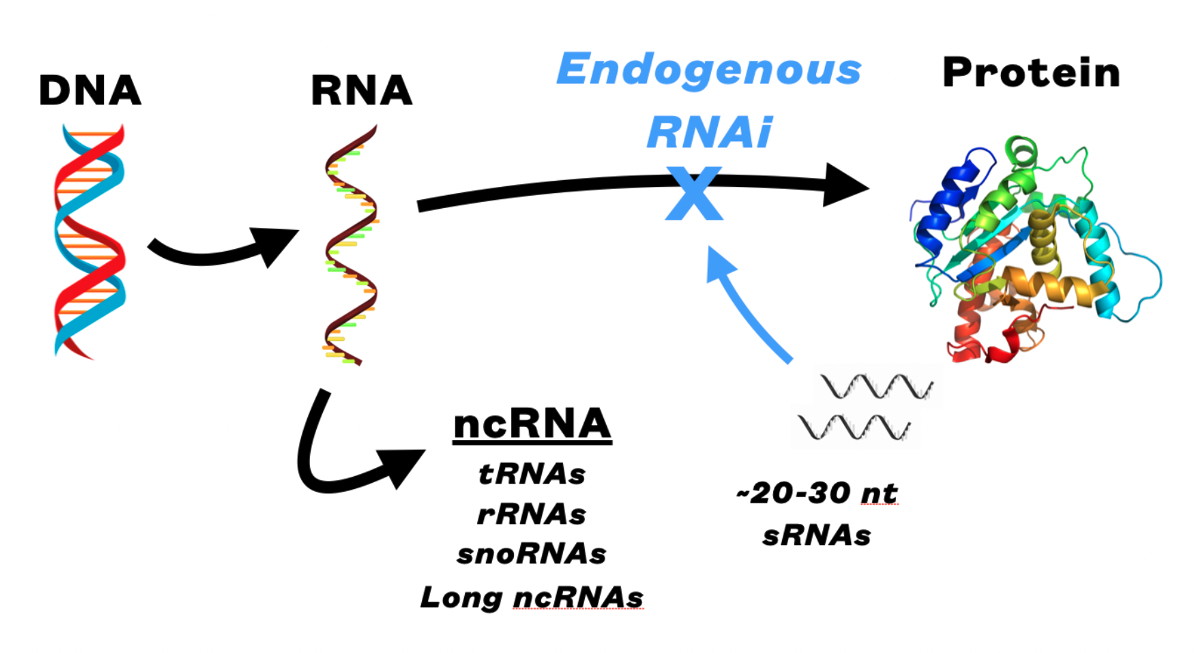
The central dogma with emphasis on a) where ncRNAs are synthesized and b) where RNAi occurs thanks to sRNA interference. Figure by Cory Von Eiff
miRNAs—MicroRNAs (miRNAs) are found in most organisms, originating as “short” hairpins, which are RNAs that fold back on themselves to create a loop. These ~19–25 nucleotide miRNAs are typically transcribed by Polymerase II and are heavily involved in gene regulation, typically triggering mRNA degradation before it reaches the ribosomes. Because miRNAs target and bind using only some of their nucleotides rather than their full ~21–22 nucleotide length, they often bind to multiple target sites and can silence several genes at once.19
siRNAs—Small interfering RNAs (siRNAs) are ~20–24 nucleotides long and are primarily involved in viral suppression, though they also are regularly involved in gene regulation. Derived from long double-stranded RNA (dsRNA) sequences, which is more typical of viral genomes, siRNAs typically bind with 100% specificity and tend to only silence a specific gene’s mRNA rather than the mRNA from multiple genes. While some chemically modified siRNAs do have off-target effects, they are more precise than their miRNAs counterparts.20
piRNAs—Piwi-interacting RNAs (piRNAs) are ~25–30 nucleotides long, originate from long, single-stranded RNA, and are the most abundant of the gene-regulating sRNAs.21 Besides their length and abundance, piRNAs are distinct from miRNAs and siRNAs because they do not require processing by the Dicer enzyme, as miRNAs and siRNAs do, and primarily interact with the Piwi subfamily of Argonaute proteins.22 While piRNAs are largely involved in regulating transposable elements in germ cells, they also have been identified in gene regulation.23
Together, these three gene-regulating sRNAs play a major role in ensuring proper restriction of gene expression in the vast majority of life, including us humans. Thanks to the advancement of biotechnology, as we will see below, scientists have been able to exploit this naturally occurring process to tackle a host of biological issues.
RNAi’s Biotechnology Potential
The first description of RNA interference (RNAi) was recorded by Fire and Mello in their studies of the nematode Caenorhabditis elegans, which earned them the Nobel Prize in Physiology and Medicine in 2006.24 Since this discovery, the mechanisms of sRNA-mediated RNAi have been identified in nearly all organisms, providing scientists with a near ubiquitous biological process that can be harnessed to silence specific genetic traits. By synthesizing artificial RNAs and feeding or injecting them into organisms, scientists can utilize the naturally occurring sRNA biogenesis pathways to elicit gene silencing in organisms. As scientists continue to explore the applications of RNAi, many exciting possibilities stemming from this revolutionary breakthrough are coming close to fruition.
One of RNAi’s greatest strengths is that it does not affect an organism’s genomic DNA. One of the well-known genetic editing tools recently developed is the CRISPR-CAS9 system, which allows scientists to “knockout” a gene nearly anywhere in the genome by triggering the cell’s DNA repair mechanism (NHEJ) to introduce a premature stop codon.25 However, besides the ethical questions about CRISPR,26 CRISPR editing directly affects a person or organism’s genomic DNA, which will be passed on to future generations. Since every gene has multiple functions and we are far from understanding how all genes interact with one another, making major, permanent changes to a genome using CRISPR is inherently risky, with a high potential for unforeseen complications due to a removed or inserted gene. In contrast, RNAi, which occurs after the transcription process, is much safer because it does not alter an organism’s DNA and instead specifically targets mRNA that is carrying information to code a specific protein. Further, RNAi is highly specific since the gene-regulating sRNAs primarily target a specific mRNA sequence that is unique to that organism. This is especially promising in the realm of medicine since the number of potential off-target effects is significantly reduced. The most noteworthy RNAi breakthrough in medicine is Patisiran. Approved by the FDA in 2018 and sold as Onpattro, this siRNA-based medication is used to treat individuals with a rare neurodegenerate disease known as hereditary transthyretin-mediated amyloidosis (haTTR).27
Besides medicine, another exciting area where RNAi technology is being explored is its use in pest control. In these approaches, an essential protein is chosen in a pest, typically an insect, that will be targeted by RNAi. Synthesized sRNA mimics are then either fed or injected into the targeted pest, stopping the organism’s production of that protein, leading to the organism’s death. Because sRNAs target the specific mRNA strands of a particular organism, they are much better for the environment because they are harmless to off-target species. Traditional chemical pesticides are typically poisons that routinely kill or injure multiple species and often pose health risks when consumed by humans. For example, DDT is banned in the United States and many countries because, though it helps kill insect pests, it has major impacts on wildlife and presents health concerns to humans.28 In contrast, sRNA-mediated RNAi is highly specific and highly unlikely to cause health concerns to humans or nontarget species. Further, sRNAs break down and disintegrate quickly, meaning that they will not leave dangerous pollutants in the environment as many chemical pesticides do. Numerous insects are currently being studied, including the diamondback moth, which attacks plants like cabbage and broccoli, and the fall armyworm, which damages corn, cotton, and many other crops, while GreenLight Biosciences is researching an acaricide for use on arachnids.29 While research still needs to be conducted, the potential of RNAi-based biopesticides is extensive, with this technology posed to transform agricultural development, making pest control safer and more effective than ever before.
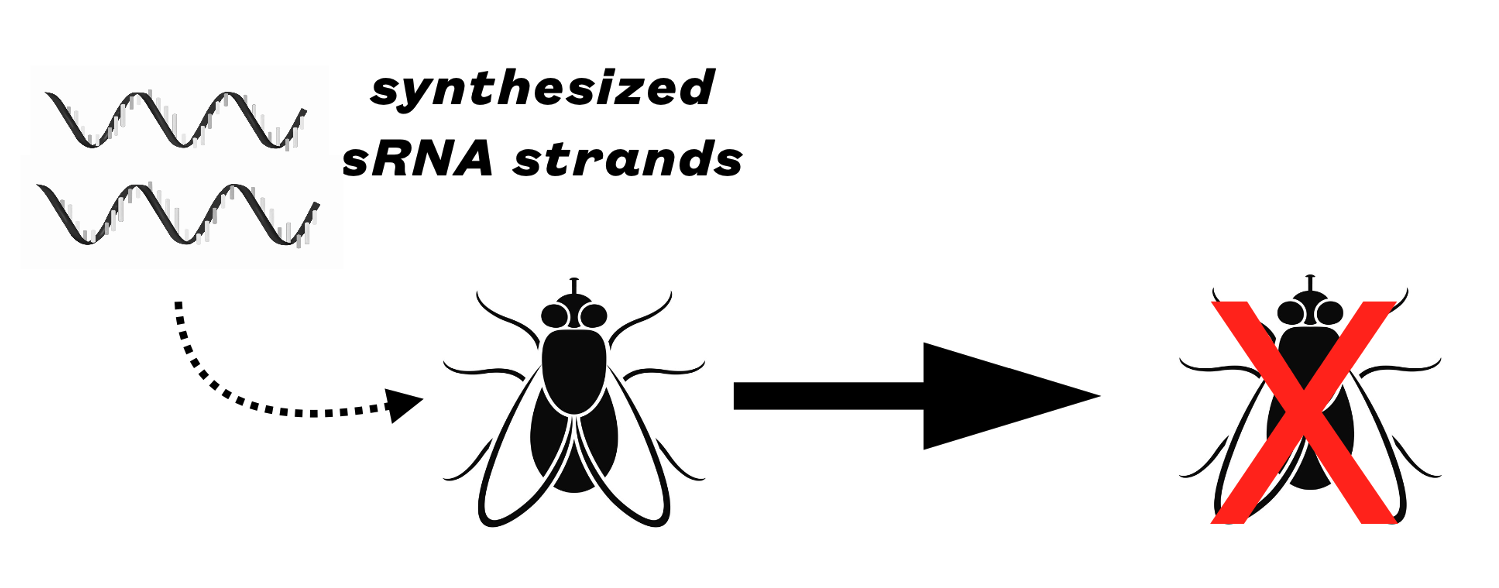
The simplified RNAi process. Basically, we inject/feed synthesized sRNAs to an insect pest, which prevents a key protein’s synthesis, leading to the insect’s death. Figure by Cory Von Eiff
That is not to say that RNAi has no drawbacks. For example, since RNAi silencing is typically transient, gene expression may eventually return to normal as the injected RNAs degrade. Further, the price of RNAi treatments for entire agricultural crops have been cost prohibitive due to how expensive synthesized RNAs have been. However, now that numerous proof-of-concept products have been developed, new cost-effective designs are being pursued to ensure that RNAi is cost effective for farmers. Yet another consideration is that the abundance of sRNA pathways varies by organism, with different classifications of organisms, and even individual species, expressing different quantities of sRNAs. For example, my own research lab’s recent analysis of annelids and mollusks has demonstrated that these two phyla do not have siRNA pathways, instead only having miRNA and piRNA pathways.30 Further research is clearly needed to see how these sRNAs will be useful for improving agriculture and human health.
Noncoding RNAs: A Testimony to God’s Creativity and Design
Rather than being mere junk, as was once thought, noncoding RNAs instead show the resourcefulness of God, who is not wasteful but has an intended purpose for everything—even tiny RNAs that are only a couple dozen nucleotides long. What’s just as fascinating is that these amazing RNAs were never even thought of throughout the vast majority of human history. For centuries, they have functioned behind the scenes, helping keep our bodies healthy and alive, with humans taking no notice or even having a vague understanding of their existence.
Rather than being mere junk, as was once thought, noncoding RNAs instead show the resourcefulness of God, who is not wasteful but has an intended purpose for everything.
When King David, thousands of years ago, expressed his gratitude toward God in Psalm 139:14, he exclaimed, “I praise you, for I am fearfully and wonderfully made.” As he penned those words, he had no concept of just how incredibly created he was. Perhaps that is one of the most beautiful attributes of God—his willingness to design intricate and breathtaking wonders that will continue to function regardless of whether humans can see them or even know about them. Whether it is galaxies in deep space, hydrothermal vents on the ocean floor, or the microscopic wonders of life, it is clear that God has created a seemingly infinite universe surrounding us that demonstrates his might, even if we never have the opportunity to experience all of it.
The more we study the natural world, the more it should draw us closer to God. After all, as Colossians 1:17 states, “He is before all things, and in him all things hold together.” And noncoding RNAs are no exception. If this world came about by chance, the result of millions and billions of years of happenstance, we would expect to see disorder and chaos that somehow barely provides for the existence of life. Yet instead, we see a rich tapestry that God has used to show us his majesty and creativity. And molecular biology is one of the most incredible testimonies to this. Every time we think that we’ve learned all there is to know about the human body, the more there is to discover. The closer we study the body, the more we realize how intricately that God has designed his creation, including us, to function. Rather than being filled with useless DNA and RNA as was originally thought, we continually discover more and more functional and highly active aspects of the cell. Noncoding RNAs, just like so much else surrounding us, offer us undeniable evidence of God’s intelligent design for the world, including our very beings. We just need to be willing to open our eyes, and maybe grab a microscope, to explore the world around us.
Answers in Depth
2026 Volume 21
Answers in Depth explores the biblical worldview in addressing modern scientific research, history, current events, popular media, theology, and much more.
Browse VolumeFootnotes
- Amaral, Paulo, Silvia Carbonell-Sala, Francisco M. De La Vega, Tiago Faial, Adam Frankish, Thomas Gingeras, et al., “The Status of the Human Gene Catalogue,” Nature 622, no. 7981 (2003): 41–47. https://doi.org/10.1038/s41586-023-06490-x.
- Amaral et al., “Status of the Human Gene Catalogue”; Eric Green, “Genome,” Talking Glossary of Genomic and Genetic Terms, National Human Genome Research Institute, last updated May 27, 2026, https://www.genome.gov/genetics-glossary/Genome; Eric Green, “Gene,” Talking Glossary of Genomic and Genetic Terms, National Human Genome Research Institute, last updated May 27, 2026, https://www.genome.gov/genetics-glossary/Gene.
- Kumar, Ravi Y. S., Atluri Bhavana, Areeba Aziz, Riya Roy, Amulya M. Reddy, Paramesha Mahadevappa, et al., “A Comprehensive Review of Ribosomal RNA-Derived Fragments (rRFs): Emerging Insights and Future Directions,” International Journal of Biological Macromolecules 330, no. 4 (2025): 148265, https://doi.org/10.1016/j.ijbiomac.2025.148265.
- Bin, Jia, Tianlong Wang, and Jean Lehmann, “Peptidyl Transferase Center Decompaction and Structural Constraints During Early Protein Elongation on the Ribosome,” Scientific Reports 11 (2021): 24061, https://doi.org/10.1038/s41598-021-02985-7.
- Gongadze, G. M., “5S rRNA and Ribosome,” Biochemistry Moscow 76 (2011): 1450–1464, https://doi.org/10.1134/S0006297911130062.
- Biela, Anna, Alexander Hammermeister, Igor Kaczmarczyk, Marta Walczak, Lukasz Koziej, Ting-Yu Lin, et al., “The Diverse Structural Modes of tRNA Binding and Recognition,” Journal of Biological Chemistry 299, no. 8 (2023): 104966, https://doi.org/10.1016/j.jbc.2023.104966.
- Ng, Karen, Dieter Pullirsch, Martin Leeb, and Anton Wutz, “Xist and the Order of Silencing.” EMBO 8 (2007): 34–39, https://doi.org/10.1038/sj.embor.7400871.
- HOXD genes function as oncogene and tumor suppressors. Polycomb Repressive Complex 2 (PRC2) proteins have numerous regulatory functions, such as playing a role in X chromosome inactivation. To read more about HOX genes,see Kaia Kloster, “Does New Mouse Experiment Explain How Humans Lost Their Tails?,” Answers in Depth (July 7, 2023): https://answersingenesis.org/genetics/does-new-experiment-explain-how-humans-lost-tails/.
- Nazari, Majid, Emad Babakhanzadeh, Arghavan Mollazadeh, Mohadese Ahmadzade, Elham Mohammadi Soleimani, and Elnaz Hajimaqsoudi, “HOTAIR in Cancer: Diagnostic, Prognostic, and Therapeutic Perspectives,” Cancer Cell International 24, no. 1 (2024): 415, https://doi.org/10.1186/s12935-024-03612-x.
- Amicone, Laura, Alessandra Marchetti, and Carla Cicchini, “The lncRNA HOTAIR: A Pleiotropic Regulator of Epithelial Cell Plasticity,” Journal of Experimental Clinical Cancer Research 13, no. 42 (2023): 147, https://doi.org/10.1186/s13046-023-02725-x.
- Falaleeva, Marina, Justin R. Welden, Marilyn J. Duncan, and Stefan Stamm, “C/D-box snoRNAs Form Methylating and Non-Methylating Ribonucleoprotein Complexes: Old Dogs Show New Tricks,” Bioessays 39, no. 6 (2017): https://doi.org/10.1002/bies.201600264.
- Torchet, Claire, Gwenaël Badis, Frédéric Devaux, Ginny Costanzo, Michel Werner, and Alain Jacquier, “The Complete Set of H/ACA snoRNAs That Guide rRNA Pseudouridylations in Saccharomyces cerevisiae,” RNA 11, no. 6 (2005): 928–938, https://doi.org/10.1261/rna.2100905.
- Skrajna, Aleksandra, Xiao-cui Yang, Katarzyna Bucholc, Jun Zhang, Traci M. Tanaka Hall, Michal Dadlez, et al., “U7 snRNP Is Recruited to Histone Pre-mRNA in a FLASH-Dependent Manner by Two Separate Regions of the Stem-Loop Binding Protein,” RNA 23, no. 6 (2017): 938–951, https://doi.org/10.1261/rna.060806.
- McNamara, Ryan P., Curtis W. Bacon, and Iván D’Orso, “Transcription Elongation Control by the 7SK snRNP Complex: Releasing the Pause,” Cell Cycle 15, no. 16 (2016): 2115–2123, https://doi.org/10.1080/15384101.2016.1181241.
- Gardner-Kay, Amanda, Lynndy Le, Michael Filla, Nataliya Kibiryeva, James E. O’Brien Jr., and Douglas C. Bittel, “CRISPR Disruption of scaRNA1 Reduces Pseudouridylation in Spliceosomal RNA U2 at U89 and Perturbs the Transcriptome in HEK293T Cells,” Cells 14, no. 23 (2025): 1882, https://doi.org/10.3390/cells14231882.
- Logan, Madelyn K., Marilyn F. Burke, and Michael D. Hebert, “Altered Dynamics of scaRNA2 and scaRNA9 in Response to Stress Correlates with Disrupted Nuclear Organization,” Biology Open 7, no. 9 (2018): bio037101, https://doi.org/10.1242/bio.037101; Tamás Kiss, “Biogenesis of Small Nuclear RNPs,” Journal of Cell Science 117, no. 25 (2004): 5949–51, https://doi.org/10.1242/jcs.01487.
- Prévost, Karine, Guillaume Desnoyers, Jean-François Jacques, François Lavoie, and Eric Massé, “Small RNA-Induced mRNA Degradation Achieved Through Both Translation Block and Activated Cleavage,” Genes and Development 25, no. 4 (2011): 385–396, https://doi.org/10.1101/gad.2001711.
- Großhans, Helge, and Witold Filipowicz, “The Expanding World of Small RNAs,” Nature 451 (2008): 414–416, https://doi.org/10.1038/451414a.
- Friedman, Robin C., Kyle Kai-How Farh, Christopher B. Burge, and David P. Bartel, “Most Mammalian mRNAs Are Conserved Targets of microRNAs,” Genome Research 19, no. 1(2009): 92–105, https://doi.org/10.1101/gr.082701.108; Dandan Feng, Qi Li, Hong Yu, Shikai Liu, Lingfeng Kong, and Shaojun Du, “Integrated Analysis of microRNA and mRNA Expression Profiles in Crassostrea gigas to Reveal Functional miRNA and miRNA-Targets Regulating Shell Pigmentation,” Scientific Reports 10, no. 1 (2020): 20238, https://doi.org/10.1038/s41598-020-77181-0.
- Dua, Pooja, Jae Wook Yoo, Soyoun Kim, and Dong-ki Lee, “Modified siRNA Structure with a Single Nucleotide Bulge Overcomes Conventional siRNA-Mediated Off-Target Silencing,” Molecular Therapy 19, no. 9 (2011): 1676–87, https://doi.org/10.1038/mt.2011.109; Aimee L. Jackson and Peter S. Linsley, “Recognizing and Avoiding siRNA Off-Target Effects for Target Identification and Therapeutic Application,” Nature Reviews Drug Discovery 9 (2010): 57–67, https://doi.org/10.1038/nrd3010.
- Iwasaki, Yuka W., Mikikio C. Siomi, and Haruhiko Siomi, “PIWI-Interacting RNA: Its Biogenesis and Functions,” Annual Review of Biochemistry 84 (2015): 405–33, https://doi.org/10.1146/annurev-biochem-060614-034258; Mingye Jiang, Xiaoning Hong, Yunfei Gao, Alvin T. Kho, Kelan G. Tantisira, and Jiang Li, “piRNA Associates with Immune Diseases,” Cell Communication and Signaling 22, (2024): 347, https://doi.org/10.1186/s12964-024-01724-5; Qi Fu and P. Jeremy Wang, “Mammalian piRNAs: Biogenesis, Function, and Mysteries,” Spermatogenesis (2014): e27889, https://doi.org/10.4161/spmg.27889.
- Yamaguchi, Sonomi, Akira Oe, Kazumichi M. Nishida, et al., “Crystal Structure of Drosophila Piwi,” Nature Communications 11 (2020): 858, https://doi.org/10.1038/s41467-020-14687-1.
- Luo, Shiqi, and Jian Lu, “Silencing of Transposable Elements by piRNAs in Drosophila: An Evolutionary Perspective,” Genomics, Proteomics, and Bioinformatics 15, no. 3 (2017): 164–176, https://doi.org/10.1016/j.gpb.2017.01.006; Eduardo Larriba and Jesús del Mazo, “An Integrative piRNA Analysis of Mouse Gametes and Zygotes Reveals New Potential Origins and Gene Regulatory Roles,” Scientific Reports 8, no. 1 (2018): 12832, https://doi.org/10.1038/s41598-018-31032-1.
- Fire, Andrew, SiQun Xu, Mary K. Montgomery, Stephen A. Kostas, Samuel E. Driver, and Craig C. Mello, “Potent and Specific Genetic Interference by Double-Stranded RNA in Caenorhabditis elegans,” Nature 391 (1998): 806–11, https://doi.org/10.1038/35888.
- Bak, Rasmus O., Natalia Gomez-Ospina, and Matthew H. Porteus, “Gene Editing on Center Stage,” Trends in Genetics 34, no. 8 (2018): 600–611, https://doi.org/10.1016/j.tig.2018.05.004.
- Check out these Answers in Genesis articles about CRISPR: “CRISPR and the Creator,” Answers Magazine 14, no. 6 (November 1, 2019): 19–20, https://answersingenesis.org/genetics/crispr-creator/; Georgia Purdom, “CRISPR: A Clear-Cut Issue?,” Answers Magazine 16, no. 1 (January 1, 2021): 68–73, https://answersingenesis.org/genetics/crispr-clear-cut-issue/.
- Akinc, Ain, Martin A. Maier, Muthiah Manoharan. et al., “The Onpattro Story and the Clinical Translation of Nanomedicines Containing Nucleic Acid-Based Drugs, Nature. Nanotechnology 14 (2019): 1084–1087, https://doi.org/10.1038/s41565-019-0591-y.
- Chapin, Georganne, and Robert Wasserstrom, “Agricultural Production and Malaria Resurgence in Central America and India,” Nature 293 (1981): 181–185, https://doi.org/10.1038/293181a0.
- Chen, Ivy, Robert J. Grebenok, Cheng Zhao, Li He, Jiaxin Lei, Rui Ji, et al., “RNAi-Mediated Plant Sterol Modification to Control Insect Herbivore Pests: Insights from Arabidopsis and the Diamondback Moth,” Journal of Pest Science 97 (2024): 725–737, https://doi.org/10.1007/s10340-023-01651-3; Keith H. Parsons, Mosharrof H. Mondal, Charles L. McCormick, and Alex S. Flynt, “Guanidinium-Functionalized Interpolyelectrolyte Complexes Enabling RNAi in Resistant Insect Pests,” Biomacromolecules 19, no. 4 (2018): 1111–1117, https://doi.org/10.1021/acs.biomac.7b01717; Alex Flynt, “Insecticidal RNA Interference, Thinking Beyond Long dsRNA,” Pest Management Science 77, no. 5 (2021): 2179–2187, https://doi.org/10.1002/ps.6147.
- Khanal, Sweta, Beatriz Schueng Zancanela, Jacob Oche Peter, and Alex Sutton Flynt, “The Small RNA Universe of Capitella teleta,” Frontiers in Molecular Biosciences 9 (2022): 802814, https://doi.org/10.3389/fmolb.2022.802814; Cory Von Eiff, Beatriz Schueng Zancanela, Megan Gima, Kevin Quito, Manitejus Kotikalapudi, Sergio Valdivia, et al., “Implications of Endogenous Small Regulatory RNAs Survey in Mollusks on Gene Silencing Approaches,” Marine Biotechnology 27, no. 143 (2025): https://doi.org/10.1007/s10126-025-10519-9;
Zarur, Audrey (andrey-zarur-a73a748), “I am extraordinarily pleased to share that GreenLight Biosciences has officially submitted our first multi-species RNA-based biological acaricide for regulatory review,” LinkedIn, March 4, 2026, https://www.linkedin.com/posts/andrey-zarur-a73a748_innovation-savethebees-cropprotection-share-7435043245539098624-4OPI/.



Support the creation/gospel message by donating or getting involved!

Answers in Genesis is an apologetics ministry, dedicated to helping Christians defend their faith and proclaim the good news of Jesus Christ.
- Customer Service 800.778.3390
- Available Monday–Friday | 9 AM–5 PM ET
- © 2026 Answers in Genesis