

Photo by Jason Mayer on Unsplash.
Busting Five Christmas Myths
Skeptics and critics frequently allege that the birth narrative in the Gospel of Matthew contradicts what the Gospel of Luke tells us about the events surrounding Christ’s birth, thus invalidating the legitimacy of both. For example, late liberal theologian and Episcopalian bishop John Shelby Spong stated the following about these two accounts:
So, modern people face the “Did it really happen?” question about these Christmas stories and answer it with an increasingly clear No! No, these things did not really happen. No, they are not literal. They did not occur in history, and it is time for the leaders of the church to say so openly. The fact is that no reputable biblical theologian today, Catholic or Protestant, is willing to defend the historical accuracy of the details of the biblical birth stories.1
Spong’s claim is patently false since there are many biblical theologians, both Catholic and Protestant, willing to defend the historical accuracy of Jesus’ birth narratives in Scripture. Based on his statement, he would argue that those who do this are not “reputable,” so he committed the “No True Scotsman” logical fallacy.
Tim Chaffey responds to Bible skeptics’ claims that the account of Christ’s birth is full of contradictions.
Despite Spong’s bombastic claim, countless critics have challenged the biblical birth narrative. We have dealt with many of their claims before, so in these cases, this article will summarize our previous findings and direct interested readers to our more detailed articles on that topic.
A preliminary observation will be helpful to keep in mind as you read the following sections: Most of the alleged contradictions do not arise from the biblical text itself. Instead, they are based on inaccurate retellings of Jesus’ birth through Sunday schools, songs, plays, and movies. Obviously, it is not an error in the Bible when someone misinterprets or misunderstands what the Bible states.
Contents
- Misconception #1: Joseph and Mary Could Not Find a Room at an Inn
- Misconception #2: Three Kings Visited Baby Jesus on the Night of His Birth
- Misconception #3: Matthew and Luke Contradict Each Other
- Misconception #4: Jesus Was Definitely Not Born on December 25, and That Day Was a Pagan Holiday
- Misconception #5: The Bible Forbids the Use of Christmas Trees
Misconception #1: Joseph and Mary Could Not Find a Room at an Inn
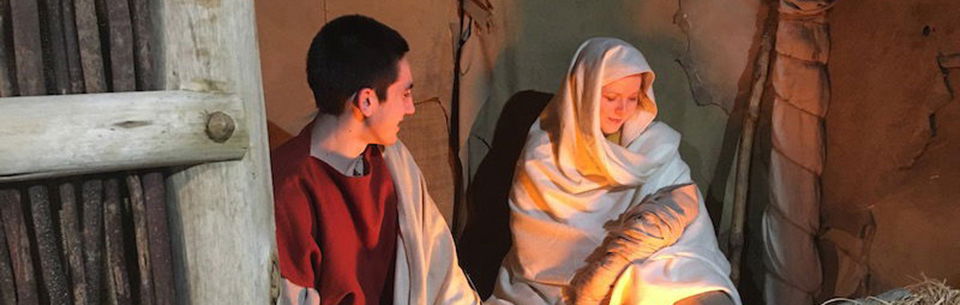
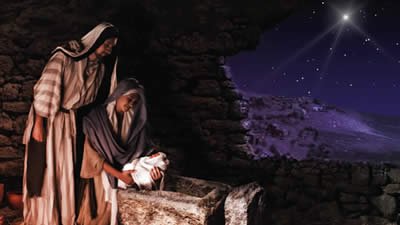
One of the most enduring and endearing retellings of Christ’s nativity is that he was born in a barn or cave because the inn was full and it was the only place available. This idea is based on a misunderstanding of Luke’s Gospel, and it involves some embellishment of the details as well.
And Joseph also went up from Galilee, from the town of Nazareth, to Judea, to the city of David, which is called Bethlehem, because he was of the house and lineage of David, to be registered with Mary, his betrothed, who was with child. And while they were there, the time came for her to give birth. And she gave birth to her firstborn son and wrapped him in swaddling cloths and laid him in a manger, because there was no place for them in the inn. (Luke 2:4–7)
Unlike the common portrayal of these events, Joseph and Mary did not need to frantically search for a place that night. Luke 2:6 states that while they were in Bethlehem, the time came for her to give birth, so it is rather likely that they had arrived in town well before Mary went into labor.
If that is the case, then why does Luke mention a feeding trough? While it is difficult to understand this based on the way most English Bibles translate verse 7, the Greek text makes no mention of anything like a hotel or inn, and it certainly does not mention an innkeeper. Luke used a term that refers to the guest room or upper room of a house (Greek καταλυμα, kataluma). Many first-century Judean homes had a guest room on the second floor. A portion of the lower level could be used to keep animals safe at night, so it would not be uncommon to find a feeding trough in the home’s first level.
- For more details on why the Greek term kataluma should not be translated as “inn,” please see “Born in a Barn (Stable)?”
- For additional details on the manger being a feeding trough, see “A Manger Misconception?”
- Finally, to consider how a very pregnant Mary might have been treated by Joseph’s family, see “Would Joseph’s Family Shun Mary?”
Misconception #2: Three Kings Visited Baby Jesus on the Night of His Birth
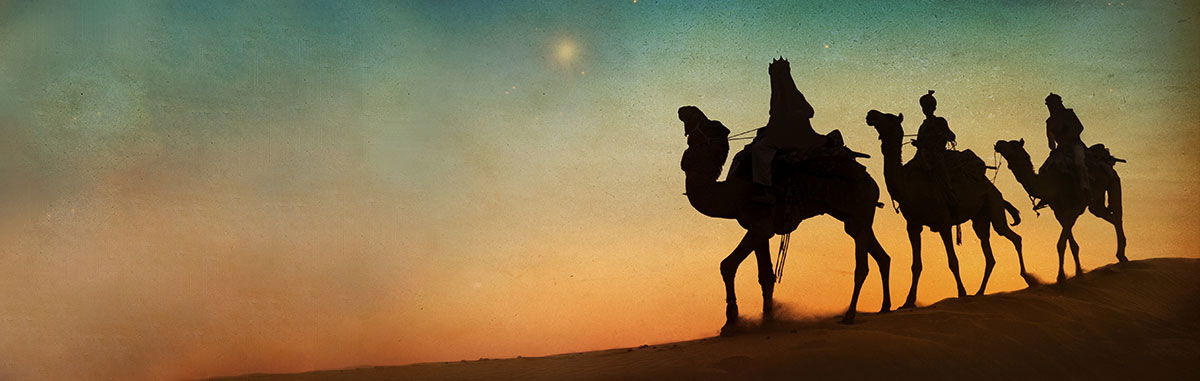
One of the most beloved Christmas hymns is titled “We Three Kings.” At least three common errors arise from the singing of this song at Christmas time.
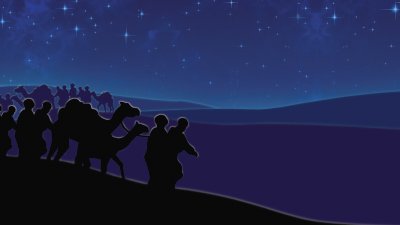
First, the Bible does not identify these men as kings. They were magi, from the Greek μαγοι, a term better translated as wise men. Originally, the magi belonged to a priestly class, and they would have been known for studying the night sky for signs or omens. Since they were from the east, they were probably from the Parthian empire.
Second, the Bible never tells us that there were three magi. The Greek μαγοι is plural, so we know there were at least two of them. The tradition that there were three magi is almost certainly based on the three gifts that they presented before Jesus: gold, frankincense, and myrrh.
Finally, the wise men definitely did not arrive on the night Jesus was born. The hymn does not specifically make this claim, but since we often sing this song at Christmastime, it has contributed to the belief that the wise men were at the nativity. This is shown in movies like Ben-Hur (1959), The Nativity Story (2006), and Son of God (2014). Many nativity scenes also include the wise men. These are just some of the reasons why many people believe the wise men arrived on the night Jesus was born, but the Bible clearly teaches otherwise.
If a person only read Matthew’s Gospel, then it is not hard to see why they might think the wise men were at the nativity. Consider the words from the end of Matthew 1 and beginning of Matthew 2.
When Joseph woke from sleep, he did as the angel of the Lord commanded him: he took his wife, but knew her not until she had given birth to a son. And he called his name Jesus. Now after Jesus was born in Bethlehem of Judea in the days of Herod the king, behold, wise men from the east came to Jerusalem, saying, “Where is he who has been born king of the Jews? For we saw his star when it rose and have come to worship him.” (Matthew 1:24–2:2)
If you are not paying close attention, you might think that the events in Matthew 2 follow immediately after Jesus’ birth. However, did you notice that Matthew 2:1 opens with the words, “Now after Jesus was born in Bethlehem . . .”? While Matthew does not tell us how much time has passed, we can learn from Luke that there were more than 40 days between Jesus’ birth and the appearance of the wise men in Jerusalem. We will address these details in the next section.
- For more details about the magi and how they might have learned about the coming Savior, see “We Three Kings.”
Misconception #3: Matthew and Luke Contradict Each Other
It is not difficult to find skeptics and critics who claim that the birth narratives in Matthew and Luke are hopelessly contradictory. A superficial reading of Matthew 1–2 and Luke 1–3 might lead one to agree with these critics since these two Gospels include many different details, but different is not the same as contradictory. These two books are actually complementary rather than contradictory.
These two books are actually complementary rather than contradictory.
Matthew opens with a genealogy that traces Jesus’ lineage from Abraham through David’s son Solomon. Then Matthew focuses more on Joseph than Mary in relation to Jesus’ birth. After Jesus’ birth, Matthew includes details about the wise men, the flight to Egypt, and Herod’s slaughter of the innocent baby boys in Bethlehem.
Luke’s Gospel is quite different. After his prologue, he begins with the events leading up to the birth of John the Baptist. Then he focuses on Mary in relation to Jesus’ birth, which he records in Luke 2:1–7. Then Luke goes on to tell of the angelic announcement to the shepherds, the shepherds seeing the newborn Savior, Jesus’ circumcision, and a visit to the temple where Simeon and Anna meet Joseph, Mary, and Jesus. Finally, in his third chapter, Luke provides a genealogy beginning with Jesus and moving back in time all the way to Adam, but the names between Jesus and David are very different than those in Matthew.
Order of Events
Let’s quickly address the notion that Matthew’s events contradict Luke’s events. In the previous section, we noticed that there was a gap of time between Matthew 1 and Matthew 2, which opens with, “Now after Jesus was born . . .” Luke 2:8–38 describes multiple events that fill in that time gap. First, the angels appear to the shepherds on the night Jesus was born, and then the shepherds enter Bethlehem and see the newborn Savior (Luke 2:8–20). Second, eight days later, Jesus was circumcised (Luke 2:21). Third, 40 days after his birth, Joseph and Mary took Jesus to Jerusalem to offer the sacrifice required by the law. It was during this visit to the temple that they met Simeon and Anna (Luke 2:22–38).
Similarly, following Luke 2:38, we need to insert the events from Matthew 2 before proceeding to Luke 2:39. Matthew 2:1–12 tells us about the visit of the magi. The next three verses describe Joseph and Mary taking Jesus to Egypt after an angel warned Joseph in a dream about Herod’s evil plot (Matthew 2:13–15). This could not have happened prior to their visit to the temple after Jesus’ 40th day. Matthew 2:16–18 describes Herod’s slaughter of the innocent baby boys in Bethlehem. We are told in Matthew 2:19–23 that Joseph, Mary, and Jesus remained in Egypt until Herod’s death. At the end of this passage, the events sync up with Luke 2:39, as both mention the move back to Nazareth.
Perhaps it would help to see these details in a list:
- Jesus is born in Bethlehem (Matthew 1:25; Luke 2:1–7).
- Angels announce Jesus’ birth to shepherds (Luke 2:8–14).
- Shepherds visit Bethlehem and see Jesus (Luke 2:15–20).
- Jesus is circumcised on the 8th day (Luke 2:21).
- Jesus is taken to the temple where Simeon and Anna see him (Luke 2:22–38).
- Magi arrive in Jerusalem, meet with Herod, and then see Jesus in Bethlehem (Matthew 2:1–12).
- Joseph takes Mary and Jesus to Egypt (Matthew 2:13–15).
- Herod slaughters Bethlehem’s baby boys (Matthew 2:16–18).
- Joseph, Mary, and Jesus move to Nazareth (Matthew 2:19–23; Luke 2:39).
Genealogy Names
Those details are fairly easy to reconcile, but as indicated above, the genealogies in Matthew and Luke pose a bit of an issue since they have different names between David and Jesus. There are actually two potential solutions to the supposed problems here.
The first solution is the easiest to follow. If Matthew records Joseph’s genealogy and Luke provides Mary’s genealogy, then it is not a problem to have different names going back to David. Luke 3:23 may hint at this when it tells us that Jesus was the son (as was supposed) of Joseph. Also, Luke closely follows Mary’s perspective of the events while Matthew follows Joseph’s perspective.
The second solution is rather complicated, but it is feasible and relies on the Mosaic law known as a levirate marriage where the brother of a married man who died before having children would marry his brother’s widow to provide a child in his brother’s name. Here is how it would work:
- Joseph’s father Heli dies before his wife has a child.
- Heli’s widow marries his brother, a man named Jacob.
- Jacob and Heli’s widow have a son (Joseph, Jesus’ earthly father), but according to the law, Joseph will belong to Heli.
- [One more confusing step:] Jacob’s father Matthan, a descendant of Solomon, dies after Jacob is born.
- Jacob’s mother remarries, but since she already has a son, she does not marry Matthan’s brother. Instead, she marries a man with a similar name, Matthat.2
Yes, it is confusing, but it explains how Joseph can be said to be the son of Heli, the son of Matthat (Luke 3:23–24), while also being called the son of Jacob, the son of Matthan (Matthew 1:15–16).
Either solution works, so there is no contradiction here.
Misconception #4: Jesus Was Definitely Not Born on December 25, and That Day Was a Pagan Holiday

These claims are noteworthy in that they often come from both atheists and concerned Christians. Atheists will claim that Christians borrowed the idea of Jesus being born on December 25 from leading figures in pagan religions. Known as the “Christ myth,” these ideas were invented in the nineteenth century and have no historical support. Some Christians are concerned that Christians might be inadvertently celebrating or worshipping pagan deities instead of Jesus by celebrating Christ’s birth on December 25.
At the outset, it should be stated that Jesus probably was not born on December 25. Since the Bible does not tell us the date on which he was born, we essentially have a 1 in 365 chance of it being on December 25. Also, there is no question that many characters (Santa, Rudolph, Frosty, etc.) and items (wreaths, holly, mistletoe, etc.) can take the focus off Jesus at this time of year. But do these things mean that Christians cannot celebrate on December 25 and praise God for Jesus Christ, the greatest gift ever given? Let’s briefly look at these two issues.
Date of Jesus’ Birth
Some Christians are adamant that Jesus could not have been born on this day for a variety of reasons. Alexander Hislop argued that it was just way too cold in Bethlehem at that time of year.
How comes it that that festival was connected with the 25th of December? There is not a word in the Scriptures about the precise day of His birth, or the time of the year when He was born. What is recorded there, implies that at what time soever His birth took place, it could not have been on the 25th of December. At the time that the angel announced His birth to the shepherds of Bethlehem, they were feeding their flocks by night in the open fields. Now, no doubt, the climate of Palestine is not so severe as the climate of this country [Scotland]; but even there, though the heat of the day be considerable, the cold of the night, from December to February, is very piercing, and it was not the custom for the shepherds of Judea to watch their flocks in the open fields later than about the end of October.3
It would have been helpful if Hislop left his native Scotland to visit Bethlehem in December. He would have learned that the average low temperature there in December is 47.3 degrees Fahrenheit (8.5 degrees Celsius).4 While this is by no means balmy, it is not too cold for shepherds to spend the night in the field with their flocks. In fact, Jacob lived in a cooler region while keeping Laban’s flocks, and he said that he kept watch over them during the frost at night (Genesis 31:40). I have visited Bethlehem in December 2017, and I am currently in Israel again as I review this article before it is posted. It is now December 8, and I have been here the past five days and have worn shorts and T-shirts every day and evening. I can assure the reader that it is not too cold for shepherds at night.
A more sophisticated argument has been lodged against the traditional date. Since Zacharias (father of John the Baptist) was of the division of Abijah (Luke 1:5), it is assumed that we can determine when he would have served in the temple. From there, it is assumed that Elizabeth conceived immediately after Zacharias came home from Jerusalem. We know that Elizabeth was in her sixth month of pregnancy when Gabriel informed Mary of her virginal conception (Luke 1:36). However, we do not know if Mary conceived immediately after this meeting, and we do not know if her pregnancy lasted precisely 40 weeks. Even more difficult for this view is that we do not know when the order of Abijah served in the temple. They were listed as the eighth order in 1 Chronicles 24:10, but that was prior to the exile when the temple was out of service for approximately 70 years. Upon their return from exile, the order of Abijah is listed as the 11th, 12th, and 17th in the lists given in Nehemiah, and they are not even mentioned in the list found in Ezra 2. As such, there is just far too much speculation in this argument to rule out or pinpoint any date, including December 25.
Finally, some Christians have argued that Jesus was born during the Feast of Tabernacles. Since Jesus’ crucifixion and resurrection corresponded to Passover and Firstfruits, respectively, they assume that each of the national feasts described in Leviticus 23 must correspond to major events in Jesus’ life and ministry. And since Tabernacles has to do with dwellings and since Jesus is the Word who became flesh and “dwelt among us” (John 1:14), then Tabernacles must be the time of Jesus’ birth. This festival is celebrated in late September or early October. While this is an interesting argument, there is nothing in Scripture that tells us that major events in Jesus’ life and ministry had to occur at the times of these other festivals. And even if he were born at Tabernacles, it would mean that the Word actually became flesh about nine months earlier, which would have been in late December.
A Pagan Holiday?
There simply are no watertight arguments against December 25 being the date of Christ’s birth. But what of the claims that this date was a pagan holiday? Such claims are groundless. The dates of Saturnalia do not overlap with the traditional date of Christmas. Further, the records of Sol Invictus being celebrated postdate the birth of Christ by several hundred years. We also have records of Christmas being celebrated on December 25 by the early church before Sol Invictus was named an official holiday. Even if pagans celebrated Saturnalia and Sol Invictus during this time of year, it does not follow that Christians celebrating the birth of Jesus are worshipping Saturn or the sun when they praise God for sending his Son. Furthermore, every day of the week is named after a pagan god, so if Christians cannot celebrate on a day claimed by pagans, then we could never worship God on any day.
- For more details on the errors of the “Christ myth,” see “Jesus Did Not Exist.”
- For more details on December 25 and why Christians have the freedom to celebrate or not celebrate the birth of Christ on that day, see “Christians Celebrating Christmas at Christmas Town.”
Misconception #5: The Bible Forbids the Use of Christmas Trees
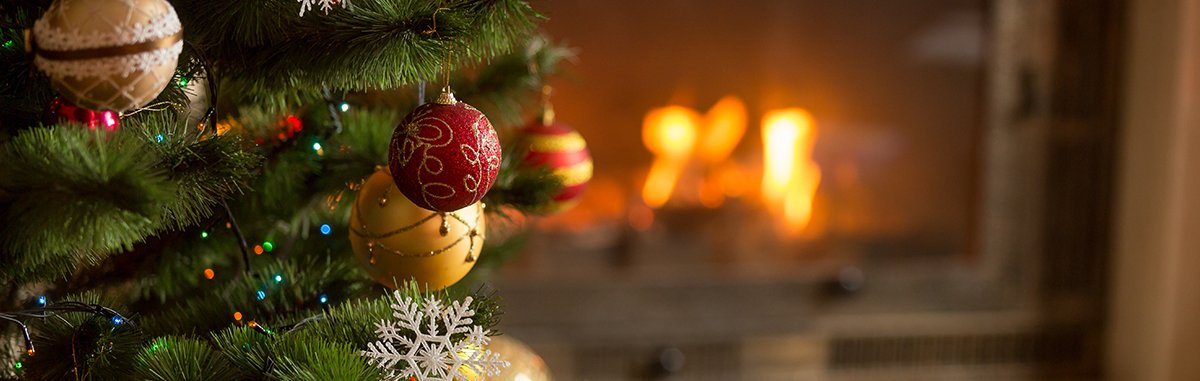
Finally, we come to our last myth to bust. We have often been told that Christmas is a pagan holiday because the Bible forbids the use of Christmas trees. If you have never heard this one before, it might sound rather silly, but those who espouse it seem to have strong feelings about it. The claim is based on Jeremiah 10, where God spoke the following words through the prophet:
Hear the word that the Lord speaks to you, O house of Israel. Thus says the Lord:
“Learn not the way of the nations, nor be dismayed at the signs of the heavens because the nations are dismayed at them, for the customs of the peoples are vanity. A tree from the forest is cut down and worked with an axe by the hands of a craftsman. They decorate it with silver and gold; they fasten it with hammer and nails so that it cannot move. Their idols are like scarecrows in a cucumber field, and they cannot speak; they have to be carried, they cannot walk. Do not be afraid of them, for they cannot do evil, neither is it in them to do good.” (Jeremiah 10:1–5)
If you take just a moment to examine the context of this passage, it becomes painfully obvious that these verses have nothing to do with Christmas trees. The prophet is in the process of warning the Israelites to not make idols like the Gentiles often did. The trees were cut down and made into idols by craftsmen. This just simply is not about Christmas trees.
We need to keep Christ first at all times, including Christmas.
Of course, Christmas trees can become problematic if one focuses more on the tree than on the real reason for the season. We need to keep Christ first at all times, including Christmas. If anything comes between our relationship with him, such as focusing on a Christmas tree (or the items beneath it) or other traditions, then these things become stumbling blocks and could be sinful. But the Bible does not forbid the use of Christmas trees.
- To learn more about why Jeremiah 10 does not forbid the use of Christmas trees, see “Do Christmas Trees Have Pagan Roots?”

Footnotes
- John Shelby Spong, “The Christmas Story: What’s Real—and What’s Not,” Beliefnet, accessed December 2025, www.beliefnet.com/faiths/christianity/2000/12/the-christmas-story-whats-real-and-whats-not.aspx
- Eusebius, Ecclesiastical History, Book 1 Vol. 7, https://archive.org/details/eusebius-ecclesiastical-history-loeb/page/n109/mode/2up, 57.
- Alexander Hislop, The Two Babylons, or The Papal Worship Proved to Be the Worship of Nimrod and His Wife, 4th ed. (London: Chas. J. Thynne, 1871), 91. Emphasis in original. Readers need to be wary of trusting Hislop’s claims. Many of his claims were highly speculative and based on shoddy research and an improper methodology.
- World Weather & Climate Information, “Bethlehem (PS): Weather in December,” accessed December 2025, www.weather-and-climate.com:80/bethlehem-ps-December-averages.


Support the creation/gospel message by donating or getting involved!

Answers in Genesis is an apologetics ministry, dedicated to helping Christians defend their faith and proclaim the good news of Jesus Christ.
- Customer Service 800.778.3390
- Available Monday–Friday | 9 AM–5 PM ET
- © 2026 Answers in Genesis