

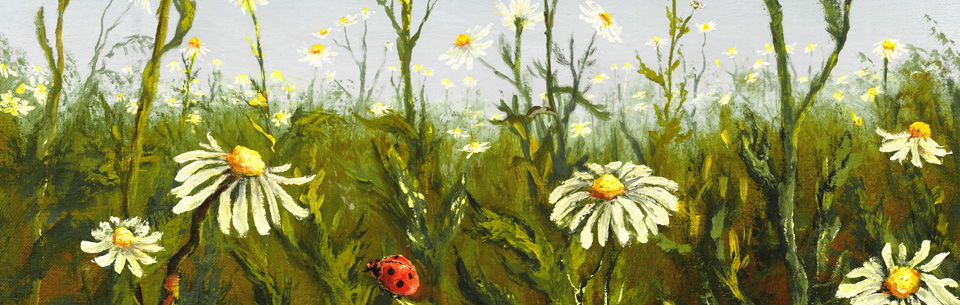
Worries and Wildflowers
What can the flowers of the field teach us about trusting God?
As an entomologist, I’m an expert in insects, not plants. But because I teach botany at a Christian university, I get to teach my students how to identify trees, wildflowers, ferns, and mosses.
Together, my students and I have the opportunity to worshipfully wonder at God’s great ingenuity, such as how plants make food from light through photosynthesis and how trees use xylem tissue to transport water up hundreds of feet. And how about those intricate flowers and the amazing ways insects pollinate them? I get excited just thinking that insects, created on day six of creation week, were designed to eat and pollinate the vegetation and flowers created on day three.
Since becoming a Christian in the mid-1990s, I’ve read through the Bible at least once a year. I know the overarching narrative of redemption and the details of the familiar accounts. But each year, I’m amazed that I easily overlook some of the most stunning passages of Scripture.
When I see something new, I wonder how I ever missed it. That happened last year when I came across this amazing promise in Matthew 6:28–30:
“And why are you anxious about clothing? Consider the lilies of the field, how they grow: they neither toil nor spin, yet I tell you, even Solomon in all his glory was not arrayed like one of these. But if God so clothes the grass of the field, which today is alive and tomorrow is thrown into the oven, will he not much more clothe you, O you of little faith?”
This passage in Jesus’ famous Sermon on the Mount offers an admonition: Do not be anxious about your life and do not be anxious about tomorrow. Those categories sum up most things we tend to worry about.
This time, when I was reading these verses, I realized that Jesus said to consider plants—even those pesky weeds that are “thrown into the oven.” After meditating on this passage, I went out to do just what Jesus instructed.
Pick a Flower, Any Flower
My yard is a typical upstate South Carolina lawn, with many different flowering plants—some I had never noticed. Just their names are fascinating: Venus’ looking-glass, hairy vetch, Carolina crane’s-bill, pinkladies, oriental false hawksbeard, sticky mouse-ear chickweed, Star-of-Bethlehem, bird’s-eye speedwell, pink-sorrel, confederate violet, field madder, tiny bluet, hairy bittercress, henbit deadnettle. One especially grabbed my attention: the American field pansy (Viola rafinesquei).
But wait! Jesus said to observe lilies, and I don’t have any of those in my yard. The word used for lily in Matthew 6:28 and in the similar passage of Luke 12:27 literally means “lily.” But many biblical scholars think that Jesus didn’t have a specific flower in mind (even though some commentators will list possible species of lilies, tulips, or gladioluses).
In my opinion, Jesus was likely telling the listeners to go look at plants in the field—any number of plants. They all make the same convicting point: your heavenly Father has given them amazing features.
Such a Pansy!
After identifying the American field pansy and some other plants in the same genus (Viola) around my yard, I started seeing them everywhere. I found them at work, I saw them in friends’ fields, and I spotted other species on hiking trails. Then I started reading about these pretty little plants.
Though American field pansies share the same basic structure as pansies you can buy in the store, the field pansy is much more delicate. In the spring, it produces delicate flowers that are lavender with streaks of dark purple and a center that is half white and yellow.
Most fascinating of all, the American field pansy produces two types of flowers. The first is the type of flower we typically picture—the one with bright showy petals that insects come to pollinate. Scientifically, these are called chasmogamous (from the root word chasm), meaning an open flower.
The second type of flower—called a cleistogamous (the root word cleist means closed) flower—does not open. The pollen it produces on the stamen self-fertilizes an ovule in the carpel (female organ of a flower).
However, the flowers that show up early in the spring are showy and require the right kind of pollinator to be around for fertilization to produce seed.
The closed flowers don’t appear until summer, but they also produce seed—no pollinator necessary. Both the ovules and the pollen are produced by meiosis (the process that halves the number of chromosomes, producing the cells needed for reproduction). When the genes recombine in the closed flowers, the seeds will be genetically different from the parent plant.
In the fall of the year, I tried to find the American field pansy, but I didn’t see it. However, I know that lots of tiny seeds from the plant’s two flowers are waiting to germinate next spring or late winter, ready for someone to observe.
Why two types of flowers? I don’t know. But our heavenly Father designed this beautiful, delicate plant to reproduce year after year with this uncommon method. What an incredible Designer!
Why Worry?
Since meditating on Jesus’ teaching, I’ve been sharing the truth with friends and family. Why do we worry about God not meeting our needs? We mean so much more to him than flowers.
One day I came home to a new painting by my daughter. Its green background featured brush strokes that resembled grass. All around were delicate flowers with cursive words that beautifully captured Jesus’ teaching: “Observe . . . do not worry.” The painting is a constant reminder of my temptation to be anxious—and the remedy.
Observe and Learn
Even wilted flowers remind us that, in our sin-cursed world, we too are wilting away. Our days are like grass; our lives are like a flower of the field. The psalmist says, “The wind passes over it, and it is gone and its place knows it no more” (Psalm 103:16).
But the more you learn about flowers, the more you will come to love and trust our loving heavenly Father who clothes even the grass of the field, which will wilt tomorrow. Go consider the lilies—and field pansies and dandelions and golden rod—and learn how much more he will take care of you!
Observing flowers is an opportunity to see the Creator’s handiwork. But when you study them, you find that God’s creativity is ingenious! Many common plants in our yards show the ingenious creativity of our Creator.
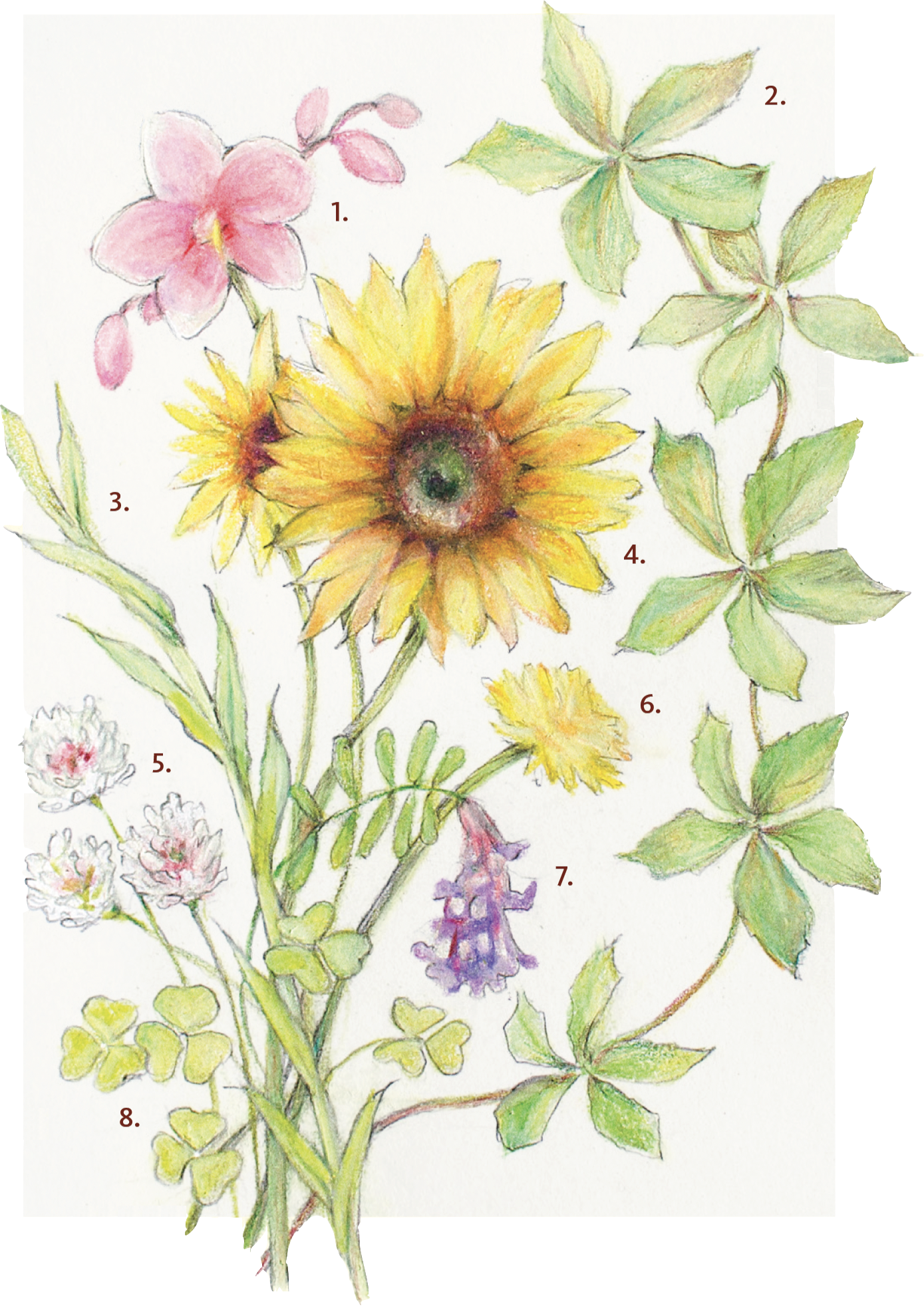
-
Orchids
To ensure pollination, some orchids look and smell like female bees. When male bees are attracted, they pollinate the flowers. -
Virginia Creeper
The stem of this pretty vine can grow up to 20 feet long in a single a year. -
Crabgrass
This ever-present weed has seeds that can remain dormant for years before germination. Keep pulling it up; maybe your grandchildren will finally get it all! -
Sunflowers
When sunflowers are young, they follow the sun during the day (a process called phototropism), but once they are ready for pollination, the flowers continually face east to warm up in the morning for greater pollination—even pollinators like their food warm. -
White Clover
This simple plant protects itself from leaf-feeding insects by producing cyanide when the insects take their first bite. -
Dandelion
Those white fluffy seeds can travel several miles on just a slight breeze. -
Hairy Vetch
Sometimes considered a weed, this purple-flowered plant has an amazing relationship with bacteria in its roots that allows it to convert nitrogen from the air into usable nitrogen in the soil. Other plants can take advantage of the naturally added fertilizer. -
Wood Sorrel
This low-growing, edible plant, easily identified by its three sets of heart-shaped leaflets, produces seed capsules that explode to fling the seeds up to two yards away.
earned a PhD in entomology from Clemson University in 2001 and served for five years as a research entomologist with the USDA. He is the head of the biology department at Bob Jones University.
Answers Magazine
July–September 2025

This anniversary issue celebrates a legacy of unwavering commitment to a biblical worldview and the ongoing impact of creation-based apologetics.
Browse Issue


Support the creation/gospel message by donating or getting involved!

Answers in Genesis is an apologetics ministry, dedicated to helping Christians defend their faith and proclaim the good news of Jesus Christ.
- Customer Service 800.778.3390
- Available Monday–Friday | 9 AM–5 PM ET
- © 2026 Answers in Genesis