

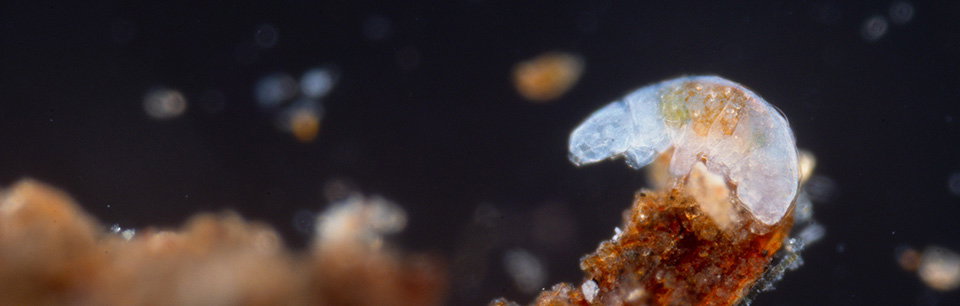
Thomas Shahan, CC BY 2.0 , via Wikimedia Commons
Tardigrades: Tough, Tiny, and . . . Useful?
Tardigrades could fit through the eye of a needle, yet they may have a ginormous impact on modern medicine.
Also known as water bears or moss piglets, tardigrades are known for their ability to survive in the most extreme conditions. They have been found on the Himalayas and in the depths of the ocean, and they can withstand extreme heat and frigid cold. They were the first animals to survive direct exposure to space,1 and some have even survived being shot out of a gun!2
But how are they so resilient in such inhospitable environments? Dr. Georgia Purdom, “tardigrade enthusiast,” explains in the video that certain tardigrades have several coping mechanisms.
They enter a stage called cryptobiosis, in which they suspend their metabolism. And it slows—get ready for this—to 0.01% of its normal rate. It’s almost like they die and then they can resurrect. . . .
They form what is called the “tun” stage, in which they basically curl up into a little ball. They lose 97% of their body moisture and shrivel to one-third their size. . . .
They can also enter another stage called a cyst stage in which they grow multiple cuticle layers around that tun. . . . They have an exoskeleton called a cuticle that’s made of a very durable protein called chitin, and . . . they’ll form multiple layers of this.
And that’s not to mention the unique proteins they produce or their DNA repair system, about which scientists still have more to learn. Yes, even this minuscule creature declares the glory of God, who created it 6,000 years ago on purpose. Perhaps one reason God made tardigrades is so that we could learn something to help us resist extreme environments in our sin-cursed world. As Dr. Purdom noted,
Why would God make them the way He did? Well, you know, we live in a fallen world that can have extreme conditions. And since tardigrades can survive many of these, it’s really important that we study them to understand better how they do that. And then we apply it to other situations.
So what “other situations” could benefit from what scientists are learning about tardigrades?
1. Increasing Medicine Accessibility
Most animals’ cells collapse when they become severely dehydrated, but not tardigrades’ cells. They have proteins that form into a framework to uphold their cells. When they are rehydrated, the framework dissolves so the cells can continue functioning like normal.3
Biologics (“pharmaceuticals containing or derived from living organisms”4) need to be kept at a precise temperature; otherwise, they break down, which makes transporting and storing them a meticulous job. Today, scientists are seeking to apply what we’ve learned about tardigrades’ proteins to help these pharmaceuticals bounce back from dehydration, which would increase their accessibility.5
2. Minimizing Radiation Damage
Tardigrades can survive 1,000 times more radiation than humans can.6 This is because they accelerate their production of DNA-repair proteins, in addition to having other helpful proteins.7 In cancer patients today, radiation therapy is used to destroy tumor cells, but it also destroys healthy cells, causing severe side effects in the patient. Scientists have successfully produced one of tardigrades’ damage-reducing proteins in mice, and they hope to eventually do similarly in humans to minimize radiation’s harmful effects.8
3. Slowing the Aging Process
Studies have shown that tardigrades don’t age in either their frozen stage (cryobiosis, a form of cryptobiosis) or their dry stage (anhydrobiosis, “tun” is a form of this).9 In these stages, their metabolism barely functions, and when they return to a normal state, they go back to operating as if no time had passed.10 In 2024, scientists showed that a protein that slows tardigrades’ metabolism “can also slow metabolism in human lab dishes.”11
We know that physical death is inevitable because of sin’s curse (Hebrews 9:27). Still, as Dr. Purdom said in the video, scientists may be able to “figure out ways to slow the aging process or maybe lessen its damaging effects on the body.”
Tardigrades: A Reminder of God’s Greatness and Our Responsibility
Even scientists who defy Christ exercise this God-given dominion when they study tardigrades and seek to apply what they learn in useful ways!
God gave His image bearers the responsibility and privilege of stewarding the earth (Genesis 1:27–28). Even scientists who defy Christ exercise this God-given dominion when they study tardigrades and seek to apply what they learn in useful ways! And think about it: These scientists believe tiny tardigrades are so incredible that they are attempting to mimic God’s design of them in other areas. How could sheer chance produce something that we intelligent creatures marvel at?
We might not all agree with Dr. Purdom that these creatures are “cute,” but we can agree that they are awe-inspiring. As we learn more about God’s world, our love for Him should grow, and we should use what we discover to demonstrate love to others (Matthew 22:37–39). And we can rejoice that—while we cannot escape physical death (and neither can tardigrades, try as they might)—those who have faith are promised eternal life through Jesus’ death and resurrection (John 3:16).


Footnotes
- SpaceRef, “Unique Animal Species Can Survive in Space,” Space News, September 10, 2008, https://spacenews.com/unique-animal-species-can-survive-in-space/.
- Yasemin Saplakoglu, “Tardigrades Can Survive Being Shot Out of High-Speed Gun,” Live Science, May 20, 2021, https://www.livescience.com/tardigrades-survive-being-shot-gun.html.
- Jim Lynch, “Death-Defying Protein Found in Tardigrades Preserves Synthetic Cells,” Michigan Engineering, last modified May 8, 2026, https://news.engin.umich.edu/2026/05/death-defying-protein-found-in-tardigrades-preserves-synthetic-cells/.
- University of Wyoming, “UW Scientists Use Tardigrade Proteins for Human Health Breakthrough,” March 20, 2023, https://www.uwyo.edu/news/2023/03/uw-scientists-use-tardigrade-proteins-for-human-health-breakthrough.html.
- University of Wyoming, “UW Researchers Work to Convert Liquid Medicines to Dry State for Transport, Storage,” July 20, 2026, https://www.uwyo.edu/news/2026/07/uw-researchers-work-to-convert-liquid-medicines-to-dry-state-for-transport-storage.html.
- Lei Li, Zhengping Ge, Shihao Liu, Kun Zheng, Yaqi Li, and Kaiqi Chen et al., “Multi-Omics Landscape and Molecular Basis of Radiation Tolerance in a Tardigrade,” Science 386, no. 6720 (October 25, 2024): https://doi.org/10.1126/science.adl0799.
- Chaitra Shree Udugere Shivakumara Swamy and Thomas C. Boothby, “Tardigrades: Surviving Extreme Radiation,” eLife, July 4, 2024, https://elifesciences.org/articles/100219.
- Vicki Contie, “Tiny Tardigrades May Hold Clues to Cancer Care,” National Institutes of Health, March 25, 2025, https://www.nih.gov/news-events/nih-research-matters/tiny-tardigrades-may-hold-clues-cancer-care.
- J. Sieger, F. Brümmer, H. Ahn, G. Lee, S. Kin, and R. O. Schill, “Reduced Ageing in the Frozen State in the Tardigrade Milnesium inceptum (Eutardigrada: Apochela),” Journal of Zoology 318, no. 4 (September 26, 2022): 253–259, https://doi.org/10.1111/jzo.13018.
- Sieger et al., “Reduced Ageing in the Frozen State.”
- Jennifer Nalewicki, “Tardigrade Proteins Could Slow Aging in Humans, Small Cell Study Finds,” Live Science, March 29, 2024, https://www.livescience.com/health/tardigrade-proteins-could-slow-aging-in-humans-small-cell-study-finds.


Support the creation/gospel message by donating or getting involved!

Answers in Genesis is an apologetics ministry, dedicated to helping Christians defend their faith and proclaim the good news of Jesus Christ.
- Customer Service 800.778.3390
- Available Monday–Friday | 9 AM–5 PM ET
- © 2026 Answers in Genesis