
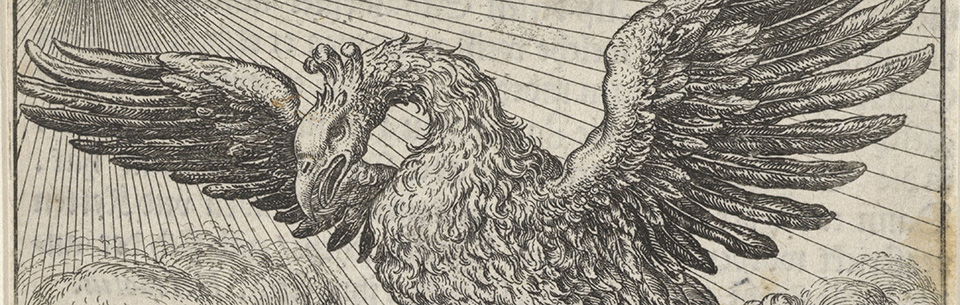
Rijksmuseum, CC0, via Wikimedia Commons
Does the Old Testament Refer to a Mythical Beast Called Ziz?
In Hebrew, sometimes it is hard to identify very specific nouns, particularly relating to plants, animals, and minerals. If your Bible has footnotes, you may see many names of animals have multiple possible identifications, for example.
In Psalm 50:11 and 80:13, some people think a mythical beast is being referred to in the second half of the verses.
I know all the birds of the hills, and all that moves in the field is mine. (Psalm 50:11)
The boar from the forest ravages it, and all that move in the field feed on it. (Psalm 80:13)
In both cases, the word translated “all that moves” is ziz. It doesn’t occur anywhere else. The ESV translates it “all that moves” because the etymology suggests that it comes from the verb meaning “to move around.” Many other English translations say “wild beasts of the field,” but there is a word that means beast, and the psalmist didn’t use it here.
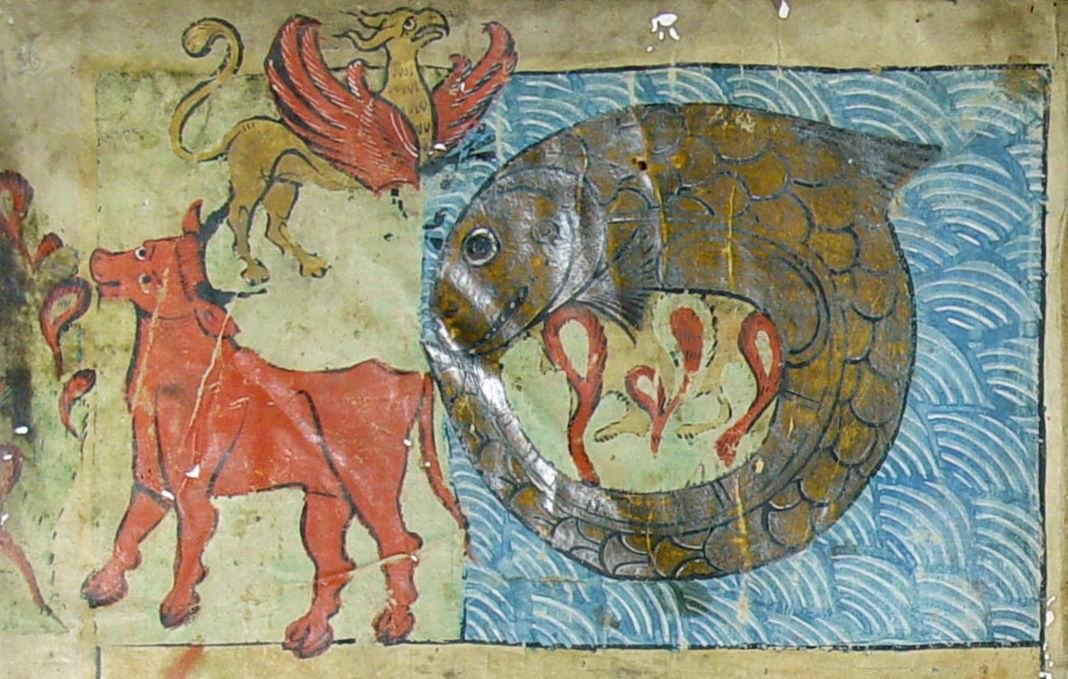
Some Jewish interpreters thought ziz referred to a giant bird that formed a triad with Behemoth and Leviathan.
Public domain, via Wikimedia Commons
In the medieval period, some Jewish interpreters thought ziz referred to a giant bird. They thought that it formed a triad with Behemoth and Leviathan—Behemoth being a land creature, Leviathan being a sea creature, and Ziz being a sky creature. For instance, the Talmud describes the Ziz as a bird with its head in the heavens and its legs at the bottom of a very deep body of water.
And Rabba bar bar Ḥana said: Once we were traveling in a ship and we saw a certain bird that was standing with water up to its ankles [kartzuleih] and its head was in the sky. And we said to ourselves that there is no deep water here, and we wanted to go down to cool ourselves off. And a Divine Voice emerged and said to us: Do not go down here, as the ax of a carpenter fell into it seven years ago and it has still not reached the bottom. And this is not because the water is so large and deep. Rather, it is because the water is turbulent. Rav Ashi said: And that bird is called ziz sadai, wild beast, as it is written: “I know all the fowls of the mountains; and the ziz sadai is Mine” (Psalms 50:11).1
However, ziz in the Bible isn’t identified with the sky but with the field. The rabbinic tradition may have missed this by calling the creature “ziz sadai” rather than just “ziz.” If “sadai” was seen as part of the name rather than the descriptor “of the field,” this association could have been lost.
Ziz in the Bible isn’t identified with the sky but with the field.
Many times with identifications like this, I like to look at the Septuagint (the ancient Greek translation of the Hebrew Old Testament) because even though it is a translation that isn’t inspired like the Hebrew text was, it can tell us what interpreters thought at the time of the Septuagint’s translation, a few centuries before the incarnation of Jesus. However, in this case, it isn’t helpful: The Septuagint translates ziz as “beauty” in Psalm 50 and “wild donkey” in Psalm 80. Inconsistencies like this show that while the Septuagint can be a helpful translation, it isn’t perfect.
Another thing we can look at is other languages related to Hebrew that have cognates that may be helpful. Aramaic (ziz), Arabic (ziz), and Akkadian (zizanu) all have words that sound like the Hebrew ziz, and in those languages, it refers to crickets and locusts. It makes sense that these creatures would be associated with “the field” because they devour crops and destroy fields.
So how did the ziz go from something like a grasshopper to a legendary bird? The latter comes from rabbinic traditions long after the time of Jesus. That reading never became standard among any group of professing Christians, and it’s unclear how popular it was even among different groups of Jews.
The identification of ziz teaches us several things. While sometimes the Bible refers to extraordinary creatures that probably no longer exist (like Behemoth and Leviathan in Job, for instance), this is not normally the case. Most of the animals, plants, and minerals referred to in Scripture are things that the Israelite readers would have come into contact with. And even when there are only a few clues about the identification in the Bible itself, we can carefully use other tools to help us zero in on the answer.

Footnotes
- Bava Batra 73b, https://www.sefaria.org/Bava_Batra.73b.7?lang=bi


Support the creation/gospel message by donating or getting involved!

Answers in Genesis is an apologetics ministry, dedicated to helping Christians defend their faith and proclaim the good news of Jesus Christ.
- Customer Service 800.778.3390
- Available Monday–Friday | 9 AM–5 PM ET
- © 2026 Answers in Genesis