

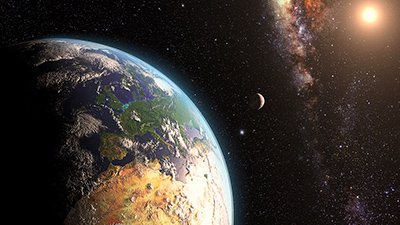
Image by Keshan Jalota via Unsplash
There’s Something Out There
January 2 is National Science Fiction Day, and sci-fi stories have fascinated us throughout history. What does our love for the supernatural reveal about us?
When the words Star Wars exploded on the screen, scrolling upward to John Williams’ thunderous orchestral score, my life changed forever. From that moment, I filled my childhood with starships, blasters, and sentient robots. I battled friends with plastic lightsabers, and I imagined flying across the galaxy. I read as many futuristic tales as I could get my hands on. Nothing quite captivated me like science fiction.
Even today, a good portion of my personal library is dedicated to that genre. Besides enjoying the fun escape these stories provide, I love the excitement of exploring new ideas, worlds, and civilizations that only these tales can offer.
I’m certainly not alone in my fascination. Modern American culture is heavily influenced by science fiction. Films such as Star Wars, Dune, and Jurassic World regularly dominate the box office, and the last century of literature is filled with best-selling science fiction novels, from Isaac Asimov’s Foundation series to Douglas Adam’s Hitchhiker’s Guide to the Galaxy and Andy Weir’s The Martian.
While the label science fiction describes a wide range of themes, perhaps no theme shows up in films and books as often as encounters with extraterrestrial life-forms. While all alien-themed tales are fictional, first encounter stories—in which humans encounter aliens on or near earth rather than in alien universes—often contain a hint of plausibility. Some have even been mistaken as real events, such as the infamous 1938 radio drama of The War of the Worlds.
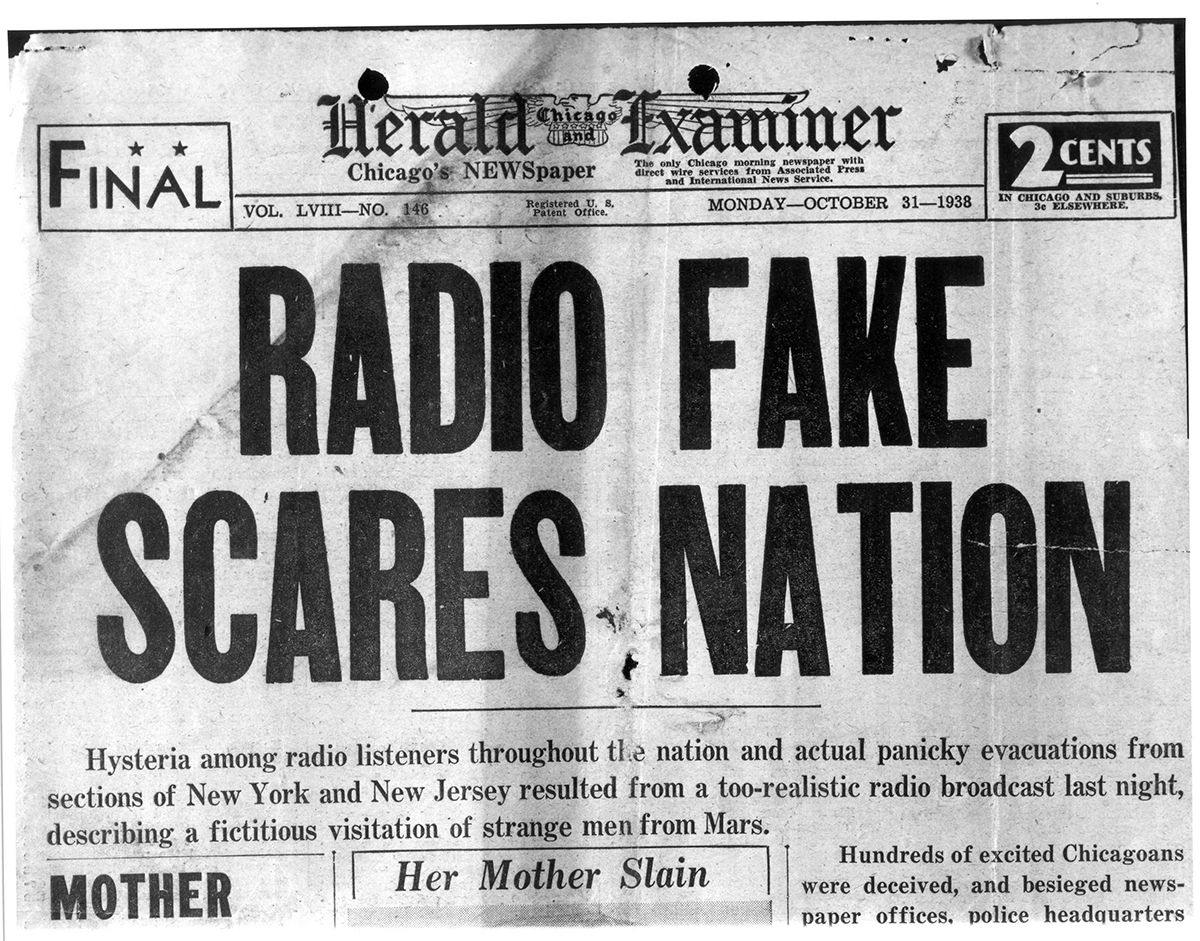
Records of the Federal Communications Commission, RG 173, via National Archives
In addition to giving us an adrenaline rush, a well-written alien story can cause people to question if life exists somewhere else in the universe. If so, how would these aliens interact with us? In science fiction, we find some frightening answers. Although some alien encounters are described as friendly and charming (like ET), most tend to be portrayed as terrifying events. From minor invasions (Signs) to worldwide catastrophes (A Quiet Place), aliens are regularly seen as a threat, reaching out from the depths of space to attack and subdue mankind.
While these chilling alien encounters could be chalked up to the need for interesting story plots, perhaps a more significant reason underlies this recurring theme. Could it be that mankind’s fascination—and fear—of aliens comes from our innate sense that there is something bigger than we are in the universe?
Aliens in Ancient Times
Throughout history, humans have always had an inherent feeling that something greater than themselves exists beyond this immediate world. As men reject the existence of the one true God, they try to fill this longing with various entities, many of which are supernatural.
In ancient societies, such as Greece and Rome, it was the gods who lived beyond our world. Some ancient philosophers also believed in what we think of today as aliens. For example, Epicurus (c. 341–271 BC) wrote that not only are there infinite worlds, but “we must believe that in all worlds there are living creatures and plants and other things we see in this world.”1 Though most major philosophers, including Plato and Aristotle, rejected Epicurus’ opinion, the gods were closely tied with humanity, looking and acting like humans and to an extent playing a positive role in human existence. While some gods could be temperamental, such as Thor in Norse mythology, many, especially those in the Greek and Roman traditions, also aided men on their quests, like Athena and Hera.
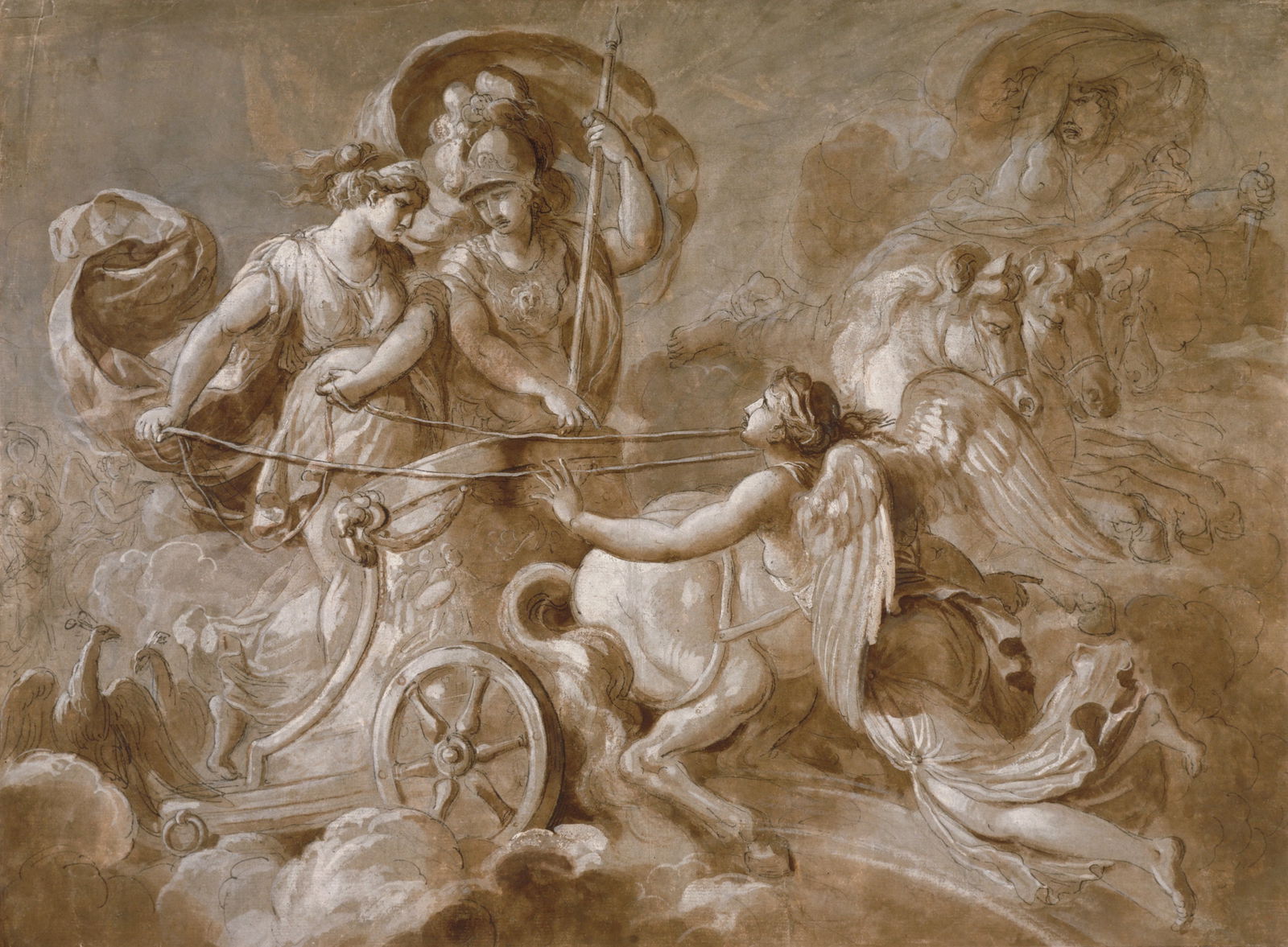
Attributed to Louis-Jean-François Lagrenée, Public domain, via Wikimedia Commons
Darwin and Wells: A Shift Toward Fear
With the rise of Christianity, extraterrestrial life was largely relegated to supernatural beings such as angels, with a few notable exceptions, including Lucian’s True History (c. 125–c. 180, the tale of a man who traveled to the moon and encountered humans and other strange life-forms).2 After the Copernican Revolution, numerous books were published that included extraterrestrial beings, including Johannes Kepler’s Somnium (1634) and Voltaire’s Le Micromégas (1752). Yet these depictions of extraterrestrials still closely resembled humans.
It was not until Charles Darwin’s Origin of Species that this traditional view of extraterrestrial life drastically changed.
It was not until Charles Darwin’s Origin of Species that this traditional view of extraterrestrial life drastically changed. Rejecting the supernatural, Darwin’s idea of evolution instead promoted atheism, arguing that the world and all within came about by random chance. With so many possible variations in which life could evolve, this theory suggests that life could have also developed in strange and different ways across the universe.
From a literary perspective, the idea of evolution was a revolutionary addition, inspiring writers to develop fantastic worlds filled with oddly evolved animals. For example, many of the creatures in the tales of Edgar Rice Burroughs, creator of Tarzan, are heavily influenced by evolution, including those from his Pellucidar and Venus series. In Pellucidar, as the narrator describes a monstrous Mahar, he states that “she was a member of the dominant race of Pellucidar. By a strange freak of evolution her kind had first developed the power of reason in that world of anomalies. To her, creatures such as I were of a lower order.”3
Unfortunately, the rise of evolutionary thought also eroded the biblical concept of man’s uniqueness, suggesting that we evolved accidentally after millions of years of random chance. In Origin of Species and his subsequent Descent of Man, Darwin argues that man is nothing more than a highly developed animal. This philosophy severely degraded the sanctity of human life in science fiction of the early twentieth century, particularly in the novels of the renowned H. G. Wells.
In The War of the Worlds, for example, Wells emphasizes that man can be exterminated just like animals. As a martian invasion threatens to annihilate humans from earth, mankind is powerless to stop it. In the words of an artilleryman who survived a battle with the martians, “This isn’t a war. . . . It never was a war, any more than there’s war between men and ants.”4 Because the martians are vastly superior to man, they treat man as nothing more than animals, slaughtering them at will.

Frank R. Paul, Public domain, via Wikimedia Commons
As John Huntington notes in The Logic of Fantasy, Wells’ novel “places humanity, not at the top of the natural hierarchy, but in a middle position, the predator of lower nature . . . and the victim of the superior Martians.”5 The artilleryman demonstrates Huntington’s assessment, stating, “There’s the ants that build their cities, live their lives, have wars, revolutions, until the men want them out of the way, and then they go out of the way. That’s what we are now—just ants.”6
In The War of the Worlds, rather than being the crowning jewel of God’s creation, man is instead subject to being exterminated by another more powerful being that has come to take over earth. Though terrifying, this result should come as no surprise for those who believe in Darwin’s philosophies. As Huntington states, the martian invasion clearly demonstrates “the ethical horror of natural evolutionary behavior.”7 Because Wells’ views are Darwinian, his book demonstrates that if there were some entity more powerful than mankind, it would outcompete and displace man on earth, at least temporarily.
Wells’ views are common among science fiction stories, with similar themes seen in the Have Space Suit—Will Travel novel, Twilight Zone’s “To Serve Man” episode, the comic series Mars Attacks, and films such as Independence Day. In each tale, highly evolved aliens choose to attack what they see as weaker life-forms, hunting and killing humans with ease.
Alien Encounters: Fun Romps or Cautionary Tales?
Beyond making exciting stories, aggressive alien species also demonstrate that though we long for something beyond our world, we are fearful of what might be awaiting us, especially since we can be aggressive and destructive ourselves.
Historically, Western civilization was eager to explore, venturing forth to “boldly go where no man has gone before,” just as a groundbreaking science fiction TV show would proclaim centuries later. From the Age of Discovery (1400s–1600s) through the first half of the twentieth century, we were doing just that. Continents, civilizations, and ecosystems were constantly being discovered and explored. Men and women dreamed of the future and excitedly looked forward to mankind’s next achievement.
As science fiction became popular, writers imagined exciting encounters with aliens. Though some early writers, such as Wells, described mankind as inferior to aliens, many writers showed humans as heroic and superior. These encounters were fun and charming, and if the aliens turned hostile, the humans would easily overcome them. Examples of this include Edgar Rice Burroughs’ A Princess of Mars, the Buck Rogers and Flash Gordon comics, and much of the content in the early Amazing Stories magazines. In these early days of science fiction, aside from a few writers like Wells, the genre was generally considered lighthearted and upbeat.
A Darker Perspective
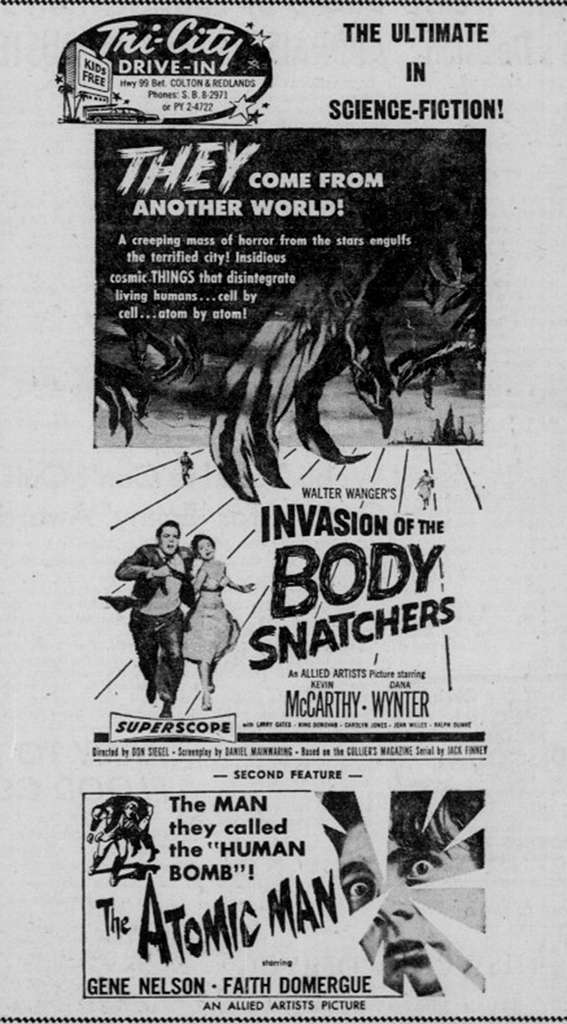
San Bernardino Sun, Public domain, via Picryl
But then came World War II, massive genocides, the rise of totalitarian governments, and the atomic bomb. As the legendary science fiction writer Isaac Asimov explained, “The dropping of the atom bomb in 1945 made science fiction respectable. Once the horror at Hiroshima took place, anyone could see that science fiction writers were not merely dreamers and crackpots after all, and that many of the motifs of that class of literature were now permanently part of the newspaper headlines.”8
No longer was science fiction merely fanciful; it instead inspired fear. As the Cold War began, Western civilization, especially the US, became aware of how fragile our civilization could be. Amid the Red Scare of Soviet espionage, a weapon and space race, and numerous conflicts raging across the world, Americans no longer looked to the future with excitement but with fear. If mankind could tear itself apart despite our advanced technology and knowledge, how much more dangerous could an alien species be? From this fear were spawned Twilight Zone’s “Black Leather Jackets” episode and films such as The Body Snatchers, The Puppet Masters, and Invaders from Mars, which all focus on secret alien invasions of earth. Other tales integrated the dangers of nuclear war with alien encounters, including Bradbury’s The Martian Chronicles novel and the film The Day the Earth Stood Still.
This fear of something beyond earth was also heavily rooted in the rapid decline of religion in post–World War II society. From a Christian perspective, we know that God created all things with a good design, though his creation is now corrupted by Adam’s fall into sin. However, throughout the first half of the twentieth century, Christianity buckled as secular, evolutionary ideologies attacked the authority of Scripture. By the late 1940s, many Americans had abandoned their faith, choosing to instead accept a naturalistic view of the world. And in this worldview, deep space is terrifying. From an atheistic and evolutionary perspective, anything could exist in the cosmos. Who knows what types of horrifying creatures are hiding in the shadows of the universe, without morality or conscience?
That perspective is reflected by the fact that in today’s science fiction stories, when we discover an alien species, we rarely see a society of utopian—or even friendly—creatures. Instead, we find societies as corrupt as our own.
When Fiction Becomes “Fact”
A belief in the fiction of evolution leads us to invite extraterrestrial beings into the realm of reality.
A belief in the fiction of evolution leads us to invite extraterrestrial beings into the realm of reality. Without Christian morality and purpose, many people now look to the skies with trepidation, concerned with the creatures that could possibly exist in a universe formed by evolution. Since evolution is sporadic and has no purpose or will, there could be creatures lurking in the universe, waiting to wipe out humanity, just like the Gbaba in the Safehold series or the Whitespikes in The Tomorrow War—or about half of the superhero stories.
Events such as the 1947 Roswell weather balloon incident and many supposed UFO sightings and abductions prompted Americans to consider that something may be lurking among the stars. Despite most of these stories being debunked as hoaxes or government experiments, the number of Americans who believe in space aliens increased from 20% to 34% over the last quarter century (1996–2022),9 and nearly two-thirds of the US population now believes in extraterrestrial life.10
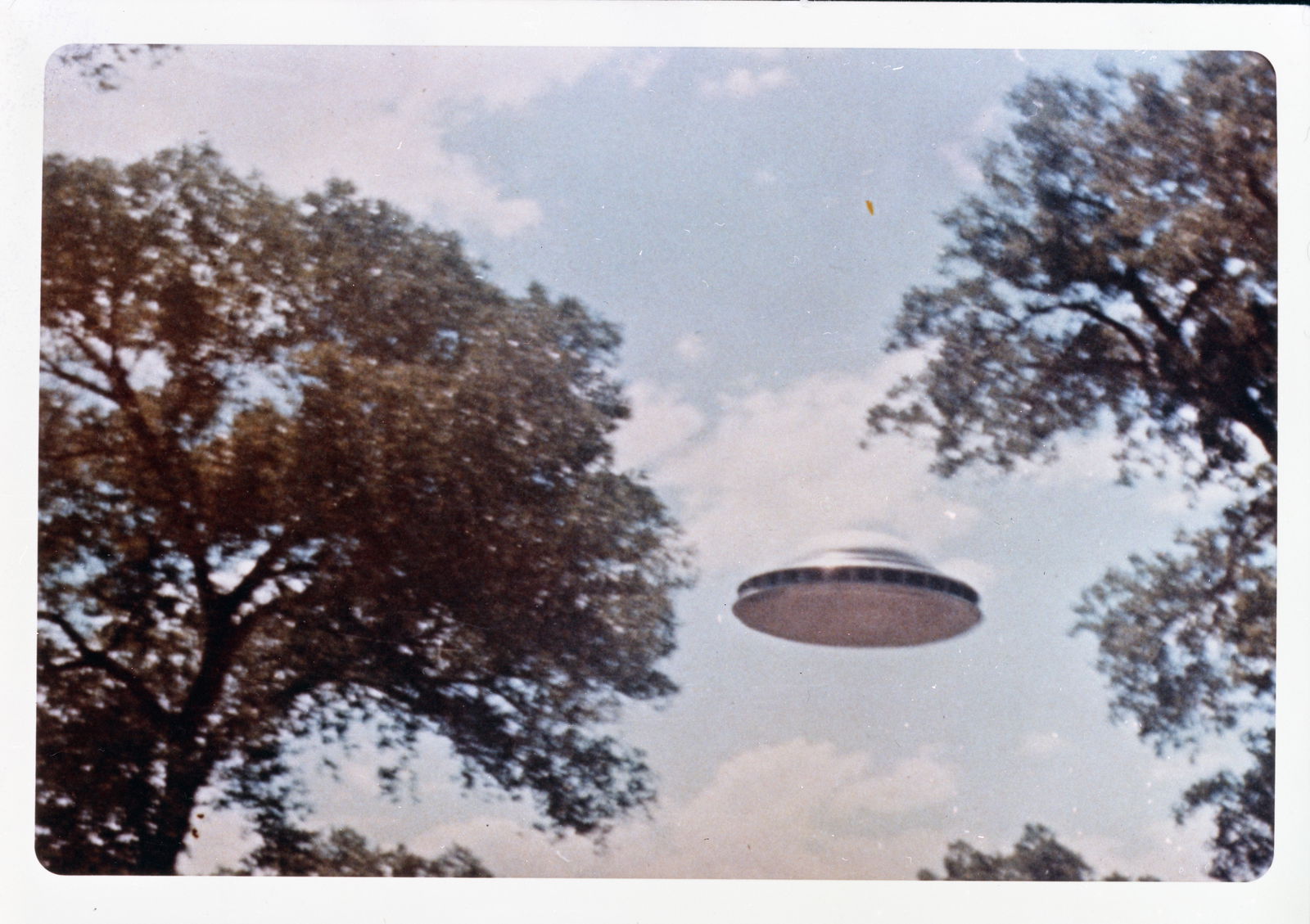
Flying Saucer, Goddard Space Flight Center, via National Archives
This staunch belief has been fueled by supposed alien footage recorded by the US military, the new discoveries made by the James Webb Space Telescope, the US’ planned return to the moon, and Elon Musk’s talk of colonizing Mars.
Public interest in extraterrestrials has become so intense that the US government funded the Unidentified Aerial Phenomena Task Force (UAPTF) from 2020–2021 and founded the All-domain Anomaly Resolution Office (AARO) within the Office of the Secretary of Defense in 2022 to analyze UAP (Unidentified Anomalous Phenomena) encounters.
In early 2024, this office officially announced that “no empirical evidence that any UAP investigatory effort since 1945—foreign, domestic, government, private, or academic—has ever uncovered verifiable information regarding the recovery or existence of extraterrestrial beings or crafts.”11 Still, many people in America and across the globe remain convinced that aliens are real.
Why All the Alarm About Aliens?
Besides the enduring fascination with science fiction, the frenzy around finding life in outer space stems largely from the hope that it will prove the world formed by chance. If life evolved by chance here on earth, then there might be a good chance it evolved somewhere else too, especially since the rest of the universe is supposedly even older than the earth. For secularists, life on other planets would offer a plausible explanation for humanity’s existence.
However, from a biblical perspective, there is no evidence that alien life exists in the universe.12 The universe did not evolve randomly over billions of years. Instead, according to the Genesis account of creation week, God carefully designed the earth specifically for mankind and created the rest of the universe—the planets, moons, and stars—“for signs and seasons” (Genesis 1:14). With that knowledge, we can relinquish our fixation on the possibility of finding life beyond our world.
In the film Ad Astra, Roy Richard McBride travels from earth to Neptune to find his father, who has been searching for extraterrestrial life for decades. After all those years, McBride’s father, who left his wife and family to explore the stars, realizes he has nothing to show for his effort. Learning from his father’s mistakes, McBride chooses to no longer travel out into deep space but instead focus on the ones he loves back on earth. If we are not careful, we can be like McBride’s father, focusing too much on our fascination with aliens and science fiction.
When we pause our films, put down our books, and go look at the stars, we see not the home of extraterrestrial life but the handiwork of the Creator God. Imagine the discoveries humans could make if we focused our scientific efforts on better understanding the universe that God gave us to explore and left the notion of extraterrestrial life in science fiction.
What About Science Fiction?
Our relentless fascination with extraterrestrial life reflects the fact that God placed inside all of us an understanding that we are not alone—that there is something greater beyond this earth.
I still rank science fiction tales among my favorite books and films. Yes, many of them also include evolution, but after all, it is science fiction, and what is more fictional than the evolutionary origins of life?
At its core, our relentless fascination with extraterrestrial life reflects the fact that God placed inside all of us an understanding that we are not alone—that there is something greater beyond this earth. No, it’s not little green men or an army of advanced warriors waiting to subdue us. Instead, we are each being called to by God, who came to earth, not as an alien but as a human who died and rose again to offer us salvation from our sin.
holds a PhD in biology from the University of Southern Mississippi. Beyond his RNA-focused research, he has a broad educational background, holding both a BA and MS in history and English.

Footnotes
- Epicurus, “Letter to Herodotus,” trans. Cyril Bailey (Oxford: The Clarendon Press, 1926), https://users.manchester.edu/Facstaff/SSNaragon/Online/texts/316/Epicurus,%20LetterHerodotus.pdf.
- Some consider Lucian’s True History one of the first science fiction stories. Written to satirize extravagant tales told by travels of his day, True History tells the story of a man who traveled to the moon, where he encounters humans from the moon and sun warring over Venus, along with various strange life-forms.
- Edgar Rice Burroughs, Pellucidar (London: Methuen and Co., 1935), 12.
- H. G. Wells, The War of the Worlds, in Seven Science Fiction Novels of H. G. Wells (New York: Dover Publications, 1970), 430.
- John Huntington, The Logic of Fantasy: H. G. Wells and Science Fiction (New York: Columbia University Press, 1982), 62.
- Wells, War of the Worlds, 431.
- Huntington, Logic of Fantasy, 62–63.
- Isaac Asimov, Nightfall, and Other Stories (Garden City, NY: Doubleday, 1969), 93.
- Taylor Orth, “A Growing Share of Americans Believe Aliens Are Responsible for UFOs,” YouGov, October 4, 2022, https://today.yougov.com/technology/articles/43959-more-half-americans-believe-aliens-probably-exist.
- Courtney Kennedy and Arnold Lau, “Most Americans Believe in Intelligent Life Beyond Earth; Few See UFOs as a Major National Security Threat,” Pew Research Center, June 30, 2021, https://www.pewresearch.org/short-reads/2021/06/30/most-americans-believe-in-intelligent-life-beyond-earth-few-see-ufos-as-a-major-national-security-threat/.
- The Department of Defense All-Domain Anomaly Resolution Office, “Report on the Historical Record of U.S. Government Involvement with Unidentified Anomalous Phenomena (UAP). Volume I,” March 6, 2024, 35–36, https://media.defense.gov/2024/Mar/08/2003409233/-1/-1/0/DOPSR-CLEARED-508-COMPLIANT-HRRV1-08-MAR-2024-FINAL.PDF.
- You can learn more about the biblical perspective of aliens at Danny R. Faulkner, “Is There Life on Other Planets?” Answers Magazine 14, no. 6 (November 2019), https://answersingenesis.org/astronomy/alien-life/there-life-other-planets/.

Support the creation/gospel message by donating or getting involved!

Answers in Genesis is an apologetics ministry, dedicated to helping Christians defend their faith and proclaim the good news of Jesus Christ.
- Customer Service 800.778.3390
- Available Monday–Friday | 9 AM–5 PM ET
- © 2026 Answers in Genesis